




The Work, Energy, and Simple Machines Class 9 Science Handwritten Notes are a topper's own neat revision of Chapter 7 from the new Exploration textbook. Every idea, work, kinetic and potential energy, the law of conservation of energy, power, and the three simple machines, is written by hand with the key formula W = F × s boxed in the margin. You revise the whole 2026-27 chapter in one short sitting, just as you would set it out in the exam.
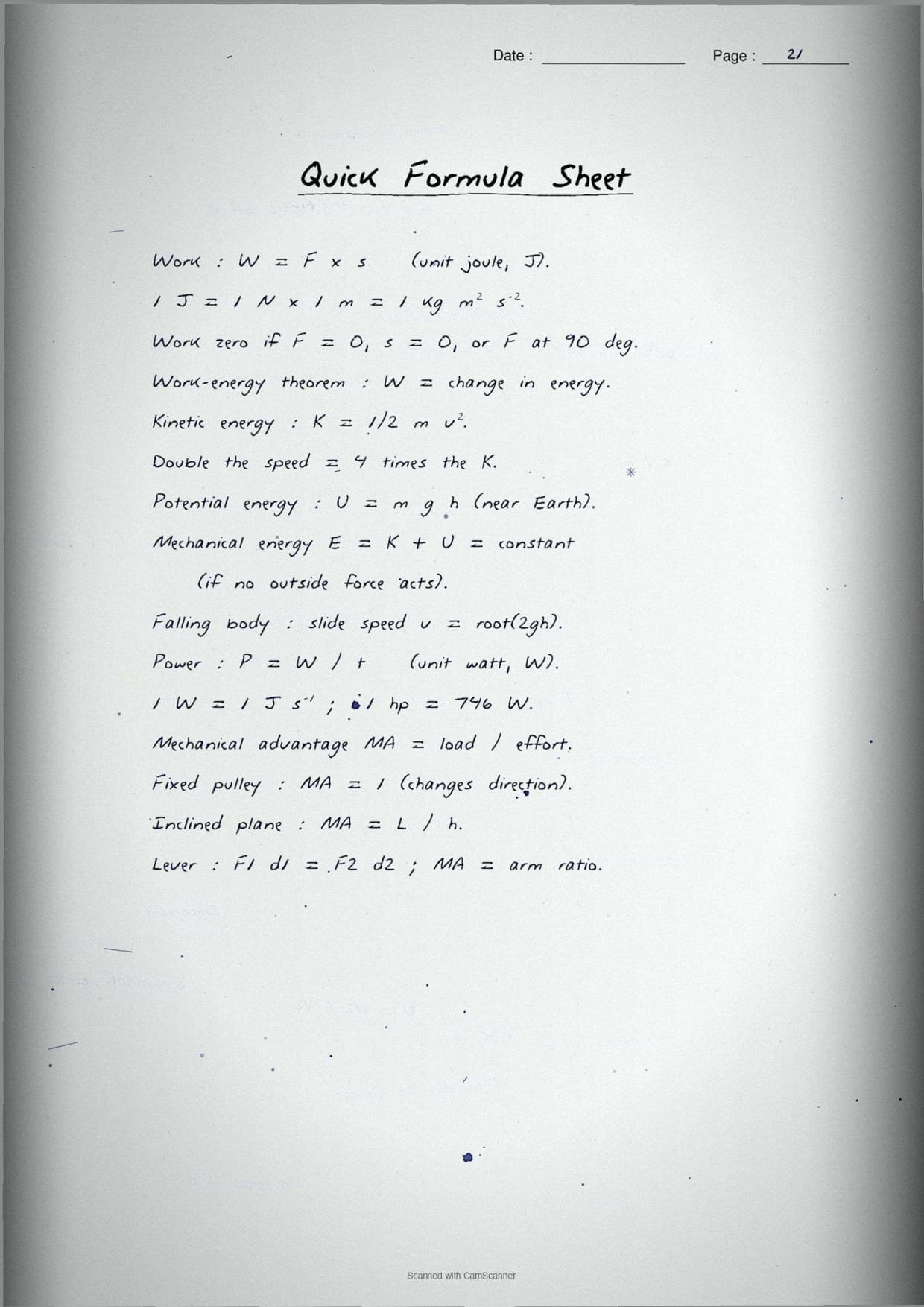
- What you get: work, kinetic and potential energy, the law of conservation of energy, power, and simple machines, all in clear handwriting.
- Colour-coded: new sub-topics in red, each formula in a hand-drawn box, and solved examples in blue.
- Why by hand: writing W = F × s and each energy bar chart by hand helps you recall it fast in the exam.
Student Feedback
In a Collegedunia study of 1,240 Class 9 students, 81% said hand-written pages of the energy formulas were easier to recall than typed notes. About 4 out of 5 rated the boxed K = ½mv2 formula and the red-marked mistakes as the most useful part before a test.
Work, Energy, and Simple Machines Class 9 Science Explained in One Shot
Source: Alakh Pandey - Class 9th & 10th on YouTube
Why Use Handwritten Notes for Class 9 Science Chapter 7 Work, Energy, and Simple Machines
Chapter 7 packs several formulas and a few graphs into one place, so a clean, hand-written page saves real time. The Work, Energy, and Simple Machines Class 9 Science Handwritten Notes keep one idea per line, with a small sketch beside it, so nothing runs together. You revise the full chapter in one sitting without flipping through the Exploration book.
- Each formula, like W = F × s, sits in its own hand-drawn box.
- A quick bar chart or lever sketch is drawn next to the idea it explains.
- Red sub-headings split the chapter into short, easy parts.
- The wording is plain, like a senior showing you the method.
What Is Inside the Work, Energy, and Simple Machines Handwritten Notes PDF
The PDF runs to 23 pages of neat, hand-written revision. It moves from what work means, to kinetic and potential energy, the law of conservation of energy, power, and the three simple machines, with a solved example after each idea. The colour code below tells you what every mark means.
- Red: new sub-topic headings, such as Work-Energy Theorem, Kinetic Energy, or Mechanical Advantage.
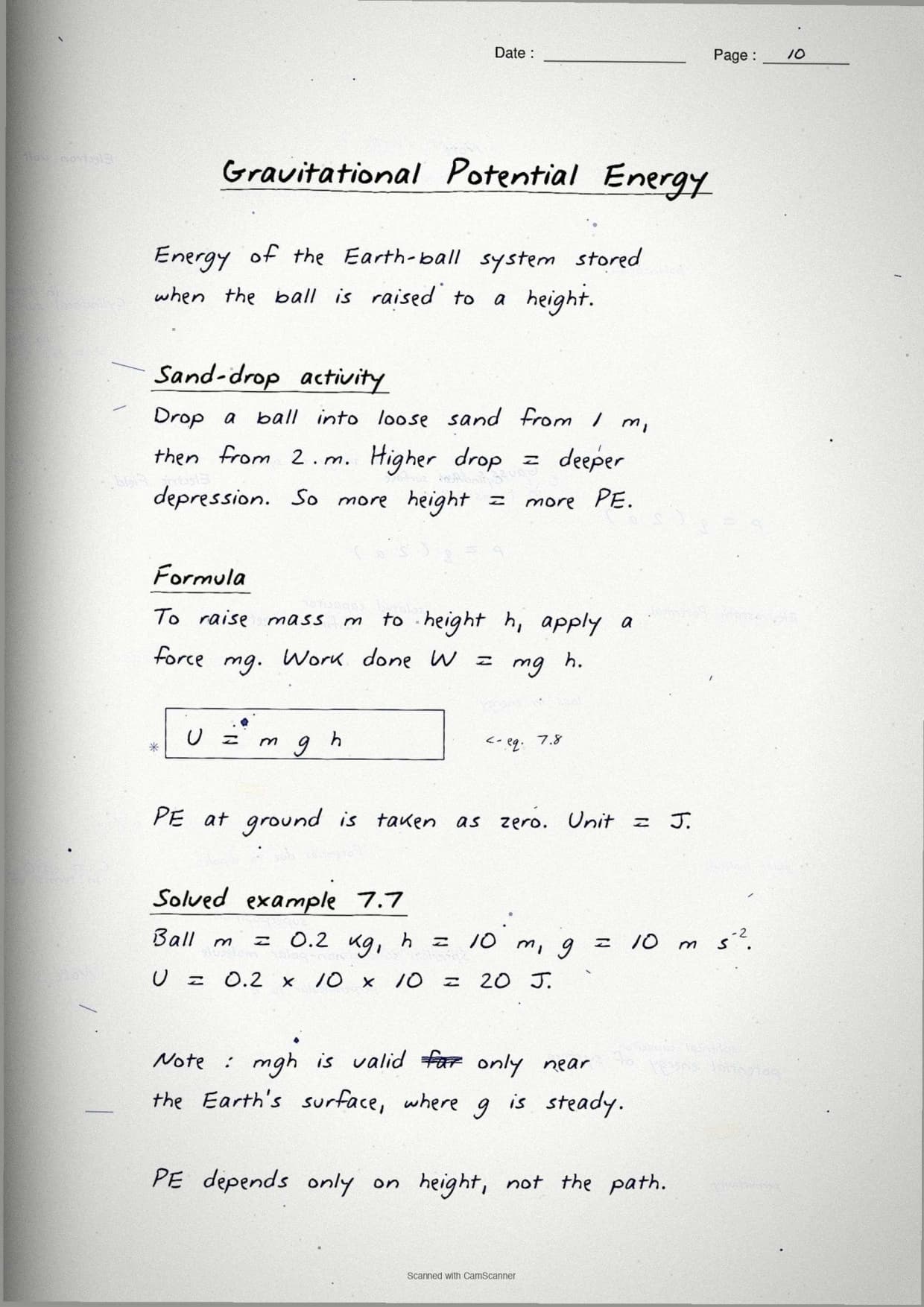
- Boxes: each formula, like K = ½mv2 and U = mgh, drawn by hand.
- Blue: solved examples and the numbers worked out in them.
Work Done by a Force: Formula and Sign in the Notes
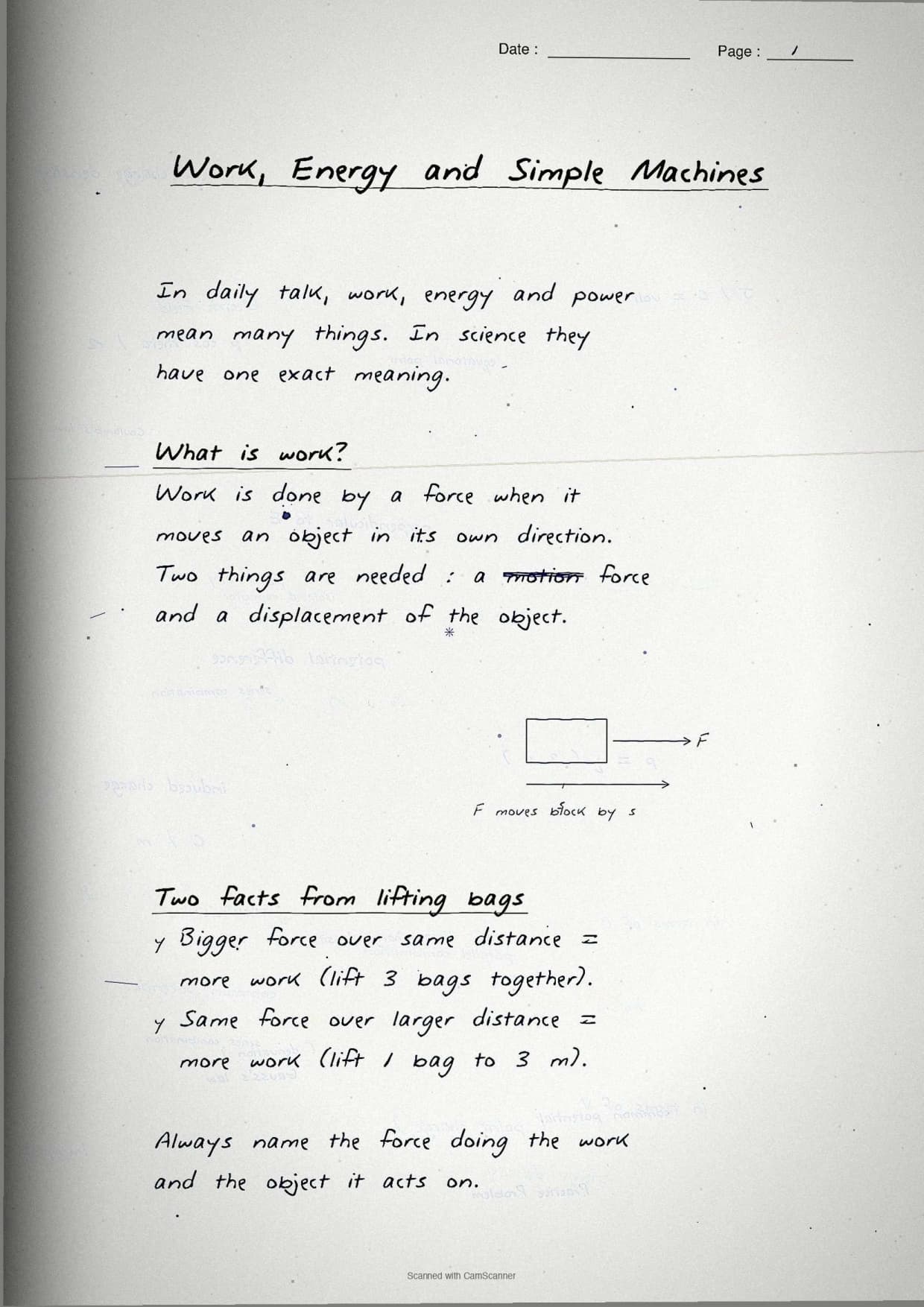
Work is the starting idea of the chapter, so the notes open here. In science, work is done only when a force moves an object through a distance in the direction of the force. Feeling tired is not the same as doing work.
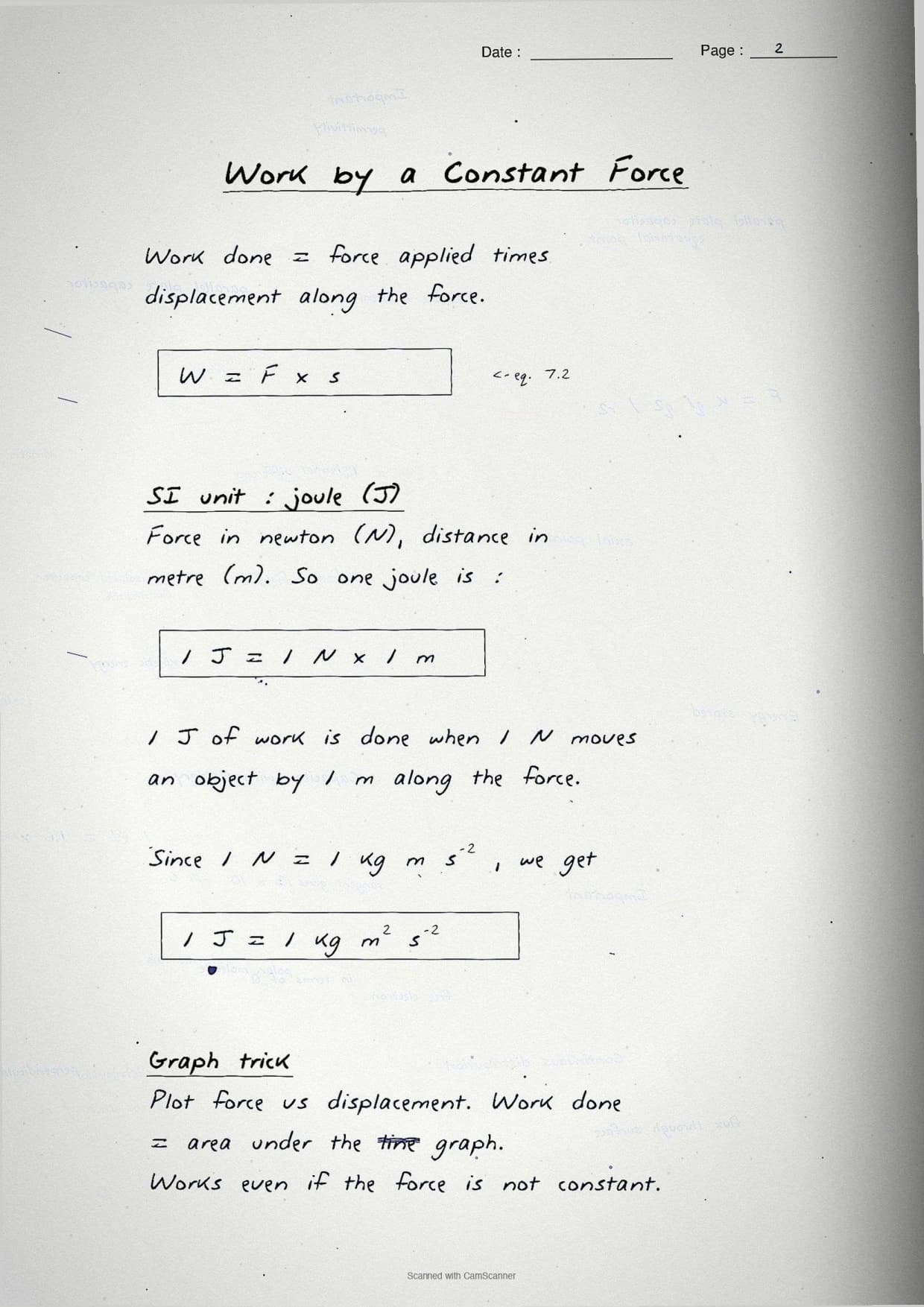
- Formula: W = F × s, where F is the force and s is the displacement along the force.
- SI unit: the joule (J), where 1 J = 1 N × 1 m.
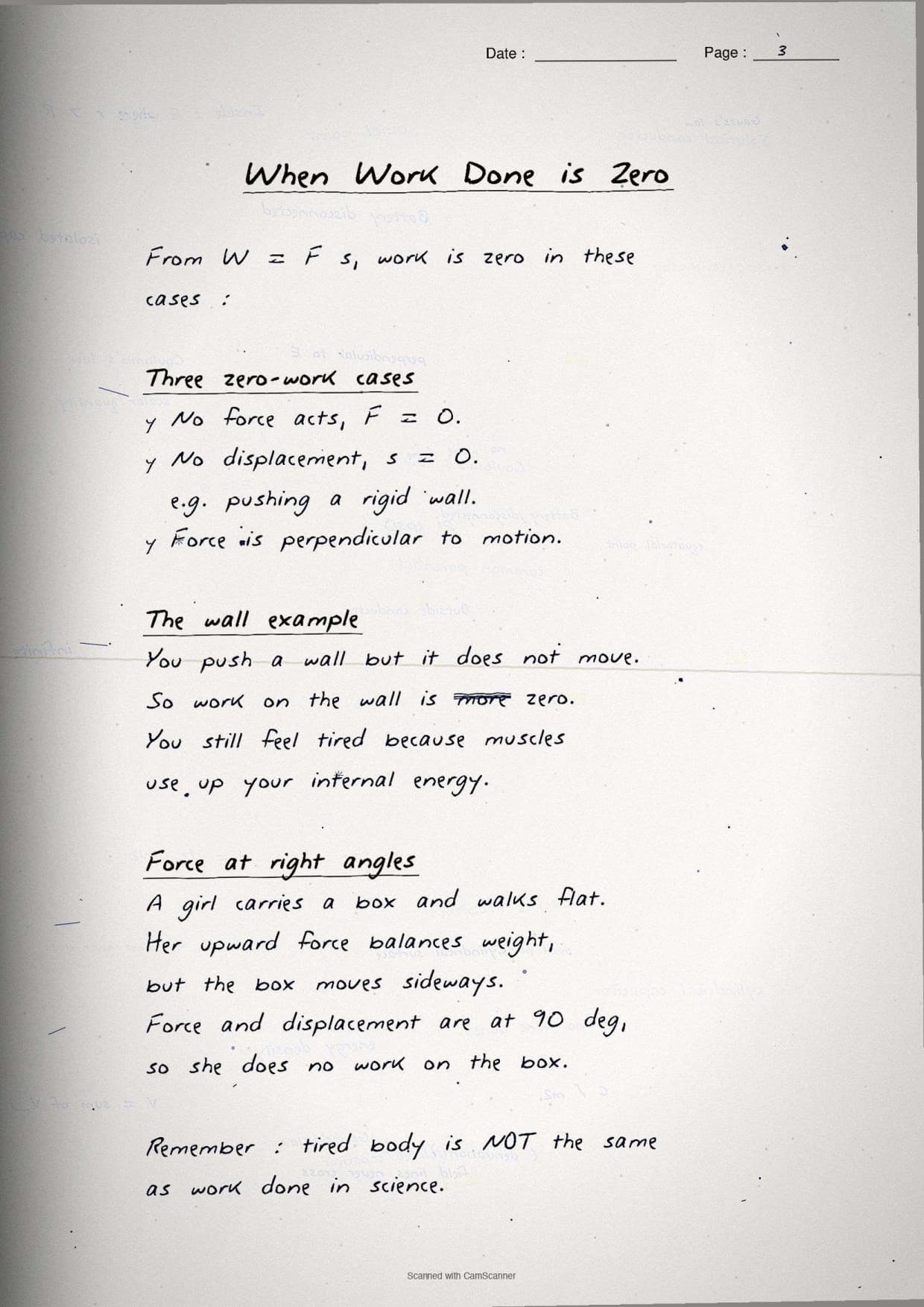
- Zero work: when there is no force, no displacement, or the force is at a right angle to the motion.
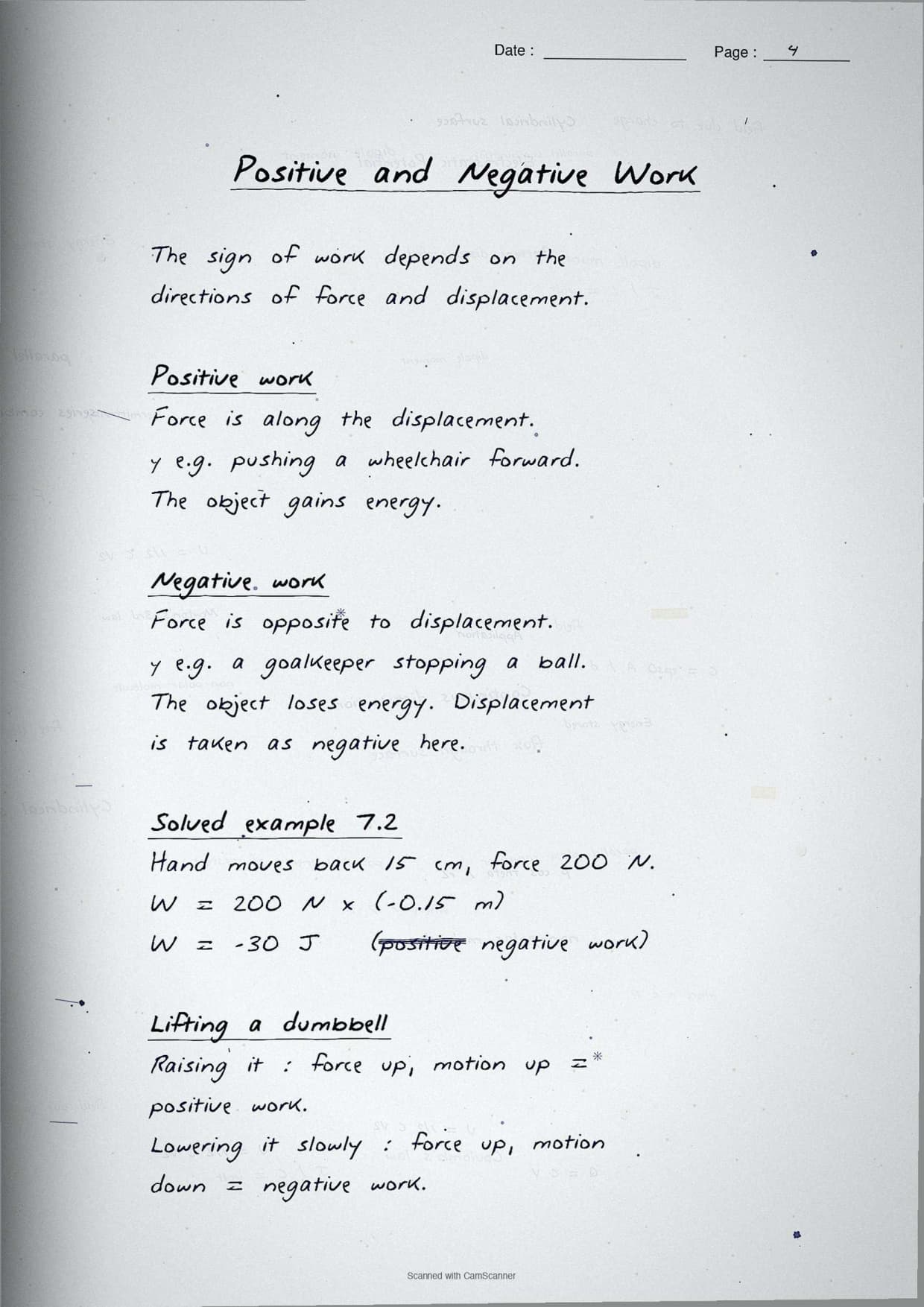
Work carries a sign. When the force and the displacement point the same way, the work is positive. When the force opposes the motion, like a goalkeeper stopping a ball, the work is negative. The notes box this sign rule in red because it is asked almost every year.
Kinetic and Potential Energy: Hand-Drawn Formula Boxes
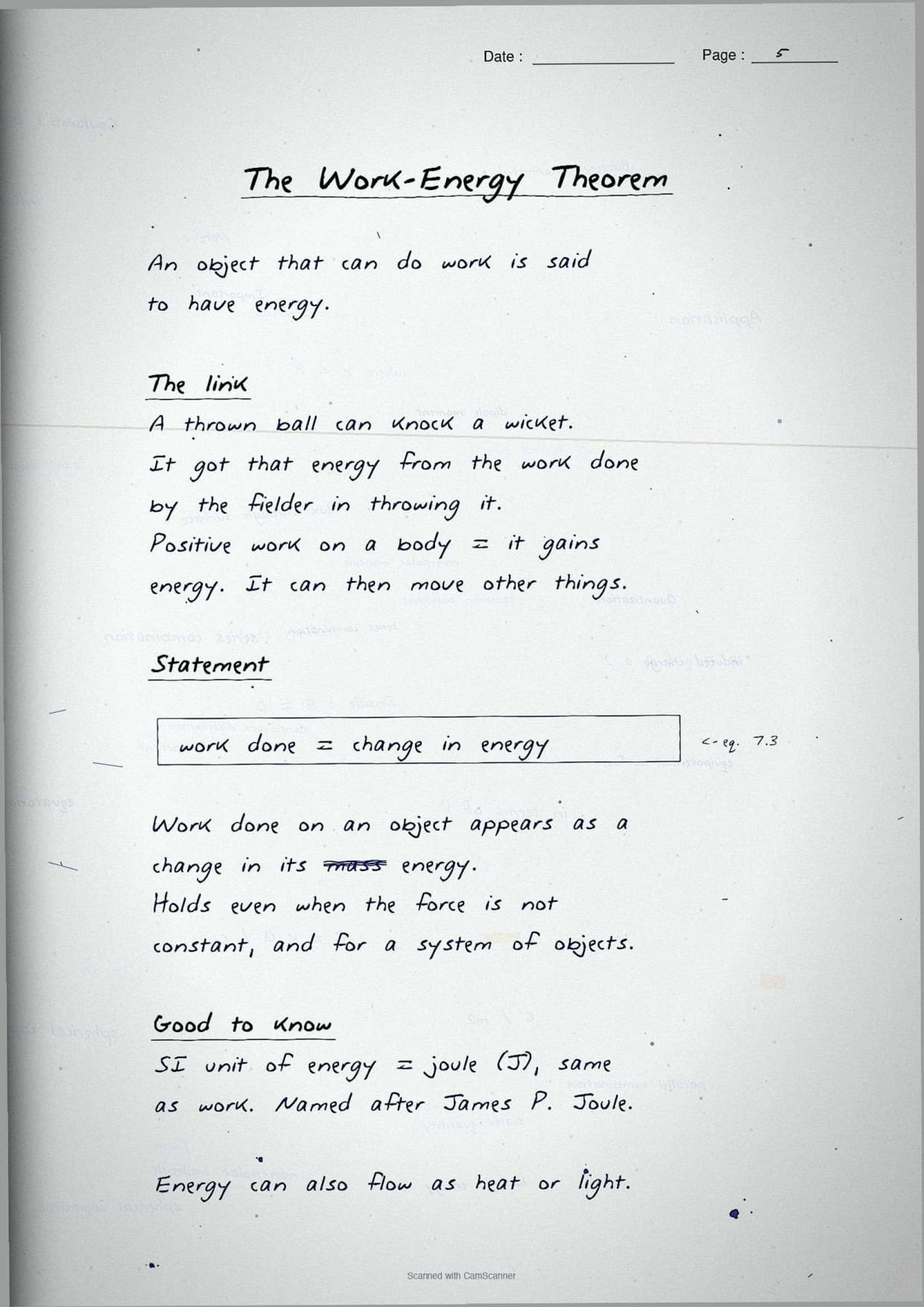
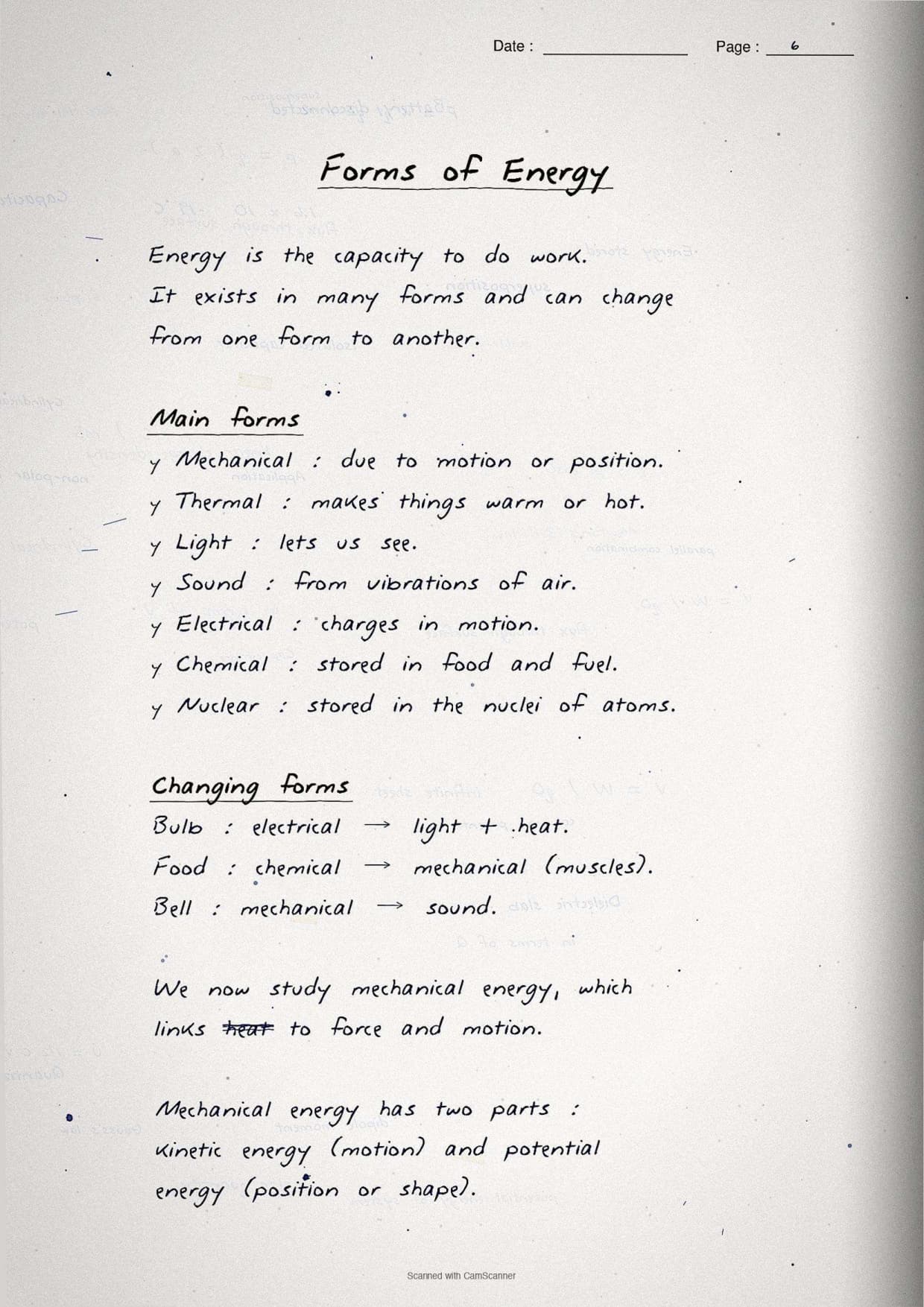
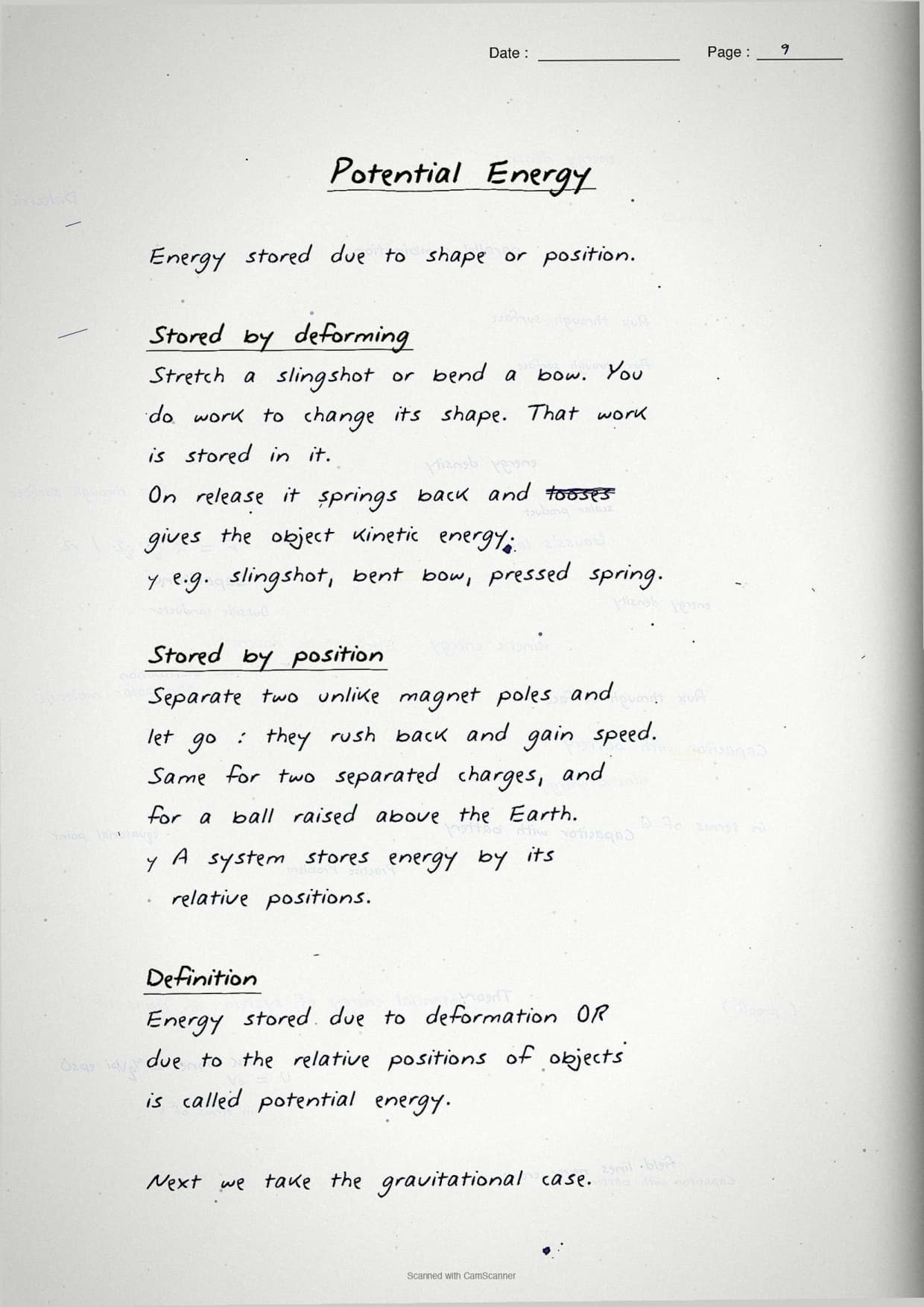
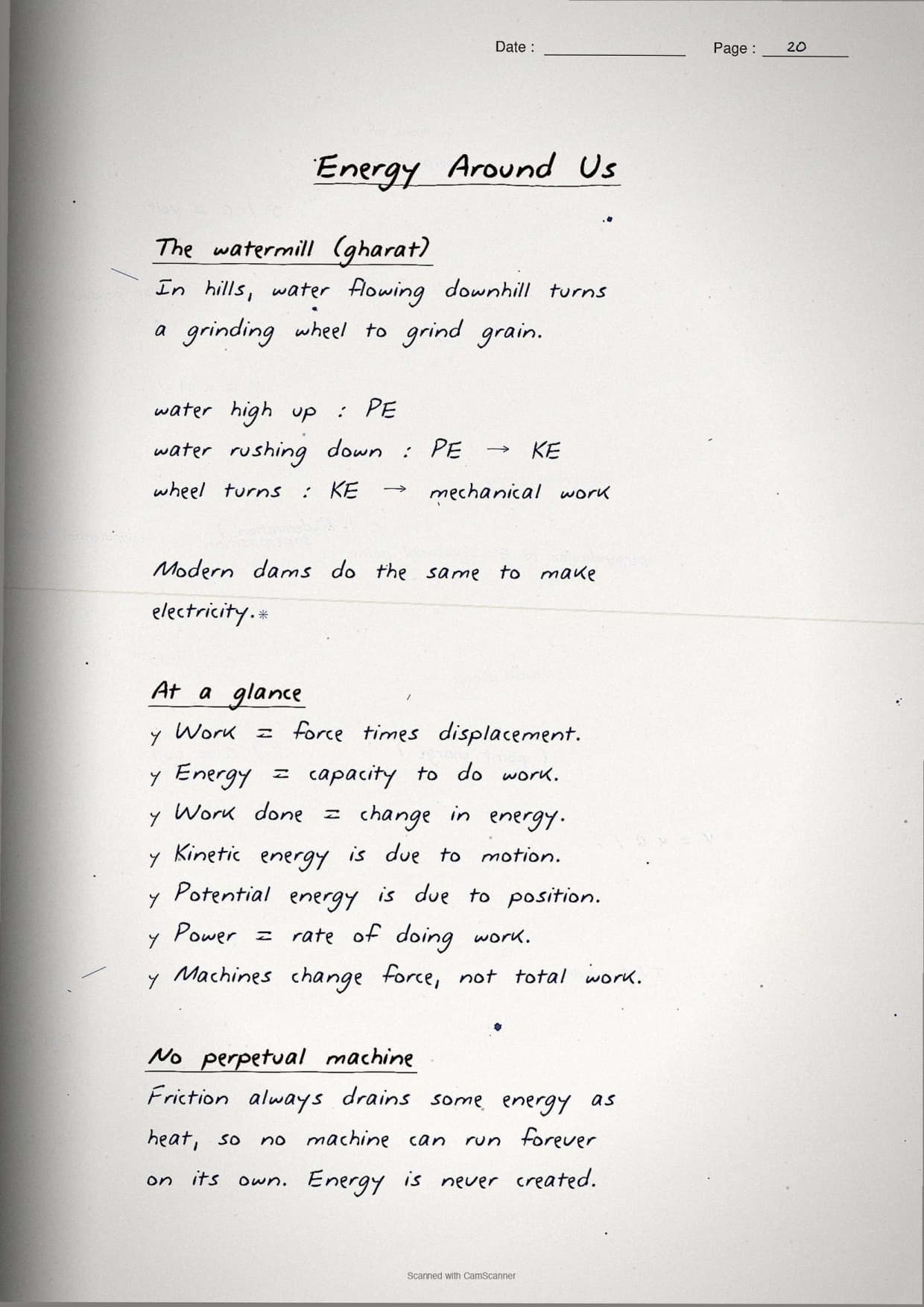
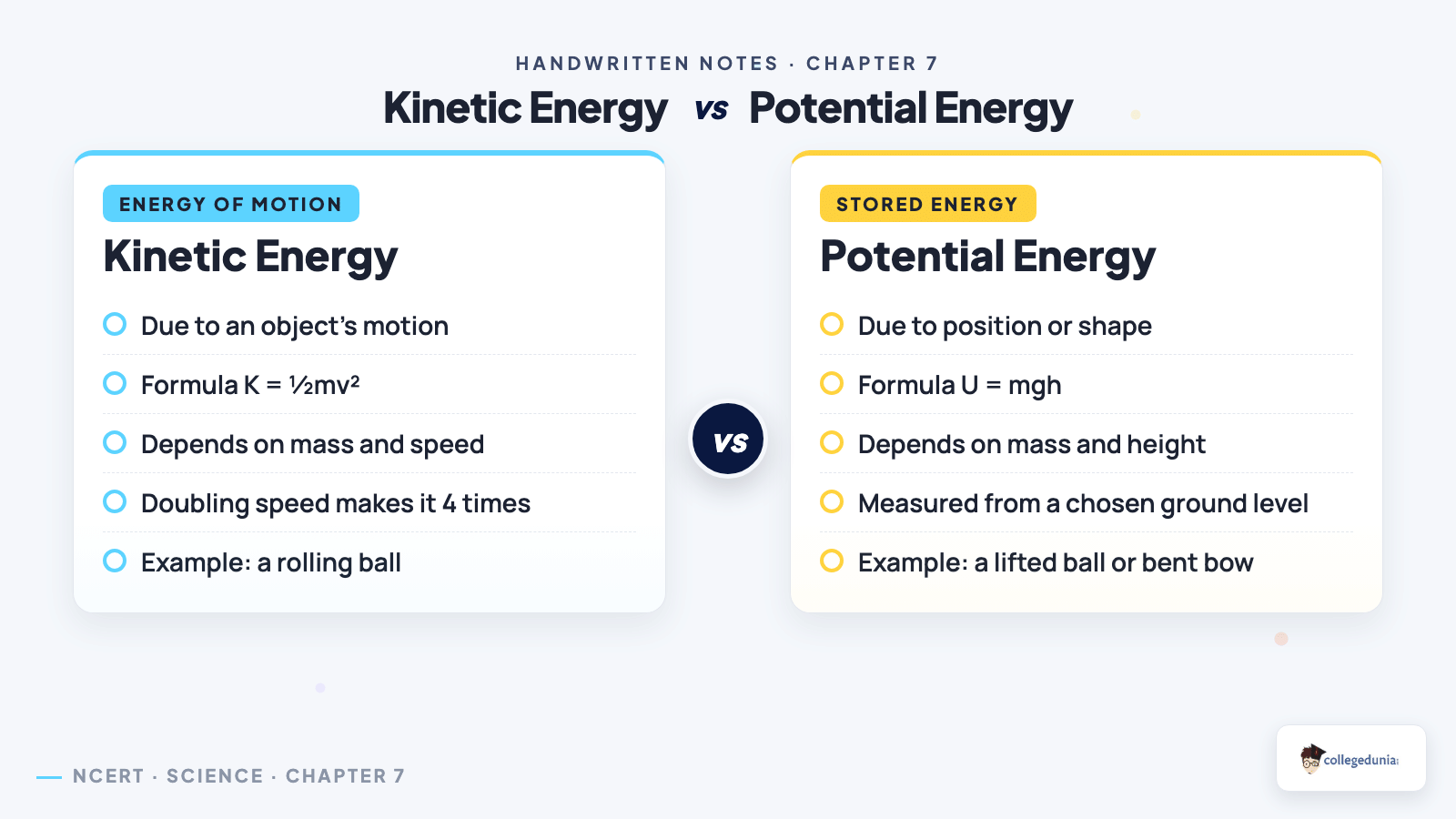
An object that can do work is said to have energy, also measured in joule. The notes split mechanical energy into two clear kinds and box each formula so you copy it correctly in the exam. The work-energy theorem ties them together: the work done on an object equals the change in its energy.
| Type | Formula | Simple meaning |
|---|---|---|
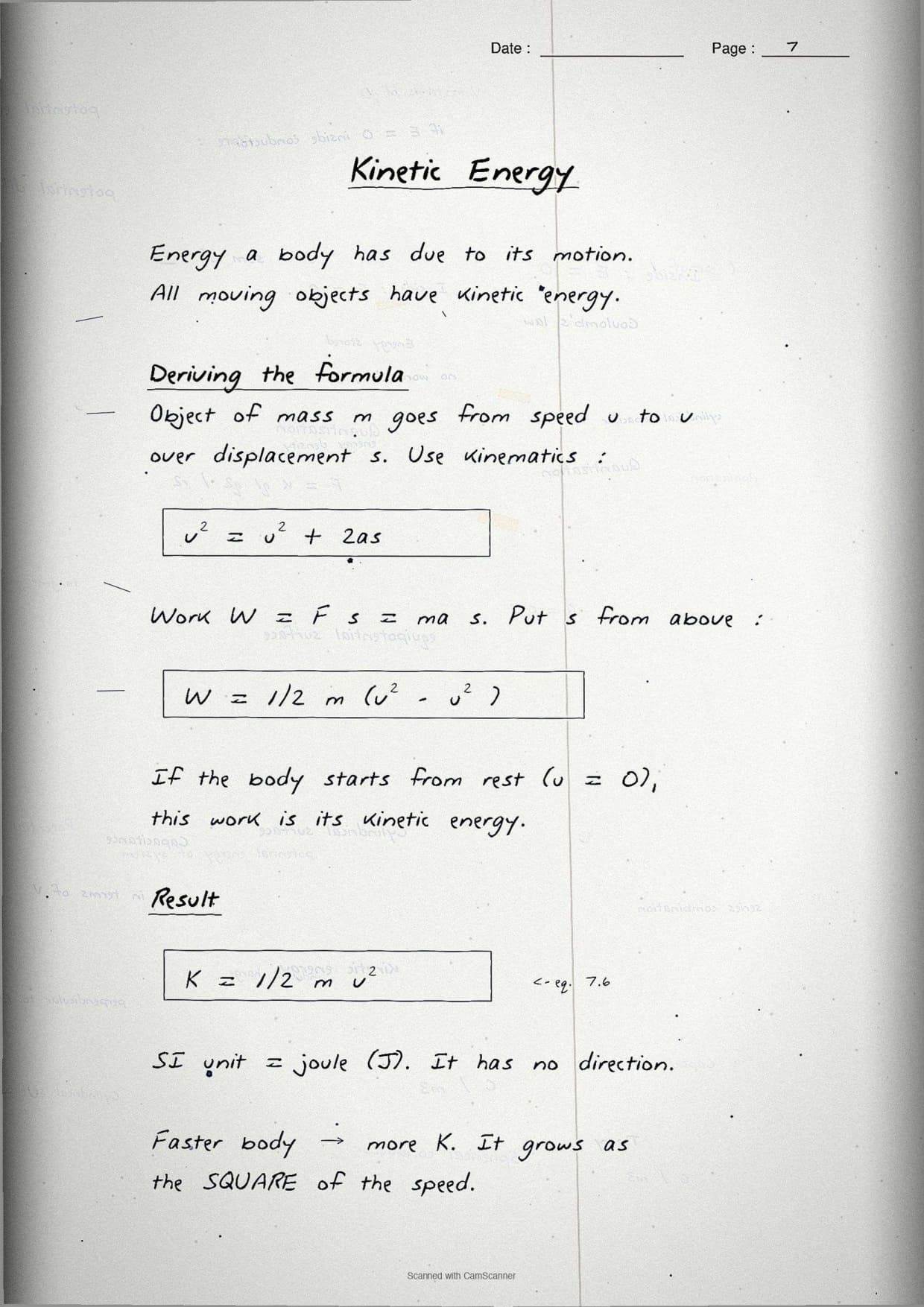
| Kinetic energy | K = ½mv2 | Energy an object has because it is moving. |
| Potential energy | U = mgh | Energy stored by position or by shape. |
| Work-energy theorem | W = change in energy | Work done shows up as a change in energy. |
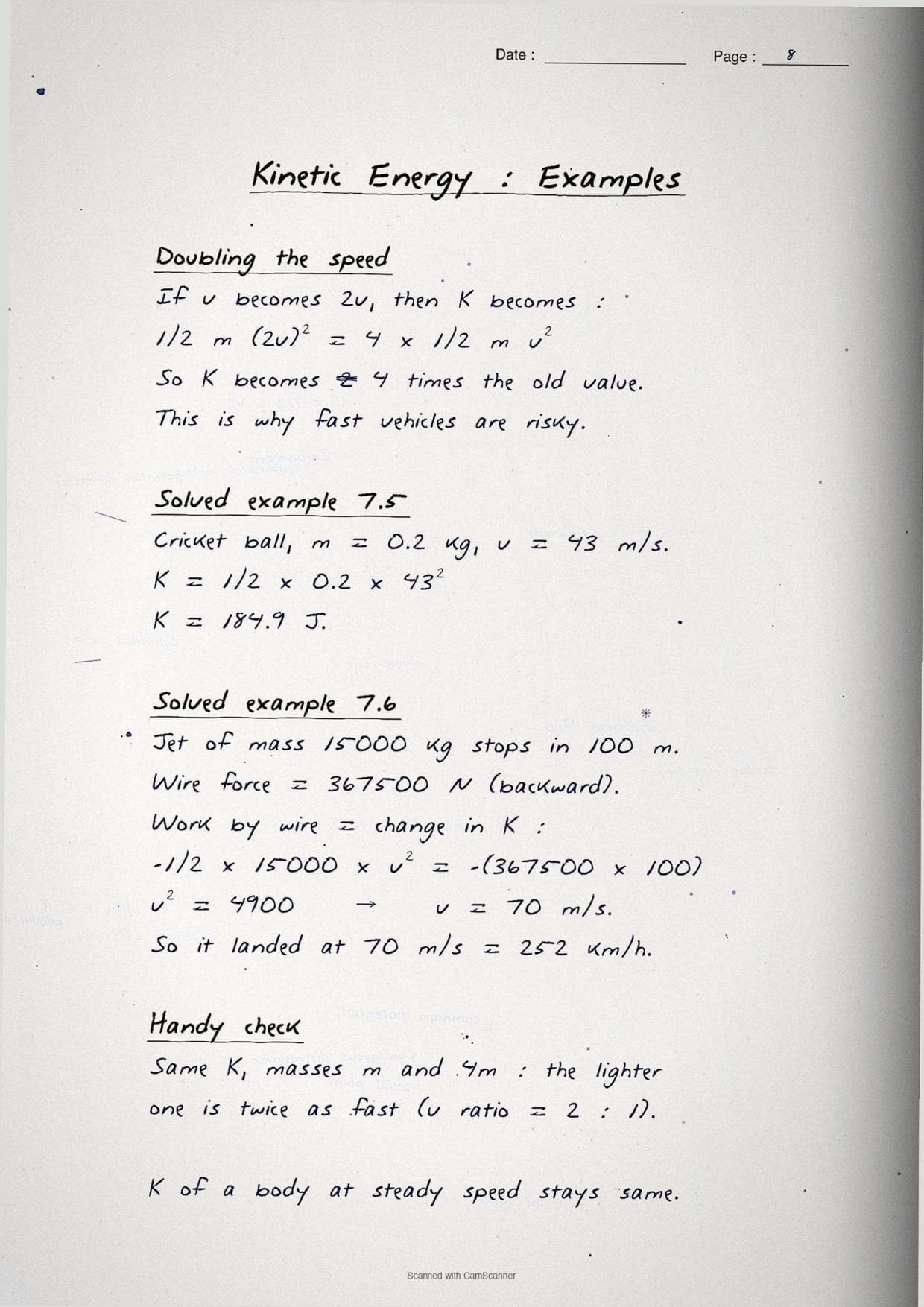
- Kinetic energy: because K depends on v2, doubling the speed makes the energy four times as large.
- Potential energy: lifting a mass m to height h stores mgh, measured from a chosen ground level.
Conservation of Mechanical Energy in Your Own Handwriting
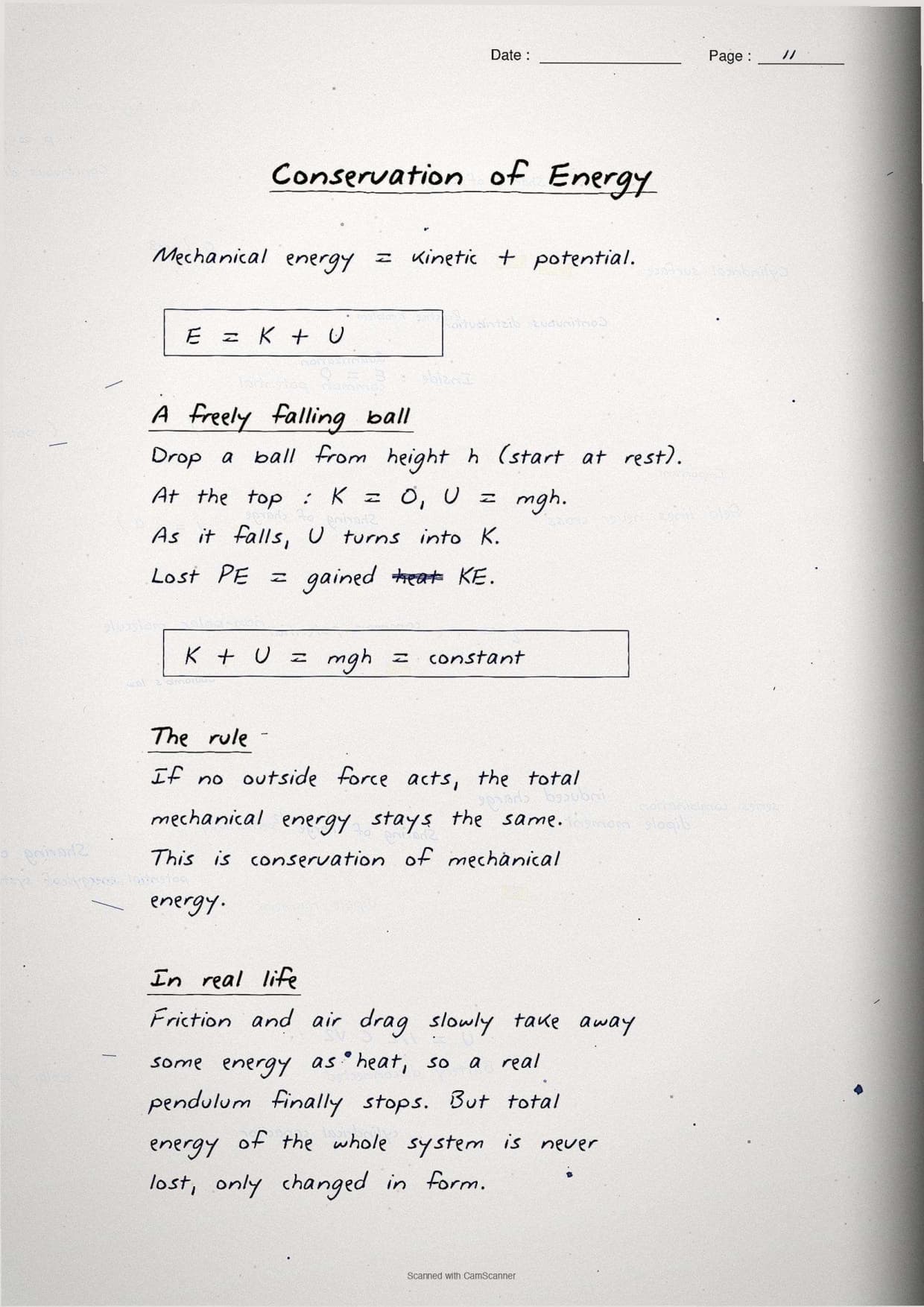
The sum of an object's kinetic and potential energy is its mechanical energy. As an object falls under gravity alone, this sum stays constant, so the notes draw a bar chart to show the two shares trading places. This is one of the most tested ideas in Chapter 7.
| Point of the fall | Potential energy | Kinetic energy |
|---|---|---|
| Top (A) | Full (mgh) | Zero |
| Middle (B) | Half | Half |
| Bottom (C) | Zero | Full (½mv2) |
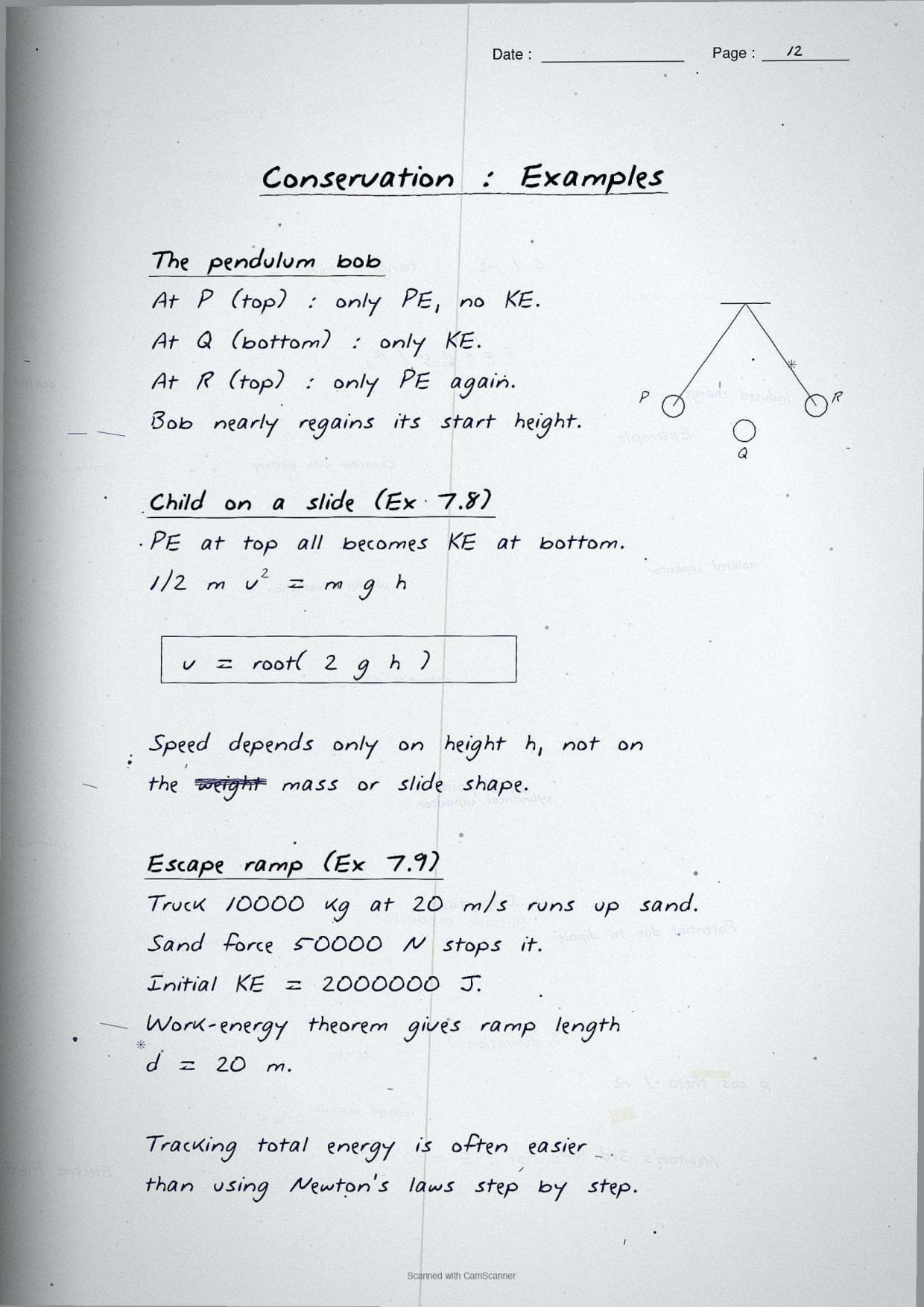
At every point the total column height is the same, so the potential energy lost equals the kinetic energy gained. A swinging pendulum shows the same trade: only potential energy at the ends, only kinetic energy at the lowest point. The notes flag one trap in red: in real life the bob slowly stops because friction and air resistance turn the energy into heat and sound, so mechanical energy alone is conserved only when these are ignored.
Power and Its Units Drawn by Hand
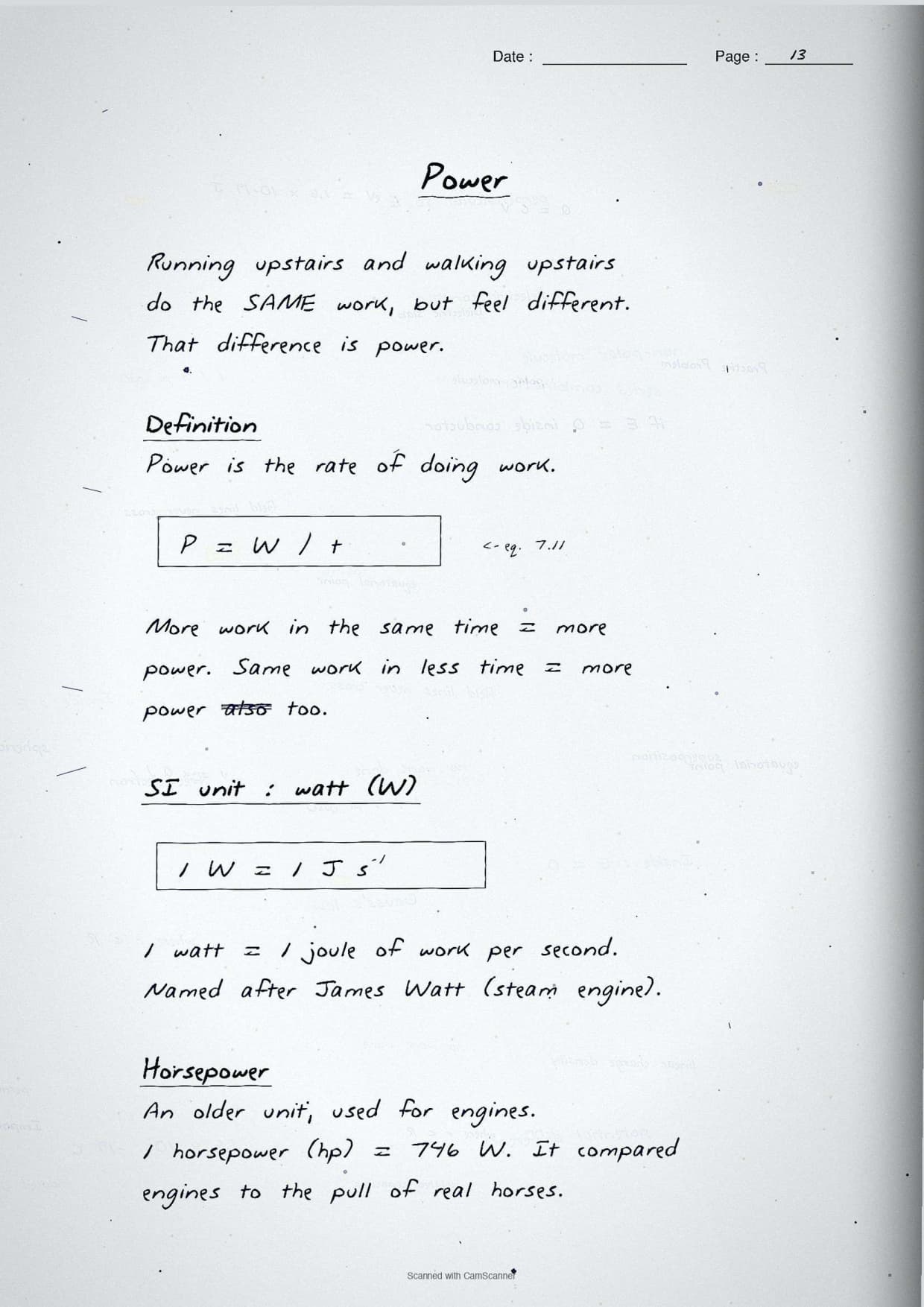
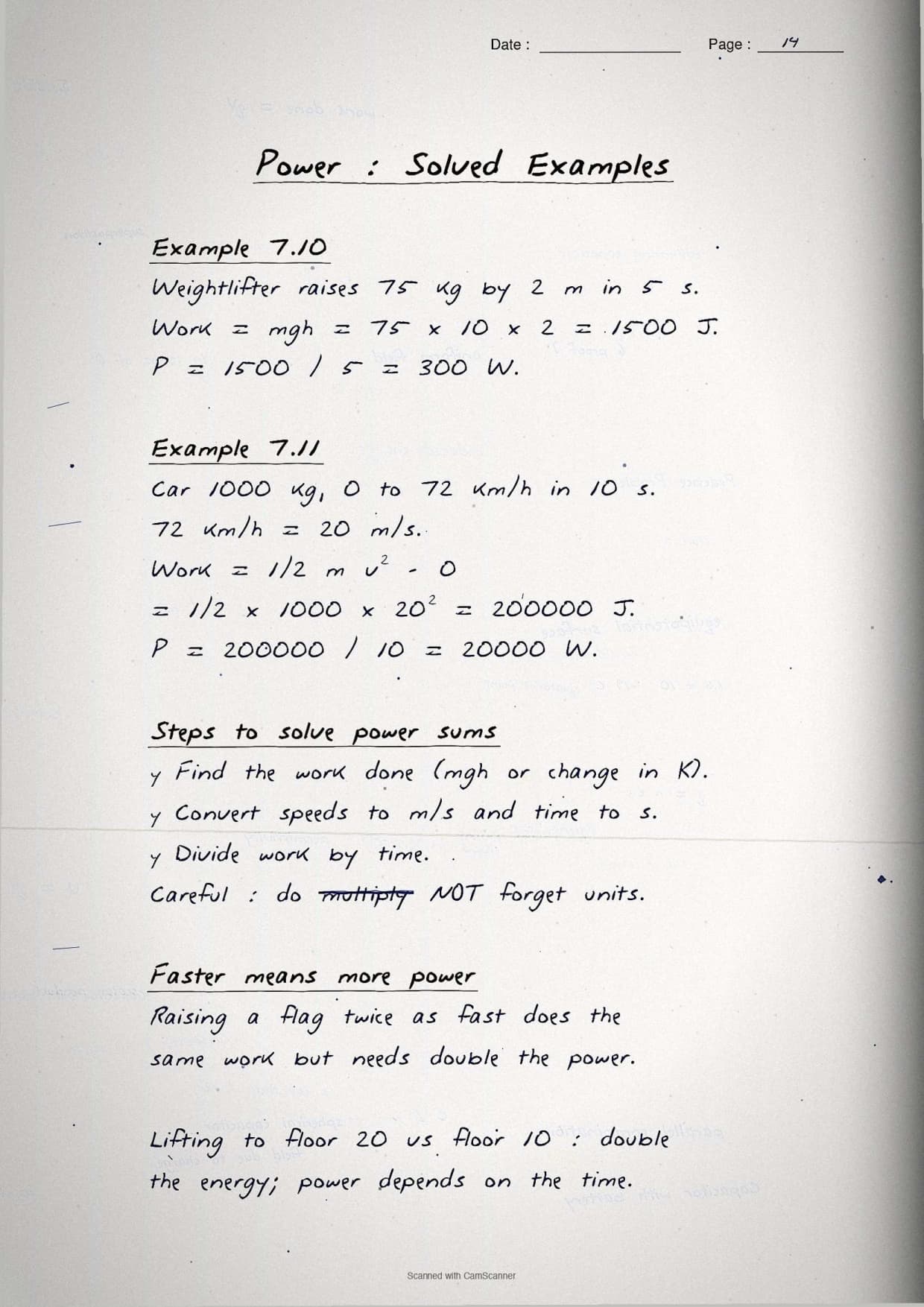
Carrying a bag upstairs in one minute or five minutes needs the same work, but they feel very different. Power captures that difference. It is the rate at which work is done, or how fast energy is transferred.
- Formula: P = Wt, where W is the work done and t is the time taken.
- SI unit: the watt (W), where 1 W = 1 J s-1, named after James Watt.
- Bigger unit: the horsepower, where 1 hp = 746 W, still used for engines and pumps.
Simple Machines: Pulley, Inclined Plane and Lever in the Notes
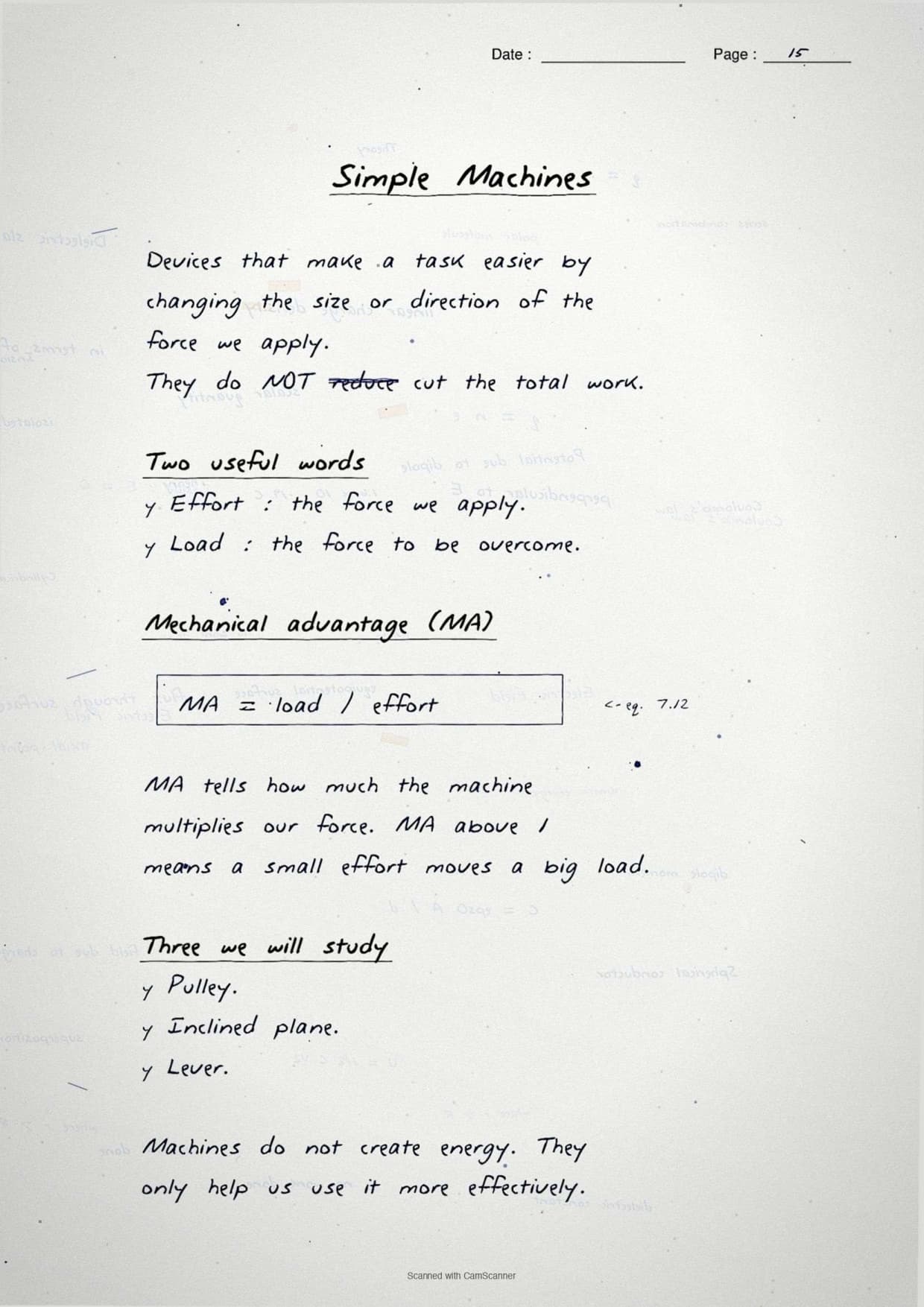
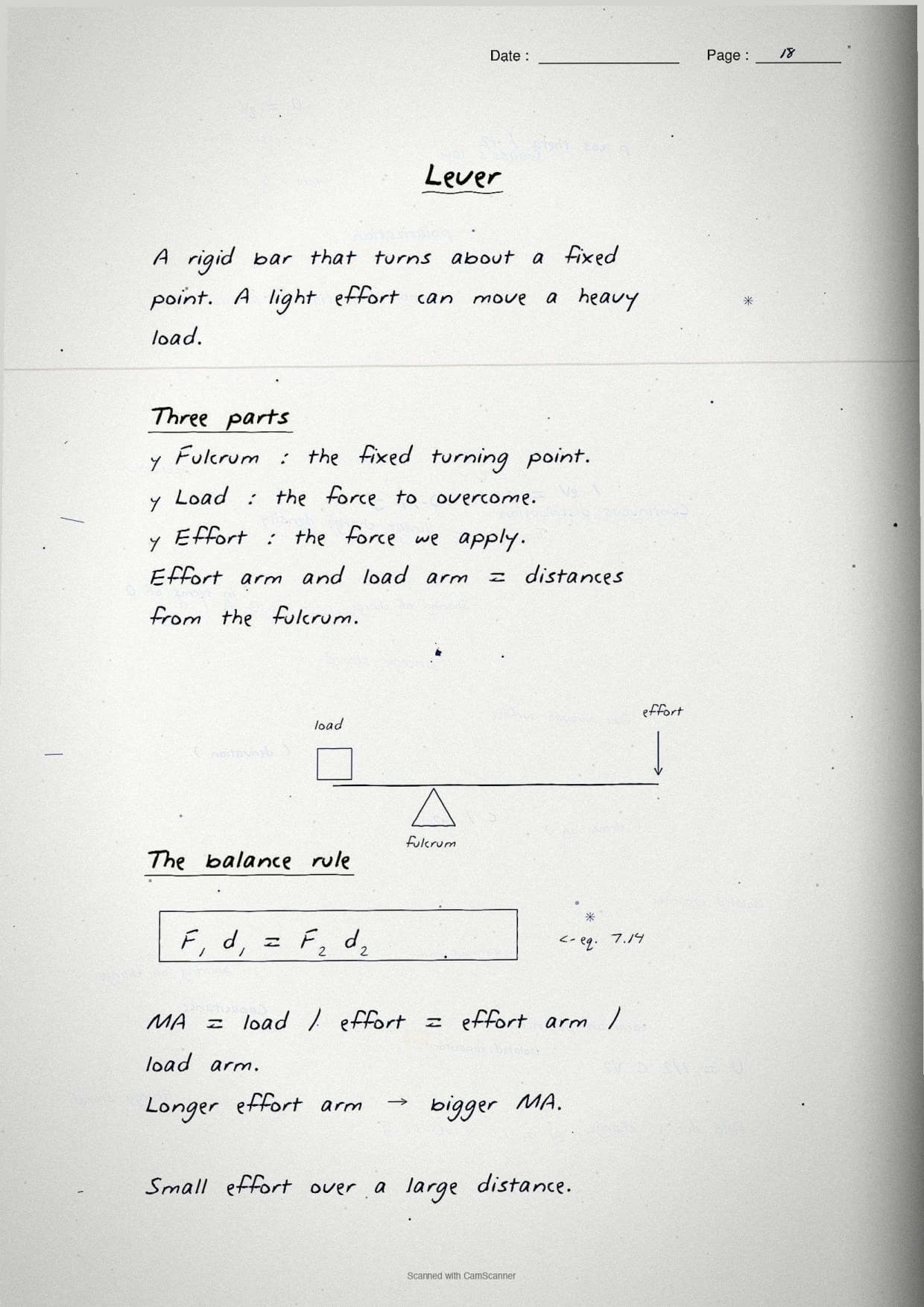
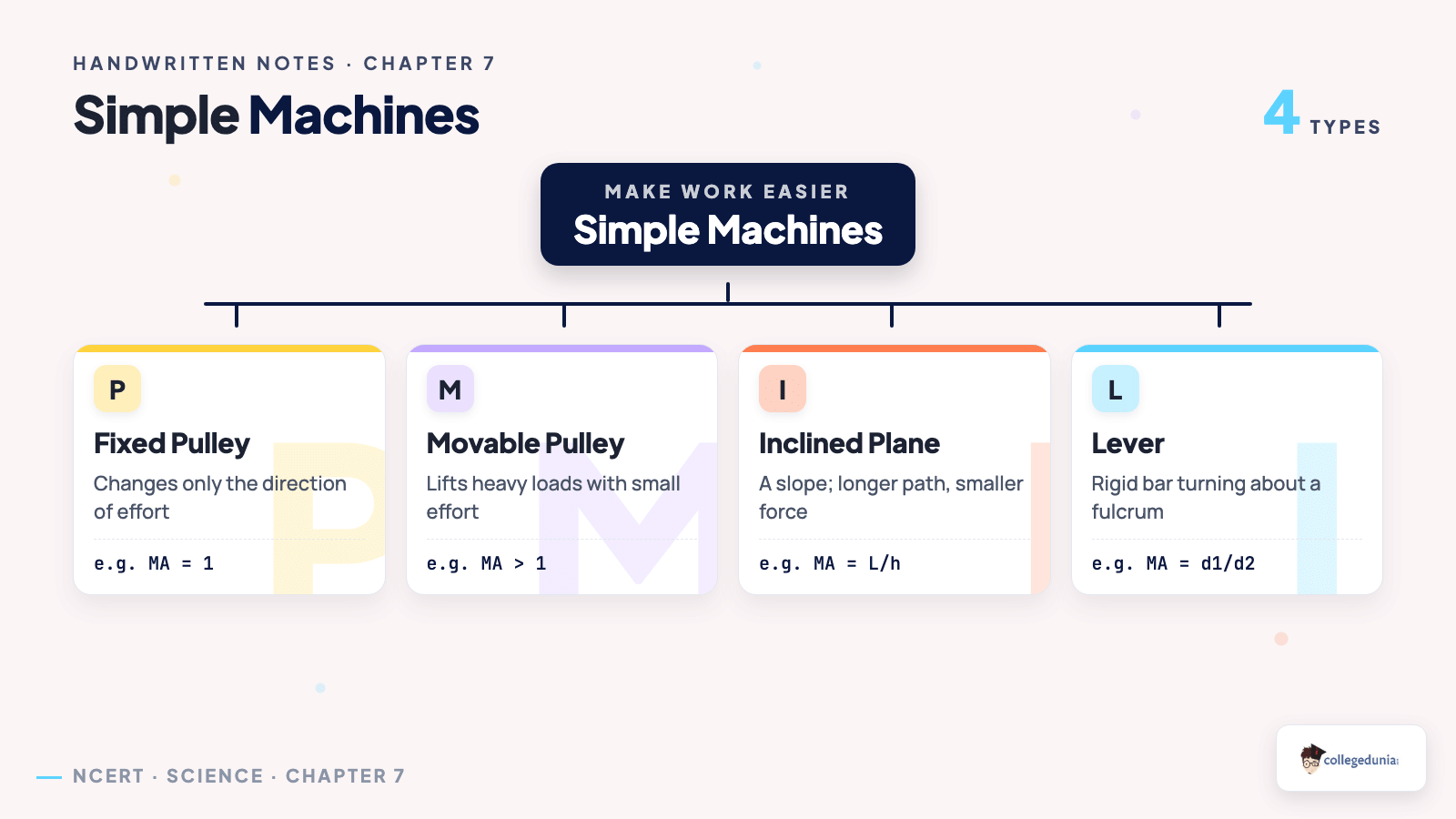
A simple machine cannot reduce the total work needed, but it can make a task easier by changing the size or direction of the force we apply. The notes box the key ratio, mechanical advantage = load ÷ effort. A value greater than 1 means a small effort overcomes a large load.
| Machine | What it changes | Mechanical advantage |
|---|---|---|
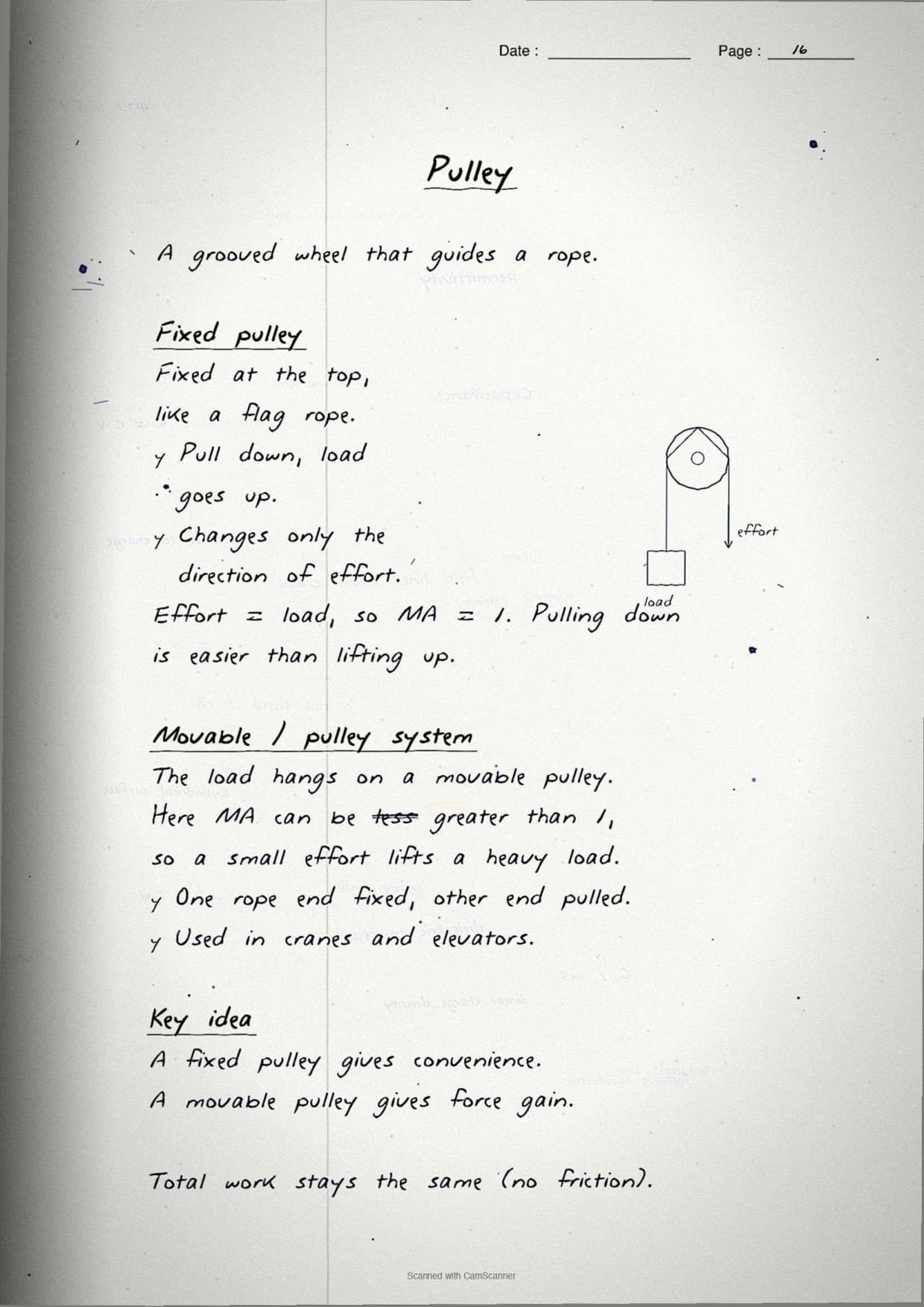
| Fixed pulley | Direction of the effort | Equal to 1 |
| Movable pulley or system | Size of the effort | Greater than 1 |
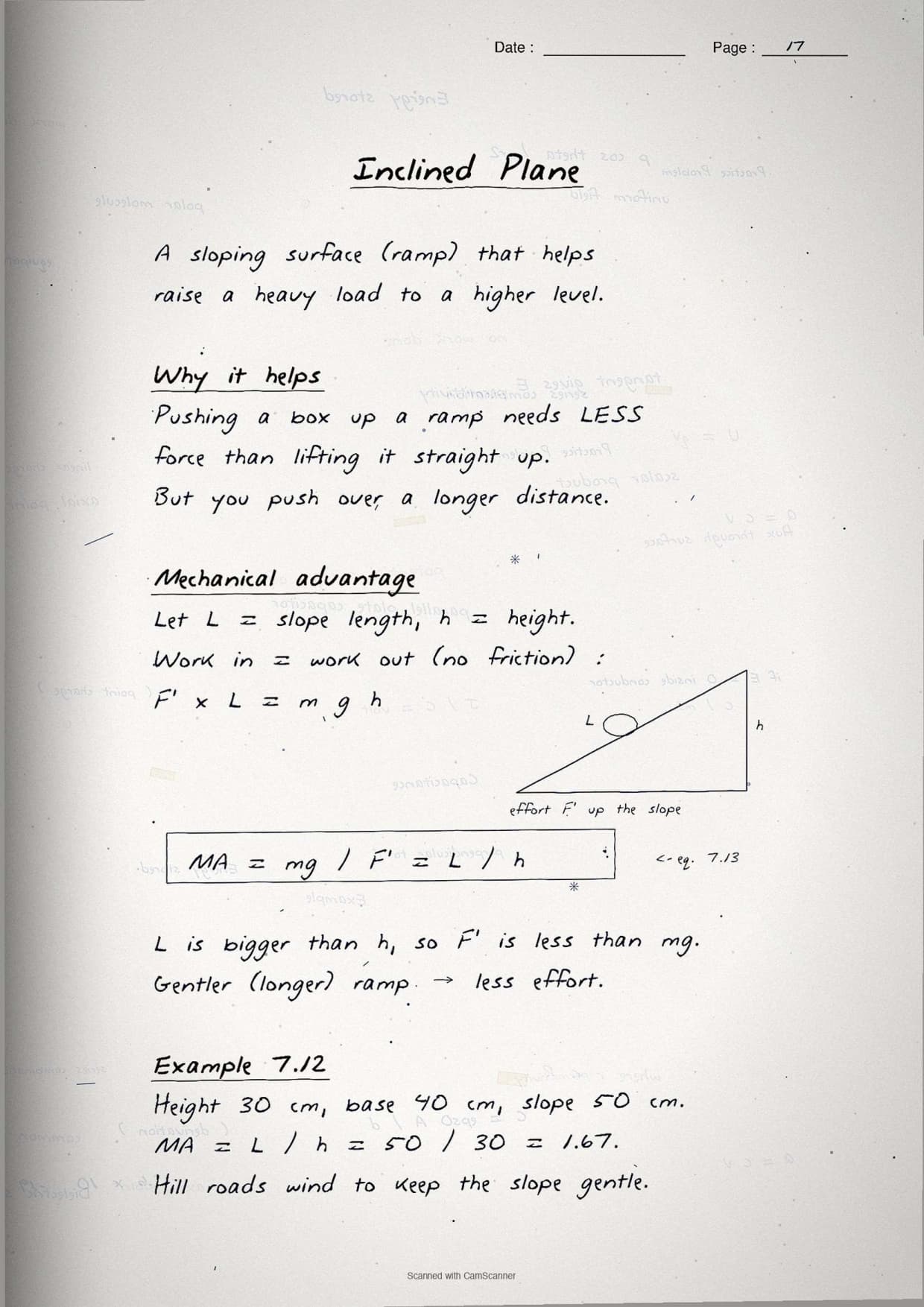
| Inclined plane | Size of the effort, longer path | L/h > 1 |
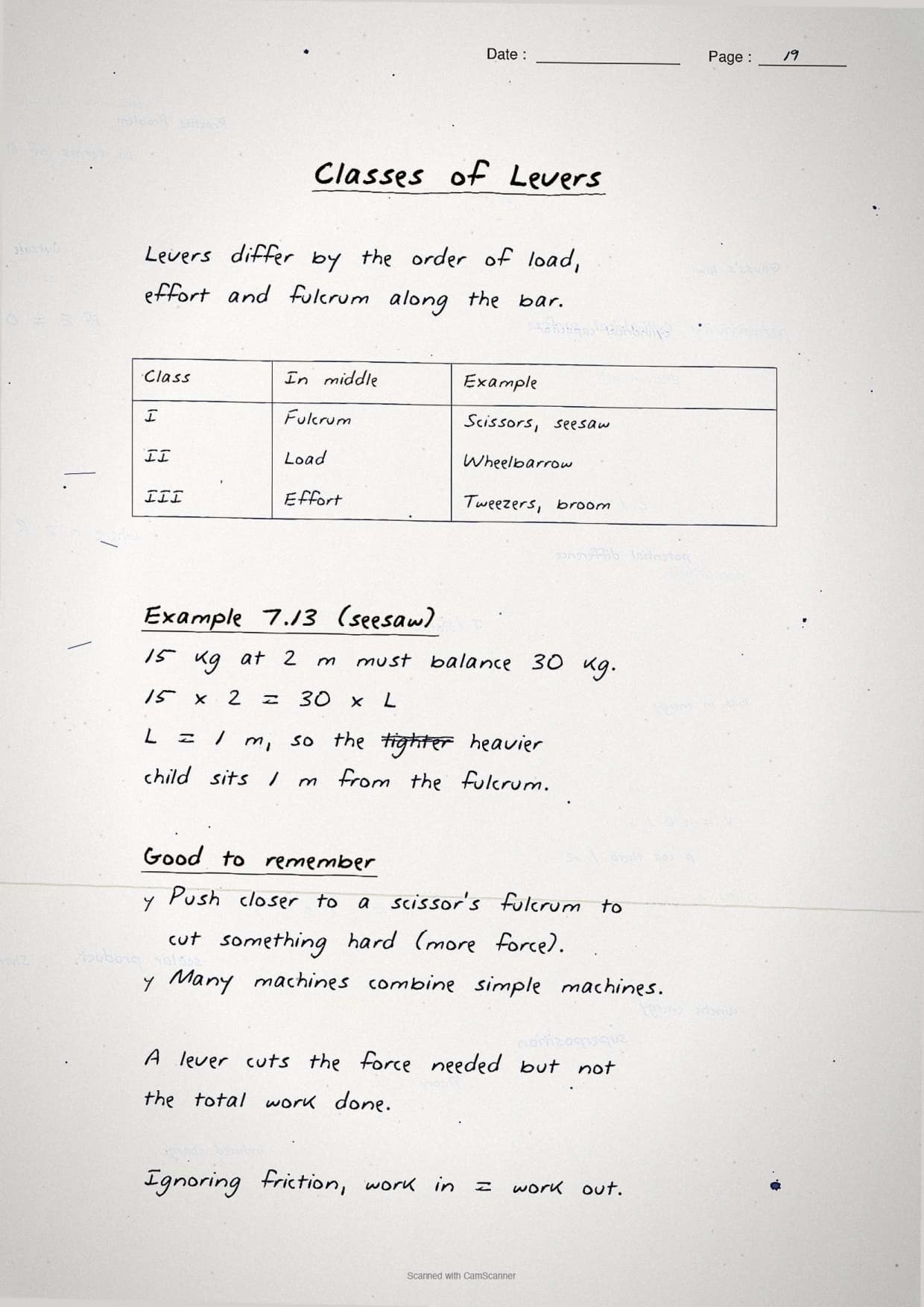
| Lever | Size and direction of the effort | d1/d2, can be more, equal or less than 1 |
- Pulley: a single fixed pulley only changes direction, so you pull down to raise a load up; a movable system lifts heavy loads with a small effort.
- Inclined plane: a longer, gentler ramp gives a larger mechanical advantage, which is why hill roads wind in long curves.
- Lever: a rigid bar that turns about a fulcrum; a longer effort arm gives a larger mechanical advantage. The notes list the three classes with the mnemonic FLE for the middle part.
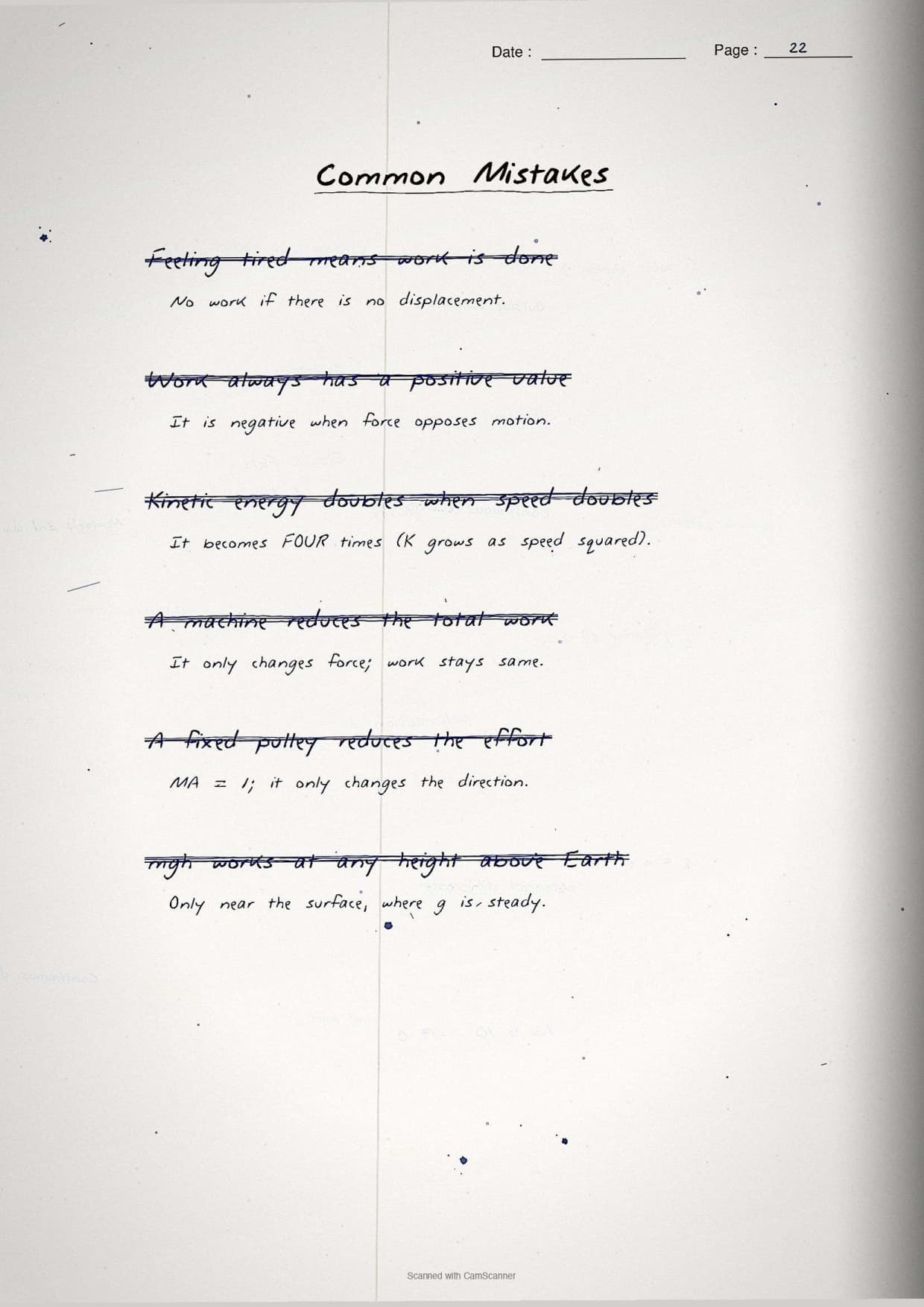
Common Mistakes Flagged in Red
Most lost marks in this chapter come from small slips, not hard ideas. The handwritten notes circle these in red so you fix them while you revise.
- Thinking that feeling tired means work is done, even when the object does not move.
- Forgetting the square rule: doubling the speed makes kinetic energy four times, not twice, as large.
- Saying a stopped pendulum has lost its energy, instead of it turning into heat and sound.
- Dropping the joule and leaving an energy answer in newton or metre alone.
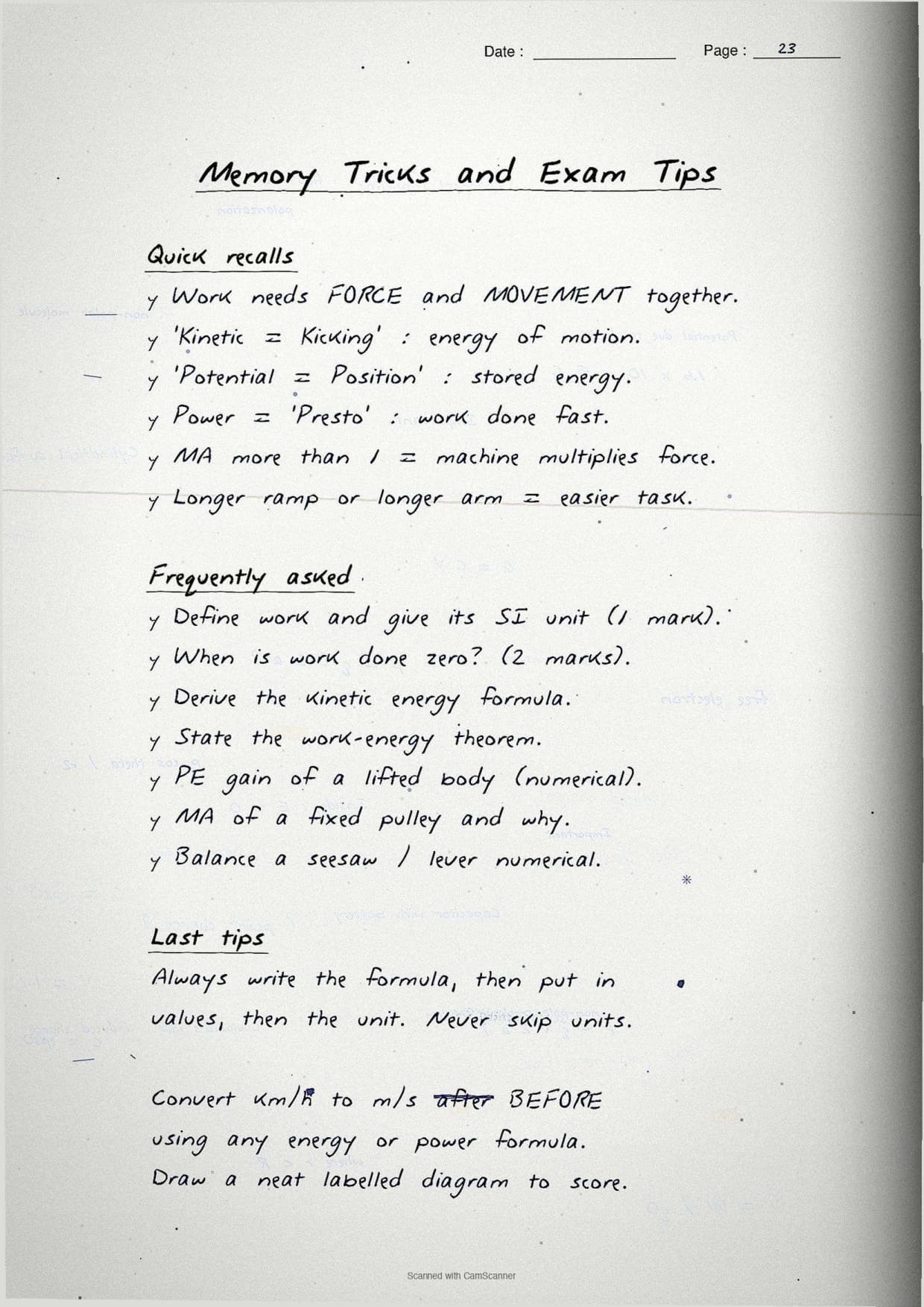
Last-Minute Revision with These Handwritten Notes
The night before your exam, the Work, Energy, and Simple Machines Class 9 Science Handwritten Notes work as a quick skim. Every boxed formula and red heading is a checkpoint, so you can cover the whole chapter in well under an hour.
- State the scientific meaning of work and its SI unit.
- Write K = ½mv2 and U = mgh from their boxes.
- Recall the free-fall energy bar chart in one glance.
- Define power, give its unit, and relate horsepower to the watt.
- Read the red mistake note about machines before you close the notes.
How Collegedunia's Handwritten Notes Help You With Work and Energy
Collegedunia brings you the Work, Energy, and Simple Machines Class 9 Science Handwritten Notes as a free, clear PDF you can open on any phone. It saves you the time of making your own notes and matches the new Exploration book.
- 2026-27 match: every page follows the new textbook and the Revise, Reflect, Refine flow.
- Clean handwriting: a topper's neat writing makes each formula and diagram easy to read.
- Exam-ready: boxes and colour cues let you revise fast before the annual exam, and later for CBSE, JEE, and NEET basics.
- Free download: keep the PDF offline and revise any time.
More Work, Energy, and Simple Machines Class 9 Science Resources
Use the table below to open the other resources for this chapter of the new Class 9 Science Exploration book.
| Resource | Open |
|---|---|
| Handwritten Notes | Work, Energy, and Simple Machines Class 9 Science Handwritten Notes |
| NCERT Solutions | Work, Energy, and Simple Machines Class 9 Science NCERT Solutions |
| Revision Notes | Work, Energy, and Simple Machines Class 9 Science Notes |
| Formula Sheet | Work, Energy, and Simple Machines Class 9 Science Formula Sheet |
| NCERT Book PDF | Work, Energy, and Simple Machines Class 9 Science NCERT Book PDF |
NCERT Handwritten Notes for Class 9 Science: All Chapters
Use the table below to open the handwritten notes for any other chapter of the new Class 9 Science Exploration book.
| Chapter | Handwritten Notes |
|---|---|
| Chapter 2 | Cell The Building Block of Life |
| Chapter 3 | Tissues in Action |
| Chapter 4 | Describing Motion Around Us |
| Chapter 5 | Exploring Mixtures and their Separation |
| Chapter 6 | How Forces Affect Motion |
| Chapter 7 | Work, Energy, and Simple Machines |
| Chapter 8 | Journey Inside the Atom |
| Chapter 9 | Atomic Foundations of Matter |
| Chapter 10 | Sound Waves Characteristics and Applications |
| Chapter 11 | Reproduction How Life Continues |
| Chapter 12 | Patterns in Life Diversity and Classification |
| Chapter 13 | Earth as a System Energy, Matter, and Life |
Work, Energy, and Simple Machines Class 9 Science Handwritten Notes FAQs
Ques. How many pages are the Work, Energy, and Simple Machines Class 9 Science handwritten notes?
Ans. The handwritten notes run to 23 pages. They cover the full chapter, from work and the work-energy theorem to kinetic and potential energy, the law of conservation of energy, power, and simple machines, with a solved example after each idea.
Ques. Are these real handwritten notes?
Ans. Yes. They are a topper's own clear handwritten revision notes, with each formula boxed, energy bar charts drawn by hand, and sub-headings colour-coded in red.
Ques. What are the main formulas in the Chapter 7 notes?
Ans. The key formulas are work W = F × s, kinetic energy K = ½mv2, potential energy U = mgh, and power P = W/t, all boxed in the margins.
Ques. Can I use these handwritten notes for last-minute revision?
Ans. Yes. The boxed formulas and red headings let you skim the whole chapter in under an hour, so they suit the night before your annual exam.
Ques. Is Work, Energy, and Simple Machines part of the new Class 9 Science book?
Ans. Yes. Work, Energy, and Simple Machines is Chapter 7 of the new Exploration textbook for the 2026-27 syllabus. It builds on the earlier chapter on forces and motion.



Comments