SRMJEEE UG Model Question Paper with Solutions is now available for download here. The SRM Institute of Science and Technology conducts the SRMJEEE UG exam. The exam is conducted for admission to B.Tech and M.Tech programs across SRM Group campuses. The official SRMJEEE UG question paper consists of 130 questions divided into 4 sections - Section A (Physics), Section B (Chemistry), Section C (Mathematics) and Section D (English).
This model question paper is designed as per the latest syllabus and exam pattern. You can download SRMJEEE UG Model Question Paper with Solutions from the links provided below.
SRMJEEE UG Model Question Paper with Solutions
Question 1:
The density of a metal is calculated as follows. The weight of \(57.4\) grams is divided by the volume \(6.2\ \text{cm}^3\). Using the approximate rule for significant figures in this calculation, the value of the density, in \(\text{g/cm}^3\), should be reported as:
(A) \(9\)
(B) \(9.3\)
(C) \(9.26\)
(D) \(9.258\)
Question 2:
If the Reynolds number is less than \(2000\), the flow in a pipe is
(A) Turbulent
(B) Laminar
(C) Transition
(D) None of the above
Question 3:
Maximum load a structure can bear before its failure is called
(A) Normal Load
(B) Shear load
(C) Ultimate load
(D) Safety load
Question 4:
Three point charges \(q+Q,\ q,\ q-Q\) are enclosed by the surface \(S\). What net flux crosses \(S\)?
(A) \(3q\)
(B) \(2q\)
(C) \(3q-Q\)
(D) cannot be determine based on the data given in question
Question 5:
Number of electrons in one coulomb of charge will be
(A) \(5.46\times10^{23}\)
(B) \(5.25\times10^{18}\)
(C) \(1.6\times10^{-19}\)
(D) \(9\times10^{11}\)
Question 6:
Choose the vector physical quantity
(A) Electric flux
(B) Electric potential
(C) Electric potential energy
(D) Electric intensity
Question 7:
The voltage is a form of
(A) Kinetic energy
(B) Potential energy
(C) Mechanical energy
(D) Both kinetic and potential energy
Question 8:
A charge of \(60\ \text{C}\) passes through an electric lamp in \(2\) minutes. Then the current in the lamp is
(A) \(30\ \text{A}\)
(B) \(1\ \text{A}\)
(C) \(0.5\ \text{A}\)
(D) \(5\ \text{A}\)
Question 9:
Four wires of equal length and of resistance \(3\ \Omega\) each are connected in the form of a square. The equivalent resistance between the diagonally opposite corners of the square is
(A) \(12\ \Omega\)
(B) \(3/4\ \Omega\)
(C) \(6\ \Omega\)
(D) \(3\ \Omega\)
Question 10:
The number of free electrons per cm of copper wire is \(2\times10^{21}\). The average drift speed of the electrons is \(0.25\ \text{mm/s}\). The current flowing is
(A) \(0.8\ \text{A}\)
(B) \(8\ \text{A}\)
(C) \(80\ \text{A}\)
(D) \(800\ \text{A}\)
Question 11:
The sensitivity of a potentiometer can be increased by
(A) Increasing the emf of the cell
(B) Decreasing the emf of the cell
(C) Increasing the length of the potentiometer wire
(D) Decreasing the length of the potentiometer wire
Question 12:
is the rule used to know the direction of the induced current in the circuit.
(A) Fleming’s left hand rule
(B) Fleming’s right hand rule
(C) Right hand thumb rule
(D) Ampere’s rule
Question 13:
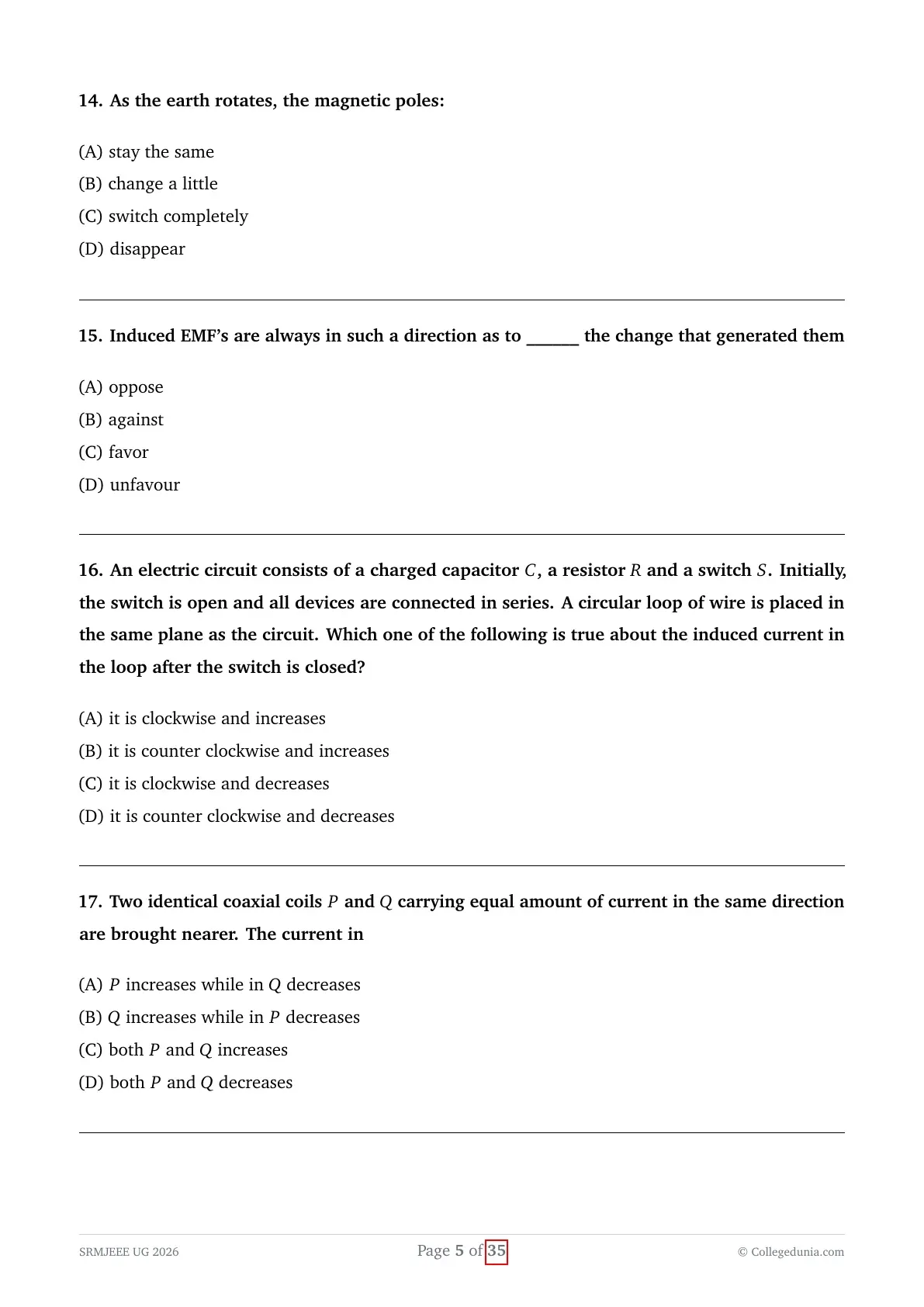
As the earth rotates, the magnetic poles:
(A) stay the same
(B) change a little
(C) switch completely
(D) disappear
Question 14:
Induced EMF’s are always in such a direction as to the change that generated them
(A) oppose
(B) against
(C) favor
(D) unfavour
Question 15:
An electric circuit consists of a charged capacitor \(C\), a resistor \(R\) and a switch \(S\). Initially, the switch is open and all devices are connected in series. A circular loop of wire is placed in the same plane as the circuit. Which one of the following is true about the induced current in the loop after the switch is closed?
(A) it is clockwise and increases
(B) it is counter clockwise and increases
(C) it is clockwise and decreases
(D) it is counter clockwise and decreases
Question 16:
Two identical coaxial coils \(P\) and \(Q\) carrying equal amount of current in the same direction are brought nearer. The current in
(A) \(P\) increases while in \(Q\) decreases
(B) \(Q\) increases while in \(P\) decreases
(C) both \(P\) and \(Q\) increases
(D) both \(P\) and \(Q\) decreases
Question 17:
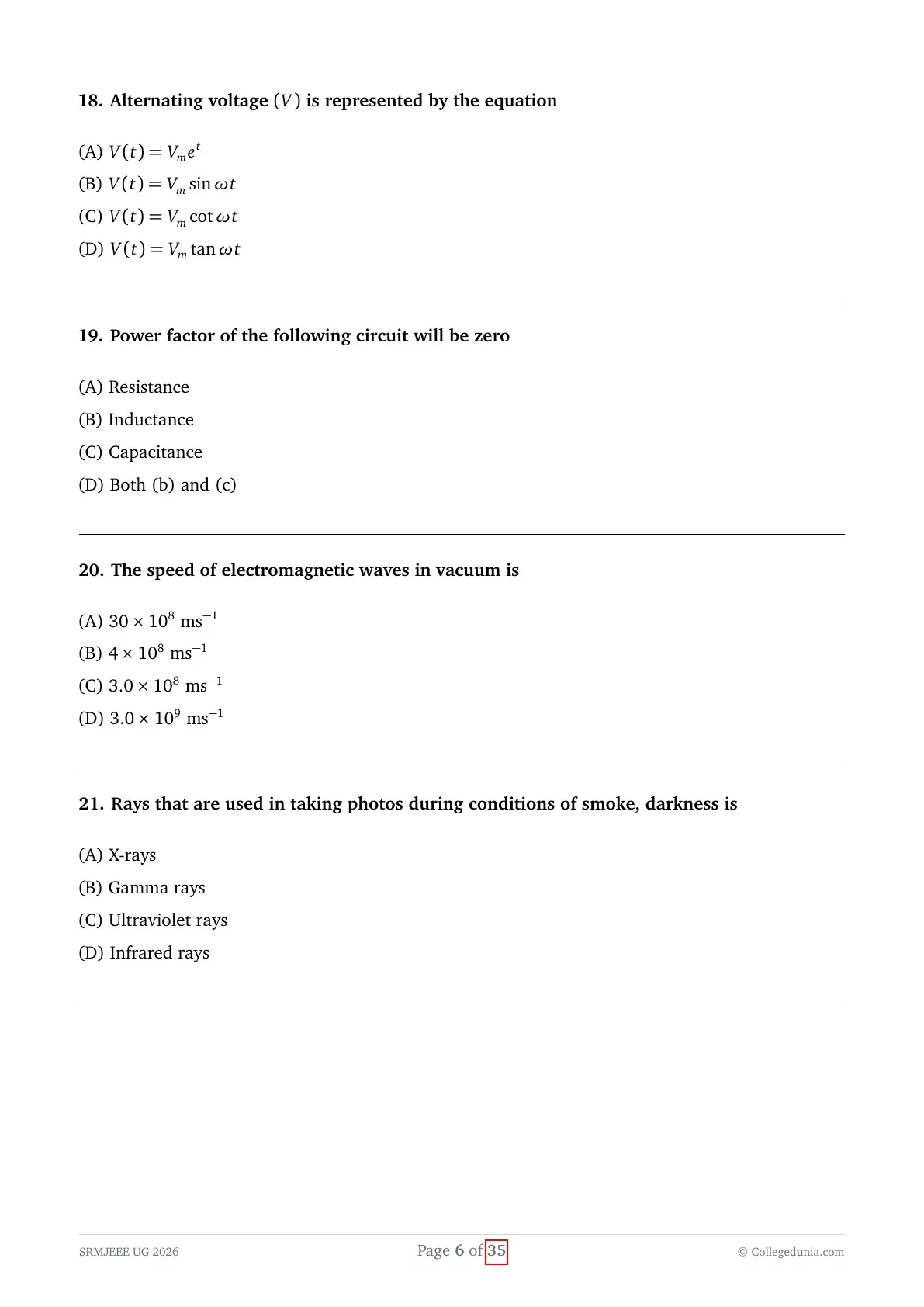
Alternating voltage \((V)\) is represented by the equation
(A) \(V(t)=V_m e^t\)
(B) \(V(t)=V_m\sin \omega t\)
(C) \(V(t)=V_m\cot \omega t\)
(D) \(V(t)=V_m\tan \omega t\)
Question 18:
Power factor of the following circuit will be zero
(A) Resistance
(B) Inductance
(C) Capacitance
(D) Both (b) and (c)
Question 19:
The speed of electromagnetic waves in vacuum is
(A) \(30\times10^8\ \text{ms}^{-1}\)
(B) \(4\times10^8\ \text{ms}^{-1}\)
(C) \(3.0\times10^8\ \text{ms}^{-1}\)
(D) \(3.0\times10^9\ \text{ms}^{-1}\)
Question 20:
Rays that are used in taking photos during conditions of smoke, darkness is
(A) X-rays
(B) Gamma rays
(C) Ultraviolet rays
(D) Infrared rays
Question 21:
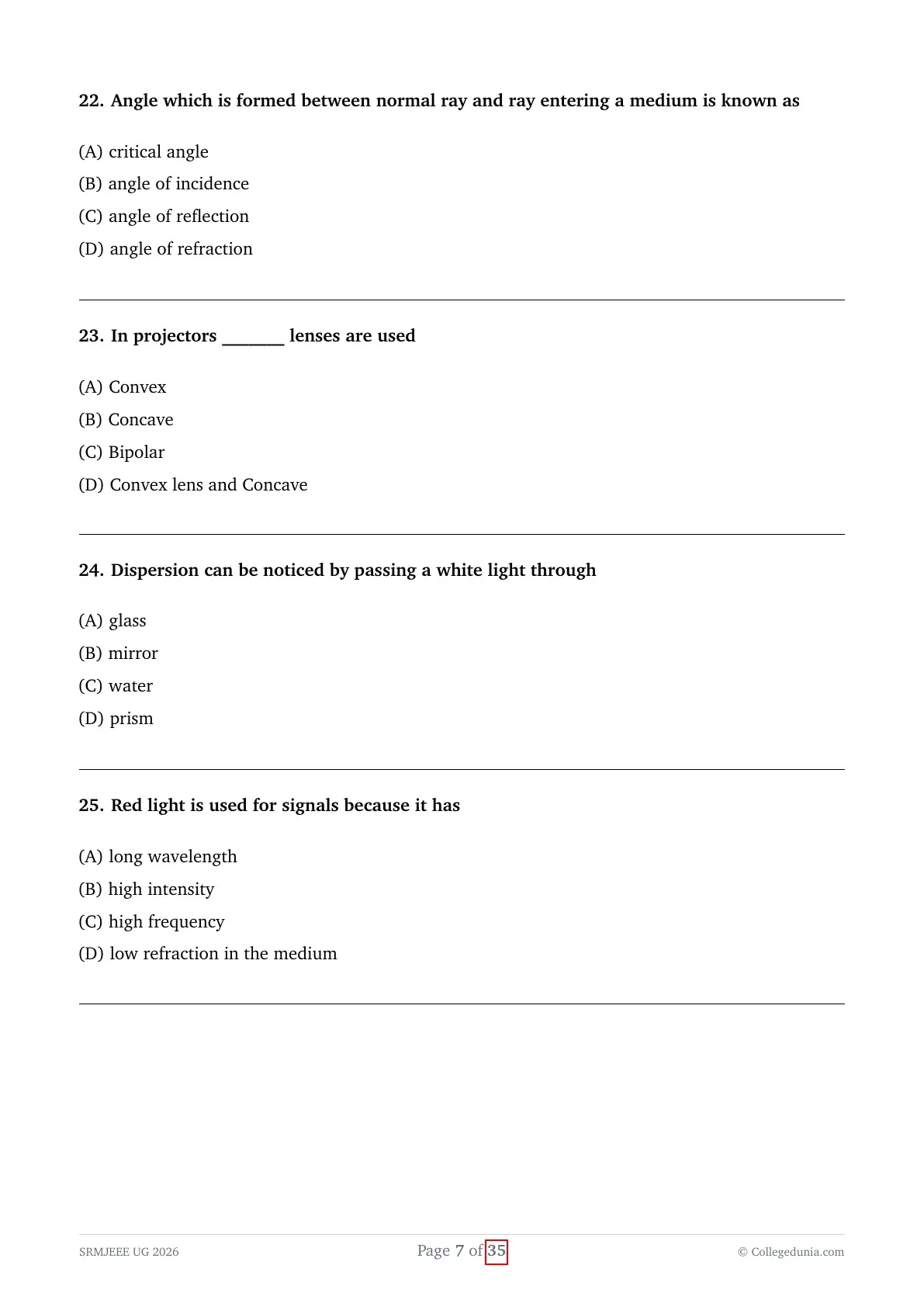
Angle which is formed between normal ray and ray entering a medium is known as
(A) critical angle
(B) angle of incidence
(C) angle of reflection
(D) angle of refraction
Question 22:
In projectors lenses are used
(A) Convex
(B) Concave
(C) Bipolar
(D) Convex lens and Concave
Question 23:
Dispersion can be noticed by passing a white light through
(A) glass
(B) mirror
(C) water
(D) prism
Question 24:
Red light is used for signals because it has
(A) long wavelength
(B) high intensity
(C) high frequency
(D) low refraction in the medium
Question 25:
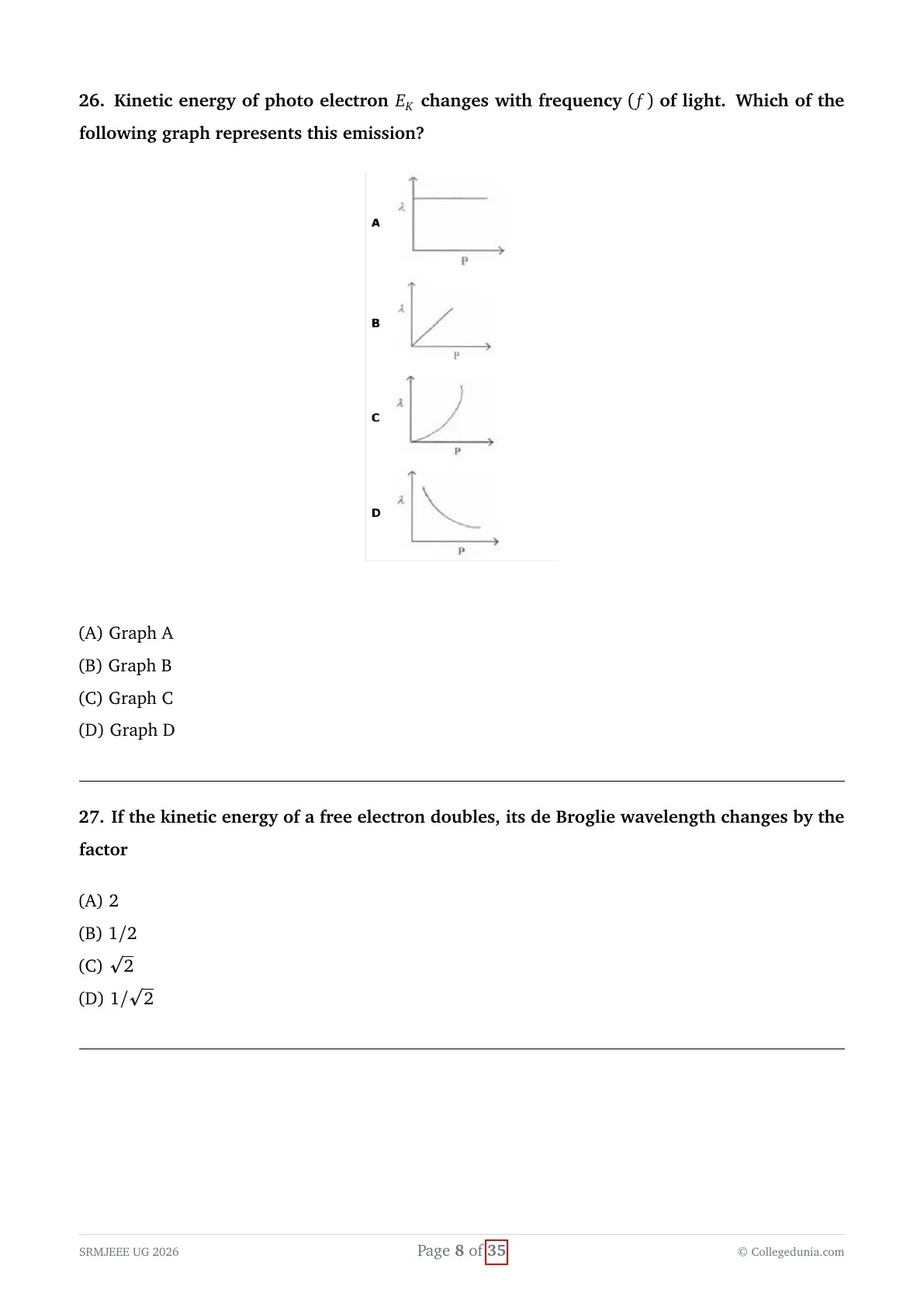
Kinetic energy of photo electron \(E_K\) changes with frequency \((f)\) of light. Which of the following graph represents this emission?
(A) Graph A
(B) Graph B
(C) Graph C
(D) Graph D
Question 26:
If the kinetic energy of a free electron doubles, its de Broglie wavelength changes by the factor
(A) \(2\)
(B) \(1/2\)
(C) \(\sqrt{2}\)
(D) \(1/\sqrt{2}\)
Question 27:
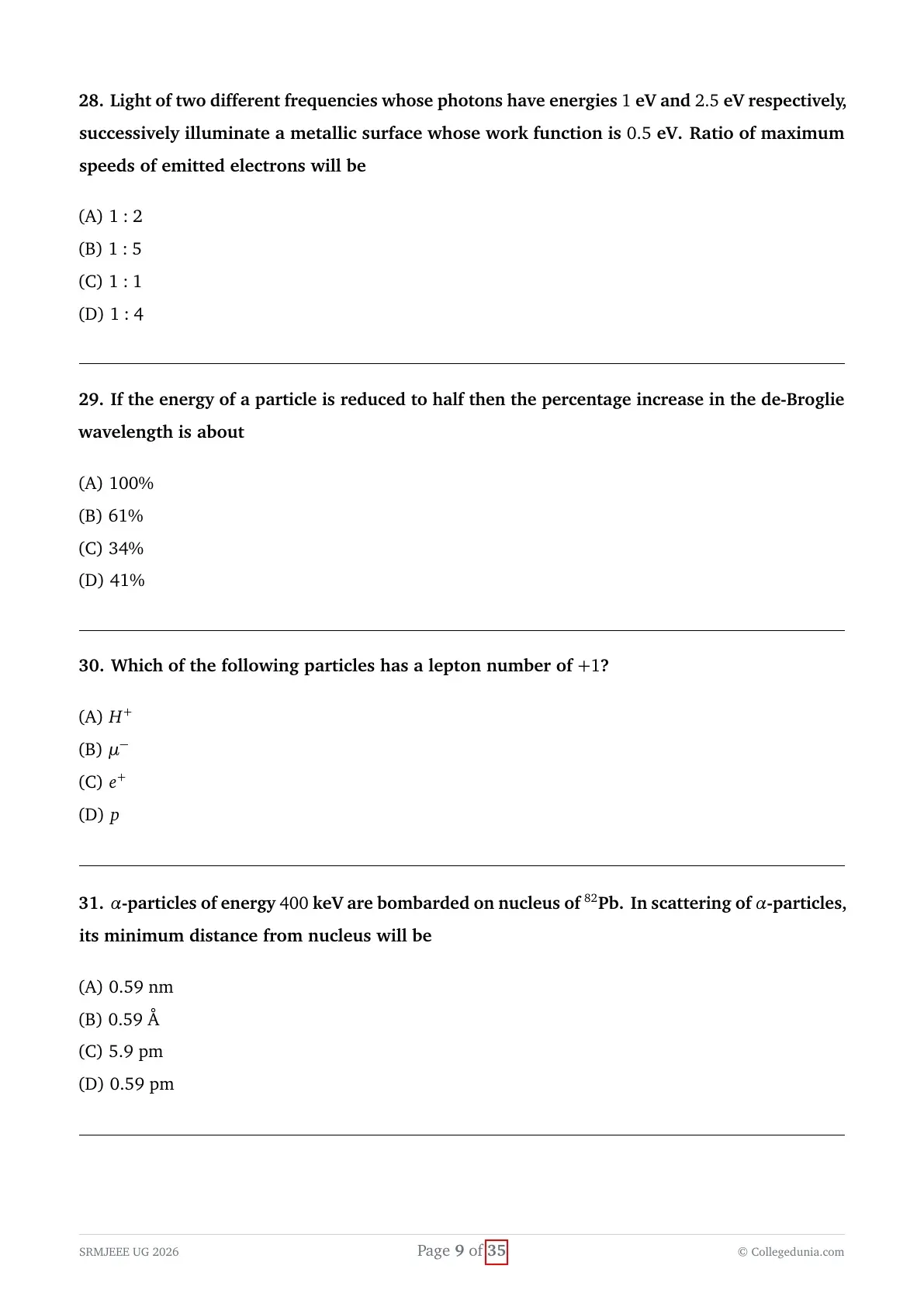
Light of two different frequencies whose photons have energies \(1\ \text{eV}\) and \(2.5\ \text{eV}\) respectively, successively illuminate a metallic surface whose work function is \(0.5\ \text{eV}\). Ratio of maximum speeds of emitted electrons will be
(A) \(1:2\)
(B) \(1:5\)
(C) \(1:1\)
(D) \(1:4\)
Question 28:
If the energy of a particle is reduced to half then the percentage increase in the de-Broglie wavelength is about
(A) \(100\%\)
(B) \(61\%\)
(C) \(34\%\)
(D) \(41\%\)
Question 29:
Which of the following particles has a lepton number of \(+1\)?
(A) \(H^+\)
(B) \(\mu^-\)
(C) \(e^+\)
(D) \(p\)
Question 30:
\(\alpha\)-particles of energy \(400\ \text{keV}\) are bombarded on nucleus of \({}^{82}\text{Pb}\). In scattering of \(\alpha\)-particles, its minimum distance from nucleus will be
(A) \(0.59\ \text{nm}\)
(B) \(0.59\ \text{Å}\)
(C) \(5.9\ \text{pm}\)
(D) \(0.59\ \text{pm}\)
Question 31:
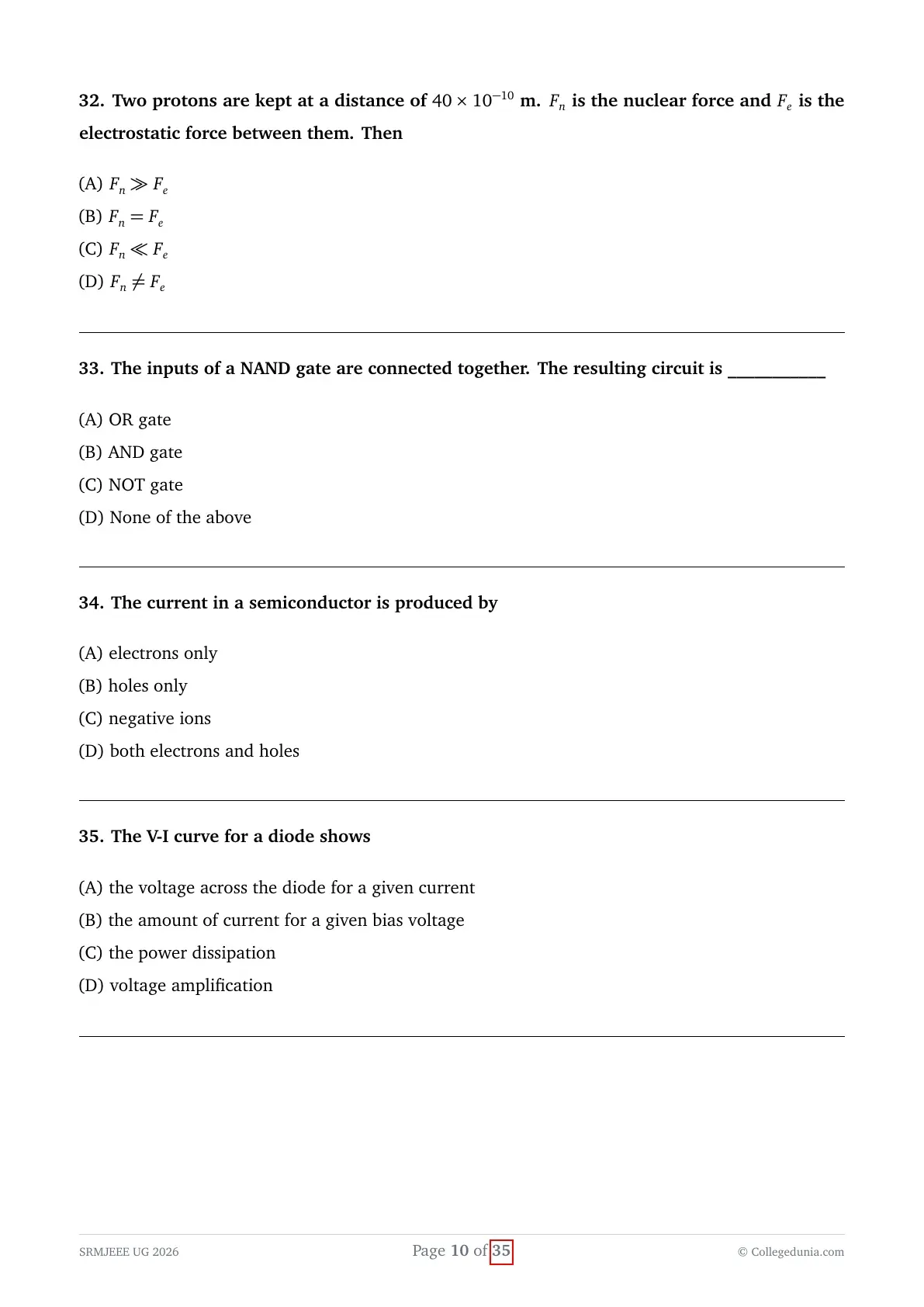
Two protons are kept at a distance of \(40\times10^{-10}\text{ m}\). \(F_n\) is the nuclear force and \(F_e\) is the electrostatic force between them. Then
(A) \(F_n \gg F_e\)
(B) \(F_n = F_e\)
(C) \(F_n \ll F_e\)
(D) \(F_n \ne F_e\)
Question 32:
The inputs of a NAND gate are connected together. The resulting circuit is
(A) OR gate
(B) AND gate
(C) NOT gate
(D) None of the above
Question 33:
The current in a semiconductor is produced by
(A) electrons only
(B) holes only
(C) negative ions
(D) both electrons and holes
Question 34:
The V-I curve for a diode shows
(A) the voltage across the diode for a given current
(B) the amount of current for a given bias voltage
(C) the power dissipation
(D) voltage amplification
Question 35:
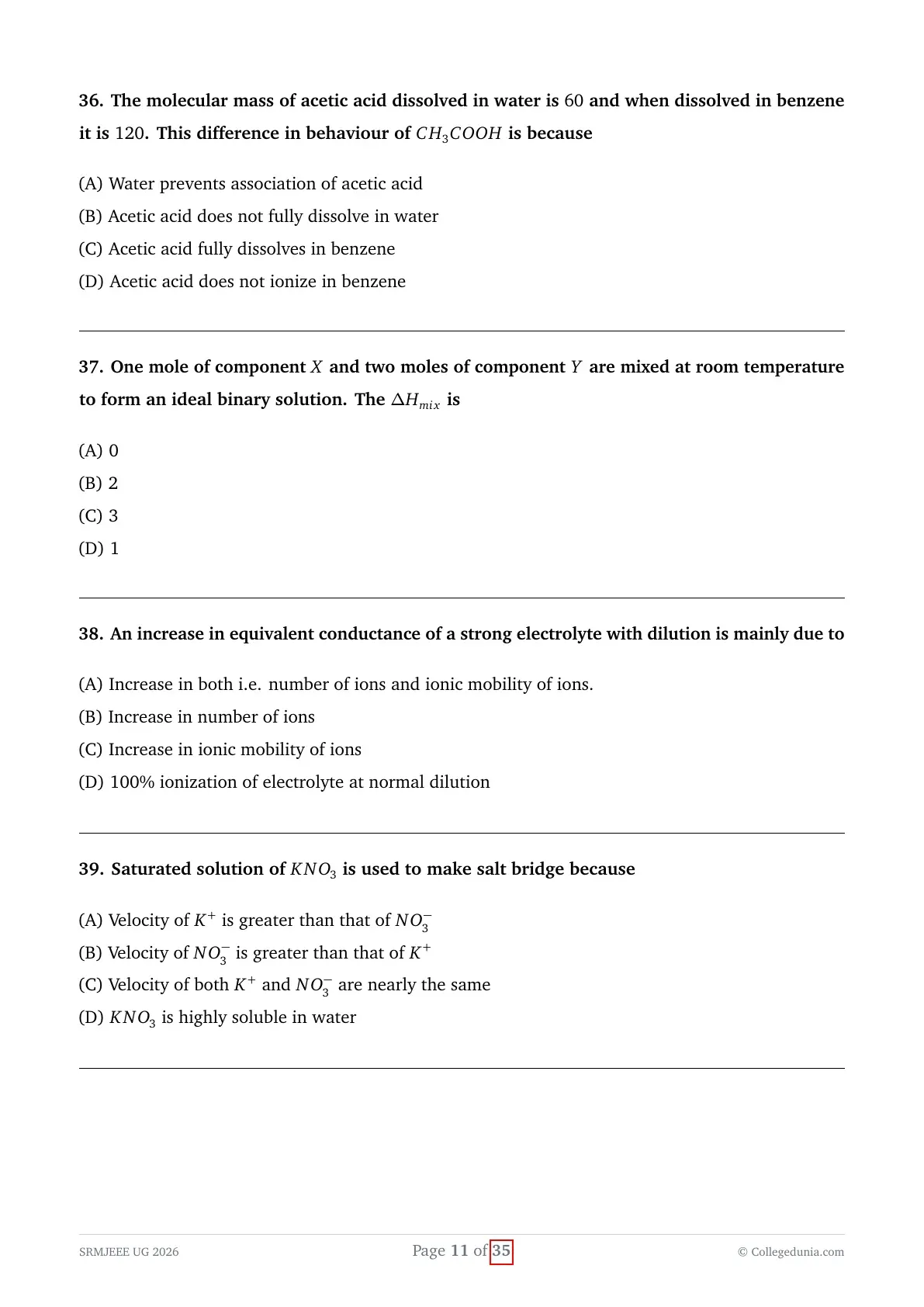
The molecular mass of acetic acid dissolved in water is \(60\) and when dissolved in benzene it is \(120\). This difference in behaviour of \(CH_3COOH\) is because
(A) Water prevents association of acetic acid
(B) Acetic acid does not fully dissolve in water
(C) Acetic acid fully dissolves in benzene
(D) Acetic acid does not ionize in benzene
Question 36:
One mole of component \(X\) and two moles of component \(Y\) are mixed at room temperature to form an ideal binary solution. The \(\Delta H_{mix}\) is
(A) \(0\)
(B) \(2\)
(C) \(3\)
(D) \(1\)
Question 37:
An increase in equivalent conductance of a strong electrolyte with dilution is mainly due to
(A) Increase in both i.e. number of ions and ionic mobility of ions.
(B) Increase in number of ions
(C) Increase in ionic mobility of ions
(D) 100% ionization of electrolyte at normal dilution
Question 38:
Saturated solution of \(KNO_3\) is used to make salt bridge because
(A) Velocity of \(K^+\) is greater than that of \(NO_3^-\)
(B) Velocity of \(NO_3^-\) is greater than that of \(K^+\)
(C) Velocity of both \(K^+\) and \(NO_3^-\) are nearly the same
(D) \(KNO_3\) is highly soluble in water
Question 39:
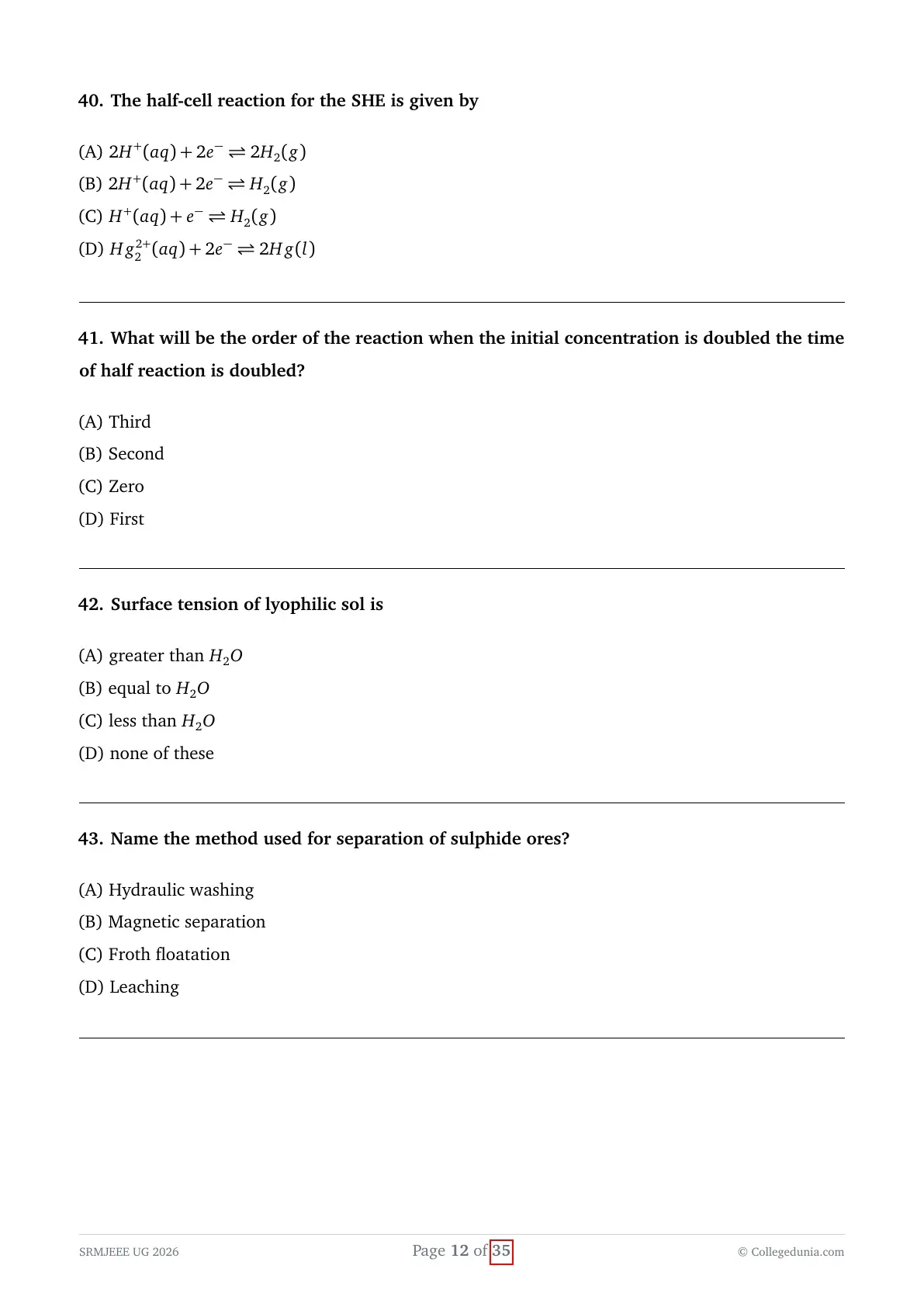
The half-cell reaction for the SHE is given by
(A) \(2H^+(aq)+2e^- \rightleftharpoons 2H_2(g)\)
(B) \(2H^+(aq)+2e^- \rightleftharpoons H_2(g)\)
(C) \(H^+(aq)+e^- \rightleftharpoons H_2(g)\)
(D) \(Hg_2^{2+}(aq)+2e^- \rightleftharpoons 2Hg(l)\)
Question 40:
What will be the order of the reaction when the initial concentration is doubled the time of half reaction is doubled?
(A) Third
(B) Second
(C) Zero
(D) First
Question 41:
Surface tension of lyophilic sol is
(A) greater than \(H_2O\)
(B) equal to \(H_2O\)
(C) less than \(H_2O\)
(D) none of these
Question 42:
Name the method used for separation of sulphide ores?
(A) Hydraulic washing
(B) Magnetic separation
(C) Froth floatation
(D) Leaching
Question 43:
\(P_4\) reacts with \(X\) selectively to give \(P_4O_6\). The \(X\) is
(A) A mixture of \(O_2\) and \(N_2\)
(B) \(KMnO_4\)
(C) Jones reagent
(D) \(K_2Cr_2O_7\)
Question 44:
\(ICl_2^-\) is isostructural with
(A) \(XeF_2\)
(B) \(SbCl_3\)
(C) \(BaCl_2\)
(D) \(TeF_2\)
Question 45:
Helium is preferred to be used in balloons instead of hydrogen because it is
(A) Incombustible
(B) Lighter than hydrogen
(C) More abundant than hydrogen
(D) Non-polarizable
Question 46:
Which of the following transition metal ion has magnetic moment \(3.87\) BM?
(A) \(Mn^{2+}\)
(B) \(Co^{3+}\)
(C) \(Fe^{2+}\)
(D) \(Co^{2+}\)
Question 47:
Lanthanoids are difficult to purify due to their
(A) large size
(B) similar chemical and physical properties
(C) paramagnetic nature
(D) radioactivity
Question 48:
Correct order of ionic radius of the following \(Ln^{3+}\) ions is
(A) \(Ho > Lu > Ce > Sm\)
(B) \(Lu > Ce > Ho > Sm\)
(C) \(Ce > Sm > Ho > Lu\)
(D) \(Lu > Ho > Sm > Ce\)
Question 49:
ion forms colored aqua complexes.
(A) \(Cu^{2+}\)
(B) \(Zn^{2+}\)
(C) \(Ti^{4+}\)
(D) \(Mn^{7+}\)
Question 50:
A ligand can also be regarded as
(A) Lewis acid
(B) Bronsted base
(C) Lewis base
(D) Bronsted acid
Question 51:
Monomer which is used to make Poly Vinyl Chloride (PVC) is called
(A) chloroethene
(B) chloromethane
(C) chloropropane
(D) chlorobutane
Question 52:
Which carbon-halogen bond has the lowest bond enthalpy?
(A) C-Br
(B) C-Cl
(C) C-F
(D) C-I
Question 53:
What is the correct IUPAC name of the given compound?
(A) 1-Bromo-2-ethylpropane
(B) 1-Bromo-2-ethyl-2-methyl ethane
(C) 1-Bromo-2-methylbutane
(D) 2-Methyl-1-bromobutane
Question 54:
Molecules whose mirror image is non-superimposable over them are known as chiral. Which of the following molecules is chiral in nature?
(A) 2-Bromobutane
(B) 1-Bromobutane
(C) 2-Bromopropane
(D) 2-Bromopropan-2-ol
Question 55:
In the given reaction, \(X\) is .
(A) Benzene
(B) Chlorobenzene
(C) 1,2-Dichlorobenzene
(D) 1,3,5-Trichlorobenzene
Question 56:
Benzoyl chloride can be prepared from benzoic acid by
(A) \(SO_2Cl_2\)
(B) \(Cl_2/\text{Light}\)
(C) \(SOCl_2\)
(D) \(Cl_2+H_2O\)
Question 57:
Phenol can be converted to \(o\)-hydroxybenzaldehyde by
(A) Riemer-Tiemann reaction
(B) Tischenko reaction
(C) Sandmeyer reaction
(D) Wurtz reaction
Question 58:
What happens when glycol reacts with lead tetraacetate?
(A) No reaction
(B) Ketones will be formed
(C) Aldehyde will not be formed
(D) Monohydric alcohols will be formed
Question 59:
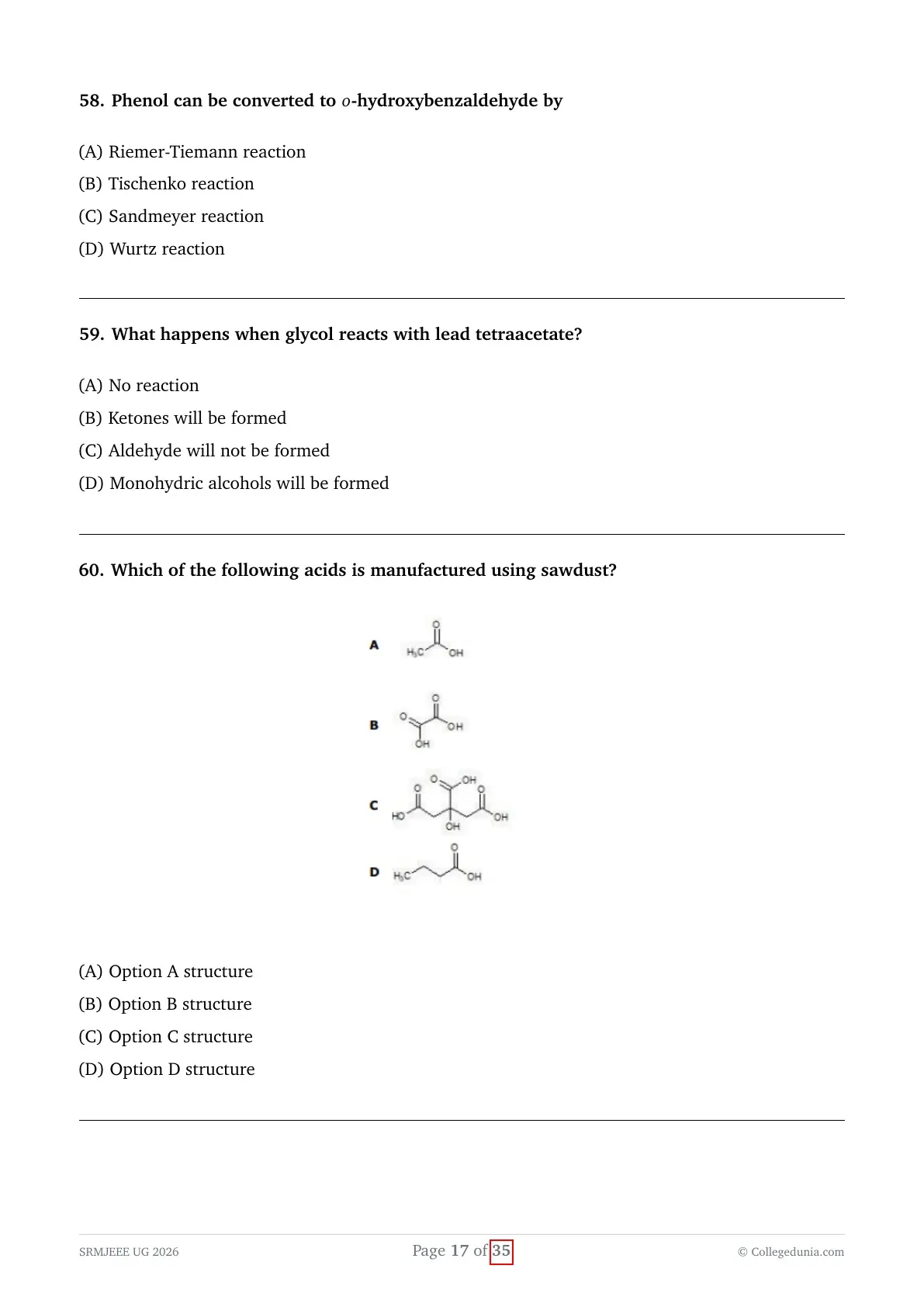
Which of the following acids is manufactured using sawdust?
(A) Option A structure
(B) Option B structure
(C) Option C structure
(D) Option D structure
Question 60:
Hydrolysis of \(CH_3CH_2NO_2\) with \(85\%\ H_2SO_4\) gives which of the following compound
(A) \(CH_3CH_2OH\)
(B) \(C_2H_6\)
(C) \(CH_3CHNO\)
(D) \(CH_3COOH\)
Question 61:
The hydrolysis of an ester \((A)\) gives an Acid \((B)\) and an Alcohol \((C)\). The acid \((B)\) reduces Fehling solution. Oxidation of the alcohol \((C)\) gives the acid \((B)\). The ester \((A)\) is
(A) Methyl formate
(B) Ethyl formate
(C) Methyl acetate
(D) Ethyl acetate
Question 62:
Which of the following statement about primary amines is false?
(A) Alkyl amines are stronger bases than aryl amines
(B) Alkyl amines react with nitrous acid to produce alcohols
(C) Aryl amines react with nitrous acid to produce phenols
(D) Alkyl amines are stronger bases than ammonia
Question 63:
Nucleic acid is a polymer of
(A) Nucleosides
(B) Amino acids
(C) Nucleotides
(D) Glucose
Question 64:
Which is not a macromolecule
(A) DNA
(B) Starch
(C) Palmitate
(D) Insulin
Question 65:
Sugars are
(A) Optically active polyhydroxy aldehydes
(B) Optically active polyhydroxy ketones
(C) Optically active polyhydroxy aldehydes or ketones
(D) Polyhydroxy aldehydes or ketones which may or may not be optically active
Question 66:
Rayon yarns are obtained from
(A) Polymethylene
(B) Polyesters
(C) Cellulose
(D) Styrene
Question 67:
Terylene is the polymer of
(A) Melamine and formaldehyde
(B) Ethylene glycol and terephthalic acid
(C) Vinyl chloride and formaldehyde
(D) Hexamethylene diamine and adipic acid
Question 68:
Condensation product of caprolactam is
(A) Nylon-6
(B) Nylon-66
(C) Nylon-60
(D) Nylon-6,10
Question 69:
An azo dye is fixed on fabrics by the process applicable in
(A) Vat dyes
(B) Mordant dyes
(C) Developed dyes
(D) Substantive dyes
Question 70:
The domain of the function \(f(x)=\sqrt{x-1}+\sqrt{6-x}\) is
(A) \([0,\infty)\)
(B) \((-\infty,6)\)
(C) \([1,6]\)
(D) None of these
Question 71:
Let \(R\) be a relation in \(N\) defined by \(R=\{(x,y): x+2y=8\}\). The range of \(R\) is
(A) \(\{2,4,6\}\)
(B) \(\{1,2,3\}\)
(C) \(\{1,2,3,4,6\}\)
(D) None of these
Question 72:
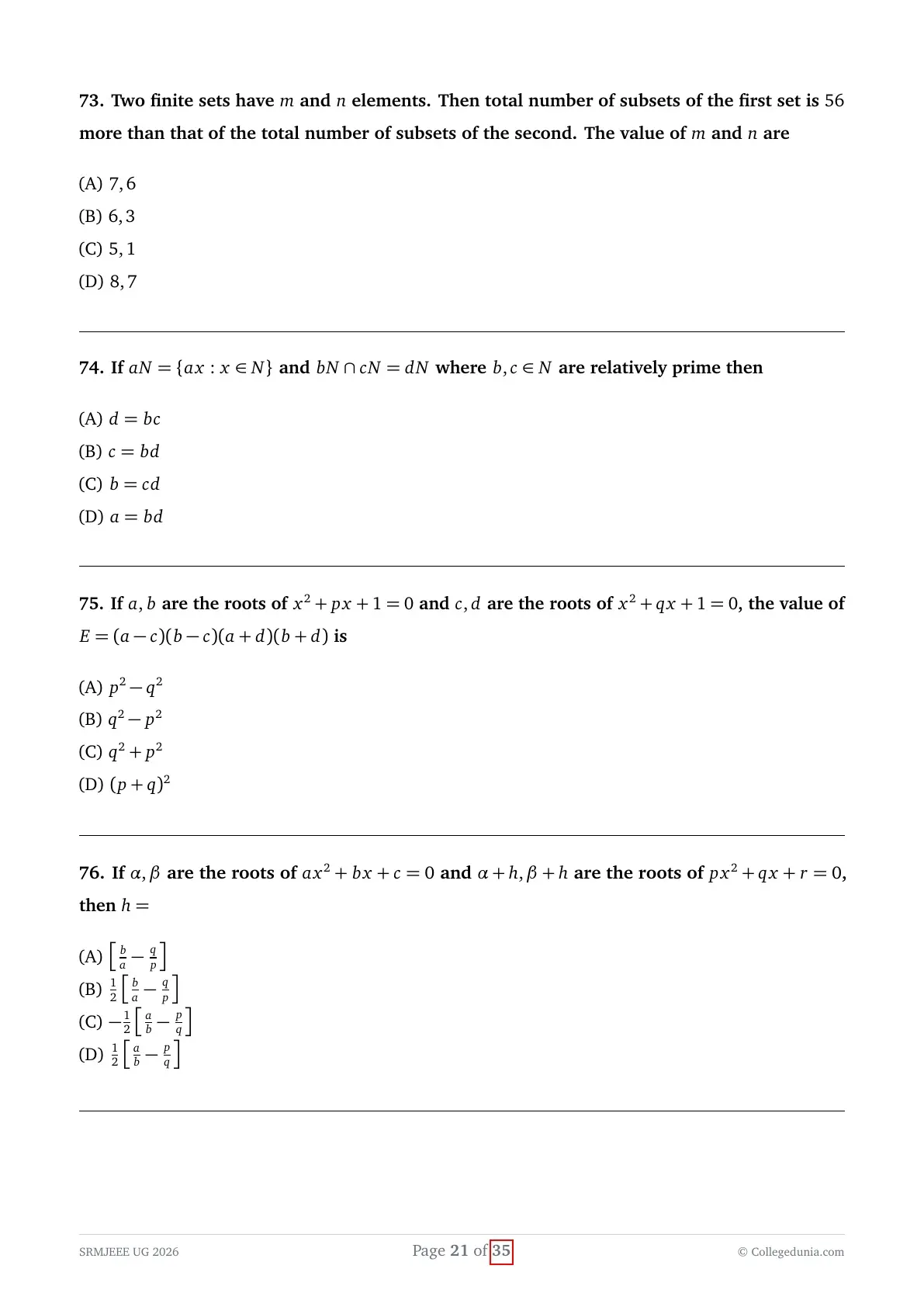
Two finite sets have \(m\) and \(n\) elements. Then total number of subsets of the first set is \(56\) more than that of the total number of subsets of the second. The value of \(m\) and \(n\) are
(A) \(7,6\)
(B) \(6,3\)
(C) \(5,1\)
(D) \(8,7\)
Question 73:
If \(aN=\{ax:x\in N\}\) and \(bN\cap cN=dN\) where \(b,c\in N\) are relatively prime then
(A) \(d=bc\)
(B) \(c=bd\)
(C) \(b=cd\)
(D) \(a=bd\)
Question 74:
If \(a,b\) are the roots of \(x^2+px+1=0\) and \(c,d\) are the roots of \(x^2+qx+1=0\), the value of \(E=(a-c)(b-c)(a+d)(b+d)\) is
(A) \(p^2-q^2\)
(B) \(q^2-p^2\)
(C) \(q^2+p^2\)
(D) \((p+q)^2\)
Question 75:
If \(\alpha,\beta\) are the roots of \(ax^2+bx+c=0\) and \(\alpha+h,\beta+h\) are the roots of \(px^2+qx+r=0\), then \(h=\)
(A) \(\left[\frac{b}{a}-\frac{q}{p}\right]\)
(B) \(\frac{1}{2}\left[\frac{b}{a}-\frac{q}{p}\right]\)
(C) \(-\frac{1}{2}\left[\frac{a}{b}-\frac{p}{q}\right]\)
(D) \(\frac{1}{2}\left[\frac{a}{b}-\frac{p}{q}\right]\)
Question 76:
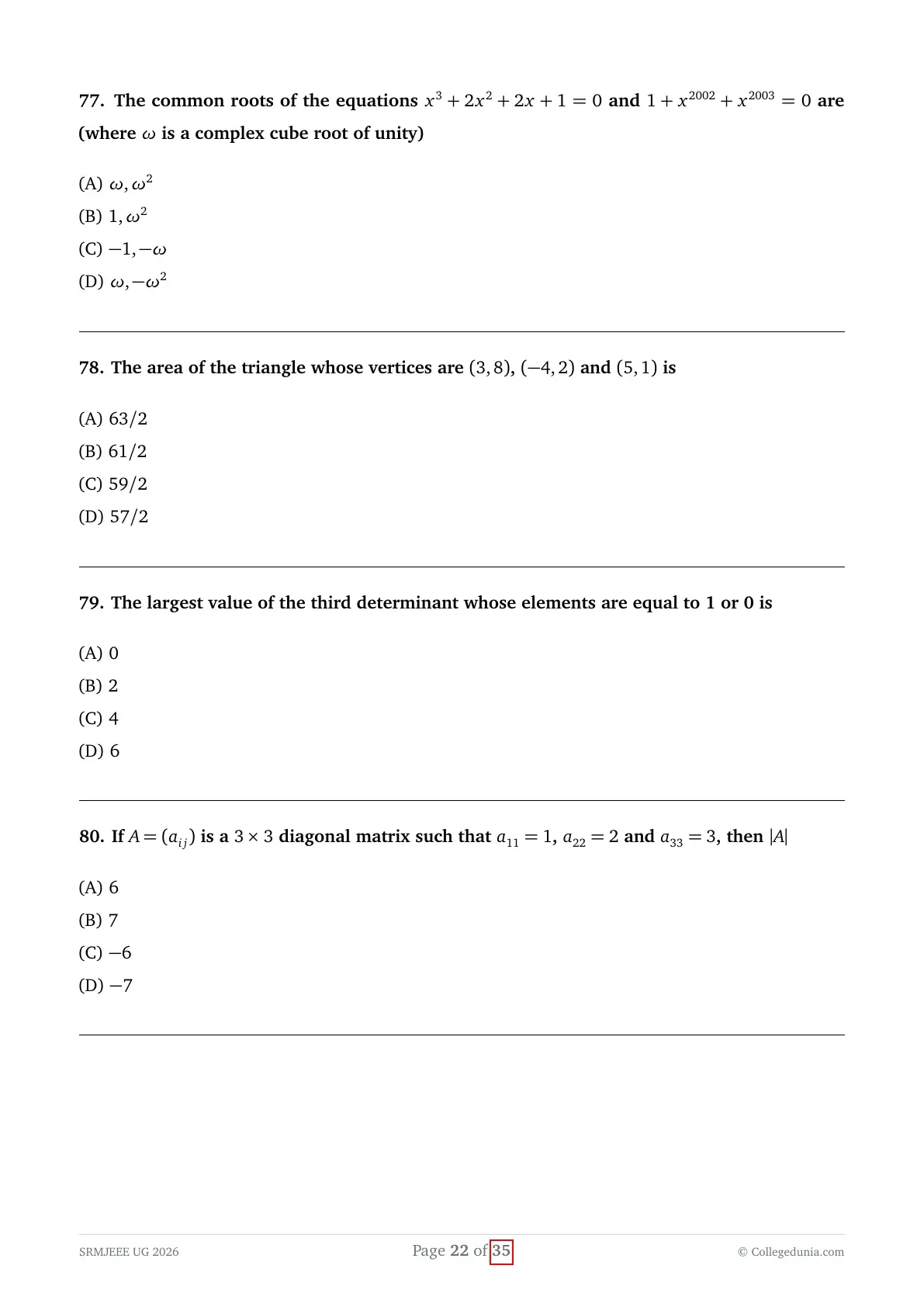
The common roots of the equations \(x^3+2x^2+2x+1=0\) and \(1+x^{2002}+x^{2003}=0\) are (where \(\omega\) is a complex cube root of unity)
(A) \(\omega,\omega^2\)
(B) \(1,\omega^2\)
(C) \(-1,-\omega\)
(D) \(\omega,-\omega^2\)
Question 77:
The area of the triangle whose vertices are \((3,8)\), \((-4,2)\) and \((5,1)\) is
(A) \(63/2\)
(B) \(61/2\)
(C) \(59/2\)
(D) \(57/2\)
Question 78:
The largest value of the third determinant whose elements are equal to 1 or 0 is
(A) \(0\)
(B) \(2\)
(C) \(4\)
(D) \(6\)
Question 79:
If \(A=(a_{ij})\) is a \(3\times 3\) diagonal matrix such that \(a_{11}=1\), \(a_{22}=2\) and \(a_{33}=3\), then \(|A|\)
(A) \(6\)
(B) \(7\)
(C) \(-6\)
(D) \(-7\)
Question 80:
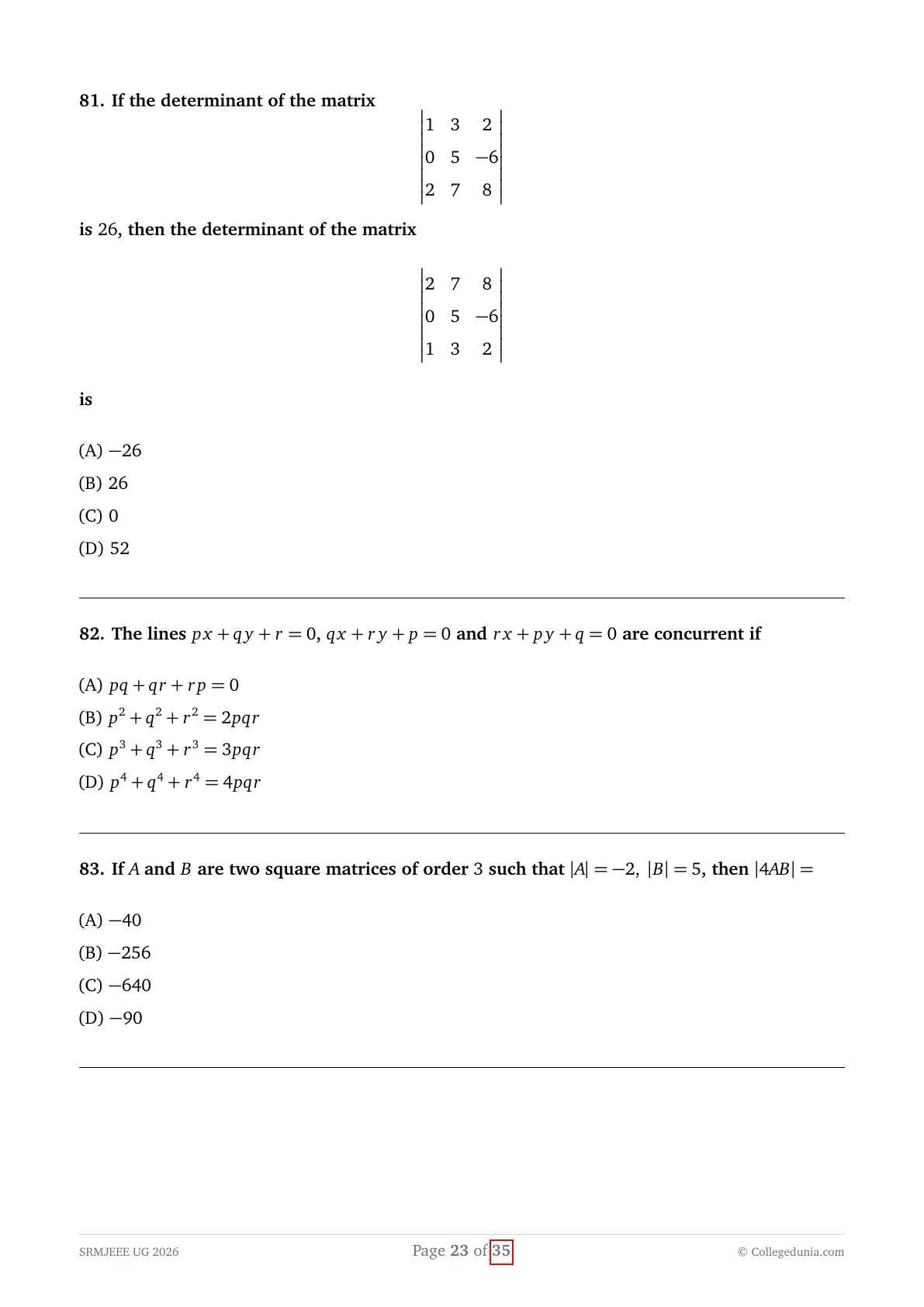
If the determinant of the matrix \[ \begin{vmatrix} 1 & 3 & 2\\ 0 & 5 & -6\\ 2 & 7 & 8 \end{vmatrix} \] is \(26\), then the determinant of the matrix \[ \begin{vmatrix} 2 & 7 & 8\\ 0 & 5 & -6\\ 1 & 3 & 2 \end{vmatrix} \] is
(A) \(-26\)
(B) \(26\)
(C) \(0\)
(D) \(52\)
Question 81:
The lines \(px+qy+r=0\), \(qx+ry+p=0\) and \(rx+py+q=0\) are concurrent if
(A) \(pq+qr+rp=0\)
(B) \(p^2+q^2+r^2=2pqr\)
(C) \(p^3+q^3+r^3=3pqr\)
(D) \(p^4+q^4+r^4=4pqr\)
Question 82:
If \(A\) and \(B\) are two square matrices of order \(3\) such that \(|A|=-2,\ |B|=5\), then \(|4AB|=\)
(A) \(-40\)
(B) \(-256\)
(C) \(-640\)
(D) \(-90\)
Question 83:
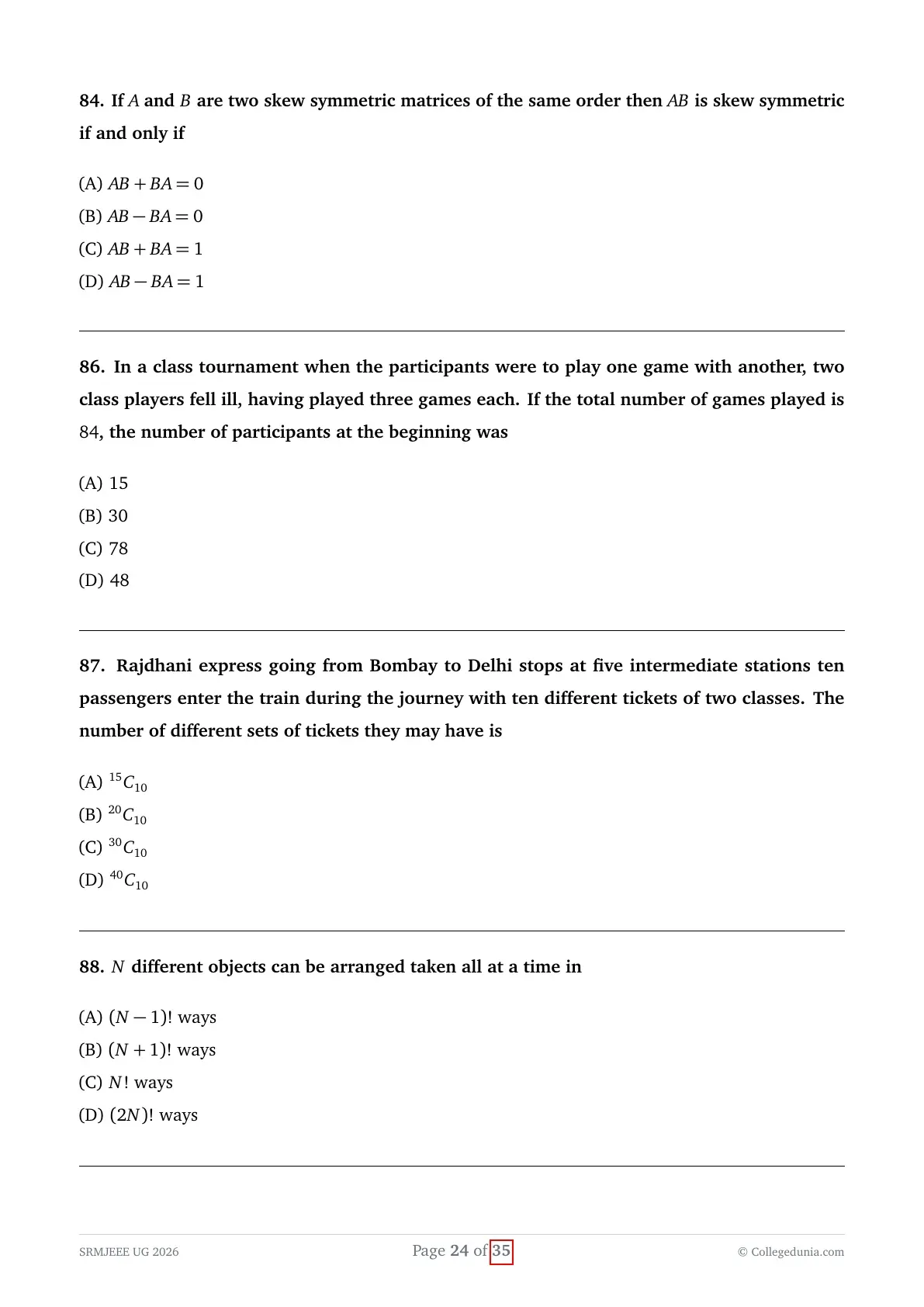
If \(A\) and \(B\) are two skew symmetric matrices of the same order then \(AB\) is skew symmetric if and only if
(A) \(AB+BA=0\)
(B) \(AB-BA=0\)
(C) \(AB+BA=1\)
(D) \(AB-BA=1\)
Question 84:
In a class tournament when the participants were to play one game with another, two class players fell ill, having played three games each. If the total number of games played is \(84\), the number of participants at the beginning was
(A) \(15\)
(B) \(30\)
(C) \(78\)
(D) \(48\)
Question 85:
Rajdhani express going from Bombay to Delhi stops at five intermediate stations ten passengers enter the train during the journey with ten different tickets of two classes. The number of different sets of tickets they may have is
(A) \({}^{15}C_{10}\)
(B) \({}^{20}C_{10}\)
(C) \({}^{30}C_{10}\)
(D) \({}^{40}C_{10}\)
Question 86:
\(N\) different objects can be arranged taken all at a time in
(A) \((N-1)!\) ways
(B) \((N+1)!\) ways
(C) \(N!\) ways
(D) \((2N)!\) ways
Question 87:
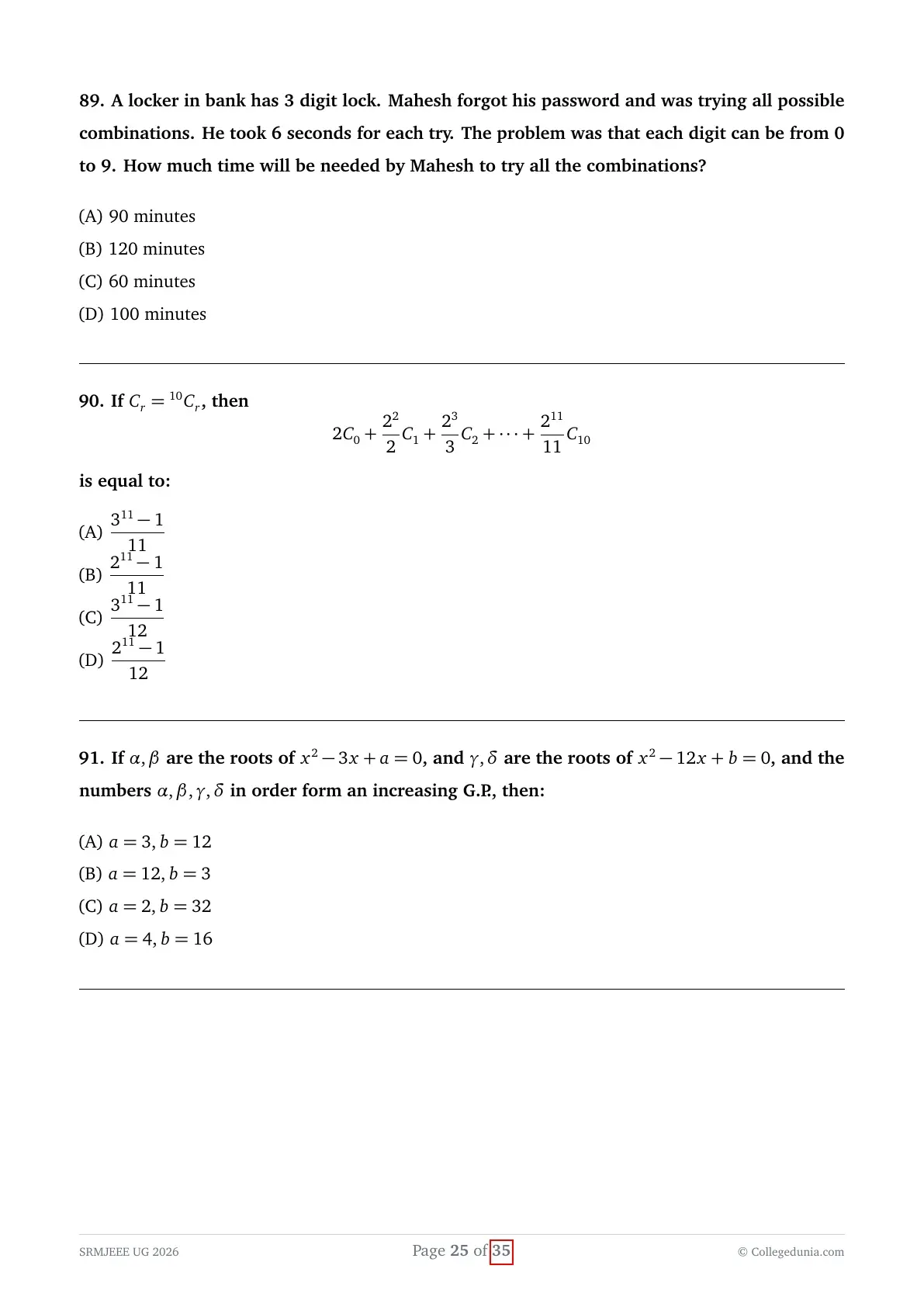
A locker in bank has 3 digit lock. Mahesh forgot his password and was trying all possible combinations. He took 6 seconds for each try. The problem was that each digit can be from 0 to 9. How much time will be needed by Mahesh to try all the combinations?
(A) \(90\) minutes
(B) \(120\) minutes
(C) \(60\) minutes
(D) \(100\) minutes
Question 88:
If \(C_r={}^{10}C_r\), then \[ 2C_0+\frac{2^2}{2}C_1+\frac{2^3}{3}C_2+\cdots+\frac{2^{11}}{11}C_{10} \] is equal to:
(A) \(\dfrac{3^{11}-1}{11}\)
(B) \(\dfrac{2^{11}-1}{11}\)
(C) \(\dfrac{3^{11}-1}{12}\)
(D) \(\dfrac{2^{11}-1}{12}\)
Question 89:
If \(\alpha,\beta\) are the roots of \(x^2-3x+a=0\), and \(\gamma,\delta\) are the roots of \(x^2-12x+b=0\), and the numbers \(\alpha,\beta,\gamma,\delta\) in order form an increasing G.P., then:
(A) \(a=3,b=12\)
(B) \(a=12,b=3\)
(C) \(a=2,b=32\)
(D) \(a=4,b=16\)
Question 90:
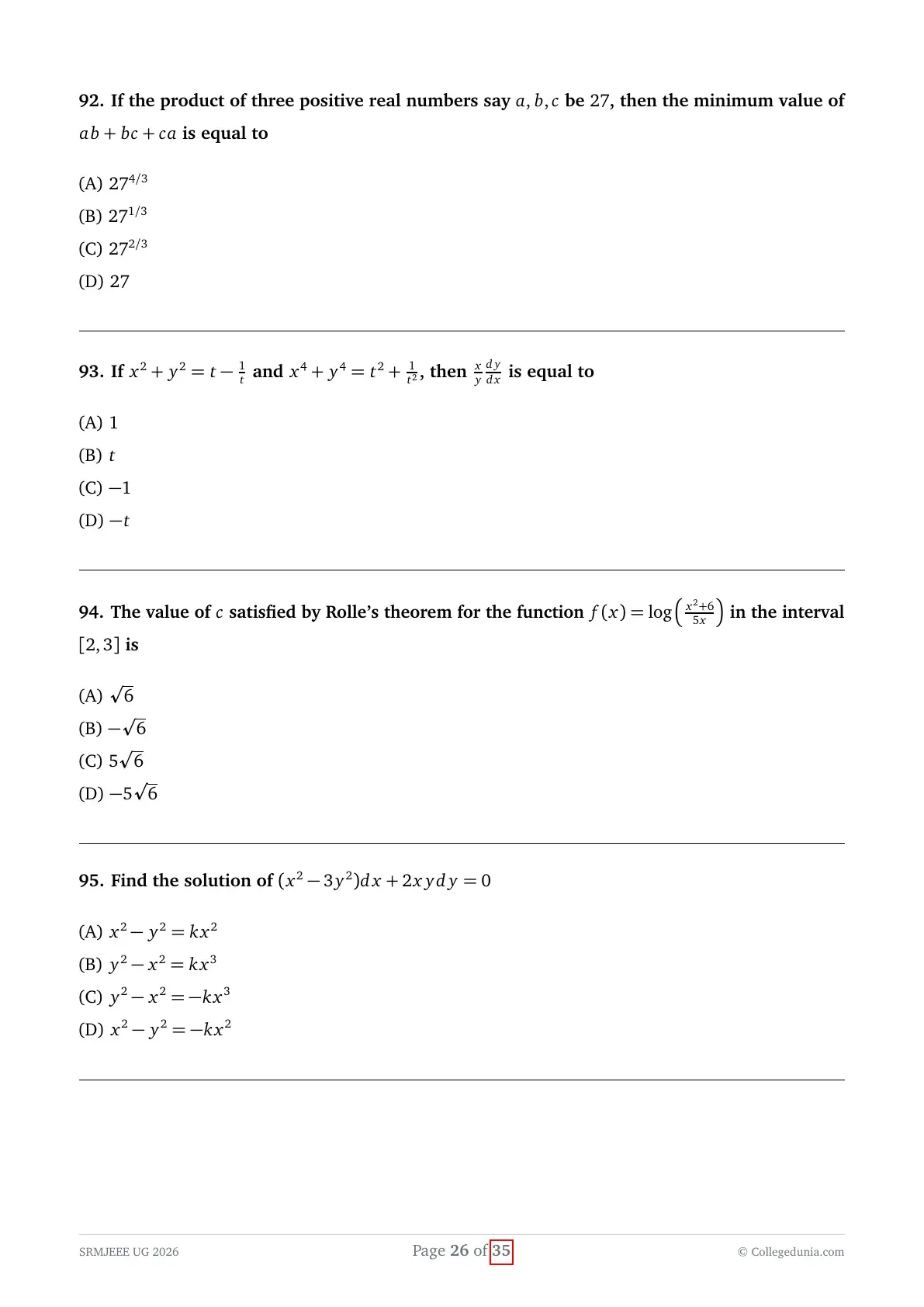
If the product of three positive real numbers say \(a,b,c\) be \(27\), then the minimum value of \(ab+bc+ca\) is equal to
(A) \(27^{4/3}\)
(B) \(27^{1/3}\)
(C) \(27^{2/3}\)
(D) \(27\)
Question 91:
If \(x^2+y^2=t-\frac{1}{t}\) and \(x^4+y^4=t^2+\frac{1}{t^2}\), then \(\frac{x}{y}\frac{dy}{dx}\) is equal to
(A) \(1\)
(B) \(t\)
(C) \(-1\)
(D) \(-t\)
Question 92:
The value of \(c\) satisfied by Rolle’s theorem for the function \(f(x)=\log\left(\frac{x^2+6}{5x}\right)\) in the interval \([2,3]\) is
(A) \(\sqrt{6}\)
(B) \(-\sqrt{6}\)
(C) \(5\sqrt{6}\)
(D) \(-5\sqrt{6}\)
Question 93:
Find the solution of \((x^2-3y^2)dx+2xydy=0\)
(A) \(x^2-y^2=kx^2\)
(B) \(y^2-x^2=kx^3\)
(C) \(y^2-x^2=-kx^3\)
(D) \(x^2-y^2=-kx^2\)
Question 94:
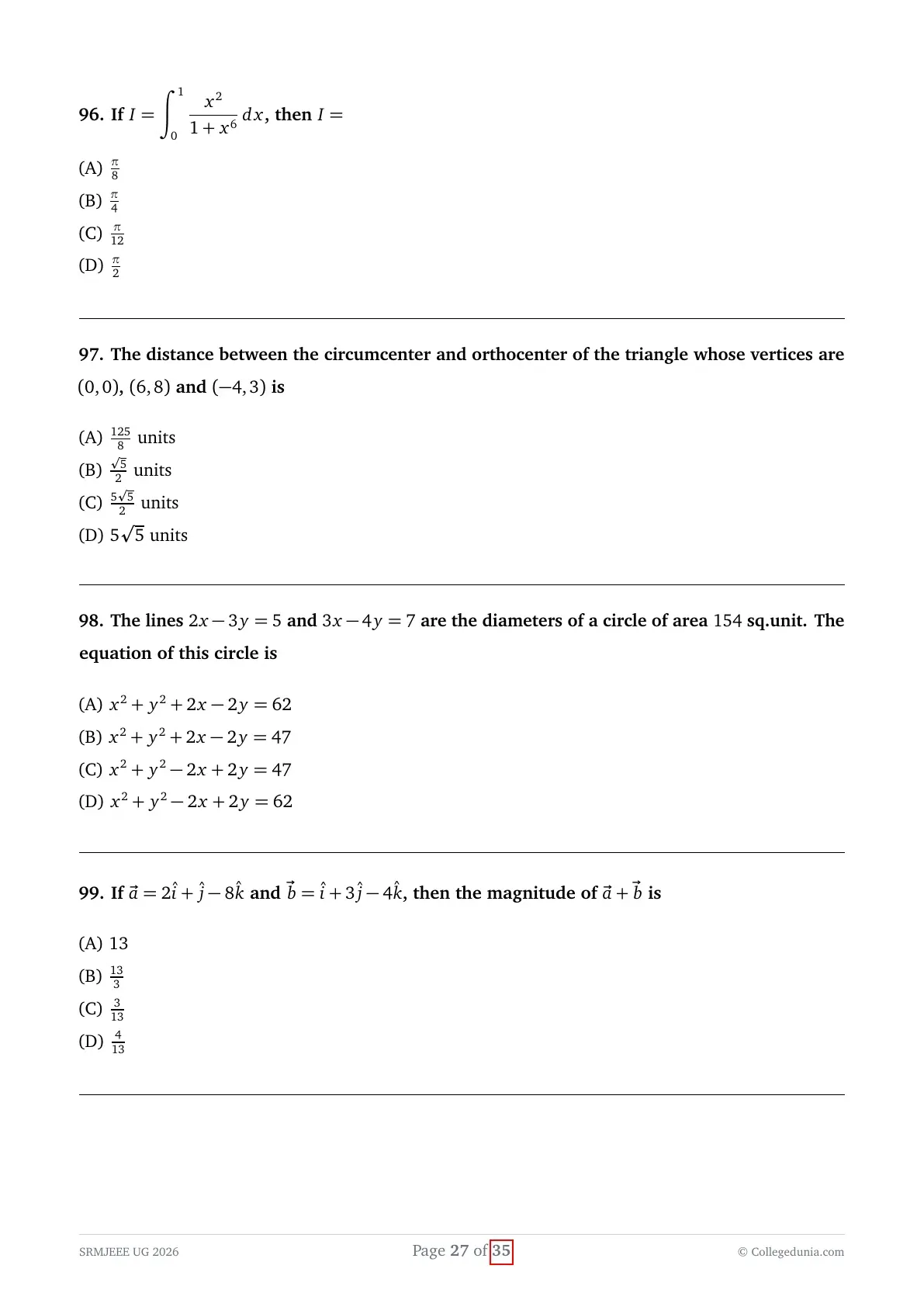
If \(I=\displaystyle\int_0^1 \frac{x^2}{1+x^6}\,dx\), then \(I=\)
(A) \(\frac{\pi}{8}\)
(B) \(\frac{\pi}{4}\)
(C) \(\frac{\pi}{12}\)
(D) \(\frac{\pi}{2}\)
Question 95:
The distance between the circumcenter and orthocenter of the triangle whose vertices are \((0,0)\), \((6,8)\) and \((-4,3)\) is
(A) \(\frac{125}{8}\) units
(B) \(\frac{\sqrt5}{2}\) units
(C) \(\frac{5\sqrt5}{2}\) units
(D) \(5\sqrt5\) units
Question 96:
The lines \(2x-3y=5\) and \(3x-4y=7\) are the diameters of a circle of area \(154\) sq.unit. The equation of this circle is
(A) \(x^2+y^2+2x-2y=62\)
(B) \(x^2+y^2+2x-2y=47\)
(C) \(x^2+y^2-2x+2y=47\)
(D) \(x^2+y^2-2x+2y=62\)
Question 97:
If \(\vec{a}=2\hat{i}+\hat{j}-8\hat{k}\) and \(\vec{b}=\hat{i}+3\hat{j}-4\hat{k}\), then the magnitude of \(\vec{a}+\vec{b}\) is
(A) \(13\)
(B) \(\frac{13}{3}\)
(C) \(\frac{3}{13}\)
(D) \(\frac{4}{13}\)
Question 98:
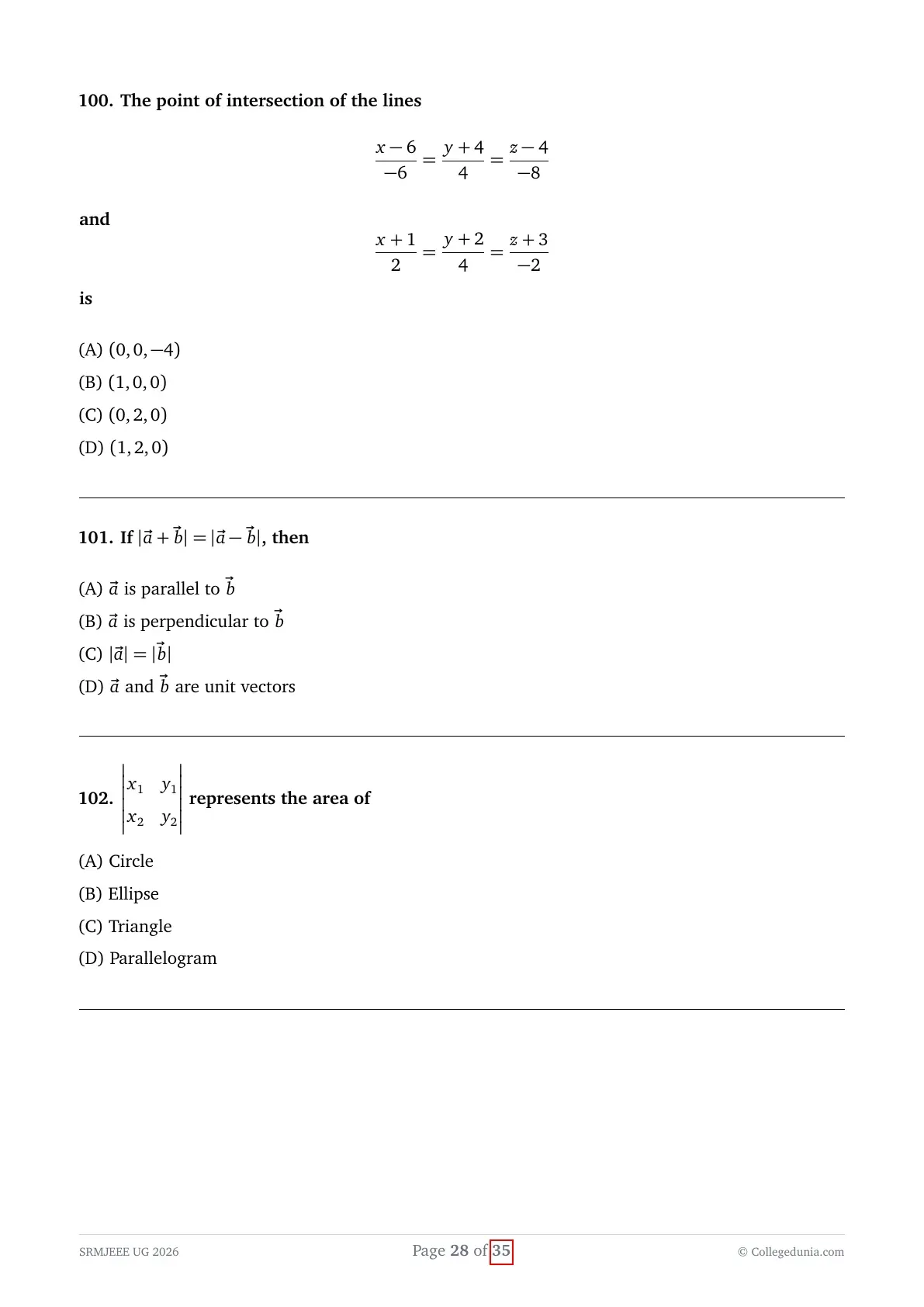
The point of intersection of the lines \[ \frac{x-6}{-6}=\frac{y+4}{4}=\frac{z-4}{-8} \] and \[ \frac{x+1}{2}=\frac{y+2}{4}=\frac{z+3}{-2} \] is
(A) \((0,0,-4)\)
(B) \((1,0,0)\)
(C) \((0,2,0)\)
(D) \((1,2,0)\)
Question 99:
If \(|\vec{a}+\vec{b}|=|\vec{a}-\vec{b}|\), then
(A) \(\vec{a}\) is parallel to \(\vec{b}\)
(B) \(\vec{a}\) is perpendicular to \(\vec{b}\)
(C) \(|\vec{a}|=|\vec{b}|\)
(D) \(\vec{a}\) and \(\vec{b}\) are unit vectors
Question 100:
\(\left|\begin{matrix}x_1 & y_1\\ x_2 & y_2\end{matrix}\right|\) represents the area of
(A) Circle
(B) Ellipse
(C) Triangle
(D) Parallelogram
Question 101:
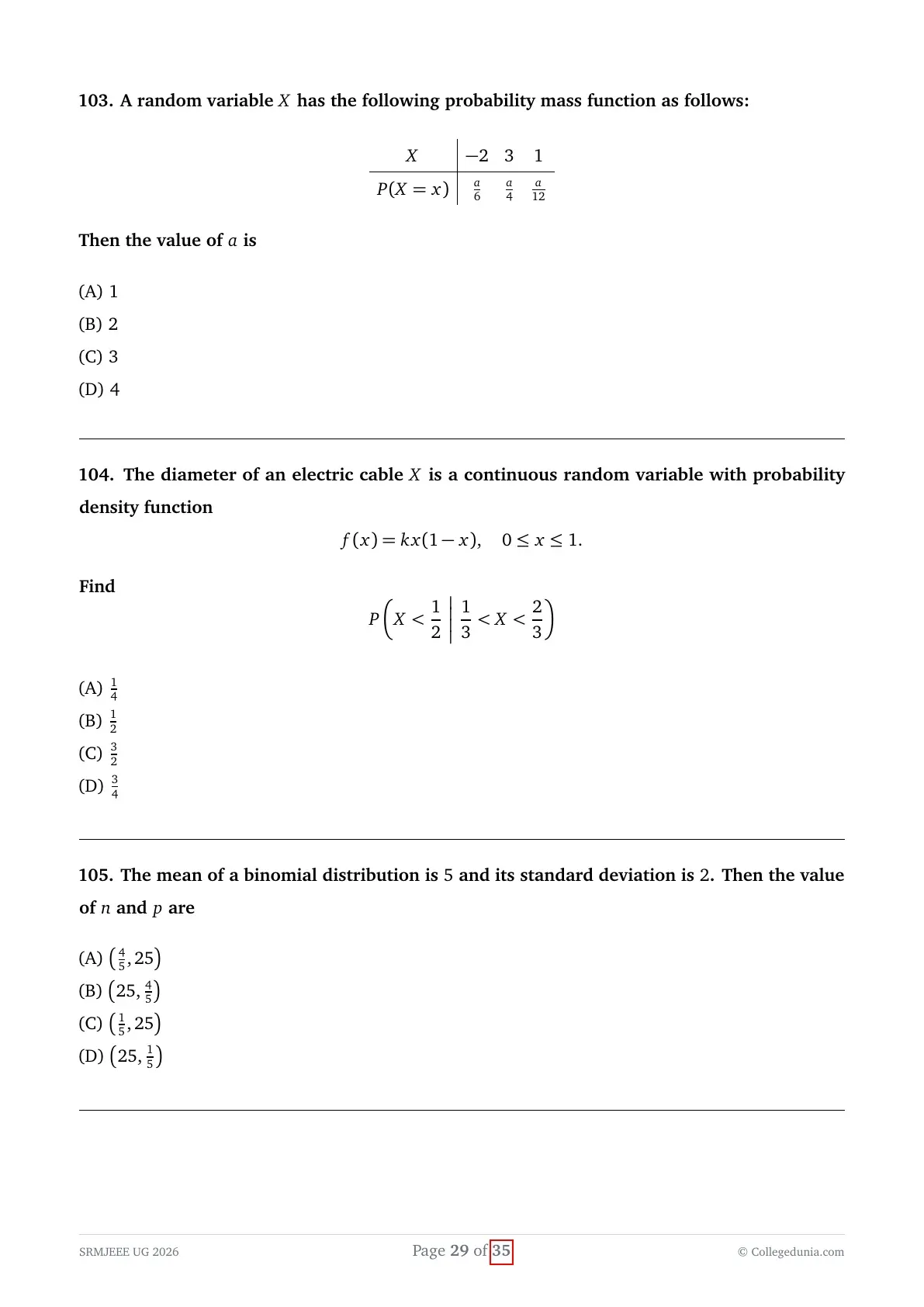
A random variable \(X\) has the following probability mass function as follows: \[ \begin{array}{c|ccc} X & -2 & 3 & 1 \\ \hline P(X=x) & \frac{a}{6} & \frac{a}{4} & \frac{a}{12} \end{array} \] Then the value of \(a\) is
(A) \(1\)
(B) \(2\)
(C) \(3\)
(D) \(4\)
Question 102:
The diameter of an electric cable \(X\) is a continuous random variable with probability density function \[ f(x)=kx(1-x),\quad 0\leq x\leq 1. \] Find \[ P\left(X<\frac{1}{2}\ \middle|\ \frac{1}{3}<X<\frac{2}{3}\right) \]
(A) \(\frac{1}{4}\)
(B) \(\frac{1}{2}\)
(C) \(\frac{3}{2}\)
(D) \(\frac{3}{4}\)
Question 103:
The mean of a binomial distribution is \(5\) and its standard deviation is \(2\). Then the value of \(n\) and \(p\) are
(A) \(\left(\frac{4}{5},25\right)\)
(B) \(\left(25,\frac{4}{5}\right)\)
(C) \(\left(\frac{1}{5},25\right)\)
(D) \(\left(25,\frac{1}{5}\right)\)
Question 104:
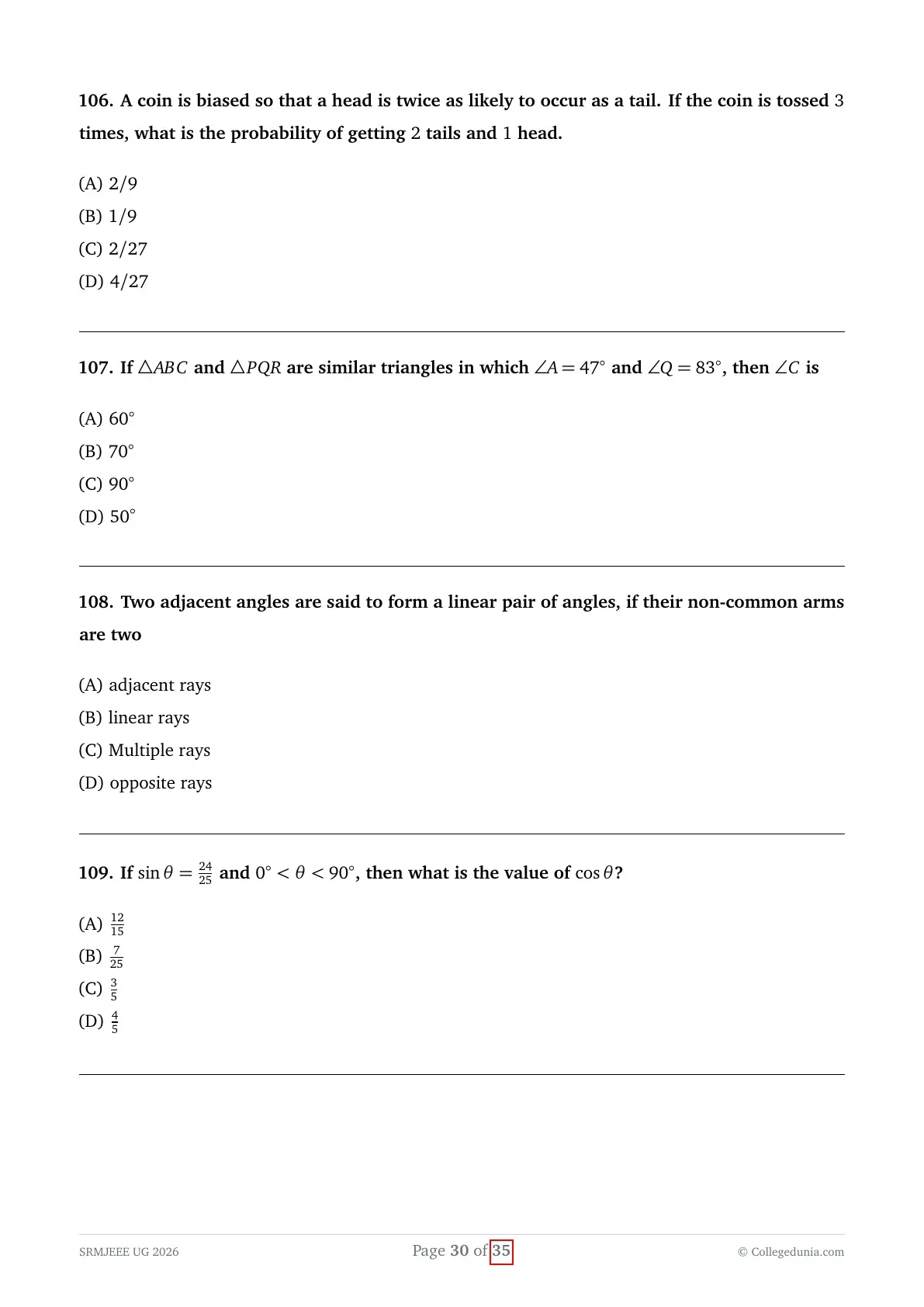
A coin is biased so that a head is twice as likely to occur as a tail. If the coin is tossed \(3\) times, what is the probability of getting \(2\) tails and \(1\) head.
(A) \(2/9\)
(B) \(1/9\)
(C) \(2/27\)
(D) \(4/27\)
Question 105:
If \(\triangle ABC\) and \(\triangle PQR\) are similar triangles in which \(\angle A=47^\circ\) and \(\angle Q=83^\circ\), then \(\angle C\) is
(A) \(60^\circ\)
(B) \(70^\circ\)
(C) \(90^\circ\)
(D) \(50^\circ\)
Question 106:
Two adjacent angles are said to form a linear pair of angles, if their non-common arms are two
(A) adjacent rays
(B) linear rays
(C) Multiple rays
(D) opposite rays
Question 107:
If \(\sin\theta=\frac{24}{25}\) and \(0^\circ<\theta<90^\circ\), then what is the value of \(\cos\theta\)?
(A) \(\frac{12}{15}\)
(B) \(\frac{7}{25}\)
(C) \(\frac{3}{5}\)
(D) \(\frac{4}{5}\)
Question 108:
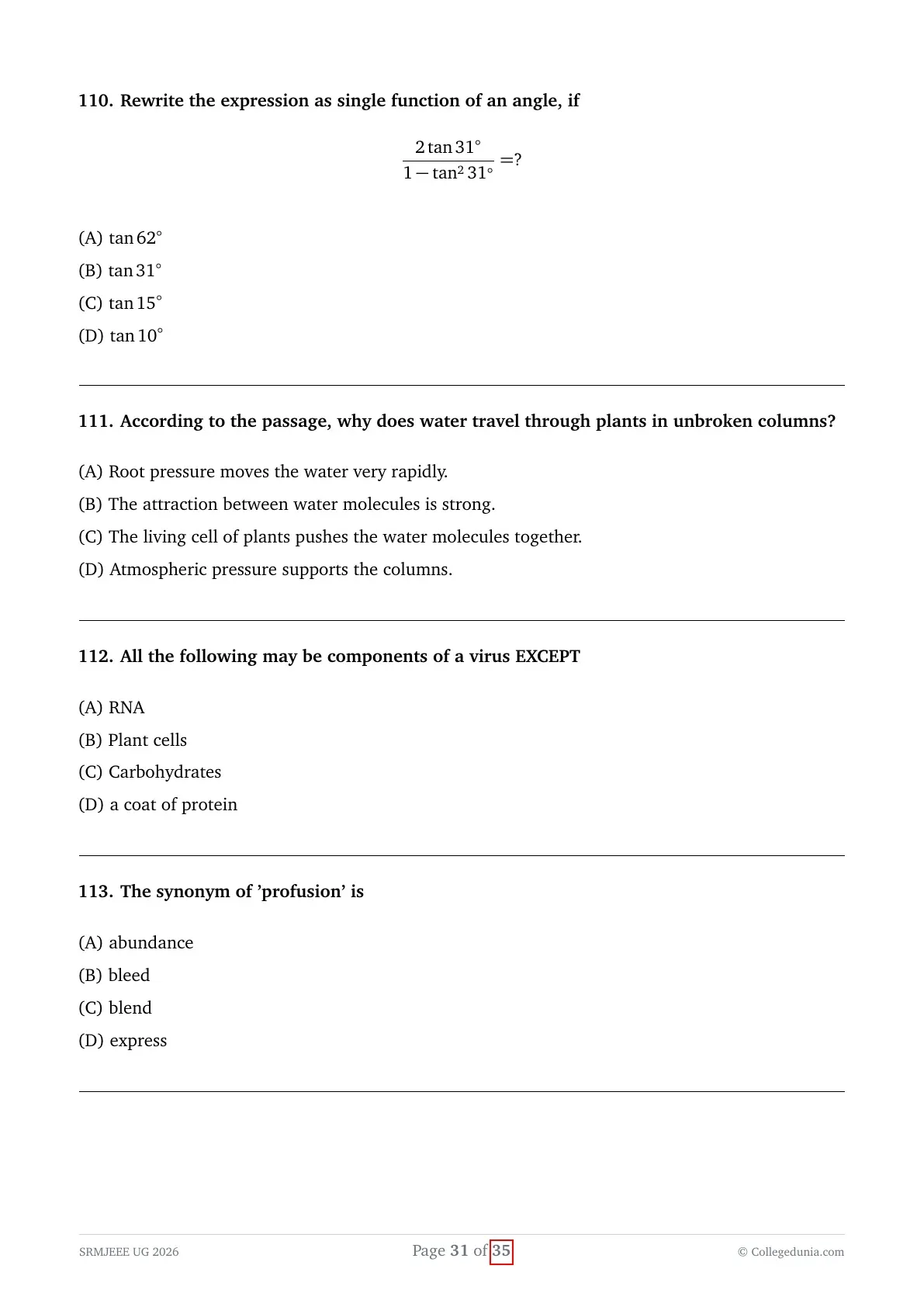
Rewrite the expression as single function of an angle, if \[ \frac{2\tan31^\circ}{1-\tan^2 31^\circ}=? \]
(A) \(\tan62^\circ\)
(B) \(\tan31^\circ\)
(C) \(\tan15^\circ\)
(D) \(\tan10^\circ\)
Question 109:
According to the passage, why does water travel through plants in unbroken columns?
(A) Root pressure moves the water very rapidly.
(B) The attraction between water molecules is strong.
(C) The living cell of plants pushes the water molecules together.
(D) Atmospheric pressure supports the columns.
Question 110:
All the following may be components of a virus EXCEPT
(A) RNA
(B) Plant cells
(C) Carbohydrates
(D) a coat of protein
Question 111:
The synonym of ’profusion’ is
(A) abundance
(B) bleed
(C) blend
(D) express
Question 112:
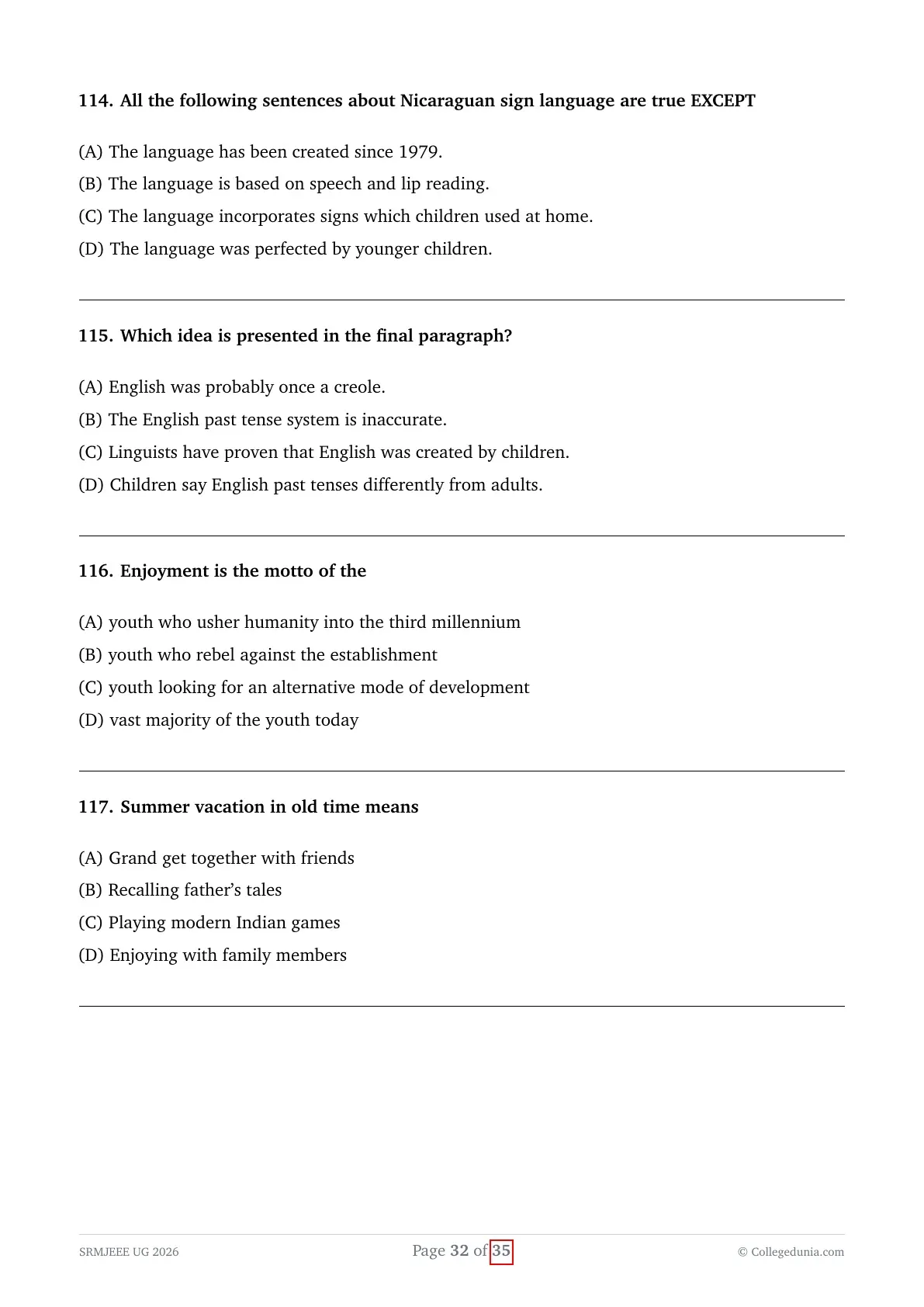
All the following sentences about Nicaraguan sign language are true EXCEPT
(A) The language has been created since 1979.
(B) The language is based on speech and lip reading.
(C) The language incorporates signs which children used at home.
(D) The language was perfected by younger children.
Question 113:
Which idea is presented in the final paragraph?
(A) English was probably once a creole.
(B) The English past tense system is inaccurate.
(C) Linguists have proven that English was created by children.
(D) Children say English past tenses differently from adults.
Question 114:
Enjoyment is the motto of the
(A) youth who usher humanity into the third millennium
(B) youth who rebel against the establishment
(C) youth looking for an alternative mode of development
(D) vast majority of the youth today
Question 115:
Summer vacation in old time means
(A) Grand get together with friends
(B) Recalling father’s tales
(C) Playing modern Indian games
(D) Enjoying with family members
Question 116:
What does "a good conversationalist" refer to?
(A) sympathetic communicator
(B) efficient communicator
(C) who reads others emotion and talk accordingly
(D) who can talk pleasantly to ameliorate the situation
Question 117:
In the given passage who considers Interviews to be immoral?
(A) V.S. Naipaul
(B) Rudyard Kipling
(C) Mark Twain
(D) Rudyard Kipling and Mark Twain
Question 118:
According to the author, what is the benefit of public reasoning or argumentation?
(A) It produces a rich and dynamic democracy.
(B) It creates chaos and public disagreements that make governing difficult.
(C) It allowed the British to divide and rule Indians.
(D) By promoting arguments and discord it hurts the cause of secularism.
Question 119:
The author is making a comparison between
(A) Science-fiction and Epics
(B) Science fiction and non-fiction
(C) Science-Fiction and Romance
(D) Pulp Fiction and Epics
Question 120:
Based on the given passage which of the following statements is true
(A) Human beings are awfully close to their material possessions
(B) Civilizations are built through great efforts.
(C) One must always try to acquire better things.
(D) Human existence is casual and haphazard.
Question 121:
The word ’cavalier’ as used in the passage means all of the following except
(A) Haughty
(B) Rash
(C) Prudent
(D) Frenetic
Question 122:
The expression \(x^2-x+1=0\) has
(A) One proper linear factor
(B) Two proper linear factors
(C) No proper linear factor
(D) Cannot be determined
Question 123:
If ’+’ means ’divided by’, ’-’ means ’add’, ’ ’ means ’minus’ and ’/’ means ’multiplied by’, what will be the value of the following expression?
(A) infinite
(B) \(0\)
(C) \(118\)
(D) \(219\)
Question 124:
Starting from a Point ’M’ Harish walked \(18\) m towards South. He turned to his left and walked \(5\)m. He then turned to his left and walked \(18\) m. He again turned to his left and walked \(35\) m and reached a point ’P’. How far is Harish from the point ’M’ and in which direction?
(A) \(10\) m East
(B) \(10\) m South
(C) \(10\) m West
(D) None of these
Question 125:
\((1+\tan A+\sec A)(1+\sec A-\tan A)-2\sec A=\)
(A) \(0\)
(B) \(-2\)
(C) \(1\)
(D) \(2\)








Comments