TS PGECET 2026 Architecture and Planning (AR) Question Paper is available for download here. JNTU Hyderabad on behalf of Telangana Council of Higher Education (TGCHE) conducted TS PGECET 2026 AR exam on May 30 in Shift 2 from 2 PM to 4 PM. TS PGECET AR Question Paper consists of 120 questions for 120 marks to be attempted in 2 hours.
- TS PGECET AR Question Paper 2026 is divided into 2 sections- Engineering Mathematics with 10 questions and Architecture and Planning domain with 110 questions.
- Each questions carries 1 mark each and there is no negative marking for incorrect answers.
Candidates can download TS PGECET 2026 AR Question Paper with Answer Key and Solution PDF from links provided below.
TS PGECET 2026 AR Question Paper with Solution PDF
Question 1:
Which of the following statements is false?
- (A) Cities first evolved in Mesopotamia and other civilisations followed this city building practice later
- (B) The first cities evolved because of transition from hunting and gathering to agricultural food production
- (C) One of the first regions in which cities evolved was Indus Valley
- (D) Rome was one of the first large cities with good roads, piped water, sewerage systems and grand public buildings
Question 2:
Which of the following is not an essential component or principle of contemporary city-planning?
- (A) Accessibility and mobility
- (B) Low-density residential areas
- (C) Sustainable and eco-friendly approach
- (D) Land use planning and zoning
Question 3:
The Central Place theory was first presented by:
- (A) C A Doxiadis
- (B) Ebenezer Howard
- (C) Patrick Geddes
- (D) Walter Christaller
Question 4:
In which category of the roads, parking can be least restricted?
- (A) Arterial Roads
- (B) Sub-arterial Roads
- (C) Local and Access streets
- (D) Collector Streets
Question 5:
Which of the following is not an example of SEZ City in India?
- (A) Sri City
- (B) Kandla
- (C) Bhopal
- (D) Noida
Question 6:
The growth rate of urbanization in India has
- (A) Been growing exponentially in the last decade
- (B) Decreased drastically in the last decade
- (C) Slightly increased in the last few years
- (D) Slightly decreased in the last few years
Question 7:
The example for an eco-city in India is
- (A) Gurgaon
- (B) Mysore
- (C) Hyderabad
- (D) Shillong
Question 8:
Inclusive planning is a planning approach that
- (A) Considers all the land under the control of the planning authority and there is no left-over land without a designated use
- (B) Considers all users with various types of needs
- (C) Includes all stakeholders involved in the planning process
- (D) Includes needs of people of all age groups
Question 9:
Which of the following is not a component of disaster resilient urban planning?
- (A) Designing buildings and infrastructure that can withstand disasters and can be restored to service as early as possible
- (B) Appropriate land-use planning and zoning
- (C) Early warning systems
- (D) Neighbourhood watch systems
Question 10:
An important component to achieve better outcome in Slum improvement projects is
- (A) Construction of multistoried tenements
- (B) Sites and Services Schemes
- (C) Security of tenure
- (D) Full subsidy for beneficiaries
Question 11:
Currently in India, government elementary schools exclusively for the neighbourhood children are provided in
- (A) Only traditional type of old neighbourhoods
- (B) High rise gated communities
- (C) All types of gated communities
- (D) Standard planned residential sectors and layouts
Question 12:
Which of the following statements about urban density is true in the current scenario?
- (A) It needs to be controlled and kept to a minimum to benefit the residents
- (B) Compact cities with lower sprawl can be encouraged
- (C) It needs to be kept as high as possible with only tall residential towers being permitted
- (D) In India it is very low compared to other cities of the world
Question 13:
Typically, in contemporary Indian cities, multi-storeyed residential buildings can be seen in
- (A) Inner city areas only
- (B) Peripheral areas
- (C) Any part of the cities
- (D) Very large gated communities only
Question 14:
The most appropriate definition of the term informal housing is
- (A) Squatter settlements where the residents do not have any title to the land
- (B) Illegal land tenure where the properties have not been registered
- (C) Shanty settlements of substandard quality
- (D) Any settlement, including buildings of good construction quality, built outside the formal regulatory framework of planning and building controls
Question 15:
In the context of CAD and BIM use in AEC (Architecture, Engineering, and Construction) education, which pedagogical progression is identified as beneficial for Architecture students?
- (A) Beginning with rendering tools, then moving to hand drafting
- (B) Teaching scripting before any visual modelling
- (C) Introducing BIM modelling early, followed by discipline specific modules and collaborative projects
- (D) Restricting first-year students only to 2D CAD
Question 16:
The percentage of households with access to a principal source of drinking water within the dwelling in India, as per official statistics, is approximately:
- (A) \(27%\) in rural areas and \(56%\) in urban areas
- (B) \(56%\) in rural areas and \(27%\) in urban areas
- (C) \(50%\) average across the country considering both rural and urban areas
- (D) \(55%\) average across the country considering both rural and urban areas
Question 17:
The acronym for the affordable housing programme of the Central Government in India is:
- (A) PMAY
- (B) AMRUT
- (C) HRIDAY
- (D) PM-SVANidhi
Question 18:
What type of initiative has been taken by the Real Estate Regulatory Authority (RERA) in the affordable housing sector?
- (A) There is no role of RERA in affordable housing sector
- (B) It permits only qualified property developers to take up affordable housing projects
- (C) It mandates certain measures to improve transparency and accountability
- (D) It is responsible for project and financial management of all affordable projects taken up by private builders
Question 19:
Which of the following is true about bamboo used in buildings?
- (A) It cannot be used for structural components such as beams and trusses
- (B) It has very low tensile strength
- (C) It is not as long lasting as timber
- (D) It cannot be combined with steel reinforcement
Question 20:
The various National Housing Policies of India have focused mostly on:
- (A) On reduction of densities in urban areas
- (B) On regulatory frameworks and finance management
- (C) Have focused mostly on urban sector
- (D) Have focused on both the rural and urban sectors
Question 21:
For a farm house built in an area with old, large and beautiful trees existing in the site, what is broadly the best approach for choosing further appropriate planting to maintain a better sense of scale?
- (A) Choose large trees throughout to maintain the same scale and ambience
- (B) Choose smaller shrubs close to the house and larger ones further away from the house
- (C) Choose small shrubs throughout to reduce to human scale
- (D) Choose large trees close to the house and smaller shrubs further away from the house
Question 22:
Which of the following is not usually required in the site analysis process for a commercial complex in a central city location?
- (A) Visual corridors and visual analysis
- (B) Contours and slope analysis
- (C) Climate and weather data
- (D) Socio-economic profiling of local residents
Question 23:
Which of these historical landscape styles featured naturalistic forms and undulating topography?
- (A) English
- (B) Mughal
- (C) French
- (D) Japanese
Question 24:
While choosing a plant species for outdoor planting, the most important visual consideration is:
- (A) Size and form of the plant
- (B) Colour and texture of foliage
- (C) Colour and size of flowers
- (D) How much maintenance is required
Question 25:
For the design of a very large green lung space in a city in India, the most appropriate approach for selection of plant species is:
- (A) Choosing beautiful flowering plants to cater to public aesthetic tastes
- (B) Choosing mostly one or two sturdy native plant species that are easy to maintain
- (C) Choosing a mix of various local plants to create a biodiversity rich environment
- (D) Using mostly drought-resistant plants to optimize water management
Question 26:
Which part of the computer performs the function of executing the operations of a computer programme?
- (A) Hard Disk
- (B) RAM
- (C) CPU
- (D) Motherboard
Question 27:
Which of the following is used to create images using mathematical formulae for lines and shapes?
- (A) Pixel mapping
- (B) Raster graphics
- (C) Vector Graphics
- (D) Voxel rendering
Question 28:
Which of the following is true about Visual Basic and C?
- (A) Both are object-oriented languages
- (B) Both are low-level, general-purpose languages
- (C) Visual Basic is an object-oriented language
- (D) C is a low-level, object-oriented language
Question 29:
Rhino is especially popular for:
- (A) 2D drafting
- (B) Analysis for Geographical Information Systems
- (C) Simplifying building quantity, estimating and costing
- (D) Complex free-form and parametric modeling
Question 30:
Which statement is not true about 3ds Max?
- (A) It is used extensively only for architectural visualization
- (B) It can be used to create realistic visualization of building projects
- (C) Furniture, lighting and other details can be added to scenes
- (D) It supports related plugins for better rendering in building projects
Question 31:
Which of the following is fundamental in the functioning of the ecosystem as a complete unit?
- (A) Energy flow
- (B) Nutrient cycle
- (C) Decomposition
- (D) Productivity
Question 32:
The concept of niche in the ecosystem refers to which of the following?
- (A) The physical place where a species lives
- (B) The role of a species in an ecosystem in the nutrient cycle
- (C) The total number of individuals of a species
- (D) The geographic distribution of a species
Question 33:
The chemical method for treatment of water pollution is:
- (A) Activated sludge
- (B) Sedimentation
- (C) Coagulation
- (D) Reverse osmosis
Question 34:
The correct statement regarding sun breakers in India is:
- (A) Horizontal sun breakers are considered most effective on South facades
- (B) Vertical sun breakers are considered most effective on South facades
- (C) Horizontal sun breakers are considered most effective on East and West facades
- (D) Sun breakers are not required in Indian context
Question 35:
The correct statement about Green Building rating systems is:
- (A) LEED and GRIHA use identical criteria for evaluation
- (B) LEED is the only rating system recognized globally
- (C) GRIHA focuses more on life cycle impacts and includes vernacular materials
- (D) Rating systems are mandatory for all construction projects in India
Question 36:
The bioclimatic chart:
- (A) Only shows the relation between rainfall and temperature
- (B) Is used to predict extreme weather events
- (C) Is irrelevant for building design considerations
- (D) Indicates comfort zone and can also be used to indicate corrective measures
Question 37:
While planning for acoustics in an auditorium, sound diffusers are mainly used:
- (A) To reflect sound in various directions and maintain a natural ambience
- (B) To absorb all low-frequency sounds completely
- (C) To amplify the sound signal electronically
- (D) To create localized echo points intentionally
Question 38:
In which of the following simulation, software is not usually used for analysing natural lighting and ventilation?
- (A) Cool Vent
- (B) DesignBuilder
- (C) IES Virtual Environment
- (D) Ladybug
Question 39:
For a large-scale utility to be used \(24 \times 7\), which choice of solar energy is preferable?
- (A) Solar Photovoltaic cells with lead-acid batteries
- (B) Rooftop Solar panels
- (C) Concentrated Solar Power
- (D) Floating Solar farms
Question 40:
Which of these is not a passive strategy commonly used in buildings in India?
- (A) Thick masonry walls for high thermal mass
- (B) Air-tight joints in window fittings
- (C) Shading devices like chajjas and louvers
- (D) Courtyard planning for natural ventilation
Question 41:
High-resolution satellite imagery is most critically required in urban planning when:
- (A) Studying continental scale climate variations
- (B) Preparing small-scale regional maps at 1:50,000 scale
- (C) Detecting unauthorized constructions at parcel level
- (D) Estimating gross country-wide urban population growth metrics
Question 42:
Choose the option which does not evoke a strong “sense of place”?
- (A) Varanasi
- (B) Auroville
- (C) Gurgaon
- (D) Connaught Place in Delhi
Question 43:
Space can be divided and segregated by visual means apart from physical elements. Which of the following is not a visual divider of space?
- (A) Varying lighting levels
- (B) Elevated or sunken floors
- (C) Change in flooring material and texture
- (D) Glass partitions
Question 44:
The ‘Harmonised Guidelines and Space Standards for Barrier-Free Built Environment for Persons with Disability and Elderly Persons’ in India, has been brought out by:
- (A) Ministry of Urban Development, Government of India
- (B) Ministry of Social Justice and Empowerment, Government of India
- (C) Indian Road Congress
- (D) Council of Architecture
Question 45:
The theory for understanding the spatial distribution of cities and the factors that influence their size and location is:
- (A) Concentric Zone Theory
- (B) The Central Place Theory
- (C) Multiple Nuclei Theory
- (D) Sector Theory
Question 46:
Choose the correct option that best explains focal points in urban design?
- (A) Random objects scattered throughout the city to add visual interest
- (B) Symmetrical arrangements of buildings along a main axis road
- (C) Attention capturing planned or natural features, that become active nodes
- (D) Enclosed private courtyards restricted to building users
Question 47:
Vistas are best described as:
- (A) Panoramic views of an entire region from a mountain top
- (B) Any significant views that help in creating cognition
- (C) Dark enclosed spaces with restricted views
- (D) Random patches of green spaces inside commercial areas
Question 48:
Which of the following is not a significant outcome of strong imageability in urban spaces?
- (A) Better cognitive mapping by residents
- (B) Enhanced psychological comfort and security
- (C) Strong civic identity and sense of belonging
- (D) Reduced trip lengths and durations for all pedestrians and motorists
Question 49:
Figure-ground diagrams are:
- (A) 3D digital renderings showing material textures of buildings
- (B) Charts used to calculate project budget estimates
- (C) Graphic layouts showing indoor furniture arrangements
- (D) Used to analyze urban morphology and density of development
Question 50:
As per Kevin Lynch’s Imageability studies, the element that helps in orienting people in the urban environment is:
- (A) Landmarks
- (B) Edges
- (C) Districts
- (D) Paths
Question 51:
Harmika in Buddhist architecture is
- (A) Living quarter and meditation cell for monks
- (B) Rock-cut Hall with vaulted roofs
- (C) Square balcony type of structure on top of the dome of a stupa
- (D) Buddhist monastery and monastic complex
Question 52:
In which type of architecture, the use of the double dome is seen in India
- (A) Buddhist
- (B) Mughal
- (C) Dravidian
- (D) Colonial
Question 53:
Which style of temple architecture in India has curvilinear shikharas and cruciform plan?
- (A) Dravida
- (B) Nagara
- (C) Vesara
- (D) Pallava
Question 55:
The Basilica of San Vitale is an example of which style of architecture?
- (A) Gothic
- (B) Renaissance
- (C) Roman
- (D) Byzantine
Question 56:
Choose the correct statement about Greek architecture?
- (A) Monumental scale, semi-circular arches and Corinthian columns
- (B) Pointed arches, mosaics and pendentives
- (C) Massive masonry, piers and groin vaults
- (D) Well-proportioned, Triangular pediments and use of entasis
Question 57:
Art Nouveau is characterized by
- (A) Geometric, sleek and symmetrical shapes
- (B) Handcrafted design, in resistance to mass-production
- (C) Organic and flowing curves, with natural motifs
- (D) Artisan made elements with simple forms
Question 58:
Smart city planning emphasizes
- (A) Low density
- (B) ICT-enabled services
- (C) Highway expansion
- (D) Single land use
Question 59:
Koti-Banal architecture is
- (A) An ancient, earthquake-resistant, building style of Uttarakhand
- (B) Mud and timber architecture of Ladakh
- (C) Bamboo dwellings of Assam
- (D) Mud and wattle dwellings of coastal Andhra
Question 60:
Flooring, made of rice straw and rush straw in traditional Japanese houses are called
- (A) Tatami
- (B) Shoji
- (C) Fusuma
- (D) Kawara
Question 61:
Which of the following is not an integral component or impact of biophilic buildings?
- (A) Improvement of mental health
- (B) Improvement of physical health
- (C) Organic forms
- (D) Natural light and ventilation
Question 62:
Embodied carbon refers to
- (A) Emissions from power used in building for routine operation
- (B) Emissions associated with manufacture and transport
- (C) Life cycle carbon footprint of a building
- (D) Emissions from manufacture of concrete and steel used in buildings
Question 63:
Digital twin of a building
- (A) Is the same as digital shadow
- (B) Restricts data flow to one direction
- (C) Can help in monitoring structural integrity of a building for seismic loads
- (D) Can be used proactively for prescribing actions
Question 64:
Nari Gandhi's buildings are/have
- (A) mostly high-rise and high-tech buildings
- (B) distinguished by early use of AI
- (C) a strong organic character
- (D) focused on low-income mass housing solutions
Question 65:
The power plant with a ski slope, built in Europe, has been designed by architect
- (A) Renzo Piano
- (B) Bjarke Ingels
- (C) Norman Foster
- (D) Rem Koolhaas
Question 66:
Minimum water seal recommended in traps is
- (A) \(25 mm \)
- (B) \(100 mm \)
- (C) \(75 mm \)
- (D) \(50 mm \)
Question 67:
Choose the correct statement about Sewage Treatment Plants (STP):
- (A) STP treats wastewater to reduce the volume of the wastewater and reduce it to a semi-solid byproduct
- (B) STP treats wastewater to make it into environmentally safe water, which is safe to discharge
- (C) In primary and secondary treatment of sewage in STP, both aerobic and anaerobic processes are used
- (D) STP processes mainly involve thickening, stabilising and dewatering
Question 68:
Which drainage trap has a horizontal outlet?
- (A) P trap
- (B) Nahni trap
- (C) S trap
- (D) Bottle trap
Question 69:
As per the NBC and IS, a standard lighting sub-circuit should not have more than how many power points like lights, fans, or 5A power outlets?
- (A) 10 points
- (B) 8 points
- (C) 12 points
- (D) 15 points
Question 70:
What type of lifts are used in high-rise buildings?
- (A) Hydraulic lifts
- (B) Vacuum lifts
- (C) Traction machines
- (D) Hydraulic and vacuum lifts
Question 71:
A town with a population of 50,000 has a water supply of 135 LPCD. Find the average daily demand:
- (A) 5.4 MLD
- (B) 6.75 MLD
- (C) 7.5 MLD
- (D) 8.1 MLD
Question 72:
The incorrect statement regarding Waste to Energy plants is:
- (A) They require solid waste with high calorific values for their operation
- (B) They are a cause for environmental concern as they release toxic gases
- (C) They are preferred because they do not require segregation of municipal waste at source
- (D) There are only a few operational Waste to Energy Plants currently in India
Question 73:
The maximum distance from a door to a fire exit in a residential building in India is:
- (A) \(22.5 m \)
- (B) \(30 m \)
- (C) \(15 m \)
- (D) \(25 m \)
Question 74:
Cement concrete roofs have a run-off coefficient of:
- (A) \(0.60 - 0.70 \)
- (B) \(0.80 - 0.95 \)
- (C) \(0.50 - 0.75 \)
- (D) \(0.70 - 0.85 \)
Question 75:
Crime Prevention Through Environmental Design focuses on principles of:
- (A) Achieving security mostly through electronic surveillance
- (B) Using natural surveillance and territoriality to improve safety
- (C) Dealing leniently with small offenses to give users higher comfort levels
- (D) Restricting activities are very few to avoid unnecessary friction between stakeholders
Question 76:
Masonry blocks that are popular in contemporary construction due to being lighter, much larger and having better thermal insulation are:
- (A) Fire clay blocks
- (B) Engineering blocks
- (C) Concrete blocks
- (D) AAC blocks
Question 77:
Timber as a building material:
- (A) Has more tensile strength than steel
- (B) Is preferred due to high compressive strength and flexibility
- (C) Lower strength-to-weight ratio compared to concrete
- (D) Exhibits maximum strength perpendicular to the grain
Question 78:
Identify the correct statement about working stress method and limit state method of design?
- (A) Working stress method reflects the true safety margin of a structure at failure.
- (B) Limit State Method is generally more conservative, resulting in heavier, less economical sections.
- (C) Design process of Limit State Method is based on plastic, or ultimate behaviour.
- (D) Working stress method accounts for the simultaneous variation of loads and material strengths using multiple partial safety factors.
Question 79:
An activity X has three direct precursor activities A, B, and C of duration 10, 14 and 09 days respectively. What is the earliest time that activity X can start?
- (A) 14 days
- (B) 33 days
- (C) 23 days
- (D) 24 days
Question 80:
Free float is:
- (A) The time an activity can be delayed without affecting the early start of a successor activity
- (B) The time an activity can be delayed without affecting the project completion date
- (C) Always more than total float
- (D) Used to identify Critical Path
Question 81:
What is the advantage of conventional construction over pre-fabrication?
- (A) Quality Control is easier
- (B) Customisation of design is easier
- (C) Construction is faster
- (D) Labour requirement on site is lower
Question 82:
What is prestressing?
- (A) Internal tensile stresses are introduced in concrete to counteract external compressive stresses
- (B) It reduces elasticity of concrete to take large loads
- (C) It helps keep concrete in tension, to reduce cracking and improve durability
- (D) Internal compressive stresses are introduced in concrete to counteract external tensile stresses
Question 83:
Which of these materials, used in their standard forms, is more resistant to fire?
- (A) Concrete
- (B) Steel
- (C) Brick
- (D) Bamboo
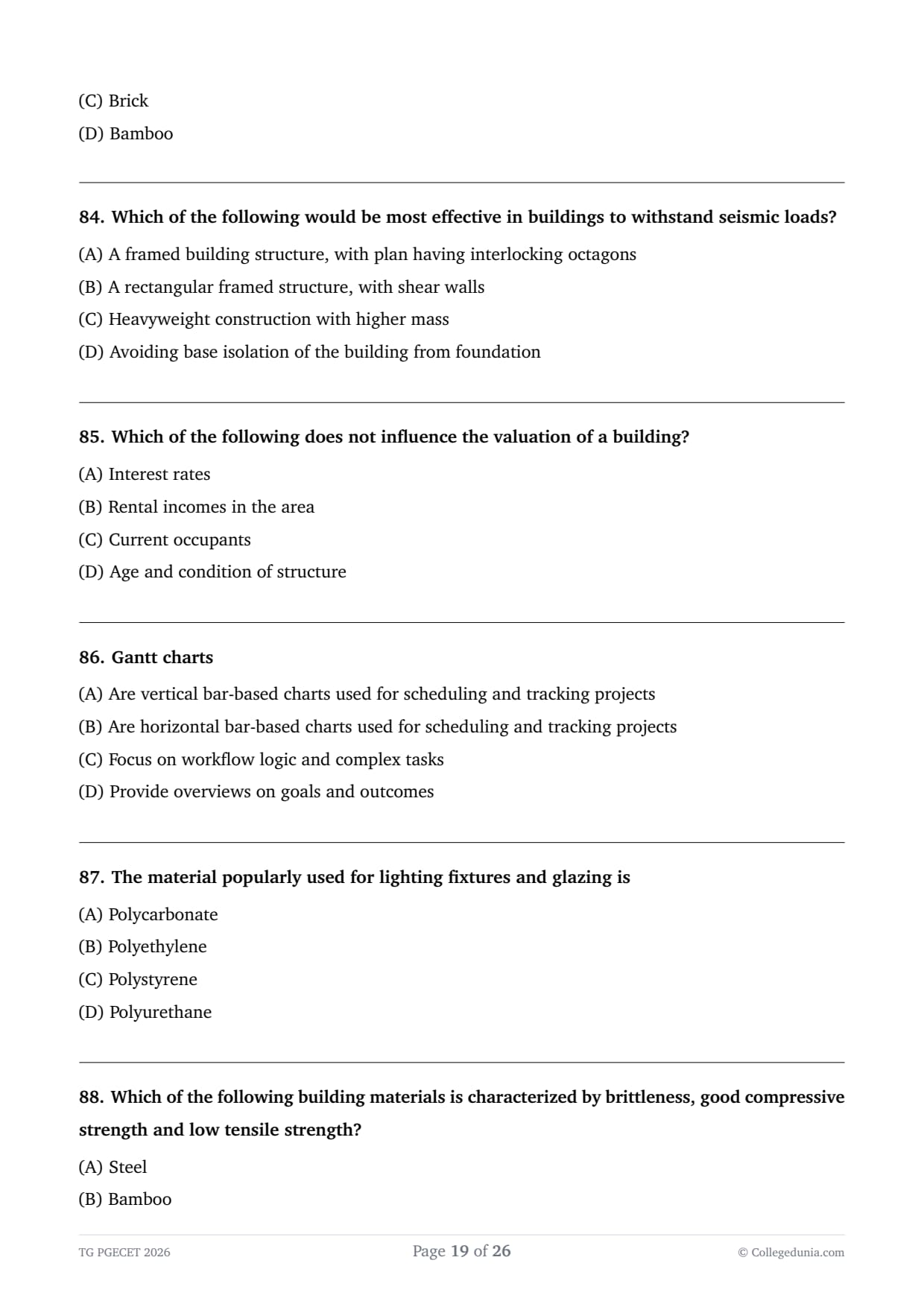
Question 84:
Which of the following would be most effective in buildings to withstand seismic loads?
- (A) A framed building structure, with plan having interlocking octagons
- (B) A rectangular framed structure, with shear walls
- (C) Heavyweight construction with higher mass
- (D) Avoiding base isolation of the building from foundation
Question 85:
Which of the following does not influence the valuation of a building?
- (A) Interest rates
- (B) Rental incomes in the area
- (C) Current occupants
- (D) Age and condition of structure
Question 86:
Gantt charts
- (A) Are vertical bar-based charts used for scheduling and tracking projects
- (B) Are horizontal bar-based charts used for scheduling and tracking projects
- (C) Focus on workflow logic and complex tasks
- (D) Provide overviews on goals and outcomes
Question 87:
The material popularly used for lighting fixtures and glazing is
- (A) Polycarbonate
- (B) Polyethylene
- (C) Polystyrene
- (D) Polyurethane
Question 88:
Which of the following building materials is characterized by brittleness, good compressive strength and low tensile strength?
- (A) Steel
- (B) Bamboo
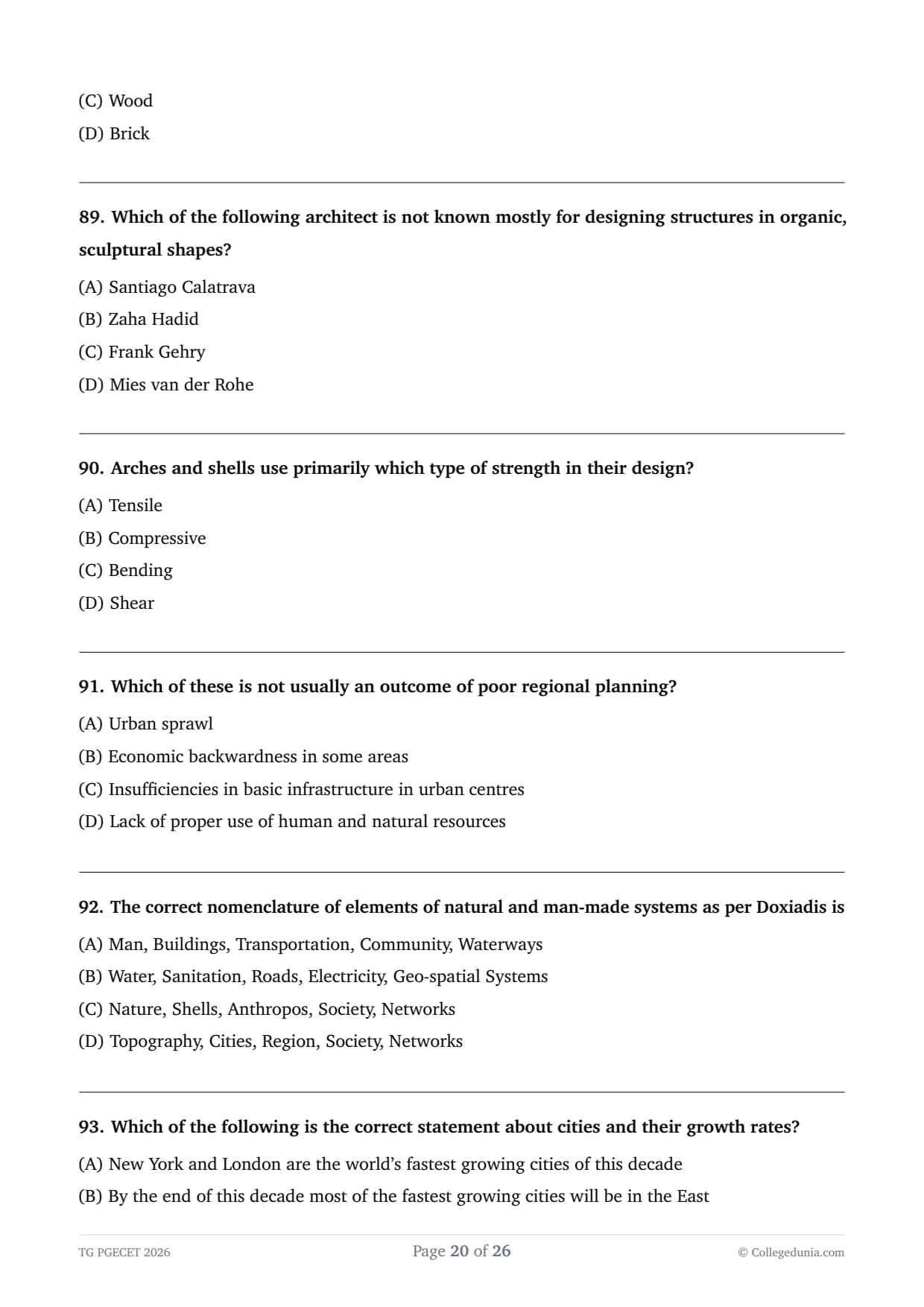
- (C) Wood
- (D) Brick
Question 89:
Which of the following architect is not known mostly for designing structures in organic, sculptural shapes?
- (A) Santiago Calatrava
- (B) Zaha Hadid
- (C) Frank Gehry
- (D) Mies van der Rohe
Question 90:
Arches and shells use primarily which type of strength in their design?
- (A) Tensile
- (B) Compressive
- (C) Bending
- (D) Shear
Question 91:
Which of these is not usually an outcome of poor regional planning?
- (A) Urban sprawl
- (B) Economic backwardness in some areas
- (C) Insufficiencies in basic infrastructure in urban centres
- (D) Lack of proper use of human and natural resources
Question 92:
The correct nomenclature of elements of natural and man-made systems as per Doxiadis is
- (A) Man, Buildings, Transportation, Community, Waterways
- (B) Water, Sanitation, Roads, Electricity, Geo-spatial Systems
- (C) Nature, Shells, Anthropos, Society, Networks
- (D) Topography, Cities, Region, Society, Networks
Question 93:
Which of the following is the correct statement about cities and their growth rates?
- (A) New York and London are the world's fastest growing cities of this decade
- (B) By the end of this decade most of the fastest growing cities will be in the East
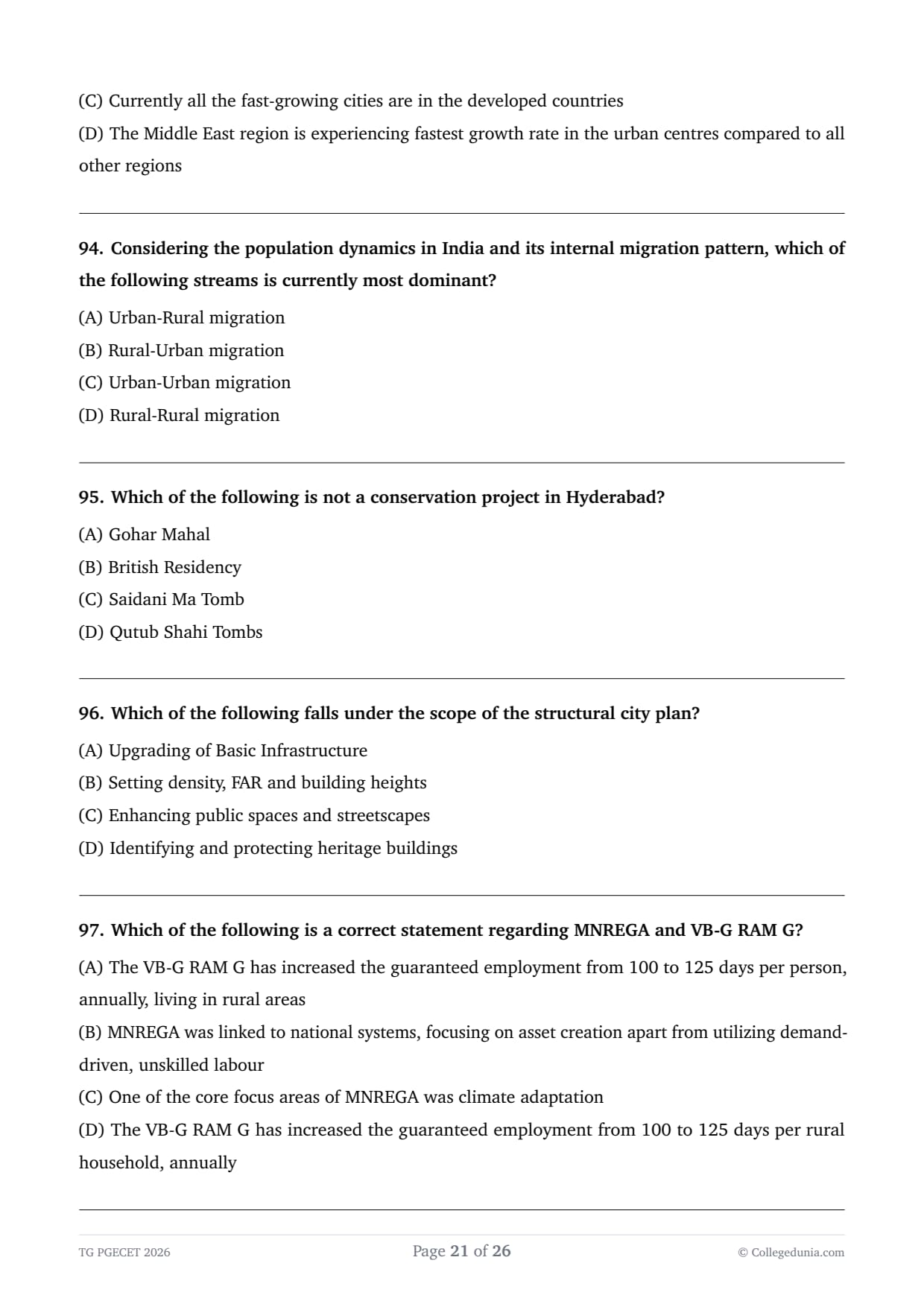
- (C) Currently all the fast-growing cities are in the developed countries
- (D) The Middle East region is experiencing fastest growth rate in the urban centres compared to all other regions
Question 94:
Considering the population dynamics in India and its internal migration pattern, which of the following streams is currently most dominant?
- (A) Urban-Rural migration
- (B) Rural-Urban migration
- (C) Urban-Urban migration
- (D) Rural-Rural migration
Question 95:
Which of the following is not a conservation project in Hyderabad?
- (A) Gohar Mahal
- (B) British Residency
- (C) Saidani Ma Tomb
- (D) Qutub Shahi Tombs
Question 96:
Which of the following falls under the scope of the structural city plan?
- (A) Upgrading of Basic Infrastructure
- (B) Setting density, FAR and building heights
- (C) Enhancing public spaces and streetscapes
- (D) Identifying and protecting heritage buildings
Question 97:
Which of the following is a correct statement regarding MNREGA and VB-G RAM G?
- (A) The VB-G RAM G has increased the guaranteed employment from 100 to 125 days per person, annually, living in rural areas
- (B) MNREGA was linked to national systems, focusing on asset creation apart from utilizing demand-driven, unskilled labour
- (C) One of the core focus areas of MNREGA was climate adaptation
- (D) The VB-G RAM G has increased the guaranteed employment from 100 to 125 days per rural household, annually
Question 98:
Shallow and broad sloping channels, with vegetation to channelize water flow and allow ground water recharge are called
- (A) Gutters
- (B) Ha-ha
- (C) Swales
- (D) Catch basins
Question 99:
Which of the following spatial data structures is best for analysing complex networks analysis, such as finding the shortest path between two points in a city's road network?
- (A) Raster data model
- (B) Vector data topological model
- (C) Grid-based model
- (D) Triangulated Irregular Network (TIN)
Question 100:
The examination scores for 5 students are 43, 76, 64, 49, and 58. The mean, median and range for this set of data are respectively
- (A) 58, 58 and 33
- (B) 60, 58 and 32
- (C) 64, 49 and 32
- (D) 58, 49 and 33
Question 101:
The correct statement regarding the Planning Commission and Niti Aayog is
- (A) The State Governments prepare draft policies and plans and submit to the Niti Aayog, where the final plan is approved by the Governing Council
- (B) The Niti Aayog plan formulation process is a consultative one, taking into consideration inputs from the State Governments
- (C) The Planning Commission had Chief Ministers of States and Lieutenant Governors of Union Territories as members
- (D) The Planning Commission consisted of ex-officio members working on a part-time basis
Question 102:
Which of the following survey techniques is the one most suitable, for gathering information on garbage collection method from households in a slum area?
- (A) Sample household survey
- (B) Key informant interviews
- (C) Focus Group Discussions
- (D) Observation
Question 103:
Which of the following is the best technique for monitoring urban sprawl?
- (A) Theodolite surveys
- (B) Multi-temporal image analysis
- (C) Hyperspectral imaging
- (D) Topographic surveys
Question 104:
Land Information System
- (A) Is a cadastral map used to identify ownership of land parcels and for land transactions
- (B) Is mostly used for management of public land banks
- (C) A database of land records with systems for acquiring and managing them
- (D) Use maps typically at a small scale of 1:50,000
Question 105:
The measurement of dispersion or spread of data points around their mean value is called
- (A) Coefficient of determination
- (B) Mode
- (C) Range
- (D) Standard Deviation
Question 106:
Which of the following is false, in comparison with roundabouts and traffic signals?
- (A) The use of roundabout reduces overall travel time
- (B) Traffic signals are more suited where traffic volumes are lower
- (C) Traffic signals help in reducing fuel usage
- (D) Roundabouts are safer for pedestrians
Question 107:
While planning for traffic arrangements for an important one-day festival in a rural area, which of the following measures would be useful?
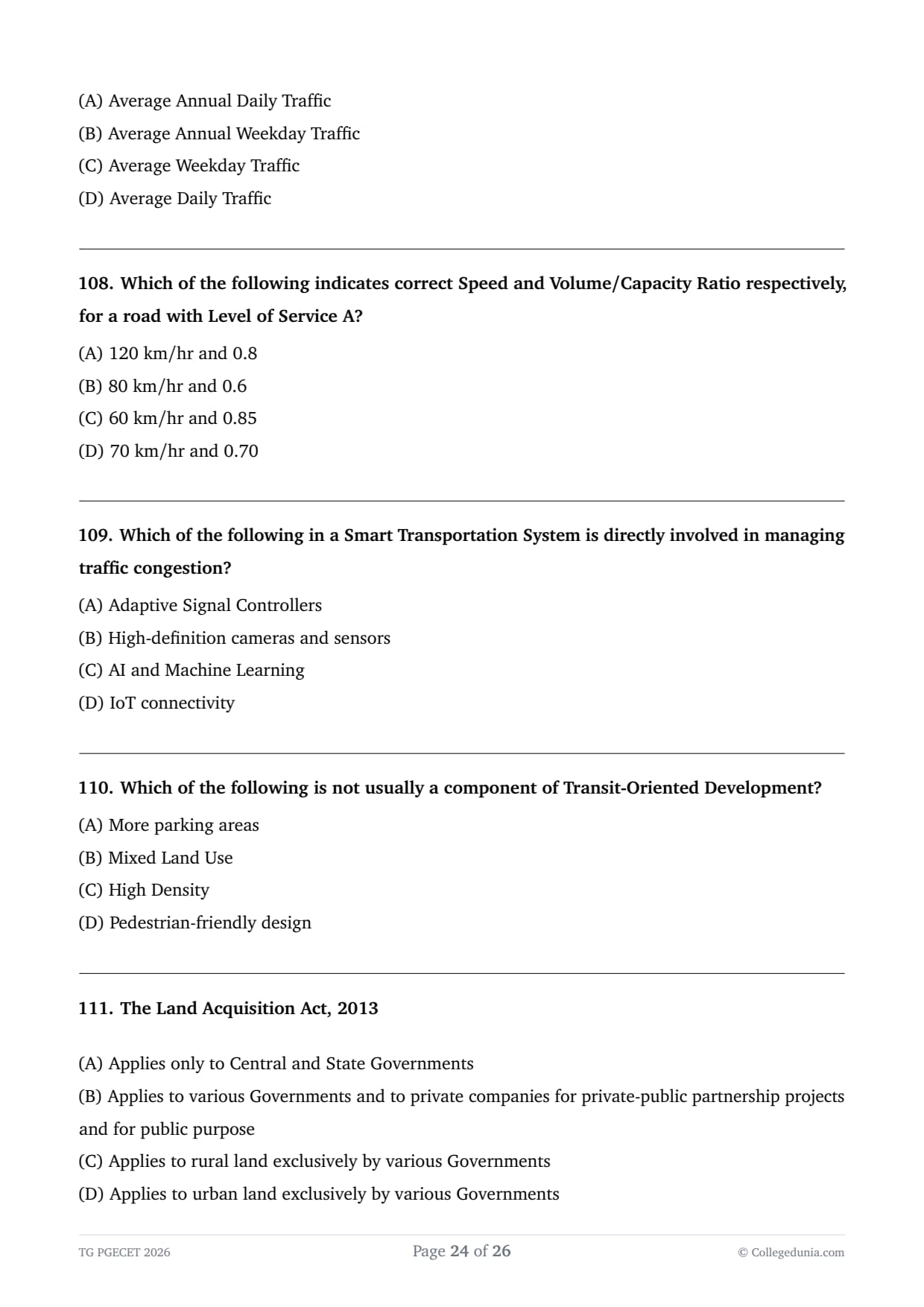
- (A) Average Annual Daily Traffic
- (B) Average Annual Weekday Traffic
- (C) Average Weekday Traffic
- (D) Average Daily Traffic
Question 108:
Which of the following indicates correct Speed and Volume/Capacity Ratio respectively, for a road with Level of Service A?
- (A) 120 km/hr and 0.8
- (B) 80 km/hr and 0.6
- (C) 60 km/hr and 0.85
- (D) 70 km/hr and 0.70
Question 109:
Which of the following in a Smart Transportation System is directly involved in managing traffic congestion?
- (A) Adaptive Signal Controllers
- (B) High-definition cameras and sensors
- (C) AI and Machine Learning
- (D) IoT connectivity
Question 110:
Which of the following is not usually a component of Transit-Oriented Development?
- (A) More parking areas
- (B) Mixed Land Use
- (C) High Density
- (D) Pedestrian-friendly design
Question 111:
The Land Acquisition Act, 2013
- (A) Applies only to Central and State Governments
- (B) Applies to various Governments and to private companies for private-public partnership projects and for public purpose
- (C) Applies to rural land exclusively by various Governments
- (D) Applies to urban land exclusively by various Governments
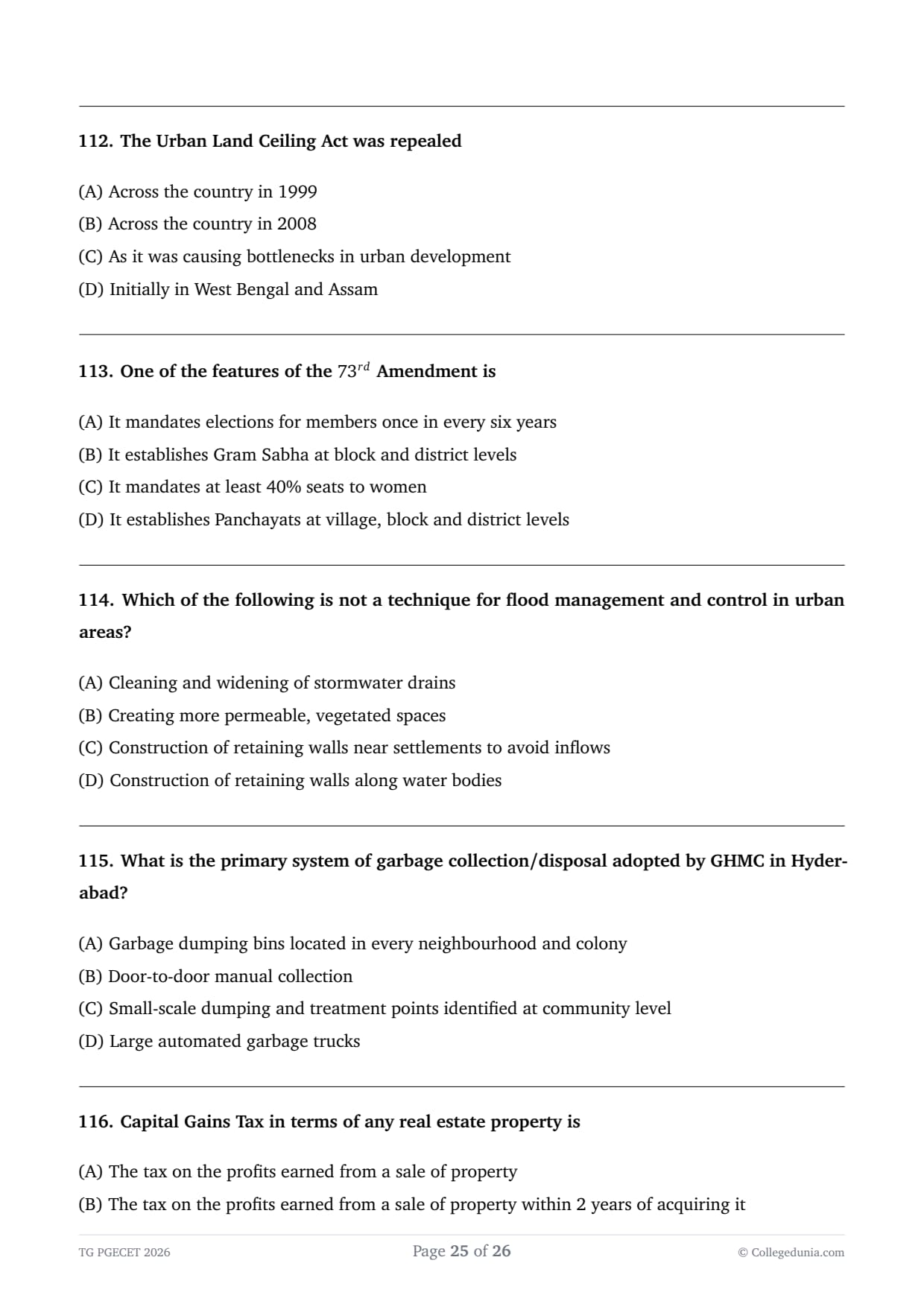
Question 112:
The Urban Land Ceiling Act was repealed
- (A) Across the country in 1999
- (B) Across the country in 2008
- (C) As it was causing bottlenecks in urban development
- (D) Initially in West Bengal and Assam
Question 113:
One of the features of the \(73^{rd}\) Amendment is
- (A) It mandates elections for members once in every six years
- (B) It establishes Gram Sabha at block and district levels
- (C) It mandates at least 40% seats to women
- (D) It establishes Panchayats at village, block and district levels
Question 114:
Which of the following is not a technique for flood management and control in urban areas?
- (A) Cleaning and widening of stormwater drains
- (B) Creating more permeable, vegetated spaces
- (C) Construction of retaining walls near settlements to avoid inflows
- (D) Construction of retaining walls along water bodies
Question 115:
What is the primary system of garbage collection/disposal adopted by GHMC in Hyderabad?
- (A) Garbage dumping bins located in every neighbourhood and colony
- (B) Door-to-door manual collection
- (C) Small-scale dumping and treatment points identified at community level
- (D) Large automated garbage trucks
Question 116:
Capital Gains Tax in terms of any real estate property is
- (A) The tax on the profits earned from a sale of property
- (B) The tax on the profits earned from a sale of property within 2 years of acquiring it
- (C) The tax on the profits earned from a sale of property after 2 years of acquiring it
- (D) The total sum of stamp duty on the capital amount spent while purchasing the property
Question 117:
Which of the following is not a valid method for improving revenue into urban local bodies?
- (A) Better mapping of the area in GIS
- (B) Public Private Partnership projects
- (C) Municipal Bonds
- (D) Sale of infrastructure
Question 118:
NGOs and CBOs can both play a role in the management and administration of urban areas. Which of the following statement is true about these organisations?
- (A) CBOs are more likely to be active in research and large-scale infrastructure projects
- (B) NGOs are more likely to have their focus on policy advocacy and capacity building
- (C) NGOs are usually restricted to localized needs and neighbourhood level projects
- (D) CBOs operate independently of local communities and emphasize top-down planning
Question 119:
What is the planning approach for peri-urban areas, as recommended by URDPFI guidelines?
- (A) The plan shall be prepared by the village authority and implemented by the municipal authority
- (B) The plan shall be prepared by the municipal body and implemented by the village authority
- (C) The plan may be prepared by the village body or municipal authority and implemented jointly
- (D) The plan shall be prepared by the municipal body and implemented by the same authority
Question 120:
The UN-Habitat concept of `Right to the City' is a concept centred on
- (A) Access to facilities for all and empowerment to participate and shape the city
- (B) Affordable housing for slum-dwellers and all marginalized sectors of the city population
- (C) Empowerment to access free public transport to all parts of the city
- (D) Surveillance of all public spaces by CCTV to prevent crime
TS PGECET 2026 Exam Pattern
| Particulars |
Details |
| Exam Mode |
Computer-Based Test(CBT) |
| Question Type |
Multiple Choice Questions(MCQs) |
| Total Questions |
120 Questions |
| Total Marks |
120 Marks |
| Exam Duration |
2 Hours |
| Marking Scheme |
+1 mark for each correct answer |
| Negative Marking |
No Negative Marking |
| Language of Paper |
English |
TS PGECET 2026 Preparation Strategy














Comments