




AIBE 22 expected questions will come from 19 subjects, with Constitutional Law, CrPC/BNSS and CPC carrying 10 questions each, based on the subject-wise distribution released with the AIBE 22 syllabus. The Bar Council of India (BCI) conducts the exam, and the AIBE 22 paper is reported for 29 November 2026.
- Pattern: AIBE 22 has 100 MCQs of 1 mark each, with no negative marking, in 3 hours 30 minutes (offline, OMR-based).
- Highest weightage: Constitutional Law, CrPC/BNSS and CPC carry 10 questions each, followed by BNS/IPC, Evidence/BSA, Family Law and Contract and Property Law with 8 each.
- New criminal laws: The syllabus lists BNS, BNSS and BSA with the older IPC, CrPC and Evidence Act, and AIBE 21 reportedly mixed both sets of sections.
- Question styles: Expect bare Act questions, conceptual questions, case law, illustration-based questions and assertion-reasoning items.
- Qualifying marks: 45 out of 100 for General/OBC and 40 for SC/ST/PwD, as reported for the latest AIBE.
- Practice set: This article includes 20 original practice MCQs on high-weightage topics, written for revision and not taken from any AIBE paper.
Related Articles:
Key Summary
- The expected topics below are based on the AIBE 22 subject-wise distribution, expert analysis of recent papers and memory-based reports, so they are predictions, not official information.
- BCI does not release an official list of expected questions, so no source can guarantee what the paper will ask.
- AIBE 21 (7 June 2026) was reported as moderate to difficult, with BNSS, BSA, Income Tax and IPR seen as the hardest areas.
- Dates, fees and registration windows below are as reported by education portals, so confirm them on the official website.
AIBE 22 at a Glance
AIBE 22 is a pen-and-paper test of 100 MCQs, and you need to qualify it to get the Certificate of Practice.
| Feature | Details (as reported) |
|---|---|
| Conducting body | Bar Council of India (BCI) |
| Exam date | 29 November 2026 |
| Registration | 19 August 2026 to 27 October 2026 |
| Fee payment deadline | 28 October 2026 |
| Correction window closes | 30 October 2026 |
| Admit card | Expected around 14 November 2026 |
| Result | Tentatively 7 January 2027 to 10 January 2027 |
| Mode | Offline, OMR-based |
| Questions and marks | 100 MCQs, 100 marks |
| Duration | 3 hours 30 minutes |
| Negative marking | None |
| Application fee | General/OBC: Rs 3,500 plus bank charges. SC/ST: Rs 2,500 plus bank charges |
| Qualifying marks | General/OBC: 45 (45%). SC/ST/PwD: 40 (40%) |
AIBE 22 Expected Questions: Subject-Wise Distribution
The AIBE 22 syllabus lists 19 subjects that add up to 100 questions. The table below also shows how much attention each subject deserves.
| Subject | Questions | Priority |
|---|---|---|
| Constitutional Law | 10 | Very high |
| Criminal Procedure: CrPC and BNSS | 10 | Very high |
| Code of Civil Procedure | 10 | Very high |
| Penal law: IPC and BNS | 8 | High |
| Evidence Act and BSA | 8 | High |
| Family Law | 8 | High |
| Contract, Specific Relief, Property Laws and Negotiable Instruments Act | 8 | High |
| Law of Tort, Motor Vehicles Act and Consumer Protection Law | 5 | Medium |
| Alternative Dispute Resolution, including Arbitration Act | 4 | Medium |
| Public Interest Litigation | 4 | Medium |
| Professional Ethics and BCI Rules on misconduct | 4 | Medium (scoring) |
| Labour and Industrial Law | 4 | Medium |
| Law related to Taxation | 4 | Medium (difficult) |
| Administrative Law | 3 | Low |
| Company Law | 2 | Low |
| Environmental Law | 2 | Low |
| Cyber Law | 2 | Low |
| Land Acquisition Act | 2 | Low |
| Intellectual Property Law | 2 | Low |
| Total | 100 |
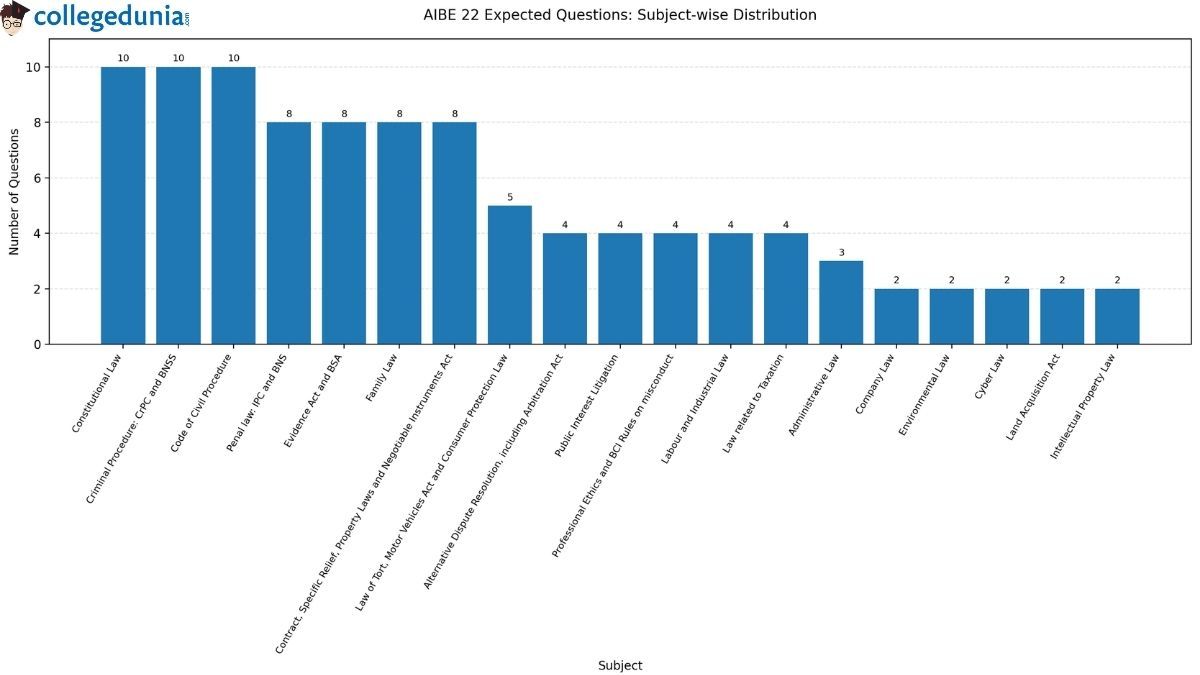
Ques. Which subject has the most questions in AIBE 22?
Ans. Constitutional Law, CrPC/BNSS and CPC have 10 questions each. Together they make up 30% of the paper.
What AIBE 21 Tells You About AIBE 22
AIBE 21 was held on 7 June 2026, and its trends are the best guide to AIBE 22. The figures below are memory-based estimates from education portals, not official data.
| Subject | Reported Difficulty in AIBE 21 | What Was Reported |
|---|---|---|
| Constitutional Law | Moderate | Fundamental Rights (Articles 14, 19, 21), DPSPs, Kesavananda Bharati, Puttaswamy and Golaknath. Assertion-reasoning items appeared. |
| BNS/IPC | Moderate to difficult | Culpable homicide, theft, extortion, dacoity and criminal conspiracy, with both BNS and old IPC sections used. |
| BNSS/CrPC | Difficult | FIR and cognisance, bail types, summons and warrants, trials, appeals and revisions. |
| CPC | Moderate | Res judicata, place of suing, execution, injunctions and Order VII. |
| BSA/Evidence | Moderate to difficult | Relevancy, admissions, confessions, burden of proof, public and private documents, estoppel. |
| Family Law | Easy to moderate | Hindu Marriage, Guardianship and Succession Acts, and Muslim law (talaq, mehr, maintenance). |
| Income Tax | Difficult | Deductions, exemptions and heads of income. |
| IPR | Moderate to difficult | Copyright, patents and trademarks, plus a question linked to the M.C. Mehta judgment. |
| Professional Ethics | Easy | BCI Rules and the Advocates Act, 1961. |
- Overall level: Education portals rated AIBE 21 as easy to moderate or moderate to difficult, so opinions differed.
- Safe attempts: Estimates put good attempts at about 70 to 80 questions for General/OBC.
- New laws: Students who had updated their preparation to BNS, BNSS and BSA reportedly had an advantage.
- Ambiguity: A few ambiguous questions were reported, so read every option carefully.
AIBE 22 Expected Question Types
Bare Act questions remain the most common type. Past analyses also show a steady move towards conceptual and situation-based questions.
| Question Type | What It Looks Like | Difficulty |
|---|---|---|
| Bare Act based | Identify the section or article that covers a given matter | Easy to moderate |
| Conceptual | Definitions, such as what a term means under the Act | Moderate |
| Case law based | Recall a judgment or the rule it laid down | Moderate to tough |
| Illustration based | Apply a principle to a short fact situation | Moderate |
| Assertion-reasoning | Judge whether the assertion and the reason are true and linked | Moderate |
| Maxims and doctrines | Meaning of Latin maxims such as res ipsa loquitur | Easy if revised |
Ques. Are AIBE questions mostly from Bare Acts?
Ans. Yes, Bare Act-based questions are the most common type. Share estimates differ across sources, so also prepare case law and illustration-based questions.
AIBE 22 Subject-Wise Expected Topics
These topics are expected because they appear repeatedly in subject-wise analyses of recent AIBE papers. They are predictions, not a guarantee.
| Subject | Expected Topics |
|---|---|
| Constitutional Law | Fundamental Rights and DPSPs, writs (Articles 32 and 226), powers of the President, Parliament and judiciary, emergency provisions, amendments, basic structure, landmark cases |
| BNS (IPC) | General exceptions, culpable homicide and murder, hurt, theft, robbery, extortion, dacoity, cheating, criminal conspiracy, defamation, new offences in BNS |
| BNSS (CrPC) | FIR and cognisance, arrest, bail (regular, anticipatory, default), summons and warrants, trial stages, appeals and revisions, compounding of offences |
| CPC | Jurisdiction and types of suits, res judicata, decrees and orders, injunctions, execution, appeals, review and revision, Order VII |
| BSA (Evidence) | Relevancy, burden of proof, admissions and confessions, documentary and oral evidence, electronic records, examination of witnesses, estoppel |
| Family Law | Marriage, divorce and maintenance, adoption and guardianship, succession under Hindu and Muslim laws |
| Contract and Property | Offer, acceptance and consideration, breach and remedies, specific relief, sale of goods, Transfer of Property Act, Negotiable Instruments Act |
| Torts | Negligence, strict and absolute liability, defamation, nuisance, Motor Vehicles Act, Consumer Protection Act |
| Professional Ethics | Duties to client, court and colleagues, professional misconduct, BCI Rules, contempt of court |
| ADR, PIL, Labour | Arbitration and conciliation, locus standi in PIL, industrial disputes, workmen and trade unions |
| Other subjects | Company law basics, environmental principles, cyber offences, IPR (copyright, patent, trademark), taxation, land acquisition, administrative law |
AIBE 22 Practice Questions With Answers
These 20 questions are original practice MCQs on high-weightage topics. They are not from any AIBE paper and are meant for revision.
| No. | Question and Options | Answer | Explanation |
|---|---|---|---|
| 1 | Which Article empowers the Supreme Court to issue writs for enforcing Fundamental Rights? (A) 32 (B) 226 (C) 136 (D) 142 | (A) | Article 32 gives the Supreme Court this power. Article 226 is for High Courts. |
| 2 | The basic structure doctrine was laid down in which case? (A) Golaknath (B) Kesavananda Bharati (C) Maneka Gandhi (D) Minerva Mills | (B) | Kesavananda Bharati v. State of Kerala (1973) held Parliament cannot alter the basic structure. |
| 3 | Right to privacy as part of Article 21 was affirmed in: (A) A.K. Gopalan (B) Kharak Singh (C) K.S. Puttaswamy (D) ADM Jabalpur | (C) | A nine-judge bench decided K.S. Puttaswamy v. Union of India in 2017. |
| 4 | Which Article provides free and compulsory education to children aged 6 to 14? (A) 21A (B) 24 (C) 45 (D) 51A | (A) | Article 21A, inserted by the 86th Amendment, makes it a Fundamental Right. |
| 5 | A National Emergency under Article 352 can be declared on the ground of: (A) Internal disturbance (B) Armed rebellion (C) Financial instability (D) Failure of constitutional machinery | (B) | The 44th Amendment replaced "internal disturbance" with "armed rebellion". |
| 6 | An Ordinance under Article 123 ceases to operate within how long of Parliament reassembling? (A) 2 weeks (B) 4 weeks (C) 6 weeks (D) 6 months | (C) | It ceases six weeks after reassembly unless disapproved earlier. |
| 7 | Which BNS section provides the punishment for murder? (A) 100 (B) 101 (C) 103 (D) 105 | (C) | Section 103 BNS replaces IPC Section 302. Section 101 defines murder. |
| 8 | Cheating is dealt with in which BNS section? (A) 303 (B) 309 (C) 318 (D) 356 | (C) | BNS Section 318 corresponds to IPC Section 420. Section 303 is theft and Section 309 is robbery. |
| 9 | Cruelty by a husband or his relatives is covered under which BNS section? (A) 63 (B) 85 (C) 152 (D) 61 | (B) | BNS Section 85 corresponds to IPC Section 498A. |
| 10 | Registration of an FIR is provided under which BNSS section? (A) 35 (B) 173 (C) 482 (D) 528 | (B) | BNSS Section 173 replaces CrPC Section 154. |
| 11 | Anticipatory bail is provided under which BNSS section? (A) 482 (B) 483 (C) 187 (D) 183 | (A) | BNSS Section 482 replaces CrPC Section 438. |
| 12 | Admissibility of electronic records, with a certificate, is dealt with in which BSA section? (A) 23 (B) 63 (C) 118 (D) 25 | (B) | BSA Section 63 replaces Section 65B of the Evidence Act. |
| 13 | The doctrine of res judicata is contained in which CPC section? (A) 9 (B) 11 (C) 34 (D) 100 | (B) | Section 11 bars a second trial of a matter already decided. |
| 14 | Notice before suing the Government under CPC Section 80 must be given for how long before the suit? (A) 15 days (B) 1 month (C) 2 months (D) 6 months | (C) | Two months' notice is required, unless the court grants leave to sue earlier. |
| 15 | A second appeal under CPC Section 100 lies only on: (A) Question of fact (B) Substantial question of law (C) Any ground (D) Question of jurisdiction only | (B) | Section 100 limits a second appeal to a substantial question of law. |
| 16 | An agreement with a minor is: (A) Valid (B) Voidable (C) Void ab initio (D) Illegal | (C) | Mohori Bibee v. Dharmodas Ghose held such an agreement void from the start. |
| 17 | Under the Contract Act, the doctrine of frustration is in: (A) Section 10 (B) Section 23 (C) Section 56 (D) Section 73 | (C) | Section 56 deals with agreements that become impossible to perform. |
| 18 | Rylands v. Fletcher laid down the rule of: (A) Absolute liability (B) Strict liability (C) Vicarious liability (D) Contributory negligence | (B) | It held a person who keeps a dangerous thing liable for its escape. Absolute liability came later in M.C. Mehta v. Union of India. |
| 19 | An application to set aside an arbitral award under Section 34 must ordinarily be made within: (A) 30 days (B) 3 months (C) 6 months (D) 1 year | (B) | Three months, extendable by 30 days if sufficient cause is shown. |
| 20 | Punishment for professional misconduct of an advocate is imposed under which Advocates Act section? (A) 30 (B) 35 (C) 49 (D) 24 | (B) | Section 35 deals with punishment for professional or other misconduct. |
How to Prepare for AIBE 22 Expected Questions
- Read the Bare Acts first: Most questions test the exact section, definition or rule.
- Learn the new section numbers: Revise BNS, BNSS and BSA with the old IPC, CrPC and Evidence Act numbers, since papers have mixed both.
- Start with the 10-question subjects: Constitutional Law, CrPC/BNSS and CPC give the most marks per hour.
- Do not skip the small subjects: Professional Ethics, ADR, Labour and Family Law are scoring areas.
- Learn 40 to 50 landmark cases in Constitutional Law, Torts, Environment and Criminal Law.
- Practise assertion-reasoning: Read both statements before checking the link between them.
- Solve previous papers and mocks: Practise a full 100-question paper in the exam time.
AIBE Official Information: Last 3 Years
Students can check the official AIBE notices, syllabus and answer keys on the website of the Bar Council of India's examination portal:
| Edition | Document | Download Link |
|---|---|---|
| AIBE XXII (2026) | Syllabus, registration and notices | View on Official Site |
| AIBE XXI (June 2026) | Syllabus, final answer key and result notices | View on Official Site |
| AIBE XX (2025) | Notices and answer key | View on Official Site |
AIBE 22 Expected Questions: FAQs
Ques. When is the AIBE 22 exam?
Ans. AIBE 22 is reported for 29 November 2026. Confirm the date in the official BCI notification.
Ques. What is the last date to apply for AIBE 22?
Ans. Registration is reported to close on 27 October 2026, with fee payment till 28 October 2026 and corrections till 30 October 2026. Check the official website for any change.
Ques. How many questions are there in AIBE 22?
Ans. AIBE 22 has 100 MCQs carrying 1 mark each, with no negative marking.
Ques. What are the qualifying marks in AIBE?
Ans. Reports give 45% (45 marks) for General/OBC and 40% (40 marks) for SC/ST/PwD. Older sources quote lower figures, so rely on the latest BCI notice.
Ques. Are the new criminal laws included in AIBE 22?
Ans. Yes, the AIBE 22 subject list names BNS, BNSS and BSA along with the IPC, CrPC and Evidence Act.
Ques. Which subjects are most important for AIBE 22?
Ans. Constitutional Law, CrPC/BNSS and CPC have 10 questions each. IPC/BNS, Evidence/BSA, Family Law and Contract and Property Law have 8 each.
Ques. How many questions should you attempt to qualify?
Ans. Since there is no negative marking, attempt all 100 questions. A score of about 45 to 50 is the qualifying zone, and about 70 to 80 correct is estimated as a good attempt.
Ques. Does BCI release official expected questions for AIBE?
Ans. No. Lists of expected questions come from teachers and education portals based on past trends. Use them for revision, not as a guarantee.
Ques. Is the AIBE 21 paper a good guide for AIBE 22?
Ans. It is a useful guide for question style and difficulty. The subject-wise distribution can change in each edition, so also follow the AIBE 22 syllabus.



Comments