





The UNSW College Diploma pathway takes Indian students into Year 2 of a UNSW Sydney bachelor’s degree in 12 months. It suits students who narrowly missed direct entry or want a slower academic start. Six diploma streams feed straight into UNSW faculties like Engineering, Business and Computer Science.
- Second-year entry: Diploma completers skip UNSW Year 1 and step straight into Year 2.
- Small-class support: Tighter cohorts and more class time suit students easing into Australian study.
- Same degree, same time: You graduate with a UNSW Sydney bachelor’s in the standard timeline.
- Backup, not a shortcut: The pathway helps students who missed direct entry, not those chasing an easier route.
Check UNSW Sydney fees, rankings and Indian-student cutoffs
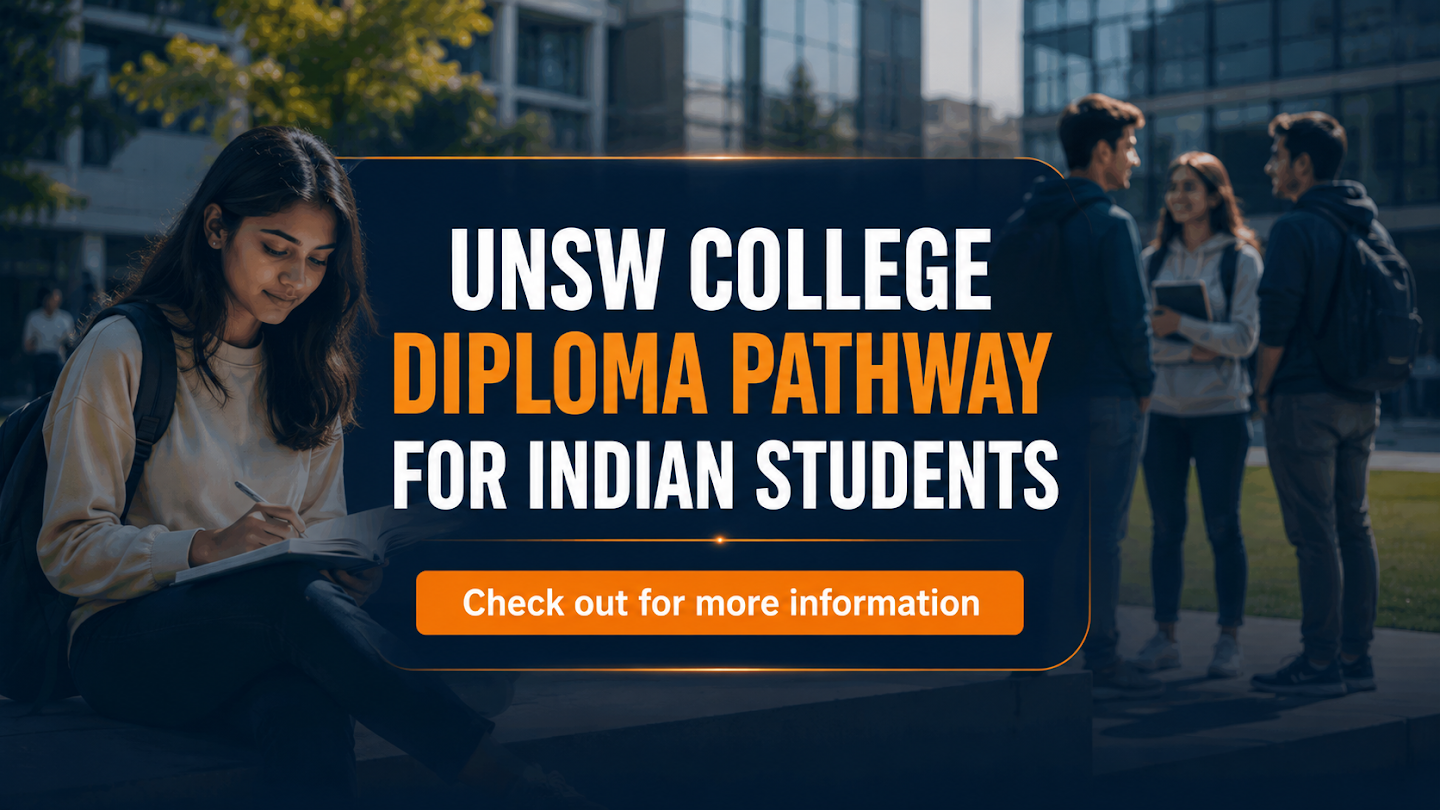
Diploma students at UNSW College get around 20% more teaching time than a UNSW Sydney first-year student. That extra classroom time is the actual product on sale. For Indian students with tight Class 12 marks, the pathway trades one thing for another. You get a slower, more guided start into UNSW.
Also read: Admission Requirements at UNSW for Indian Students
- What Is the UNSW College Diploma Pathway
- UNSW College Diploma Programs and 2026 Fees
- Entry Requirements for Indian Students
- Intakes and Application Timeline for 2026
- Progression to UNSW Sydney Year 2
- Scholarships and Funding for Indian Students
- Sydney Living Costs on the Diploma
- Australia Student Visa and Financial Proof
- When Diploma Beats Direct Entry to UNSW
- Career Outcomes and Post-Study Work Rights
Quick Facts on UNSW College Diploma Pathway
| Parameter | Detail |
|---|---|
| Provider | UNSW College (Kensington campus, Sydney) |
| Diploma streams | 6 (Architecture, Business, Computer Science, Engineering, Media and Communications, Science) |
| Duration | 12 months |
| Intakes each year | January, May, September |
| 2026 international tuition | AUD 45,330 to AUD 54,540 (about INR 30.85 lakh to INR 37.11 lakh) |
| English requirement | IELTS 6.0 to 6.5 overall or Class 12 English waiver |
| Progression to UNSW Sydney | Year 2 bachelor’s on meeting the WAM rule (weighted average mark for the year) |
| Live FX used here | 1 AUD = INR 68.05 (August 19, 2026) |
Also read: University of New South Wales Courses and Fees 2026-27
What Is the UNSW College Diploma Pathway
The UNSW College Diploma pathway is a 12-month first-year replacement. It ends with entry into Year 2 of a UNSW Sydney bachelor’s degree. UNSW College runs it at the Kensington campus, next door to UNSW Sydney.
The Diploma covers the same first-year content as the linked UNSW Sydney bachelor’s. Content is fully recognised by UNSW. Many teachers also teach at UNSW Sydney.
Class sizes stay around 20 students. UNSW College says students get 20% more teaching time than UNSW Sydney first-year students. You also get access to UNSW libraries, clubs and student services. Source: UNSW College official course pages.
The Diploma exists for students who need a smoother start. A large share are international students who just missed direct-entry cutoffs. Others hold school qualifications UNSW does not directly recognise for entry.
What the pathway gives Indian students:
- A recognised route into UNSW Sydney without repeating Class 12 or a foundation year.
- Structured English and academic writing support inside the course.
- Smaller classes and more contact hours than a typical UNSW lecture.
What the pathway does not cover:
- Some restricted UNSW degrees (Medicine, Law, Aviation Flying) have no diploma route.
- The Diploma does not lower the total cost of your UNSW Sydney degree by much.
For a wider view of Australian study routes, see the Study in Australia country guide. It covers other pathway options too.
UNSW College Diploma Programs and 2026 Fees
International tuition for the UNSW College Diploma pathway starts at AUD 45,330 and tops out at AUD 54,540 for 2026. Media and Communications is the cheapest. Business is the highest.
| Diploma Programme | 2026 Tuition (AUD) | Approx INR | Feeds Into |
|---|---|---|---|
| Media and Communications | 45,330 | INR 30.85 lakh | BA Media, BA Communications |
| Architecture | 48,060 | INR 32.70 lakh | Bachelor of Architectural Studies |
| Computer Science | 48,480 | INR 32.99 lakh | Bachelor of Computer Science or IT |
| Engineering | 48,480 | INR 32.99 lakh | Bachelor of Engineering (Honours) |
| Science | 48,480 | INR 32.99 lakh | Bachelor of Science or Advanced Science |
| Business | 54,540 | INR 37.11 lakh | Bachelor of Commerce |
What the tuition covers:
- All classes, tutorials and assessments across the 12-month diploma.
- Full access to UNSW libraries, online learning tools and career services.
- Progression assessment and UNSW Sydney enrolment support at the end.
What the tuition does not cover:
- Enrolment fee of AUD 360 (one-off).
- Overseas Student Health Cover (OSHC) for the visa period.
- Books, laptop, transport and living costs in Sydney.
Key Insight: The Diploma of Engineering costs AUD 48,480 for 12 months. Direct entry to Bachelor of Engineering at UNSW Sydney costs around AUD 61,500 in Year 1. That is a first-year saving of about AUD 13,020 (INR 8.86 lakh) before any scholarship.
Entry Requirements for Indian Students
Indian applicants for the UNSW College Diploma pathway need lower Class 12 marks than direct entry to UNSW Sydney. Direct entry to UNSW asks for 75% to 85% in Class 12. The Diploma sits below that range but still expects a solid pass.
UNSW College reviews CBSE and ISC results on aggregate. State board students are assessed case by case. Program-specific minimums apply for Business and Engineering streams. Contact UNSW College Admissions for your exact score requirement.
English options for Indian students:
- IELTS Academic: 6.0 overall for most diplomas and 6.5 for Business.
- TOEFL iBT: 74 to 90 depending on stream.
- PTE Academic: 54 to 64 depending on stream.
- CBSE Class 12 English Core: Grade C1 waives IELTS for most diplomas. Grade B2 needed for Business.
- ISC Class 12 English: 70% waives IELTS for most diplomas. 80% is needed for Business.
Source: UNSW published English proficiency table. The waiver saves Indian students roughly INR 17,000 in test fees and 6 to 8 weeks of prep time.
Check UNSW Sydney direct-entry cutoffs and Indian student rules
Intakes and Application Timeline for 2026
The UNSW College Diploma pathway runs three intakes each year: January, May and September. That flexibility is one reason Indian students pick it over single-intake diploma routes in the UK.
| Intake | Suggested apply-by month | Term starts |
|---|---|---|
| September 2026 | June 2026 (now closed) | Early September 2026 |
| January 2027 | October 2026 | Early January 2027 |
| May 2027 | February 2027 | Early May 2027 |
| September 2027 | June 2027 | Early September 2027 |
UNSW College accepts rolling applications until seats fill (applications open until the seat pool is full). Apply at least 3 months before your intake for visa processing.
Documents you need to submit:
- Class 10 and Class 12 mark sheets and passing certificates.
- Passport bio-page copy (valid for at least 6 months past your course end).
- English test scorecard or the Class 12 English waiver evidence.
- Personal statement of up to 500 words on why UNSW.
- Financial documents for the Genuine Student assessment (see visa section below).
Progression to UNSW Sydney Year 2
Diploma students who meet the progression rules step directly into Year 2 of their linked UNSW Sydney bachelor’s. No further application to UNSW is needed. Rules vary by diploma stream.
| Diploma Stream | Progression Rule to UNSW Sydney |
|---|---|
| Business | Pass all courses with a 60% overall average. Enter Year 2 of Bachelor of Commerce. |
| Engineering | WAM of 50% and Satisfactory in Communication and Academic Literacy courses. |
| Science | Minimum pass in all courses and Satisfactory in Communication and Academic Literacy. |
| Computer Science | Pass all courses and Satisfactory in Communication and Academic Literacy. |
| Architecture | Pass all courses and Satisfactory in Communication and Academic Literacy. |
| Media and Communications | Pass all courses and be Satisfactory in Communication and Academic Literacy. |
Source: UNSW College official course pages. WAM is the weighted average mark across the 12 months of study.
What progression guarantees you:
- A locked seat in Year 2 of your linked UNSW Sydney bachelor’s.
- Full recognition of your diploma credits inside the UNSW degree.
- The same UNSW Sydney degree parchment as any direct-entry student.
What progression does not guarantee:
- Entry to Honours programmes (usually needs Year 3 marks at UNSW).
- Transfer to a different bachelor’s than the one you enrolled for.
- Automatic scholarship renewal once you move to UNSW Sydney.
Total time to a UNSW Sydney bachelor’s stays at 3 or 4 years. The Diploma takes Year 1’s place. Direct-entry students spend Year 1 at UNSW Sydney instead. Both paths finish together.
If you plan to switch to a related engineering major after the diploma, first check the Bachelor of Engineering Computer Engineering track at UNSW to see what Year 2 subjects look like.
Sydney Living Costs on the Diploma
Living in Sydney as a UNSW College Diploma pathway student costs around AUD 29,710 (INR 20.22 lakh) a year. That is the minimum figure the Australian visa authority asks you to prove for the Subclass 500 student visa.
| Expense | Weekly (AUD) | Monthly (INR approx) |
|---|---|---|
| Accommodation (shared apartment) | 350 to 500 | INR 1.03 to 1.47 lakh |
| Groceries | 100 to 160 | INR 29,500 to 47,200 |
| Transport (Opal card) | 40 to 60 | INR 11,800 to 17,700 |
| Utilities and internet | 30 to 50 | INR 8,850 to 14,750 |
| Mobile, misc, social | 50 to 100 | INR 14,750 to 29,500 |
When Diploma Beats Direct Entry to UNSW
The UNSW College Diploma pathway makes sense when your Class 12 marks fall short of direct entry, when you want smaller classes, or when your board is not fully recognised. If you meet direct-entry cutoffs, apply straight to UNSW Sydney.
| Factor | UNSW College Diploma | UNSW Sydney Direct Entry |
|---|---|---|
| Class 12 cutoff | Below 75% (missed direct entry) | 75% to 85% CBSE or ISC |
| Class size (Year 1) | Around 20 students | 100 to 400 in lectures |
| Year 1 fee (Engineering) | AUD 48,480 (INR 32.99 lakh) | AUD 61,500 (INR 41.85 lakh) |
| Total time to bachelor’s | 3 or 4 years | 3 or 4 years |
| Final degree | UNSW Sydney bachelor’s | UNSW Sydney bachelor’s |
| Post-study work visa | Same 485 access | Same 485 access |
For a wider shortlist of Australian universities to compare with UNSW, see the top Australian universities list.
Career Outcomes and Post-Study Work Rights
Graduates on the UNSW College Diploma pathway finish with the same UNSW Sydney bachelor’s degree as direct-entry students. The parchment does not mention the diploma pathway. Career outcomes match direct-entry graduates.
Post-study work rights in Australia sit under the Temporary Graduate visa (Subclass 485, the work permit after your course):
- 2 years: Standard bachelor’s degree holders.
- 3 years: Bachelor’s with First Class Honours in STEM, under the India-Australia trade deal.
- Age cap: 35 or under at the time of the 485 application, effective from 2026.
- Base fee: AUD 2,300 for the primary applicant, rising to AUD 4,600 from March 2026.
Also Check:
| Engineering in Australia 2026 | MS in Australia Top Universities | BBA in Australia for Indian Students |
| PG Diploma Courses in Australia | MBA Without Work Experience in Australia | UNSW Sydney Rankings 2026 |
The UNSW College Diploma pathway is not a shortcut. It is a structured Year 1 replacement for Indian students who need a smoother start or narrowly missed direct entry. The tuition sits lower than direct Year 1 fees at UNSW Sydney. The English waiver and 20% International Student Award make it cheaper still. Compare your Class 12 aggregate against direct-entry cutoffs first. If the gap is 5% to 10%, the Diploma is a serious backup worth planning for.
FAQs on UNSW College Diploma Pathway
Ques. What is the UNSW College Diploma pathway?
Ans. The UNSW College Diploma pathway is a 12-month course that leads into Year 2 of a UNSW Sydney bachelor’s. Six streams cover Architecture, Business, Computer Science, Engineering, Media and Communications and Science. It is run by UNSW College at the Kensington campus.
Ques. Is UNSW College the same as UNSW Sydney?
Ans. No. UNSW College is a wholly owned subsidiary of UNSW Sydney but runs its own diploma, foundation and English programmes. Content in the Diploma mirrors UNSW Sydney’s Year 1 curriculum. Progression to UNSW Sydney is direct on meeting the WAM rule.
Ques. How much does the UNSW College Diploma pathway cost for Indian students in 2026?
Ans. Between AUD 45,330 and AUD 54,540 in tuition for 12 months. That is around INR 30.85 lakh to INR 37.11 lakh. Business is the highest at AUD 54,540. Media and Communications is the lowest at AUD 45,330. Add OSHC, enrolment fee AUD 360 and Sydney living costs.
Ques. What Class 12 marks do Indian students need for the diploma?
Ans. Below direct-entry cutoffs. Direct entry to UNSW Sydney needs 75% to 85% in Class 12. The Diploma accepts students in the range just below that. Business and Engineering ask for slightly higher marks than Media or Arts streams. Contact UNSW College Admissions for your exact score.
Ques. Do Indian students need IELTS for the UNSW College Diploma?
Ans. Not always. A CBSE Class 12 English Core grade of C1 or higher waives IELTS for most diplomas. ISC students need 70% in Class 12 English for the same waiver. Business needs a higher grade. If you do need IELTS, the requirement is 6.0 overall for most streams and 6.5 for Business.
Ques. When are the intakes for the diploma in 2026 and 2027?
Ans. Three intakes each year: January, May and September. Apply at least 3 months before your intake to leave time for the Subclass 500 visa. Applications are rolling until seats fill. Scholarship pools drain faster than seat pools.
Ques. Do I move directly to Year 2 of UNSW Sydney after the diploma?
Ans. Yes, if you meet the progression rule for your stream. Business needs a 60% overall average. Engineering needs a WAM of 50% plus Satisfactory in Communication. Science and other streams need pass grades in every course. UNSW does not require a fresh application. Enrolment support is included in the diploma.
Ques. Can I get a scholarship for the UNSW College Diploma pathway?
Ans. Yes. All Indian students qualify for the UNSW International Student Award which cuts tuition by 20% each year. It applies through the diploma and continues into the UNSW Sydney bachelor’s. Add a 500-word personal statement to your admission application to trigger consideration.
Ques. Is the UNSW College Diploma cheaper than direct entry to UNSW Sydney?
Ans. In Year 1, yes. The Diploma of Engineering costs AUD 48,480. Direct entry to Bachelor of Engineering costs around AUD 61,500 in Year 1. That is a saving of about AUD 13,020 (INR 8.86 lakh). Years 2, 3 and 4 are billed at UNSW Sydney rates for both paths. Total-degree saving is modest, not dramatic.
Ques. Does the UNSW College Diploma qualify me for the 485 post-study work visa?
Ans. Yes, once you finish the UNSW Sydney bachelor’s that the diploma feeds into. The final degree qualifies for 2 years of post-study work rights (Subclass 485). STEM graduates with First Class Honours can get 3 years under the India-Australia trade deal. The 485 age cap is 35 as of 2026.
Ques. What happens if I fail a course in the UNSW College Diploma?
Ans. You can repeat a failed course inside the diploma term structure. That may extend your 12-month course. If you fail multiple courses, progression to UNSW Sydney Year 2 is delayed or blocked. Your student visa also needs enough duration left to cover the extension. Speak to a UNSW College student advisor early.
Ques. Can I switch degrees at UNSW Sydney after completing the diploma?
Ans. Only within limits. Progression is locked to the linked bachelor’s for your diploma stream. A Diploma of Engineering feeds into Bachelor of Engineering. Switching from Engineering to Business after the diploma usually needs a fresh application to UNSW Sydney. Some flexibility exists inside a stream (for example between engineering majors).
interested in this College ?
Follow & Share this college to get information about admission.



Comments