



Study Abroad Expert | Updated On - Oct 28, 2026
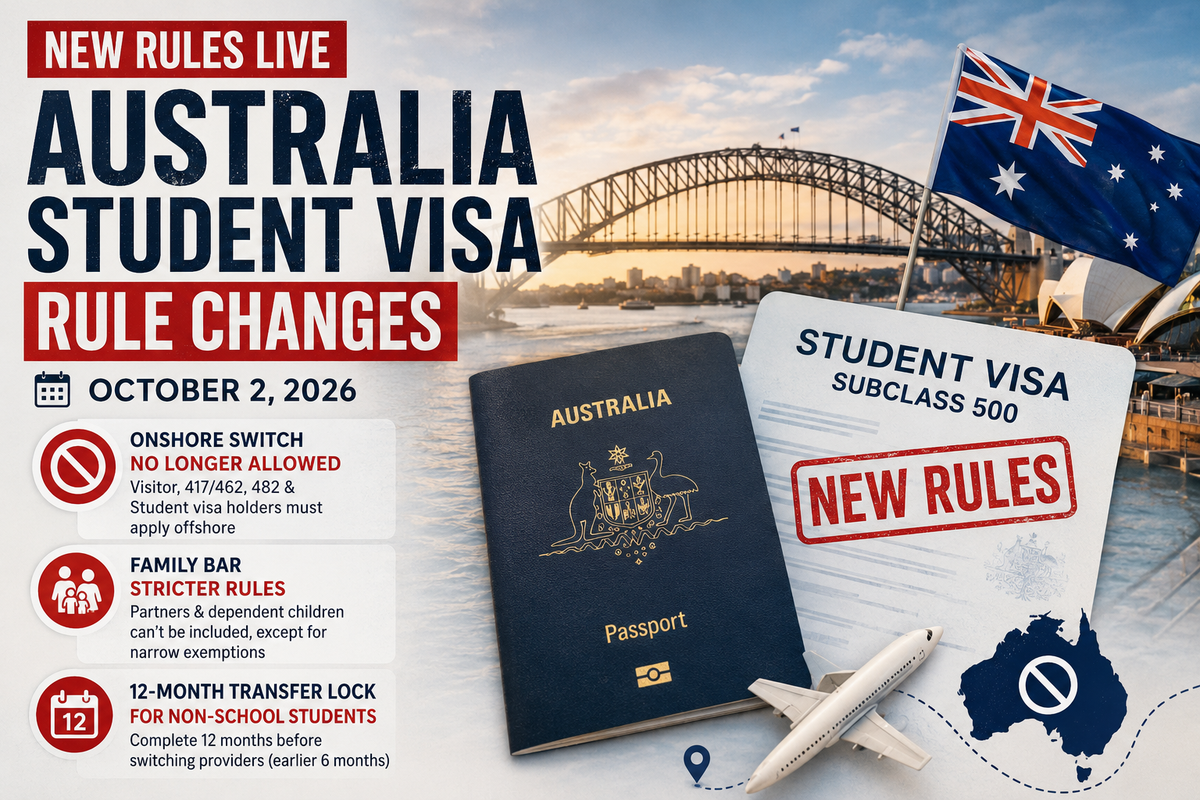
Australia’s Home Affairs made new Student visa rules live on October 2, 2026. The change blocks Indian students on visitor or working holiday visas from switching onshore. The Department confirmed the shift on its official Student visa updates page. The rule ends the onshore switch route for short-stay visa holders in Australia.
- Indian holders of Visitor (subclass 600), Working Holiday Maker (417/462), and Skills in Demand (482) visas can no longer lodge a Student visa inside Australia.
- Most applicants cannot include a partner or dependent child on the Student visa unless a narrow exemption applies.
- Non-school students must now spend 12 months on their principal course before switching providers, up from the earlier 6-month floor.
The three shifts land together as part of Canberra’s push to curb what officials call "visa hopping". Applications lodged before October 2, 2026 stay under the earlier rules.
Also Read: Australia Student Visa Subclass 500 Eligibility, Steps and Documents
Who the New Onshore Rule Shuts Out
The change pulls the ladder up on four common onshore pathways. Visitor visa holders scouting campuses cannot apply from inside Australia now. Working Holiday Maker visa holders cannot pivot into a Masters without flying home first. Skills in Demand (subclass 482) workers face the same offshore rule. Even current Student visa holders generally must leave to lodge their next Student visa.
Anyone who lodges offshore must also be outside Australia on the day of grant. A quick return before the grant letter lands will break the application.
| Current visa in Australia | Onshore switch to Student visa 500 allowed? |
|---|---|
| Visitor (subclass 600) | No, must apply from outside Australia |
| Working Holiday Maker (417/462) | No, must apply from outside Australia |
| Skills in Demand (482) | No, must apply from outside Australia |
| Existing Student visa (500) | Generally no, must apply offshore |
| Foreign Affairs or Defence sponsored | Yes, exemption applies |
| Secondary exchange (AASES) | Yes, exemption applies |
What it means for Indian Students: Indians make up a large share of Working Holiday 462 and 482 visa pools in Australia. For this cohort, the onshore-to-study route is shut, and a return trip home is now the only way to lodge the Student visa.
How Does the Family Bar Affect Indian Applicants?
Partners and dependent children cannot be included in most Student visa applications from October 2. The exemption list is narrow and covers Foreign Affairs, Defence, and secondary exchange cases. Indian postgraduate applicants earlier used a single lodgement to add a spouse.
That bundled route is gone. A dependent partner must now meet the primary-applicant tests alone, or move to a separate visa stream. Secondary visa holders already attached to a current Student visa keep their grant until it expires.
Important Distinction: The family bar applies to new applications only, not retrospectively. Partners and children already granted secondary status on an existing Student visa keep that grant on the old terms.
12-Month Transfer Lock for Non-School Students
Non-school Student visa holders must now complete 12 months of their principal course before transferring to another registered provider. The earlier floor was six months. The lock lifts only where the current provider loses CRICOS registration or faces a sanction.
The rule targets the cheap-course-then-switch tactic that regulators flagged through 2024 and 2025. For an Indian student starting a bridging college course, the practical effect is a full year of study before a move to a target university.
Why Canberra Tightened the Student Visa Pipeline
Home Affairs framed the rules as a Genuine Student integrity measure. Department data showed a steady rise in visa-to-visa switching through 2024 and 2025. Short-stay visa arrivals converting into long-stay Student visa holders drove most of the jump.
The government also lifted the Student visa application charge to AUD 2,000 in July 2024, roughly ₹1.1 lakh at current rates. The fee and the offshore rule together push the system toward applicants who commit to the student route before arrival.
What Should Indian Students Already in Australia Do Now?
- Check your current visa expiry on VEVO, the free government verification service.
- If you plan to study, book a trip to India or a nearby country before lodging.
- Hold a Confirmation of Enrolment (CoE) and Genuine Student statement before you leave.
- Lodge the subclass 500 application only after you are physically offshore.
- Do not re-enter Australia on the old visa until the Student visa grant lands.
- If you want to switch providers, confirm you have completed 12 months on your current course.
Indian applicants already in Australia face a harder reset after October 2, 2026. The onshore switch, family inclusion, and quick-transfer paths of the earlier regime are shut. The next inflection point is the February 2027 semester intake, where offshore lodgement is the only workable route.
Next Key Date for 2027 Intake Applicants: Most Australian universities close main-round applications for the February 2027 semester through late November and December 2026. Indian students targeting that intake must plan to lodge the Student visa from outside Australia.



Comments