



Content Curator
Flowering plants or angiosperms are specified by the presence of roots, stems, leaves, flowers, and fruits. These parts of the plants tend to show variations or adaptations as per the habitat they live in for protection, climbing, storage, etc. The part of the plant that grows below the soil (underground) is called the root system while the part of the plant which grows above the soil is known as the shoot system. The root system is the descending portion of the embryonal axis. It is positively geotropic, positively hydrotropic and negatively phototropic. There are three types of root systems; tap root system, fibrous root system, and adventitious root system. In this article, we will discuss the adventitious root system.
| Table of Content |
Also Read: Parts of a Seed
Adventitious Root System
The root system which arises from any other part of the plants except the radicle such as stem nodes, internodes, leaf, etc. is known as the adventitious root system. The fibrous root system is also a type of adventitious root system. They can be underground or aerial. These types of roots are commonly seen in grasses, banyan trees, Monstera, etc.
Adventitious Root System
Modifications of adventitious roots
Adventitious roots are modified for different purposes like storage of food, providing mechanical support, reproduction, etc.
For Mechanical Support:
There are three types of root modification for providing mechanical support to the plants. They are-
Prop roots/ Pillar roots:
These roots are aerial roots that arise from the branches of the stem and later grow vertically downwards into the soil. They are very thick like a pillar and provide support to the main axis of the plant. They are mostly found in dicots. Example: Banyan tree-Ficus benghalensis.

Prop roots/ Pillar roots
Stilt root/ brace roots:
They arise from the lower nodes of the stem and grow obliquely downwards into the soil. They are mostly seen in monocots. They support the two main axes of the plant. Example: Maize-Zea mays, Sugarcane-Saccharum officinarum, Screw pine-Pandanus

Stilt root/ brace roots
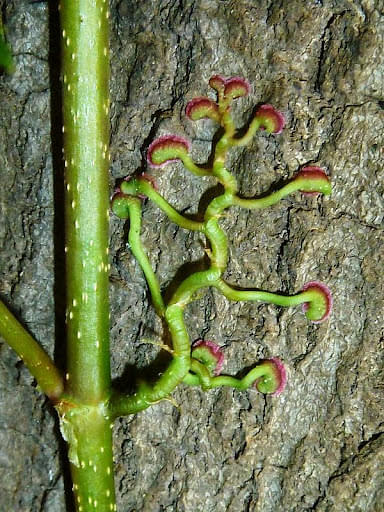
Climbing/clinging roots:
These roots are found in climbers. They arise from nodes or internodes and help in climbing by penetrating the cracks or fissures.
Example: Betel leaf-Piper betel, Black pepper- Piper nigrum, long pepper-Piper longum, money plant-Pothos
Climbing/clinging roots
For Food Storage:
Adventitious roots also become swollen for the storage of food. Based on their shapes, tap roots are classified as:
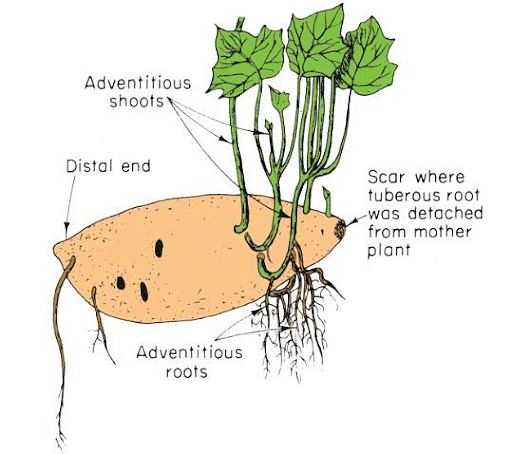
Tuberous roots:
They are swollen roots, irregular in shape, and occur singly. Example-sweet potato-Ipomoea batatas
Tuberous roots
Fasciculated roots:
They are a group/clusters of swollen and irregular-shaped roots. Example-Dahlia, Asparagus.

Fasciculated roots
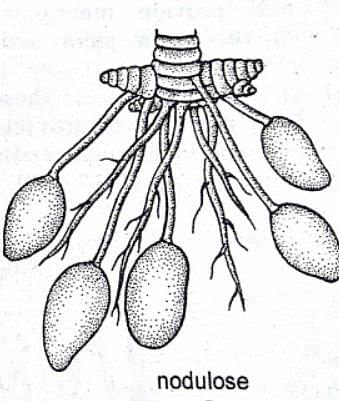
Nodulated roots:
These roots are swollen at the apex (tip). Example-Turmeric-Curcuma Domestica, Mango ginger- Curcuma Amada, etc.
Nodulated roots
Moniliform/ beaded roots:
In this type, roots are swollen at regular intervals. They appear like beads in necklaces. Example-Bitter Gourd-Momordica, Portulaca
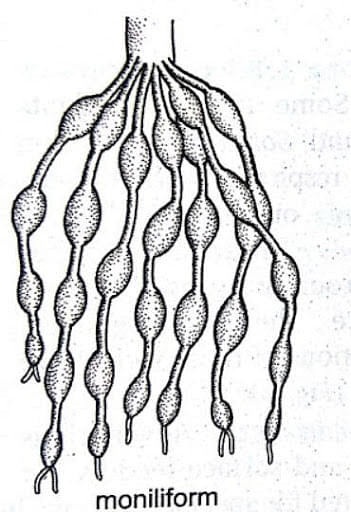
Moniliform/ beaded roots
Palmate roots:
These roots swell like fingers in Palm. Example-Orchis (Orchid)

Palmate roots
Annulated roots:
These roots appear in the form of ring-like swellings. The root swelling occurs in a series of rings that look like discs stacked one above the other. Example: Ipecac
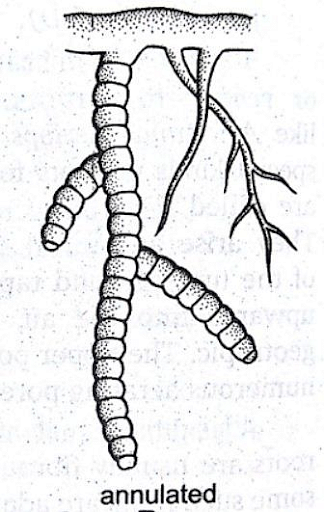
Annulated roots
For vital functions:
Sucking/ Haustorial roots:
These types of roots occur in parasitic plants (non-green). These roots penetrate the xylem and phloem of host plants and draw nourishment from them. Example: Amarbail-Cuscuta reflexa (stem parasite), Cassytha filiform, Orabanda indica (root parasite).

Sucking/ Haustorial roots
Assimilatory roots:
These are green roots that perform photosynthesis. Example-Aerial roots of Tinospora and submerged roots of water Trapa.

Assimilatory roots
Floating/ Respiratory roots:
These types of roots are seen in the Jussiaea-an aquatic plant. They arise from the nodes or branches of the stem above the water level.

Floating/ Respiratory roots
Epiphytic/hygroscopic roots:
These roots are found in plants that grow on other plants for shelter (epiphytic plants). They usually grow in dense canopy forests. They develop aerial hanging hygroscopic roots which absorb water from the surrounding atmosphere through a tissue known as velamen. Example: Orchids, Vanda

Epiphytic/hygroscopic roots
For other functions:
Epiphyllous roots:
These roots arise from the base of the leaf margin for vegetative propagation. Example- Bougainvillea, Begonia.

Epiphyllous roots
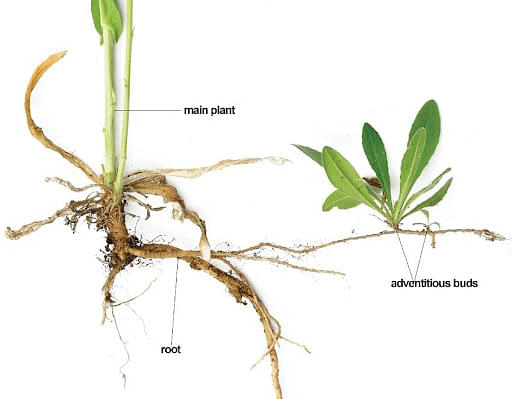
Reproductive roots:
These are the fleshy roots that develop into adventitious buds. Under favorable conditions, these buds can grow into a new plant. Example: sweet potato, dahlia
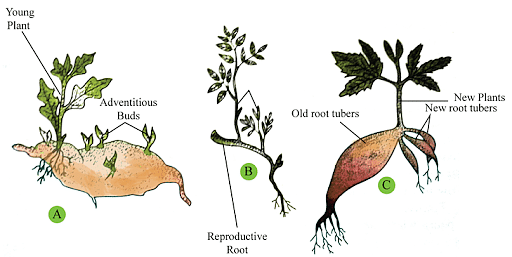
Reproductive roots
Root thorns:
Roots are thorn-like hard and pointed arising from the stem above the ground. They protect the plants against herbivores. Example: Pothos, Armatus, Acanthorhiza
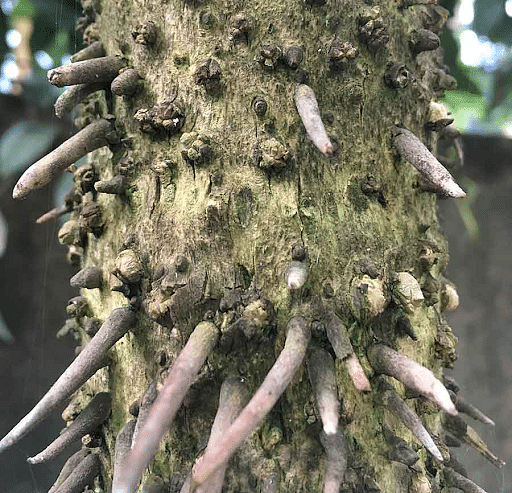
Root thorns
Things to Remember Based on Adventitious Roots
- Root system is the part of the plant that grows below the soil.
- Shoot system is the part of the plant that grows above the soil.
- There are three types of root systems; tap root system, fibrous root system, and adventitious root system.
- Adventitious Root system arises from any other part of the plants except the radicle such as stem nodes, internodes, leaf, etc. Example- grasses, banyan tree, Monstera.
- Adventitious roots are modified to provide mechanical support, to store food, for respiration, for photosynthesis and to perform other vital functions.
- Prop roots, stilt roots and climbing roots provide mechanical support to the plants.
- Tuberous roots, fasciculated roots, palmate roots, moniliform roots, nodulated roots and annulated roots are useful for storing the food.
- Sucking/ haustorial roots penetrate the xylem and phloem of host plants and draw nourishment from them.
- Epiphyllous roots arise from the base of the leaf margin for vegetative propagation.
- Reproductive roots are the fleshy roots that develop into adventitious buds. Under favorable conditions, these buds can grow into new plants.
- Some roots are thorn-lik and arise from the stem above the ground. They protect the plants from herbivores.
Important Questions Based on Adventitious Roots
Ques: What are adventitious root systems? Give examples. (2 Marks)
Ans: The root system which arises from any other part of the plants except the radicle such as stem nodes, internodes, leaf, etc. is known as the adventitious root system. They can be underground or aerial. They are thin hair-like roots, commonly seen in grasses, banyan trees, Monstera, etc.
Ques: What are reproductive roots? (2 Marks)
Ans: Reproductive roots are the fleshy root that develops into adventitious buds. Under favorable conditions, these buds can grow into a new plant. Example: sweet potato, dahlia
Ques: Sucking or haustorial roots are present in which type of plant? Describe their function and Give examples? (2 Marks)
Ans: Sucking roots occurs in parasitic plants or non-green plants. These roots penetrate the xylem and phloem of host plants and draw nourishment from them. Example: Amarbail-Cuscuta reflexa (stem parasite), Cassytha filiform, Orabanda indica (root parasite).
Ques: Ficus benghalensis shows which type of modification? Explain their function. (2 Marks)
Ans: Roots of Ficus benghalensis (Banyan tree) are modified into prop roots which are thick pillar-like aerial roots that arise from the branches of the stem and later grow vertically downwards into the soil. They provide support to the main axis of the plants.
Ques: Climbing or clinging roots are seen in which plants? Explain their function and give examples? (3 Marks)
Ans: Climbing roots are found in climbers. They arise from nodes or internodes and help in climbing by penetrating the cracks or fissures. Example: Betel leaf-Piper betel, Black pepper- Piper nigrum, long pepper-Piper longum, money plant-Pothos
Ques: What is the function of Epiphytic or hygroscopic roots? (3 Marks)
Ans: Epiphytic roots are found in plants that grow on other plants for shelter (epiphytic plants). They usually grow in dense canopy forests. They develop aerial hanging hygroscopic roots which absorb water from the surrounding atmosphere through a tissue known as velamen.
Ques: What are the functions of roots? (3 Marks)
Ans: The main functions of the root:
- Anchoring of the plant into the grounds and providing support to it.
- Absorption of water and mineral nutrients from the soil
- Transportation of absorbed water and nutrients to the upper part of the plant from the soil
- Storage of food
Ques: What are the different types of modifications shown by the adventitious root system? (3 Marks)
Ans: Adventitious roots show the following modifications:
- For Food storage: Roots are modified into fleshy roots for the storage of food.
- For Mechanical support: There are modified roots for providing mechanical support to the plants
- For vital functions: Roots are modified into sucking roots, respiratory roots, epiphytic roots, and assimilatory roots for drawing nutrition from host plants, for respiration, for absorbing water from surrounding and performing photosynthesis respectively.
- Other function: Adventitious roots are also modified into root buds and thorns for vegetative propagation and protection from herbivores.
Ques: Differentiate between taproot and adventitious root system? (5 Marks)
Ans:
| Taproots | Adventitious roots |
|---|---|
| Taproots are thick single primary roots | Adventitious roots are thin hair-like numerous roots |
| They arise from the radicle | They arise from any part of the plant except the radicle |
| Mostly seen in dicots | Mostly seen in monocots |
| The primary roots get differentiated into lateral secondary and tertiary roots | Numerous roots develop from a single point |
| Example: carrots, radish, parsley, beetroot | Example: grasses, monstera |
Ques: Explain the different modifications of adventitious root for storage? Give examples. (5 Marks)
Ans: Following are the modifications of adventitious roots for storage:
- Tuberous roots: They are swollen roots, irregular in shape, and occur singly. Example-sweet potato-Ipomoea batatas
- Fasciculated roots: They are a group/clusters of swollen and irregular-shaped roots. Example-Dahlia, Asparagus.
- Nodulated roots: These roots are swollen at the apex (tip). Example-Turmeric-Curcuma Domestica, Mango ginger- Curcuma Amada, etc.
- Moniliform/ beaded roots: In this type, roots are swollen at regular intervals. They appear like beads in necklaces. Example-Bitter Gourd-Momordica, Portulaca
- Palmate roots: These roots swell like fingers in Palm. Example-Orchis (Orchid)
- Annulated roots: These roots appear in the form of ring-like swellings. The root swelling occurs in a series of rings that look like discs stacked one above the other. Example: Ipecac



Comments