



Content Curator
Seeds are an important part of the flowering plant. They grow a new plant. Seeds can be of different shapes, colors and sizes. They can be round, wrinkled, winged, or hairy. They are in a state of sleep until they get enough sunlight, water, and soil.
| Table of Content |
Keyterms: Seed, Plant, sunlight, water, soil, phanerogams, pea, gram, almond beans, sunflowers, micropyle
Definition of Seeds
[Click Here for Sample Questions]
Seeds are fertile ovules. Outer particles are hardened to form a Seed coat, but micropyle is still present in the seed coat. It is a mature ovule with an embryonic plant, stocked material, and a coat or protective coat. Seeds are a reproductive structure from all phanerogams. The composition of the seeds can be learned from the common varieties of pea, gram, almond beans, or sunflowers. Plant growth in seeds is known as germination.

Seeds
The seed has three parts:
- Seed coat
- Endosperm
- Embryo
Hence, the seed is made up of the seed coat and the embryo. The embryo is composed of a single radical, one embryonic axis (wheat, corn), or two cotyledons (gram and pea). Seeds are found inside the fruit that becomes a new plant when we plant it. Therefore, seeds are a very important part.
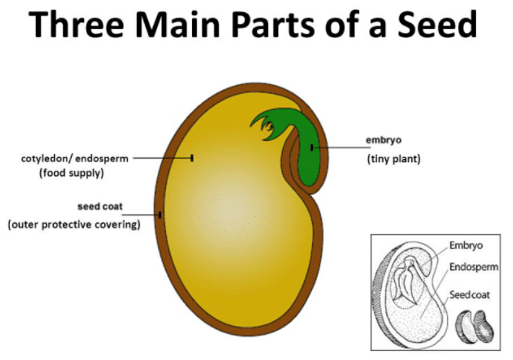
Parts of Seed
Also Read
| Related Articles | ||
|---|---|---|
| Fruit Definition | Seed Germination | Cell Biology |
Types of Seeds
[Click Here for Sample Questions]
A seed is of two types. They are -
- Monocotyledonous seeds
- Dicotyledonous seeds

Types of Seeds
Read More About Fertilization in Plants
Parts of a Seed
[Click Here for Sample Questions]
Parts of monocotyledonous seeds
Mono means one, so as the name suggests, it has only one cotyledon seed in it. There is only one outer layering of the seed coat. Therefore, the seed has the following parts - seed coat, endosperm, aleurone layer, embryo, scutellum, embryonal axis, and coleoptile and coleorhiza.
(i) Seed coat - In corn seeds like maize, the seed coat has a membrane and is attached to a fruit wall, called the Hull.
(ii) Endosperm - The endosperm is large and retains food. Usually, dense seeds are endospermic but some like orchids do not have endospermic.
(iii) Aleurone Layer - The outer layer of the endosperm separates the embryo into a protein-rich aleurone layer.
(iv) Embryo - The embryo is thin and is located in a hole at one end of the endosperm.
(v) Scutellum - This is a term used for a single-large cotyledon.
(vi) Embryonal sperm - The plumule and radicle are the two ends.
(vii) Coleoptile and Coleorhiza - Plumule and radicle are placed in a bag-like structure. They are coleoptile and coleorhiza.
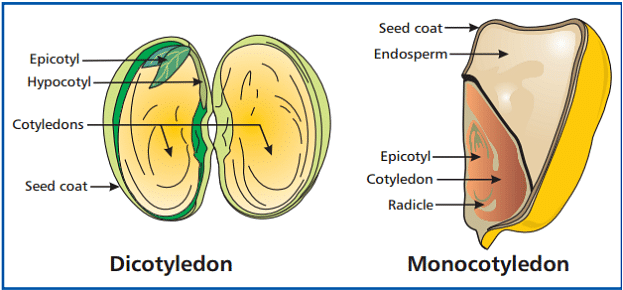
Parts of monocotyledonous seeds
Parts of Dicotyledonous seeds
Unlike monocotyledon seeds, the dicotyledonous seeds have two cotyledons. It consists of the following parts - seed coat, hilum, micropyle, embryo, cotyledons, radicle and plumule, and endosperm.
(i) Seed coat - This is the outer cover of the seed. The seed coat consists of two layers, the outer testa, and the inner tegmen.
(ii) Hilum - A scar on a seed coat is a seed that is attached to the fruit.
(iii) Micropyle - It is a tiny hole present above the hilum which helps in the exchange of oxygen and water during the germination process.
(iv) Embryo - It has an embryonal axis and two cotyledons.
(v) Cotyledons - This part maintains the food storage, provides nourishment to the growth of plumule and radicle, and seed leaves.
(vi) Radicle and Plumule - These two parts are present at the two ends of the embryonal axis.
(vii) Endosperm - In some seeds, such as castor, endosperm, formed as a result of a double pregnancy, is a food-retaining tissue. In plants such as beans, gram, and pea, the endosperm is not present in mature seeds. They are known as non-endospermic.
Also Read
| Related Articles | ||
|---|---|---|
| Plant Roots | Plant Breeding | Reproduction in Plants |
| Classification of Plants | Plant Cell | Fundamental Unit of Life |
Things to Remember
- There are three parts in a plant seed system - seed coat, endosperm, and embryo.
- The seed coat protects the internal parts of a seed. The endosperm contains nutrients, to provide nourishment to the seed. The embryo is an essential part of a seed, it is developed from the fertilized egg.
- Seeds contain everything needed for the growth and development of a new plant.
- Examples of monocotyledon seeds are wheat, rice, cone, millet, and maize.
- While, examples of dicotyledon seeds are pea, beans, lentils, and gram.
Sample Questions
Ques: Why do seeds have a small hole? (1 mark)
Ans: Seeds have a small hole because a small seed hole is very important to take in the minerals, water, and oxygen. It needs to open the seed and help it grow into each plant.
Ques: Which microorganisms destroy the seed? (1 mark)
Ans: The most common microorganism that kills seeds is mold. When the moisture content of the seeds is high, it results in the growth of mold on the seeds. Molds can damage seeds before they leave the soil. It causes seed rot.
Ques: Give some applications of seeds. (2 marks)
Ans: There are so many important applications of seeds, they are -
- Seeds are useful in the agriculture
- It can be easily stored for future use
- Seeds ensure protection to the young embryo
- Seeds provide nourishment for the growth of the embryo
Ques: The aleurone layer in maize is rich in - (1 mark)
(a) Starch (b) Protein (c) Lipids (d) Auxins
Ans: b) Proteins
Ques: The caryopsis contains (1 mark)
(a) One-seeded fruit
(b) Two-seeded fruit
(c) Multi-seeded fruit
(d) None
Ans. a) One-seeded fruit
Ques: What do you understand by seed dormancy? (2 marks)
Ans. In many plant species, seeds fail to germinate for some time after ripening and harvesting even if given the right conditions for germination. This state of seed dysfunction may be due to certain internal factors that inhibit the germination process and is called seed dormancy.
Ques: What does stratification mean? (1 mark)
Ans: To combat dormancy caused by the embryo, seeds can be stimulated to germinate early if they are stored in a cool, low-temperature environment. This process is called stratification.
Ques: In exalbuminous seeds, the food is generally stored in (1 mark)
(a) Endosperm (b) Hypocotyl (c) Cotyledons (d) Testa
Ans. c) Cotyledons
For Latest Updates on Upcoming Board Exams, Click Here: https://t.me/class_10_12_board_updates
Check-Out:



Comments