



Content Curator
Anthracene is a three amalgamate benzene ring solid polycyclic aromatic hydrocarbon (PAH) with the formula C14H10. It is also known as paranaphthalene. Anthracene is also a simple tricyclic aromatic hydrocarbon that is found in coal tar and it is used as a starting material to construct the dyestuff and for sparkling counters. Crude anthracene illuminates from a high-boiling coal-tar fraction. It is thus distilled by recrystallization and sublimation. Pure anthracene crystallises in colourless monoclinic plates, and it shows a blue fluorescence.
| Table of Content |
Key Terms: Anthracene, Polycyclic Aromatic Hydrocarbon (PAH), Paranaphthalene, Tri-Cyclic Aromatic Hydrocarbon, recrystallization, oxidation
Read Also: Cis-Trans Isomerism
What Is Anthracene Sigma Adrich?
[Click Here for Sample Questions]
Three benzene rings are combined together to form anthracene. (PAH)
Polyclinic denotes a molecule with more than one ring, Aromatic denotes a molecule with alternative double and single bonds above the ring structure, hydrocarbon denotes a molecule that compiles both carbon and hydrogen atoms.
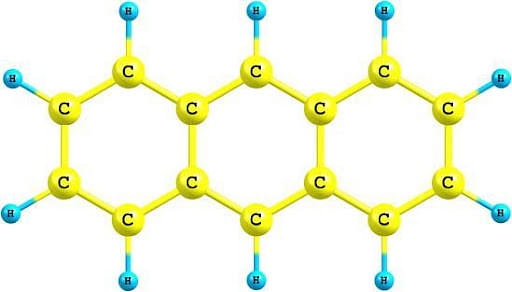
Anthracene
Read Also: Carboxylic Acid
Reaction Of Anthracene
[Click Here for Sample Questions]
Anthracene to Anthraquinone
Anthracene is changed into anthraquinone when it is reacted with an oxidizing agent like hydrogen peroxide. Anthraquinone is formed from a direct combustion process i.e. motor-operated vehicles. Anthracene has two carbon-oxygen double bonds at the two carbons of the particles, which is easily acknowledged as anthraquinone.
Methyl Anthracene
The Elbs reaction is named after Karl Elbs, a German chemist, who has invented the Elbs oxidation. It is an organic reaction in which an ortho methyl- substituted benzophenone is pyrolyzed which produces a condensed polyaromatic.
Dibenzo Anthracene
The action of UV light causes anthracene to photo-dimerize. 4+4 cycloaddition gives the solution in a pair of new carbon-carbon bonds which connect the dimer, also known as Dianthracene (or sometimes paranthracene).
Thermally or with UV irradiation under 300 nm, it turns back to anthracene presence of oxygen has an outcome over the reaction.
Read More: Alcohols, Phenols, and Ethers
Magnesium Anthracene
Magnesium anthracene is an organomagnesium chemical compound that is mostly always isolated as tetrahydrofuran (THF) which is abducted by three ligands. Air and water sensitive orange solid Mg(C14H10)(thf)3 is made up of a suspension of magnesium which was heated to make a THF solution of anthracene
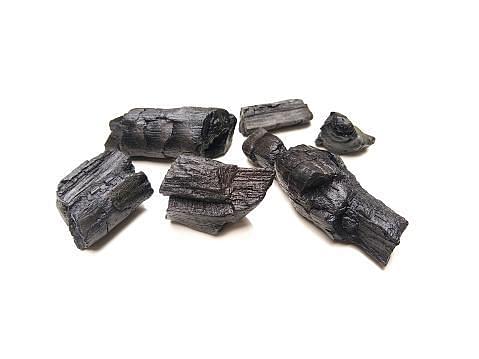
Coal- tar
Identification of Anthracene
Anthracene can be recognized as it is colourless and also pale yellow in colour which feels like sand, and feels like a bluish glow.
Read More: States of Matter
What Are Uses Of Anthracene?
[Click Here for Sample Questions]
- It can be converted into anthraquinone, a dye precursor.
- Anthracene is an organic semiconductor with a big bandgap. It is used as a scintillator for high-energy proton, electron, and alpha particle detectors. Plastics, such as polyvinyl toluene can be treated with anthracene to create a water-equivalent plastic scintillator which is used for the radiation therapy dosimetry. The emission spectrum of anthracene elevates between 400 and 440nm.
- Anthracene is generally used in UV tracers in printed wiring board conformal coating.
- Anthracene is produced like many other polycyclic aromatic hydrocarbons during the combustion process
- Anthracene is non-carcinogenic, According to various sources, it gives the answer that “consistently gives negative results in numerous in vitro and in vivo genotoxicity experiments.
- Anthracene can be used as a smokescreen scintillation counter crystals and inorganic semiconductor research.
- Anthracene is present in insecticides, wood preservatives, coating materials.

Benzene
Read More: Oxidation and Reduction
Oxidation Of Anthracene
[Click Here for Sample Questions]
Anthracene is converted into anthraquinone when it is exposed to an oxidising agent like hydrogen peroxide etc. Anthracene has two carbon-oxygen double bonds at the two middle carbons of the molecule because of which anthraquinone is easily identified.
Read Also: Preparation of Alcohols
Things To Remember
- Anthracene is also known as Paranaphthalene.
- Anthracene is an amalgamation of three benzene ring solid polycyclic aromatic hydrocarbons (PAH).
- Anthraquinone is formed from a direct combustion process.
- Anthracene converted into anthraquinone, a dye precursor.
- In the presence of an oxidizing agent, such as hydrogen peroxide, anthracene is converted into anthraquinone.
- Anthracene can be identified by its colourless and pale yellow appearance.
Read More: Dioxygen
Sample Questions
Ques. Anthracene is ________ (2 Marks)
(a) Aromatic
(b) Anti aromatic
(c) Non-Aromatic
(d) Cannot be predict
Ans - a) Aromatic
Explanation – the chemical formula of anthracene is C14H10. It has a Lewis structure that is simply because three benzene molecules are amalgamate in a row. Anthracene has two particles in the cell because the electron bond is shared among all the carbon atoms that have a single as well as a double bond.
The assemblies of benzene rings that share a common side are known as aromatic compounds. These are chemical compounds that contain conjugated planar ring systems. They are basically non-polar and unmixable with water.
So, the correct answer is a).
Ques. How is Anthracene prepared? (2 Marks)
Ans – As we know the formula of Anthracene is C14H10, it is an amalgamation of three benzene ring solid polycyclic aromatic hydrocarbons (PAH). Anthracene is colourless and also gives a texture of pale yellow, but when it is exposed to UV lights it fluoresces blue.
Anthracene’s substance is found in coal tar. It helps to make the red colour alizarin as well as other dyes.
Ques. HOW Anthracene can be purified? (2 Marks)
Ans - Physical change in the state of matter is called sublimation. It is used to distil anthracene.
“it is the process of converting a solid into a gaseous state without passing through the liquid phase, and the process in which substances are passed directly from gas to solid state is called deposition or desublimation.
Ques. Is Anthracene poisonous for humans? (2 Marks)
Ans – yes, Anthracene is poisonous for humans. Anthracene is also known as “Green Oil”. It is engrossed in both dermal and oral exposure. Anthracene is mainly harmful to the skin, eyes, and lungs. Anthracene exposure has various health symptoms like headaches, nausea, lack of appetite, gastrointestinal irritation, and weakness in humans.
Ques. Medicinal use of Anthracene? (1 Mark)
Ans – Anthracene molecules can be changed into anthraquinone, a dye precursor. A big bandgap organic semiconductor, anthracene performs as a scintillator in electron, proton, and alpha particle detectors.
Ques. In which chemicals anthracene can be soluble? (1 Mark)
Ans: Anthracene is insoluble, but it is quite soluble in carbon disulfide and also soluble in ethanol, methanol, benzene, chloroform, and other organic solvents.
Ques. What is an Elbs Reaction? ( 1 Mark )
Ans: It is an “ organic reaction describing the pyrolysis of an ortho methyl-substituted benzophenone to a condensed polyaromatic. This reaction is named after the German chemist Karl Elbs. The reaction was officially published in 1884.
Ques. What is Benzene? (2 Marks)
Ans. Benzene is the simplest organic compound that was first discovered by an English scientist, Michael Faraday. The compound received its name from the German Chemist Eilhard Mitscherlich in 1833. Benzene is understood as an aromatic hydrocarbon which is represented by the chemical formula C6H6.Benzene is an organic compound that is also an essential and natural component of crude oil. Physically, it looks like a colourless liquid with a pleasant odour that resembles the odour of gasoline. Chemically, scientists have found that benzene is a highly toxic and carcinogenic compound. Its usage as the raw material for the production of polystyrene is one of its important features.
Ques. Define benzene. Mention a few important characteristics of Benzene. (3 Marks)
Ans. Benzene is an organic compound that is also an essential and natural component of crude oil. Physically, it looks like a colourless liquid. Its characteristics are as mentioned below.
- First of all, in terms of appearance, Benzene has a crystal-like texture. It does not have any specific colour which makes it less attractive but simultaneously carries a pleasant smell.
- The chemical formula of benzene is C6H6 which is the combination of carbon and hydrogen. This also means that benzene is an aromatic hydrocarbon.
- The structure of benzene is like a ring with six inter–connected carbon atoms joined by single and double bonds.
- Benzene is also a major petrochemical substance, therefore, a large amount of benzene is also found in crude oil.
- The melting point of benzene is about 5.5 degrees Celsius while the boiling point for the same is 80.1 degree Celsius.
Read About:



Comments