



Exams Prep Master
States of matter are the different forms that various phases of matter take on. When we look around us, we notice a wide range of objects in all shapes, sizes, and textures. Solid, liquid, gaseous, and plasma can be found in our everyday life. The variations in the characteristics of the particles of matter give rise to these states of matter. Apart from the three states of the matter mentioned, there are two more states of matter that we do not see in our daily lives; neutron-degenerate matter and Bose-Einstein condensate. External factors such as pressure and temperature cause changes in the features of matter, which differentiate states of matter. Increasing the temperature of ice, for example, causes a discontinuity at 0 °C (32 °F) when energy flows into a phase transition rather than temperature rise. Here, we will discuss the states of matter along with some important questions.
| Table of Content |
Key Takeaways: State of matter, liquid, solid, gas, plasma matter, bose-einstein condensates, properties of matter
Read More: First Order Reactions
States of Matter
The states within the device are either in a gaseous, liquid, or solid-state. Solids are differentiated by their tight atomic bond and a high viscosity, which result in a rigid form. Most solids are crystalline, in as much as they possess a three-dimensional periodic atomic structure; certain solids, such as glass, lack this periodic arrangement and are non-crystalline or amorphous.
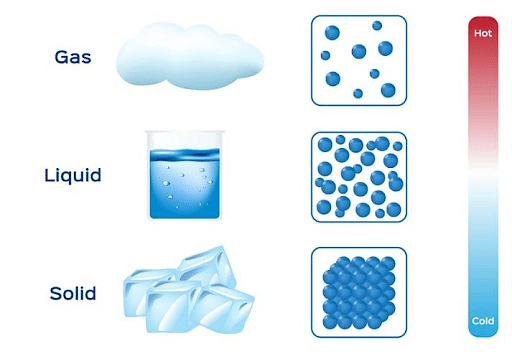
The particles, like ions, atoms, or molecules, are tightly packed together in the solid. The forces between the particles are intense in such a way that the particles can not move freely. However, they can only vibrate. This is the reason why the solid has a stable, definite shape and a certain volume.
Read More: Difference Between Electrophile and Nucleophile
A liquid is considered to be an almost incompressible fluid that takes the shape of its container but retains an almost constant volume independent of the pressure. In liquids, volume is defined if temperature and pressure are constant. Solid becomes liquid as the solid is heated beyond its melting point because the pressure becomes greater than the triple point of the material.
The molecules have enough kinetic energy within a gas such that the impact of the intermolecular forces is small or zero for the ideal gas and the normal distance between the adjacent molecules is much greater than the molecular size.
Also check:
What is Solid?
The solid matter has a defined shape, boundaries, and fixed volumes, implying that it is not compressible. When exposed to external stress, solids tend to keep their shape. Solids may break when pressed, but changing their shape is difficult, hence they are inflexible. Solids include things like solid ice, sugar, rock, wood, etc.

The solid-state of matter has the properties listed below:
- At normal temperature, solids take up space.
- Solids cannot move from one place to another on their own, yet at room temperature, they can vibrate.
- After being heated, they vibrate more and begin to move in random patterns.
- When solids melt at high temperatures, they become liquids. When you heat iron, for example, it melts.
- Solids have a strong interparticle force, resulting in a reduction in interparticle space and kinetic energy.
- Deposition is a method of converting solids to gases.
- Particles in solids are densely or closely packed.
- Because the gaps between the particles are so small, compressing them is difficult.
- The shape and volume of a solid are fixed.
Read More:
What is Liquid?
Liquids do not have a defined shape, but they do have a defined volume. Liquids flow and alter the shape, making them fluid rather than stiff. Solids and liquids both can diffuse into liquids. Gases from the atmosphere diffuse into the water and disintegrate. These gases, particularly oxygen and carbon dioxide, are necessary for aquatic creatures and plants to survive. The presence of dissolved oxygen in water allows aquatic species to breathe underwater. The rate of diffusion of liquids is faster than the rate of diffusion of solids. This is because particles in the liquid state move freely and have more space between them than particles in the solid-state. Water, milk, blood, coffee, and other liquids are examples of the liquid state of matters.

The liquid state of matter has the following properties:
- As the particles move constantly, liquids move everywhere inside the volume filled by the liquid.
- Liquids have a strong interparticle force, enough kinetic energy, and more interparticle space than solids.
- Due to the solidification process, it can be transformed into solids.
- Evaporation is the conversion of liquids to gases.
- When the temperature rises, the liquid particles begin to flow more quickly.
- Liquids are difficult to compress because there is less space between particles for particles to migrate.
- Liquids have a constant volume but no constant shape.
- In liquids, the rate of diffusion is faster than in solids.
- The attraction between particles is weaker than that between solids.
Read More:
What is Gas?
In comparison to solids and liquids, gases are extremely compressible. Large volumes of gas can be compressed into a tiny cylinder and carried easily due to its great compressibility. Gases have the property of diffusing very quickly into other gases due to the high speed of particles and huge space between them. The particles in the gaseous state move around at a high rate and at random. The gas exerts pressure on the container walls due to the force exerted by gas particles per unit area on the container walls. Air, helium, nitrogen, oxygen, carbon dioxide, and other gases are examples of the gaseous state of matter.

The gaseous state of matter has the following properties:
- Gases do not have an interparticle space, therefore they move arbitrarily and quickly in the full space available to them.
- They don't have a defined volume and space.
- Condensation is a process that allows gases to turn into liquids.
- In comparison to solids and liquids, the gaseous state has the highest compressibility.
- Diffusion is faster in gases than in solids and liquids.
- Sublimation is the process of converting gases into solids.
Read More:
What is Plasma?
The state is made up of super-excited and super-energetic particles. Ionized gases are the form of these particles. Plasma is used in fluorescent tubes and neon sign bulbs. There is neon gas within a neon sign bulb, and there is helium gas or another gas inside a fluorescent tube. When electrical energy passes through the gas, it becomes ionized, or charged. This charges the tube or bulb, resulting in a plasma glow inside the tube or bulb. Depending on the type of gas, the plasma flashes in a different color. The presence of plasma in the Sun and stars causes them to glow. Plasma is formed in stars due to their extremely high temperatures.
Also Read:
Bose-Einstein Condensates
Satyendra Nath Bose, an Indian scientist, calculated the existence of a fifth state of matter in 1920. Albert Einstein anticipated a new form of matter based on his calculations: the Bose-Einstein Condensate (BEC). The BEC is created by cooling gas with an extremely low density, roughly one-hundredth that of regular air, to extremely low temperatures.
Read More:
Difference between Solid, Liquid and Gas
The difference between the three states of matter, solid, liquid, and gas are tabulated below-
| Specific | Solid | Liquid | Gas |
|---|---|---|---|
| Definition | It's a type of matter with a solid structure and a distinct shape. | They are fluids with no fixed structure but a defined volume. | Gas is a state of matter that does not have a shape and instead takes on the shape of the container it is placed in. |
| Kinetic Energy | Its kinetic energy is the lowest. | It has a medium level of kinetic energy. | They have the most kinetic energy. |
| Compression | Solid does not get compressed. | Liquids are incompressible. | Gas is compressible to a great extent. |
| Volume and shape | Solid-state of matter has fixed volume and shape. | The liquid state of matter does not have a defined shape, they tend to shape according to the container. | The gaseous state of matter neither has fixed volume nor shape. |
| Molecule Arrangement | Molecules are organized in a regular and close pattern in the solid-state of matter. | In the liquid state of matter, molecules are grouped sparsely at random. | Molecules are grouped sparsely at random in the gaseous state of matter. |
| Intermolecular Space | Solids have no intermolecular space. | In the liquid state of matter, the intermolecular space is moderate, but it exists. | The intermolecular space is free-flowing and abundant in the gaseous form of matter. |
| Intermolecular Attraction | In the solid form of matter, the force of attraction between molecules is extremely strong. | In the liquid state of matter, the force of attraction between molecules is quite weak. | In the gaseous state of matter, there is no intermolecular attraction between molecules. |
| Diffusion Rate | The diffusion rate in a solid-state of the matter is extremely low. | The diffusion rate of a liquid state of matter is moderate. | The rate of diffusion is high in the event of a gaseous form of matter. |
| Examples | Ice, Wood, Rock, Salt, etc. | Water, Blood, etc | Helium, Oxygen, Carbon dioxide, etc. |
Things to Remember
- When we look around us, we notice a wide range of objects in all shapes, sizes, and textures. Everything in the cosmos is made up of a material called "matter", by scientists. The variations in the characteristics of the particles of matter give rise to these states of matter.
- External factors such as pressure and temperature cause changes in the features of matter, which differentiate states of matter.
- The solid matter has a defined shape, defined boundaries, and fixed volumes, implying that it is not compressible. When exposed to external stress, solids tend to keep their shape.
- Liquids do not have a defined shape, but they do have a defined volume. Liquids flow and alter the shape, making them fluid rather than stiff. Solids and liquids both can diffuse into liquids. Gases from the atmosphere diffuse into the water and disintegrate.
- The rate of diffusion of the liquid state of matter is faster than the rate of diffusion of solids. This is because particles in the liquid state move freely and have more space between them than particles in the solid-state.
- Gases have the property of diffusing very quickly into other gases due to the high speed of particles and huge space between them. The particles in the gaseous state move around at a high rate and at random.
- The BEC is created by cooling gas with an extremely low density, roughly one-hundredth that of regular air, to extremely low temperatures.
Read More:
Sample Questions
Ques: Temperature change has the greatest impact on which state of matter? (2 marks)
Ans: Temperature changes have the greatest impact on gases. Gases have the most kinetic energy and occur at the highest temperature of all the states of matter. In an open system, increasing the temperature of the gas does not change the state of matter since the gas molecules become infinitely farther apart.
Read More:
Ques: Is it possible for matter to alter state? (3 marks)
Ans: Yes. A physical change in a matter is referred to as a change of condition. They are reversible alterations that do not entail any changes to the matter's chemical makeup. The matter is made up of millions of atoms and molecules that are constantly moving. Even the molecules in solids move, albeit insignificantly. When the matter is sufficiently heated, molecules move more quickly and with greater energy. A solid can turn into a liquid, and a liquid can turn into a gas if enough heat is applied. Similarly, when molecules are chilled, they slow down. When the matter is chilled to a given temperature, it undergoes modifications.
Read More:
Ques: Explain similarities between the three states of matter- solid, liquid, and gas. (3 marks)
Ans: Solid, liquid, or gaseous, matter can exist in one of three states. Other states of matter such as plasma, Bose-Einstein condensates, and neutron stars, may exist in extreme settings. The following are some of the things that the three states have in common.
- They're made up of a lot of microscopic particles.
- They have a certain mass and can occupy space.
- There is volume in these three states.
- The atoms in these three states are attracted to each other.
Read More:
Ques: Define intermolecular space. Describe it in terms of distinct states of matter. (3 marks)
Ans: The space between two molecules or atoms is known as intermolecular space.
- Because of strong intermolecular interactions, solids' molecules are closely packed and only oscillate around their mean positions. There is no intermolecular gap between solids.
- The molecules in a liquid are packed densely together due to weak intermolecular interactions. These forces are weaker than those exerted by solids but stronger than those exerted by gases. Liquids have a fixed volume and can take on the shape of a vessel with ease. The intermolecular spacing is small but noticeable.
- Particles in gases are separated by a large distance. Because the force of attraction between the particles is low, they are free to move around. Gases are not defined by their volume or shape. The intermolecular space is abundant and free-flowing.
Read More:
Ques: What are the properties of the different states of matter? (3 marks)
Ans: Individual particles in solids are densely packed, with little room for mobility. Solids have a defined volume and a defined shape because of this. Individual particles in liquids are packed less closely than in solids (when compared to solids). This is why liquids have a specific volume but no specific shape. They tend to take on the shape of the container in which they are placed. Finally, the constituent particles in gaseous substances are arranged in a spaced-out pattern. As a result, gaseous substances lack a defined volume or shape.
Read More:
Ques: How do you explain the matter? What is the source of the information? (3 marks)
Ans: We are surrounded by matter. Atoms and compounds are made up of extremely small particles of the substance. These atoms continue to form the things you see and touch every day. Anything that has mass (volume) and occupies space is defined as matter. Small particles make up the matter as well. Atoms are the building blocks of matter. Atoms are invisible because they are so little. The majority of atoms combine to form the visible material.
Read More:
Ques: Is it possible for matter to exist in two states at the same time? What is the significance of the three states of matter? (3 marks)
Ans: Pressure can change the state of matter. Certain things vary a lot, but they usually only exist in two states and require human and technical assistance to get through all three stages. Water is the only substance on the planet that can exist in all three states: solid, liquid, and gas. Solids, liquids, and gases are the three forms of matter. The importance of understanding the particle nature of matter cannot be overstated. The particles that make up matter are atoms and molecules, not "little solid pieces" or "tiny liquid drops." The physical properties of such atoms and molecules govern their state.
Also Read:



Comments