



Content Writer-SME
Area, in geometry, is the two-dimensional measurement of the amount of space occupied by a shape or a surface. It is a measure of the extent of a surface in space. An area is defined as the space or region in the 2-D plane, enclosed by a closed geometric figure. An area formula is a mathematical expression that can help calculate the area of a particular shape or region. Moreover, area formulas are useful tools for practising and for understanding the geometry of shapes.
Area of Geometric Figures
[Click Here for Sample Questions]
Those shapes or forms which can be explained by geometry are called geometric shapes. These include angles, curves, lines and combinations of points.The area of various geometric figures is calculated using mathematical expressions known as area formulas.
- The area formula, in mathematics, is a symbolic representation of a space.
- The shape for which you are doing the calculation determines the area formula.
- The square, triangle, rectangle, circle, parallelogram, etc. are some of the most important geometric figures.
- Area formulas define the mathematical relationship between a shape's measurements and the area it occupies.
- Usually, the area formulas are expressed in square units.
Area of a Square
[Click Here for Sample Questions]
The area formula of a square is the measurement of how much space or surface it takes up. Therefore, it is equal to the product of its two sides’ lengths. Because the area of a square is equal to the product of its two sides, the area is given in square units.
Area of a Square = a x a = a2
Here a refers to the side of the given square.
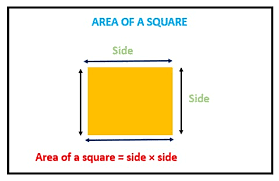
Area of Square
Example: 1 Find the area of square if one of the side is 6 cm.
Solution: In the given question, side of square is equal to 6 cm. To find the area of square, we will apply the area forumula which is given as:
Area of square= Side X Side
Thus, Area of given square = 6 X 6 = 36 cm2.
Area of a Rectangle
[Click Here for Sample Questions]
The area formulas are applicable to different shapes having defined dimensions. The area covered by a rectangle within its four sides is known as the area of a rectangle.
- The area of a rectangle is calculated using a formula that is dependent on its length and breadth (or width).
- The area of a rectangle is computed by multiplying the length and breadth (or width) of a rectangle in square units.
Area of a Rectangle = Length x Breadth= L x B
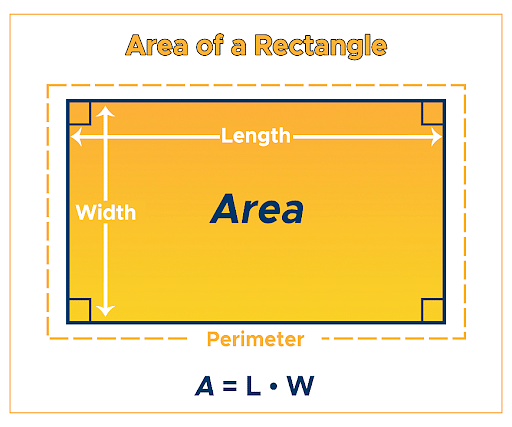
Area of Rectangle
Example: 2 Calculate the breadth of rectangle whose area and length are 24 cm2 and 4 cm respectively.
Solution: Here in this question, the area of rectangle = 24 cm2 (given)
Length of rectangle = 4 cm, and Breadth of rectangle = Unknown
We have to find the breadth of rectangle,
Thus, Area formula for rectangle = Length X Breadth
24 = 4 X Breadth
Therefore, Breadth of rectangle = 6 cm.
Area of Triangle
[Click Here for Sample Questions]
The area of a triangle is the area enclosed by its three sides. The area of a triangle is equal to half the product of its base and perpendicular height (length), given in square units.
Area of a Triangle = ½ x base x height

Area of Triangle
Example: 3 Calculate the area of the triangle whose base is 14 cm and height is 10 cm?
Solution: Area of a triangle = ½xbxh
Given, base = 14 cm & height = 10 cm
Area = ½ x 14 x 10 = 70 cm².
Area of a Circle and a Semi-circle
[Click Here for Sample Questions]
The area of a circle (or semi-circle) is the space occupied within the circumference of the circle (semi-circle). The area of a circle and semi-circle is calculated by using the formula:
Area of Circle = πr2 or πd2/4 square units

Area of Circle
Area of a Semi-circle = ½ x πr2 or πd2/8 square units
where π = 22/7 or 3.14, r is the radius of the circle, and d is the diameter of the circle.
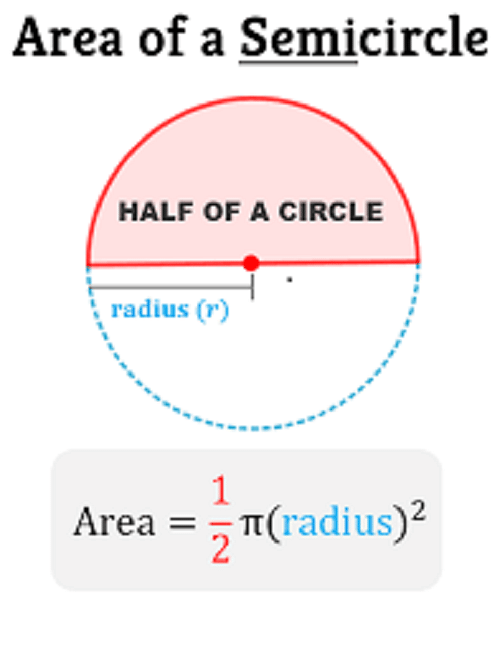
Area of Semicircle
Area of a Parallelogram
[Click Here for Sample Questions]
The area of a parallelogram is the area enclosed by its four sides in a two-dimensional space. The area of a parallelogram is calculated by using the formula:
Area = b x h sq. units
Here b refers to the base while h refers to the height of the parallelogram.
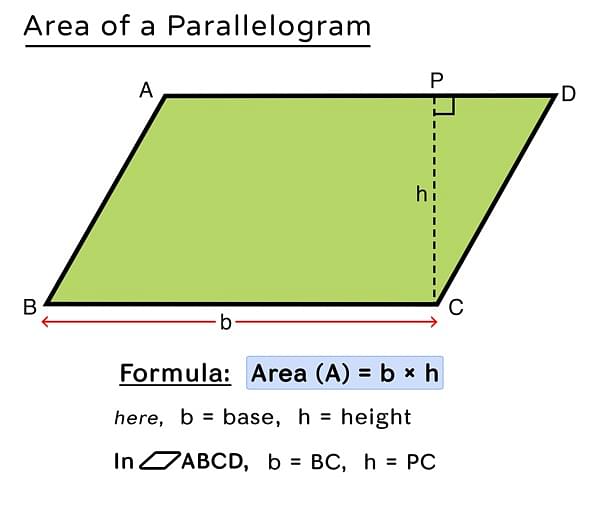
Area of Parallelogram
Area of 3D Shapes
The shapes that have three dimensions are termed 3D shapes such as cube, cuboid, cylinder, sphere and cone. These shapes have length, breadth and thickness/height. Tabulated below are the formulas for the various 3D shapes:
| Shape | Surface Area |
|---|---|
| Cube | 6a2 |
| Cuboid | 2(bl + hl + hl) |
| Cylinder | 2πr(r + h) |
| Cone | πr(r + l) |
| Sphere | 4πr2 |
| Hemisphere | 3πr2 |
Conversion of Units
[Click Here for Sample Questions]
To measure the area of a region, various units are used. The conversion of all such units is given below:
- m2 to dm2
1 meter = 10 decimetre
1 m2= 10 × 10 = 100 dm2
- m2 to cm2
1 meter = 10 centimetre
1 m2= 100 × 100 = 10000 cm2
- m2 to mm2
1 meter = 10 mm
1 m2= 1000 × 1000 = 1000000 mm2
- m2 to dam2
1 meter = 0.1 decametre
1 m2= 0.1 × 0.1 = 0.01 da m2
- m2 to hm2
1 meter = 0.01 hectometre
1 m2= 0.01 × 0.01 = 0.0001 hm2
- m2 to km2
1 meter = 0.01 kilometre
1 m2= 0.001 × 0.001 = 1 × 10 -6kilo m2
- dm2 to m2
1 dm= 0.1 m
1 dm2= 0.1 × 0.1 = 0.01 m2
- cm2 to m2
1 cm= 0.01 m
1 cm2= 0.01 × 0.01 = 0.0001 m2
- mm2 to m2
1 cm= 0.001 mm
1 mm2= 0.001 × 0.001 = 1 × 10 -6m2
- dam2 to m2
1 dam= 10 m
1 dam2= 10 × 10 = 100 m2
- hm2 to m2
1 hm= 100 m
1 hm2= 100 × 100 = 10000 m2
- km2 to m2
1 km= 100 m
1 km2= 1000 × 1000 = 1000000 m2
Things to Remember
[Click Here for Sample Questions]
- An area is the enclosed space, in a two-dimensional plane, occupied by any geometric figure.
- Area formula for different shapes be it 2D figures or 3D figures is different.
- The area of a square is side x side while the area of a rectangle is length x breadth.
- The formula of area of a triangle = ½ x base x height applies to all types of triangles– scalene, isosceles, equilateral.
- If the conversion is from a larger unit to a smaller unit, multiply and if the conversion is from a smaller unit to a larger unit, divide.
Solved Questions
Ques. What will be the area of the shaded portion? (4 Marks)
Ans. Area of the square = side x side = 14 cm × 14 cm = 196 cm²
Radius of the semicircle = 14 ÷ 2 = 7 cm
Area of two equal semicircle = 2 × ½πr2
= πr2
= 22/7 × 7 × 7
= 154 cm²
Area of the shaded portion in the given figure = 196 cm² – 154 cm² = 42 cm².
Ques. The length and breadth of a rectangular piece of land are 400 m and 200 m respectively. Find:
(a)The area of the land
(b)The cost of the land, if the land costs Rs8,000/m² (5 Marks)
Ans. Length of the rectangular piece of land = 400 m
Breadth = 200 m
Area of rectangle = Length x Breadth
= 400 x 200 m²
= 80, 000 m²
Therefore, area of the land = 80,000 m²
Now,
1 m² of the land costs = Rs 8,000
80,000 m² will cost = 80,000 x 8,000 = Rs 64,00,00,000
Ques. Calculate the breadth of a rectangular plot of land, if its area is 240 square meters and the length is 20 m. (2 marks)
Ans. Area = 240 square m (given)
Length (l) = 20 m
Area of a rectangle = l x b
240 = 20 x b
b = 240/20 = 12 m
Ques. Calculate the area of the shaded portion in the figure that is given below. (4 Marks)
Ans. Area of the square = (Side)² = 10 cm × 10 cm = 100 cm²
Area of the circle = πr²
= 22/7 × 3.5 × 3.5
= 77/2 cm²
= 38.5 cm²
Area of the shaded region in the given figure = 100 cm² – 38.5 cm² = 61.5 cm²
Ques. A rectangle park is 40 m long and 20 m wide. A path 2.5 m wide is constructed outside this park. Find the area of the path. (5 Marks)
Ans. Length of the rectangular park = 40 m
Breadth of the park = 20 m
Area of the park = l × b = 40 m × 20m = 800 m²
Length of the park including the path = 40 m + 2 × 2.5 m = 45m
Breadth of the park including the path = 20 m + 2 × 2.5 m = 30m + 5m = 25m
Area of the park including the path = 45 m × 25 m = 1125 m²
Area of the path = 1125 m² – 800 m² = 325 m²
Hence, the required area = 325 m².
Ques. From a rectangular sheet of paper of dimensions 5 cm × 4 cm, a square piece of dimension 2 cm × 2 cm. What will be the ratio of the areas of the two figures? (3 Marks)
Ans. Length = 5 cm
Breadth = 4 cm
Area of the sheet = l × b = 5 cm × 4 cm = 20 cm²
Area of the square piece = 2 cm × 2 cm = 4 cm²
Ratio of areas of two figures = 20 cm² : 4 cm² = 5 : 1
Ques. Consider that the area of a square and a rectangle are equal. If the side of the square is 60 cm and the breadth of the rectangle is 30 cm, find the length of the rectangle. (4 Marks)
Ans. Area of square = (side)²
= 60 cm × 60 cm = 3600 cm²
It is given that,
Since the area of the rectangle = the area of the square
Area of the rectangle = 3600 cm², breadth of the rectangle = 30 cm.
Area of the rectangle = l × b
or 3600 = l × 30
or 3600/ 30 = l or l = 120 cm
Ques. The radius of the larger circle is 20 cm and the radius of the smaller circle is 6 cm. Find:
(a) the area of the circle which is larger
(b) the area of the smaller circle
(c) the shaded area between the two circles. (π = 3.14) (5 Marks)
Ans. (a) Radius of the larger circle = 20 cm
So, area of the larger circle = πr²
= 3.14 × 20 × 20 = 1256 cm²
(b) Radius of the smaller circle = 6 cm
Area of the smaller circle = πr²
= 3.14 × 6 × 6 = 113.04 cm²
(c) Area of the shaded region = 1256 cm² - 113.04
= 1142.96 cm²
Ques. Find the height if the area of the parallelogram is 24 cm² and the base is 6 cm. (3 Marks)
Ans. Area of parallelogram = b × h
Therefore, 24 = 6 x h
Or 24/6 = h
or h = 4 cm
Thus, the height of the parallelogram will be 4 cm.



Comments