



Content Curator
Geometry is the branch of mathematics that deals with the shape, size, angles, and dimensions of objects. We are able to understand all the shapes we see in our life better through various shapes in geometry. It helps us in measuring and calculating the volume, area, and perimeter of various shapes. In Geometry, we learn about different angles, lines, transformations, congruences and similarities in various figures.
Read Also: Section Formula
| Table of Content |
Key Terms: Geometry, Two dimentional figure, Three dimentional figure, Polygons, Circles, Angles, Volume, Area, Geometric figure, Lines, Angles, Planes, Point
Geometry
[Click Here for Sample Questions]
Geometry can be defined as the branch of mathematics that deals with studying different types of sizes, shapes, figures, angles, and dimensions of various objects. Lines, angles, planes, and points are the base of geometry. All geometric figures are entirely based on these basic concepts.

Geometry – Lines and Angles
Branches in Geometry
[Click Here for Sample Questions]
Algebraic Geometry
Algebraic geometry includes solving sets of zeros by using polynomial and linear algebraic equations. This branch of geometry involves studying zeros of polynomials. The applications of algebraic geometry include string theory, cryptography etc.
Differential Geometry
Differential geometry employs techniques from calculus and algebra for solving applications. Its applications include general relativity etc. It is used to differentiate the natural properties of surfaces, shapes, and curves.
Convex Geometry
Convex geometry is used for problem-solving in number theory in functional analysis and optimization. It comprises convex shapes. The techniques used are of real analysis.
Discrete Geometry
It is concerned with simple geometric objects like triangles, circles, lines, points, squares, etc. and their relative position.
Euclidean Geometry
Euclidean geometry includes the study of two-dimensional (Plane figures) and three-dimensional (solid figures) shapes. It includes theorems and axioms relating to angles, planes, similarities, congruence, points, and solid figures. This geometry is applied in crystallography, mathematical problem solving, computer science, etc.
Topology
Topology is employed and applied in consideration of completeness, uniform spaces, continuity, hyperspace topologies, metric spaces, nets, proximal continuity, grills, filters, compactness, separation axioms, initial and final structures, function spaces, clusters and bunches, and proximity spaces. This geometry is concerned with properties of space under continued mapping.
Also Check: Circles
Formulas of Geometry
[Click Here for Sample Questions]
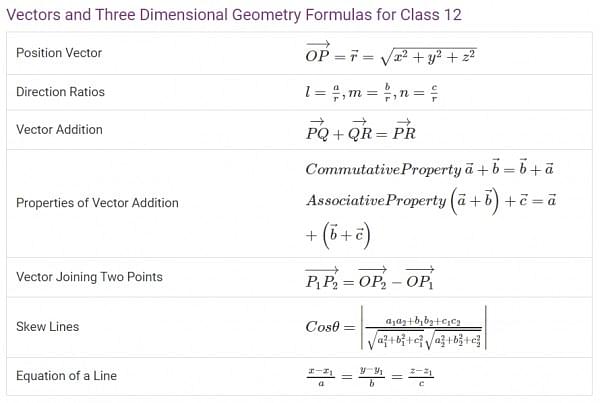
Formulas of Geometry
Also Check: Triangles
Two-Dimensional Geometry
[Click Here for Sample Questions]
Two-dimensional geometry is also known as plane geometry. It deals with flat shapes. This includes two-dimensional circles, triangles, and lines. Two-dimensional shapes only have length and breadth. Some two-dimensional shapes are square, circle, triangle, rectangle, etc.
Important terms in two-dimensional geometry:
Point
Point refers to a specific location on the plane. Point only has a position and no dimension. A point is represented by a dot.

Point
Read Further: Area Related to Circle
Line
Line is a combination of infinite points. It has no curves. The line is straight and has no breadth. It stretches in both directions infinitely. In reference to geometry, a horizontal line is an x-axis and a vertical line is a y-axis.
- Line Segment – A line with a starting point and an ending point is known as a line segment.
- Ray - A line with a starting point but no ending point is known as a Ray.

Line
Angles
When two rays meet, an angle is formed. The rays share a common endpoint, known as the vertex of the angle. There are four types of angles:–
- Acute Angle – An angle that is smaller than the right angle is called an Acute angle. It ranges from anywhere between 0 to 90 degrees.
- Obtuse Angle – An angle that is less than 180 degrees but more than 90 degrees is called an Obtuse angle.
- Right Angle – A Right angle is an angle forming 90 degrees.
- Straight Angle – A straight angle is an angle formed by a straight line. The angle is 180 degrees.

Angles
Read Also: Perimeter and Area of a Circle
Three-Dimensional Geometry
[Click Here for Sample Questions]
Three-Dimensional geometry is also called solid geometry. It involves three-dimensional objects like cylinders, cubes, prisms, and spheres. Three-dimensional shapes have breadth, height, and length. Some three-dimensional shapes have faces and some such as spheres don’t.

Three-Dimensional Geometry
Attributes of three-dimensional shapes:
Edges
The line segment on the boundary that joins two vertices to each other is called an edge. Edges are the faces that meet in a straight line. This forms the skeleton in three-dimensional shapes.
Also Check: Similarities of Triangle
Here are some three-dimensional shapes and the number of edges they have:
- Triangular Pyramid - 6 edges
- Square Pyramid - 8 edges
- Triangular Prism - 9 edges
- Pentagonal Pyramid - 10 edges
- Cube - 12 edges
- Hexagonal Pyramid - 12 edges
- Rectangular prism - 12 edges
- Pentagonal Prism - 15 edges
- Hexagonal Prism - 18 edges
Faces
Faces are flat surfaces that make up geometrical shapes. The face is always a two-dimensional figure for all three-dimensional shapes. The faces are enclosed together by the edges.
Here are some three-dimensional shapes and the number of faces they have:
- Triangular Pyramid - 4 faces
- Triangular Prism - 5 faces
- Square Pyramid - 5 faces
- Rectangular prism - 6 faces
- Cube - 6 faces
- Pentagonal Pyramid - 6 faces
- Pentagonal Prism - 7 faces
- Hexagonal Pyramid - 7 faces
- Hexagonal Prism - 8 faces
Read Also: Trigonometric Identities
Vertices
The point where the edges of the solid figure meet is called a vertex. Here are some three-dimensional shapes and the number of vertices they have:
- Triangular Pyramid - 4 vertices
- Square Pyramid - 5 vertices
- Triangular Prism - 6 vertices
- Pentagonal Pyramid - 6 vertices
- Hexagonal Pyramid - 7 vertices
- Rectangular prism - 8 vertices
- Cube - 8 vertices
- Pentagonal Prism - 10 vertices
- Hexagonal Prism - 12 vertices
Polygon
[Click Here for Sample Questions]
Polygon is a two-dimensional figure that is enclosed by a chain of straight line segments. The segments form a closed polygonal chain or circuit. There are 8 types of polygons:
- Triangle: A triangle has three sides and the sum of all the internal angles is always 180 degrees. A triangle can be an Equilateral, Isosceles, or Scalene triangle.
- Quadrilaterals: A quadrilateral has four sides and the sum of all the internal angles is always 360 degrees. It includes Square, Rectangle, Parallelogram, Rhombus, and Trapezium.
- Pentagon: A pentagon has five sides.
- Hexagon: A hexagon has six sides.
- Heptagon: A heptagon has seven sides.
- Octagon: An octagon has eight sides.
- Nonagon: A nonagon has nine sides.
- Decagon: A decagon has ten sides.

Types of Polygons
Read Also: Circumference of a Circle
Circle in Geometry
[Click Here for Sample Questions]
A circle is a shape that has no edges. The distance from the center to any point on the circle is the same and is called the radius of the circle. The length of a line that passes through the center from one point on the circle to another point on the circle is the diameter of the circle.

Circle in Geometry
Also Read:
| Related Articles | ||
|---|---|---|
| Complex Numbers and Quadratic Equations | Geometric Mean (G.M.) | Bayes Theorem Formula |
| Sequence and Series | Arithmetic Progressions Revision Notes | Real Numbers Formula |
Things to Remember
- Geometry can be defined as the branch of mathematics that deals with studying different types of sizes, shapes, figures, position angles, and dimensions of things.
- There are six branches of geometry: Algebraic geometry, differential geometry, convex geometry, discrete geometry, euclidean geometry, and topology.
- Two-dimensional geometry deals with flat shapes.
- The point, line, and angles are important attributes of two-dimensional geometry.
- Angles are of four types: acute, obtuse, right, and straight angle.
- Three-Dimensional geometry involves three-dimensional objects like cylinders, cubes, prisms, and spheres.
- Edges, faces and vertices are important attributes of three-dimensional geometry.
- A circle is a shape that has no edges.
- The distance from the center to any point on the circle is the same and is called the radius of the circle.
Also Check: Construction Formula
Sample Questions
Ques: List out the various branches of Geometry. (1 Mark)
Ans: There are six basic branches of geometry. These include:
- Algebraic geometry
- Differential geometry
- Convex geometry
- Discrete geometry
- Euclidean geometry
- Topology
Ques: Define Similarity and Congruency? (1 Mark)
Ans: When two figures have the same shape and size, they are called congruent figures. Two figures are said to be similar when they have the same shape but different sizes.
Ques: What is convex geometry? (1 Mark)
Ans: Convex geometry is a branch of geometry. Convex geometry is used for problem-solving in number theory in functional analysis and optimization. It comprises convex shapes. The techniques used are of real analysis.
Ques: What is Algebraic Geometry? (1 Mark)
Ans: Algebraic geometry includes solving sets of zeros by using polynomial and linear algebraic equations. This branch of geometry involves studying zeros of the multivariate polynomial. Such applications include string theory, cryptography, etc.
Ques: What is the difference between Euclidean Geometry and Topology? (2 Marks)
Ans: Euclidean geometry includes the study of two-dimensional (Plane figures) and three-dimensional (solid figures) shapes. It includes theorems and axioms relating to angles, planes, similarities, congruence, points, and solid figures. This geometry is applied in crystallography, mathematical problem solving, computer science, etc.
Topology is employed and applied in consideration of completeness, uniform spaces, continuity, hyperspace topologies, metric spaces, nets, proximal continuity, grills, filters, compactness, separation axioms, initial and final structures, function spaces, clusters and bunches, and proximity spaces. This geometry is concerned with properties of space under continued mapping.
Ques: What is the difference between Differential Geometry and Discrete Geometry? (2 Marks)
Ans: Differential geometry employs techniques from calculus and algebra for solving applications. Such applications include general relativity etc. it is used to differentiate the natural properties of surfaces, shapes, and curves. Discrete Geometry is concerned with simple geometric objects like triangles, circles, lines, points, squares, etc. and their relative position.
Ques: Find the direction of cosines if a line makes angles 90°, 135°, 45° with the x, y and z-axes respectively. (3 Marks)
Ans: Let the direction cosines of the line be l, m and n.
If, α = 90°, β = 135° and γ = 45°
So,
l = cos α, m = cos β and n = cos γ
So direction cosines are
l = cos 90° = 0
m = cos 135°= cos (180° – 45°) = -cos 45° = -1/√2
n = cos 45° = 1/√2
Direction cosines of the line = 0, -1/√2, 1/√2
Ques: What is a Polygon? Define its types. (5 Marks)
Ans: Polygon is a two-dimensional figure that is enclosed by a chain of straight line segments. The segments form a closed polygonal chain or circuit. There are 8 types of polygons:
- Triangle: A triangle has three sides and the sum of all the internal angles is always 180 degrees. A triangle can be an Equilateral, Isosceles, or Scalene triangle.
- Quadrilaterals: A quadrilateral has four sides and the sum of all the internal angles is always 360 degrees. It includes Square, Rectangle, Parallelogram, Rhombus, and Trapezium.
- Pentagon: A pentagon has five sides.
- Hexagon: A hexagon has six sides.
- Heptagon: A heptagon has seven sides.
- Octagon: An octagon has eight sides.
- Nonagon: A nonagon has nine sides.
- Decagon: A decagon has ten sides.
Ques: If 2x + 3y + 4z – 12 = 0, find the coordinates of the foot of the perpendicular drawn from the origin. (5 Marks)
Ans: Let the coordinate of the foot of ⊥ P from the origin to the given plane be P(x, y, z).
2x + 3y + 4z = 12 …. (1)
Direction ratio are (2, 3, 4)
√[(2)2 + (3)2 + (4)2] = √(4 + 9 + 16)
= √29
Now,
Divide both the sides of equation (1) by √29, we get
2x/(√29) + 3y/(√29) + 4z/(√29) = 12/√29
lx + my + nz = d
Where, l, m, n are the direction cosines and d is the distance
∴ The direction cosines are 2/√29, 3/√29, 4/√29
Coordinate of the foot (ld, md, nd) = [(2/√29) (12/√29), (3/√29) (12/√29), (4/√29) (12/√29)]
= 24/29, 36/29, 48/29
For Latest Updates on Upcoming Board Exams, Click Here: https://t.me/class_10_12_board_updates
Check-Out:



Comments