



Exams Prep Master
Chloroplatinic acid is a commonly known inorganic compound with a chemical formula which is shortly written as H2PtCl6. Present in the form of an aqueous solution, chloroplatinic acid can be observed as small reddish brown crystals. These are efficiently trusted to be the most crucial commercial source of the metal, platinum. It serves multiple uses and must be handled correctly. Upon coming in contact with the skin, it may cause serious burns and redness. Let us read in depth about this inorganic compound, its properties, preparation and other applications.
| Table of Content |
Read More: Number of Moles Formula
What is Chloroplatinic Acid?
[Click Here for Sample Questions]
In Chemistry, Chloroplatinic acid is a type of inorganic compound which has been formed with the help of platinum. This red colour solid substance is formed by dissolving platinum in a complex mixture of nitric acid along with hydrochloric acid. This mixture is popularly known by the name aqua regia. Sometimes it is also prepared by dissolving it in chlorine infused in hydrochloric acid.
This acid is also called hexachloroplatinic acid and serves as the most quickly available compound of the metal platinum. Apart from serving as a crucial commercial source for this metal, this compound possesses a melting point of 60 °C. It is received as a by-product from the mixture for later being crystallised. It can be observed in the form of reddish brown crystals with a specific gravity of 2.43.

Properties of Chloroplatinic Acid
[Click Here for Sample Questions]
- It is in the form of a brown deliquescent crystals with slight hints of red
- Its an inorganic compound which is highly soluble in water
- Has a melting point of 60 degree celsius
- Chloroplatinic acid starts to decompose upon reaching its boiling point
- The acid possess a molecular mass of 409.81 g/mol
- Has a density of 2.431 g/cm3
- It is known to be highly hygroscopic
- The chemical formula of chloroplatinic acid is H6Cl6O2Pt
Storage of Chloroplatinic Acid
- Being hygroscopic in nature, chloroplatinic acid must always be stored inside a glove box filled with dry inert gas.
- Once opened, it must be sealed back after use with the help of dry inert gas.
- You can use it only once for water absorption or degradation.
- Always keep away from sunlight and store in a dry atmosphere.
- It should be kept in a well ventilated area.
Read More: Gay-Lussac’s Law
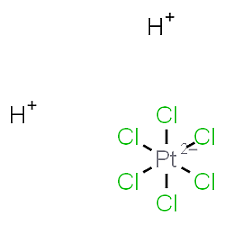
Structure and Formula of Chloroplatinic Acid
[Click Here for Sample Questions]
The IUPAC name of chloroplatinic acid is also known as Dihydronium hexachloroplatinate(2–), platonic chloride solution, or hexachloroplatinic acid solution.
The linear formula of chloroplatinic acid is mentioned as below,
| H2P2Cl6.xH2O |
Application of Chloroplatinic Acid
[Click Here for Sample Questions]
The popularity of chloroplatinic acid has touched many fields. They have been widely used in galvanising glass for a long time. Let us take a look at their contribution.
- Used in purification of platinum metal - When chloroplatinic acid is treated with ammonium salts, it starts changing and takes up the form of ammonium hexachloroplatinate. When the acid is subjected to heating in the presence of hydrogen, it transforms into elemental platinum.
- Catalysis - Chloroplatinic acid plays the role of a catalyst for chemical reactions related to hydrogenation. During catalysis, when silicon hydrides are added, it converts them to olefinic consisting of double bonds. Similarly, like other platinum compounds, the acid catalyses the addition of silanes and thereby changes them into alkenes.
- While determining potassium - In this method, from the whole solution, selective precipitation of potassium takes place. It is left over in the form of potassium hexachloroplatinate.
Read More: Relation between Molarity and Molality
Preparation of Chloroplatinic Acid
[Click Here for Sample Questions]
There are a number of methods which can be used in order to prepare chloroplatinic acid. The most popular method is dissolving platinum in aqua regia which will lead to giving us our desired result. Hexachloroplatinic acid can also be produced by electrolysis or by dissolving platinum particles in an aqueous solution and exposing the solution to chlorine gas.
Upon being produced with the assistance of aqua regia, the following equation is formed.
Pt + 4 HNO3 + 6 HCl → H2PtCl6 + 4 NO2 + 4 H2O
The solution thus obtained appears to be orange in colour. It is subjected to evaporation which ultimately leaves behind chloroplatinic acid in its crystallised form which is the form of red brown crystals.
Upon being heated, chloroplatinic acid disintegrates into platinum chloride.
(H3O)2PtCl6·nH2O → PtCl4 + 2 HCl + (n + 2) H2O
Things to Remember
- A hydronium salt of the hexachloroplatinate anion, Chloroplatinic acid is a commonly known inorganic compound in Chemistry. It is also known as hexachloroplatinic acid and has a great affinity towards water. Because it reacts so vigorously, it must be stored in an airtight box, preventing it from coming in contact with sunlight.
- The molecular formula of chloroplatinic acid is given as Cl6H4Opt whereas its linear formula is H2PtCl6.xH2O. This platonic solution of chloride is essential while preparing indelible ink, mirrors, and pumice stones. Industrial sectors are also dependent on them for making glass and photographic prints. It has a melting point of 60 degree celsius.
- Chloroplatinic acid acts as a promising catalyst for processes like hydrogenation. This hygroscopic compound’s boiling point is observed at that record where it starts to decompose. With a molecular mass of 409.81 g/mol, it should always be placed in an area owing to proper ventilation. The only drawback it has as a catalyst is its deliquescent nature.
- It readily fulfils its purpose in the catalysis of hydrosilanes to olefins. Utilised as a means to determine potassium, chloroplatinic acid has other wider applications as well. In its crystallised form, the reddish brown crystals must be always stored in a moisture-free environment. The effects of chloroplatinic acid may be harsh on the skin leading to burns.
Read More:
Sample Questions
Ques. What is chloroplatinic acid? (2 marks)
Ans. Chloroplatinic acid is an inorganic compound in chemistry which is known for being hygroscopic. Upon coming in contact with the skin, it can cause itchiness and a burning sensation, which is why it should be kept away from reach. When chloroplatinic acid is subjected to heat, it gives out chloride fumes as its by-product, mainly called as platinum IV chloride.
Ques. Are chloroplatinic and hexachloroplatinic the same thing? (2 marks)
Ans. Yes, chloroplatinic acid and hexachloroplatinic acid are indeed the same thing. These are the IUPAC names of the given acid. This inorganic compound also has other names like Dihydronium hexachloroplatinate(2–) and has a molecular formula Cl6H4Opt. The acid serves as a commercial source of the metal platinum.
Ques. What happens when Chloroplatinic acids come in contact with ammonium salt? (2 marks)
Ans. Because of its highly acidic nature, hexachloroplatinic acid, when being treated with ammonium salt, changes its form into ammonium hexachloroplatinate. This ammonium salt may be ammonium chloride. When this salt is heated with hydrogen present in its environment, it converts to platinum. This is the process from which platinum is often recycled.
Ques. Define the production of chloroplatinic acid. (2 marks)
Ans. One may opt for many solutions for preparing chloroplatinic acid. This may be
- Dissolving platinum in aqua regia, or
- Exposing the solution consisting of platinum particles to chlorine gas
Upon being prepared from the first method, the solution is exposed to evaporation, after which leaves reddish brown crystals. This may disturb the nitrosonium chloroplatinate.
Ques. Name some uses of chloroplatinic acid. (2 marks)
Ans. The hexachloroplatinic acid serves multiple uses in different fields. They are commonly known for their role in the purification of platinum. Apart from this chloroplatinic acid is also used in catalysis to convert silicon hydrides into olefines. The acid helps to find out potassium by the method of selective precipitation. They are also used to make mirrors, plating baths, and irremovable ink.
Ques. What are the properties of chloroplatinic acid? (2 marks)
Ans. Chloroplatinic acid possesses certain characteristics. These are,
- Reddish brown solid
- Highly reactive with water
- Greater solubility in water
- Has a melting point of 60âÂ,,ƒ
- Molecular mass of 409.81 g/mol
Ques. What are the things to remember while handling chloroplatinic acid? (2 marks)
Ans. It is important to remember certain points while storing chloroplatinic acid. These are as follows,
- Store it in a tight jar
- Keep it away from sunlight in a dry atmosphere
- Place it in a ventilated area free of moisture
- Fill it inside a glove box with dry inert gas
- Keep it sealed after usage
Ques. What is aqua regia? (2 marks)
Ans. Aqua regia is a reddins yellow liquid. It is a mixture of nitric and hydrochloric acids in their concentrated form. It is known to possess the ability to dissolve gold and platinum easily. The usage of aqua regia is popular in preparation of certain iron ores, selenium, slags and some sulphides. It is highly corrosive in nature and can cause burns upon being mishandled.
Related links:



Comments