



Education Journalist | Study Abroad Lead
Metallic bond is a type of chemical bond that is formed by the electrostatic attraction of conduction electrons and positively charged metal ions. Metallic bonding can be characterised as the sharing of free electrons among positively charged ions in a metal. Many physical characteristics of metals are due to metallic bonding. These characteristics include strength, ductility, thermal and electrical resistivity and conductivity, opacity, and brilliance.
| Table of Content |
Key Terms: Metallic Bond, Chemical Bond, Ions, Electrons, Atoms, Electrical resistivity, Conductivity, Opacity, Metal, Lattice
Metallic Bonds
[Click Here for Sample Questions]
A metallic bond is a chemical bond in which a cloud of free moving valence electrons bonds to positively charged ions in a metal. It is defined as the sharing of free electrons among positively charged metal ions in a lattice.
Metallic bonds have a completely different structure than ionic and covalent bonds. Metallic bonds are formed only between metal atoms. Ionic bonds connect metals to nonmetals and metallic bonds connect a large number of metal atoms.
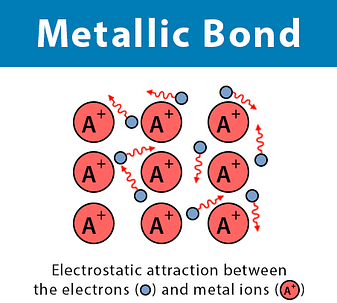
Metallic bonds can be found in pure metals and alloys, as well as certain metalloids. For example, graphene (a carbon allotrope) has two-dimensional metallic bonding. Other sorts of chemical bonds can be formed between the atoms of metals, even if they are pure. For example- the mercurous ion (Hg2+) can create metal-metal covalent bonds. Pure gallium creates covalent bonds between pairs of atoms that are connected to surrounding pairs via metallic bonds.
Also Read:
| Related Articles | ||
|---|---|---|
| Density of Unit Cell | Impurity Defects | Metal Excess Defect |
| Ferromagnetic Materials | Point defects | Frenkel Defect |
Functioning of Metallic Bonds
[Click Here for Sample Questions]
Electrons are liberated from the atoms and delocalized throughout the metal, allowing them to travel freely. Interactions between ions and electrons are still there.These interactions produce a binding force that keeps the metallic crystal together.
A metallic bond can be found in the binding force. The function of metallic bonding is explained in detail below:
- Outer energy levels (the s and p orbitals) of metal atoms overlap. At least one of the valence electrons in a metallic bond is not shared with a neighbouring atom, nor is it lost in the formation of an ion. Instead, the electrons form an ‘electron sea’ in which valence electrons can freely flow from one atom to the other.
- The electron sea model explains metallic bonding. Metallic bonding can be seen as a result of a material having more delocalized energy levels than delocalized electrons (electron deficit), which further causes localised unpaired electrons to become delocalized and mobile. Electrons may change energy levels and travel in any direction across a lattice.
- Metallic cluster formation, in which delocalized electrons flow around localised cores, is another kind of bonding. The development of bonds is highly influenced by environmental factors. For example, under high pressure, hydrogen acts as a metal. As pressure decreases, the transition of bonding takes place from metallic to nonpolar covalent bond.
Properties of Metallic bonds
[Click Here for Sample Questions]
Metals have various physical and chemical properties. These properties include the capacity to carry electricity and heat, a low ionisation energy, and a low electronegativity. Their physical characteristics include a glossy look, malleability and ductility. Metals have a crystalline structure but can easily be deformed.
Some of the basic properties of metals are:
Conductivity
Electrons in the electron sea are free to travel and transport charge, most metals are efficient electrical conductors. Conductive non-metals (such as graphite), molten ionic compounds, and aqueous ionic compounds all conduct electricity. Since electrons are free, if electrons from an external source are pushed into a metal wire at one end, the electrons would flow through the wire at the same pace and emerge at the other end.

Thermal Conductivity
Metals transmit heat because free electrons in the metals transport energy away from the heat source. The reason behind this is that atom vibrations (phonons) travel like a wave through a solid metal.

Malleability
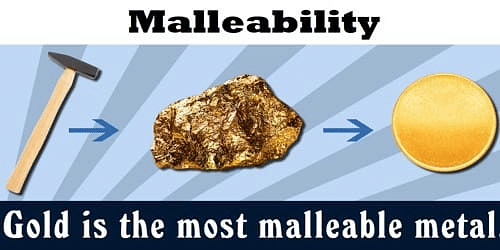
Metals are frequently malleable, or capable of being shaped or hammered into a shape. As the binding force between metals is asymmetric, drawing or sculpting a metal can not fracture it. The electrons in a metal are free to move away from one another and do not push like-charged ions together.
Ductility
Metals are ductile, or capable of being pulled into thin wires, because local connections between atoms are quickly broken and rebuilt. Single atoms or whole sheets of atoms can glide past each other and rebuild bonds.

Lustre
Metals are usually lustrous or have a metallic sheen. Once a certain minimum thickness is reached, they become opaque. Photons are reflected off the flat surface of the electron sea. The amount of light that can be reflected has an upper frequency limit.

Examples of Metallic Bonds
[Click Here for Sample Questions]
The metallic bonds are really common in metals. Few examples are mentioned below:
- Sodium (Na)- The outermost orbital of sodium, the 3s orbital, possesses a single electron. When sodium atoms are arranged together, the outermost electron of one atom shares space with the equivalent electron of another atom. A 3s molecular orbital is formed as a result. Each sodium atom is surrounded by eight additional atoms. The sharing occurs between a core sodium atom and its surrounding 3s orbitals.
All of the 3s orbitals overlap, resulting in a large number of molecular orbitals that span the whole sodium metal. The outermost electrons of a metal are considered to be delocalized. These electrons are no longer bound to any single atom and can travel freely throughout the metal. - Magnesium (Mg)- Magnesium's outermost shell i.e. the 3s shell has two electrons. These electrons are delocalized. Magnesium forms metallic bonds in the same way as sodium, except that it has a higher electron density.
Furthermore, each magnesium nucleus has double the charge of a sodium nucleus. As a result, the attraction between the nuclei and the delocalized electrons will be greater than the attraction between the nuclei and sodium. The bond strength is typically stronger in magnesium. - Aluminum (AI)- The 3s orbital of aluminium has three valence electrons. Aluminium ions have a positive charge +3 when all three electrons are lost from the atoms. These positively charged ions resist one other, while the negative electrons keep the block together.
The cations maintain a consistent pattern due to the sharing of electrons. The crystalline structure of metals is formed by this orderly arrangement of atoms. Atoms in a crystal lattice are packed closely together to optimise binding strength.
Importance of Metallic Bonds
[Click Here for Sample Questions]
- Metallic bonding has a vital role in metal characteristics.
- The electrical conductivity of metals is caused by electron delocalization.
- Metallic Bonds also provides high heat conductivity and heat transfer via metallic materials.
- In metallic bonds, electrons can easily transport energy and electricity across the metal.
- Metals are malleable and ductile, which means they can be moulded, bent, and formed into wires.
- Metal atoms have strong interactions with one another, resulting in high melting and boiling points.
Things to Remember
- Metallic bond is a type of chemical bond that is formed by the electrostatic attraction of conduction electrons and positively charged metal ions.
- Metallic bonds have a completely different structure than ionic and covalent bonds.
- Metallic bonds are formed only between metal atoms.
- Ionic bonds connect metals to nonmetals and metallic bonds connect a large number of metal atoms.
- Metallic bonding can explain various characteristics of metals.
- Metallic bonds can develop between various elements and form an alloy.
- The amalgams used in dentistry are made from various mercury alloys with other transition metals such as silver, copper, and zinc.
- Titanium metal is widely utilised in engineering, as well as in the production of osteosynthetic implants, industrial uses, and jewellery.
Read More:
Sample Questions
Ques: How is Metallic Bond formed? (2 Marks)
Ans: Metallic bonds develop when the charge is distributed across a greater distance than the size of individual atoms in solids. Left elements, like zinc and copper, make metallic bonds most of the time on the periodic table. Metal atoms are densely packed in a regular pattern because they are solid.
Ques: Are Metallic Bonds Stronger than Ionic? (2 Marks)
Ans: The metallic link is weaker than both the ionic and covalent bonds. Ionic bonds are electrostatic forces that occur between positive and negative ions. This connection is non-directional, which means that the electrons' attraction does not prefer one atom over another.
Ques: Are Metallic Bonds stronger than Covalent Bonds? (2 Marks)
Ans: Metallic bonds are formed as a result of partial attraction between the metal atoms and the metal's mobile electrons. As a result, there is no overlapping between any two atoms in a metallic connection. As a result, we may deduce that a covalent link is more powerful than a metallic bond.
Ques: What is the nature of Metallic Bonding in 3D? (3 Marks)
Ans: Metal aromaticity in metal clusters is an example of delocalization, which occurs often in three-dimensional configurations. Metals carry the delocalization principle to its logical conclusion, and a metal crystal may be thought of as a single molecule in which all conduction electrons are delocalized in all three dimensions. This indicates that, in general, molecules cannot be distinguished inside the metal, implying that metallic bonding is neither intra- nor inter-molecular. Metallic bonding is usually non-polar because there is minimal variation in the electronegativities of the atoms involved in the bonding contact, even in alloys. As a result, metallic bonding is a delocalized kind of covalent bonding.
Ques: How strong are the Metallic Bonds? (3 Marks)
Ans: Since the strength of a connection is determined by the atoms involved, it is difficult to rank different types of chemical bonds. Strong chemical bonds might be covalent, ionic, or metallic. Bonding may be strong even in molten metal. Gallium, for example, is nonvolatile with a high boiling point while having a low melting point. Metallic bonding does not even require a lattice if the conditions are correct. This has been seen in the case of amorphous glasses.
Ques: What does the strength of Metallic Bond means? (3 Marks)
Ans: Even in molten metals like gallium, metallic bonding may be quite strong. Despite the fact that gallium melts from the heat of one's touch barely above room temperature, its boiling point is not far from that of copper. Because of its strong metallic bonding, molten gallium is a highly non-volatile liquid. The strong bonding of metals in liquid form indicates that the energy of a metallic bond is not significantly reliant on the direction of the connection; this lack of bond directionality is a direct result of electron delocalization, and is best understood in contrast to covalent bond directional bonding.
For Latest Updates on Upcoming Board Exams, Click Here: https://t.me/class_10_12_board_updates
Check-Out:



Comments