



Education Journalist | Study Abroad Lead
Aluminium Sulfate is the most common aluminium coagulant. It comes in a variety of solid forms, including block, kibbled, ground, as well as a solution. Aluminium sulfate (Al2(SO4)3) is frequently, but mistakenly, referred to as 'alum' in waterworks practice. It is a white crystalline solid in its anhydrous state. In its solution state, aluminium sulfate appears as a colorless liquid. Aluminium Sulfate is non-toxic and non-combustible in both its forms. It is used as a coagulant and enhances particle collision by neutralizing charge in drinking water and wastewater treatment plants. In this article, we will learn more about aluminium sulfate as we explore its formula, structure, properties, and applications.
| Table of Content |
Read More: Difference Between Atom and Molecule
What is Aluminium Sulfate?
Filter Alum or Dialuminum trisulfate are other names for aluminium sulfate. In its anhydrous state, it is a white crystalline solid, while in its solution state, it is a colorless liquid. Both types are non-combustible and non-toxic.

Aluminium Sulphate
Aluminium sulfate is water-soluble but not ethanol soluble. It is odorless and has a sweet, moderately astringent flavor. It emits poisonous sulfur oxide gases when it decomposes. Aluminium is corroded by aluminium sulfate solution. This chemical is made in the lab by mixing sulphuric acid with aluminium hydroxide.
Also Read:
Aluminium Sulfate Formula
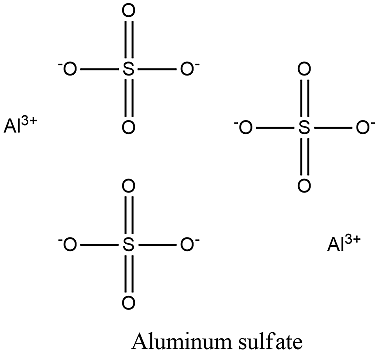
Aluminium sulfate is an ionic chemical compound, which implies that it contains both positive and negative ions. When an atom or molecule loses or receives electrons, it becomes an ion. Molecules can be either monoatomic (containing only one atom) or polyatomic (containing many atoms). The majority of ionic compounds have one metal atom that is a positive ion and one radical or negative ion that is a negative ion. When it comes to Aluminium Sulfate, the positive ion is Aluminium, which is represented by Al3+. The radical is a negative-charged sulfate ion, (SO4)2-. Because all ionic compounds are electrically neutral, the aluminium and sulphate ions react in a molecular weight ratio that cancels their electrical charges.
Read More: Difference Between Atom and Molecule

Aluminium Sulfate Formula
Aluminium Sulfate Structure
Here is how the compound aluminium sulphate looks like:
Aluminium Sulfate Properties
Al2(SO4)3 is the chemical formula for Aluminium Sulfate. It's a chemical substance that's commonly used as a coagulating agent in drinking water purification, paper production, and wastewater treatment plants.
Read More:
- In its anhydrous state, it is a white crystalline solid. It is, however, colourless in liquid form.
- Both of these types are non-toxic and non-combustible.
- Aluminium sulphate is water-soluble but not ethanol soluble.
- It has no odor and a somewhat astringent and sweet flavor.
- When it decomposes, it releases highly deadly sulphur oxide fumes.
- Aluminium is also corroded by the Aluminium Sulfate solution. This is created in the laboratory by combining Aluminium Hydroxide and Sulphuric Acid.
- Aluminium Sulfate has a molecular mass of 342.15 gm/mole (molar mass).
- Aluminium Sulfate has a density of 2.672 gm/cm3.
- Aluminium Sulfate has a boiling temperature of 214oC and a melting point of 770oF.
Also Read:
Preparation & Production of Aluminium Sulfate
i) In the laboratory-
-
Aluminium sulfate is made by mixing freshly precipitated aluminium hydroxide with the right amount of sulphuric acid. The liquid is then evaporated and allowed to crystallize. Pure, glossy crystals, granules, or powder are available.
2Al(OH)3 + 3H2SO4 → Al2(SO4)3 + 6H2O
- Heating aluminium metal in a sulfuric acid solution also produces aluminium sulphate.
2Al + 3H2SO4 → Al2(SO4)3 + 3H2↑
ii) From the schists of alum-
Iron pyrite, aluminium silicate, and numerous bituminous compounds make up alum. Upper Bavaria, Bohemia, Belgium, and Scotland are all home to these. These are either roasted or exposed to the air. Sulfuric acid is produced during the roasting process. It reacts with the clay to make Aluminium Sulfate, which is similar to what happens when the air weathers. After that, it is extracted using water and an Aluminium Sulfate solution with a specific gravity of 1.16. This solution is left to sit for a while before being evaporated till the iron (II) sulphate crystallises on cooling. It is then decanted from any sediment after being drawn off and evaporated until it reaches a specific gravity of 1.40.
Read More:
iii) From cryolite
When cryolite is used as an ore, it is combined with calcium carbonate and heated, resulting in the formation of sodium aluminate. The sodium aluminate is then extracted with water and precipitated with sodium bicarbonate or carbon dioxide and current passed through the solution. Sulfuric acid is then used to dissolve the deposit.
Read More:
iv) From bauxite or clay-
The material is calcined from clays or bauxite, then combined with sulfuric acid and water. Then it's gradually brought to a boil. Because the synthesis of Aluminum Sulfate is exothermic, no external heat is required if concentrated acid is used. It is then allowed to stand for a while before the clear solution is extracted.
Read More:
Applications of Aluminium Sulfate
- Aluminium sulfate is used in the production of paper.
- It's also used to create a variety of prints on fabric.
- It is used as a waterproofing agent and an accelerator in concrete.
- Aluminium sulfate is utilised in the production of firefighting foam.
- It is also utilised in water treatment plants for sewage treatment.
- Aluminium sulfate is utilised often as a fireproofing agent.
- It is used to make baking soda.
- It is employed in the dyeing of clothing.
- Aluminium sulfate is used in gardening to help balance the pH of the soil.
- Water purification employs the use of aluminium sulphate.

Uses of Aluminium sulfate
Things to Remember
- Aluminium sulfate is a colourless liquid in its solution form and a white crystalline solid in its anhydrous form. Both types are non-combustible and non-toxic.
- Millosevichite, a rare mineral, contains the anhydrous form of Aluminium Sulfate. For example, it is found in volcanic areas and on coal-mining waste dumps that are burning.
- In some industries, aluminium sulfate is referred to as alum or papermaker's alum. In general, the term "alum" is used to refer to any double sulphate salt. Its formula is XAl(SO4)2.12H2O, where X is a monovalent cation such as potassium or ammonium.
- Aluminium sulfate is created by reacting freshly precipitated aluminium hydroxide with the appropriate amount of sulphuric acid. The liquid is then evaporated and allowed to crystallise.
- Aluminium Sulfate is used as a coagulant. In the purification of drinking water and wastewater treatment plants, it encourages particle collision by neutralising charge.
Read More:
Sample Questions
Ques. What is the process of making Aluminium Sulfate? (3 marks)
Ans. When the exact amount of Sulphuric Acid is introduced to freshly precipitated Aluminium Hydroxide in the laboratory, Aluminium Sulfate is generated. The resultant solution is then evaporated and crystallised. Pure, glossy crystals, powder, or granules are available. The following is the reaction:
2Al(OH)3 + 3H2SO4 → Al2(SO4)3 + 6H2O
When aluminium metal is melted in a sulfuric acid solution, aluminium sulphate is formed. The following is the reaction:
2Al + 3H2SO4 → Al2(SO4)3 + 3H2↑
Ques. What kind of compound is aluminium sulfate? (2 marks)
Ans. Aluminium sulfate is an ionic compound made up of positive and negative ions. Monatomic ions (single atoms) and polyatomic ions (many atoms) are both types of ions (multiple atoms combined to form a charged part). Sulphate is the -2 polyatomic ion (SO4)-2, while aluminium produces a +3 ion, Al+3.
Read More:
Ques. Why is aluminium sulfate water soluble? (2 marks)
Ans. Aluminium sulfate is a chemical compound made from Al2(SO4)3. It is soluble in water and is largely employed as a coagulating agent (increasing particle collision by neutralizing charge) in drinking water and wastewater treatment plants, as well as in paper production.
Ques. Is aluminium sulfate a gas, a solid or a liquid? (2 marks)
Ans. Anhydrous aluminium sulphate is a crystalline white substance. Aluminum sulfate is also available as Al2(SO4)3.18H2O, which is an 18-hydrate. Both variants are water soluble, nonflammable, and harmless.
Ques. What does Aluminium Sulfate smell like? (2 marks)
Ans. Aluminium sulfate is a hygroscopic, odourless white crystalline substance that is mildly water-soluble but insoluble in organic solvents. This has a sour taste to it.
Read More:
Ques. What type of liquid is aluminium sulfate in a solution? (3 marks)
Ans: Filter Alum or Dialuminum trisulfate are other names for aluminium sulphate. In its anhydrous form, it is a white crystalline solid, while in its solution form, it is a colorless liquid. Both types are non-toxic and non-flammable. Aluminum sulfate is water-soluble but not ethanol soluble.
Ques. Briefly describe the applications of aluminium sulfate. (2 marks)
Ans. Aluminium sulfate (Al2(SO4)3)) is a water-soluble chemical compound. This chemical compound is mostly used as a coagulant in water purification, paper production and waste water treatment.
Read More:
Ques. Is Aluminium Sulfate a hazardous substance? (5 marks)
Ans. Aluminium sulfate does not cause cancer. However, it is known to irritate the skin and eyes, so if you're dealing with it, use caution and wear gloves and eye protection. If you happen to swallow Aluminum Sulfate in any way, it is somewhat hazardous since it produces Sulfuric Acid, which is quite corrosive.
When Aluminum Sulfate is mixed with water, it produces highly hazardous Sulfuric Acid, which burns the eyes and skin. Itching, red rashes, and a burning sensation result from any contact with the skin, while inhaling it irritates the lungs and throat. When inhaled, it causes shortness of breath and coughing almost immediately. Additionally, ingesting Aluminum Sulfate has a harmful impact on the lining of your stomach and intestinal tract. In the majority of cases, the person vomits, feels queasy, and has diarrhoea.
Also Read:



Comments