


Claisen rearrangement is one of the most powerful organic chemical methods where the formation of carbon-carbon bonds takes place. This method was discovered by German chemist Ludwig Claisen in 1912. Do not get confused with Claisen condensation and Claisen rearrangement because both are different reactions. In this article we will look into the mechanisms and variations of Claisen Rearrangement reactions in detail.
| Table of Content |
What is Claisen rearrangement?
Claisen rearrangement is a method of forming carbon carbon bonds. It is an organic chemical reaction named after its discoverer, the German chemist Ludwig Claisen who discovered it in 1912. It is a rearrangement reaction in which allyl vinyl ether is converted into a γ,δ--unsaturated carbonyl compound in presence of lewis acid and heat.
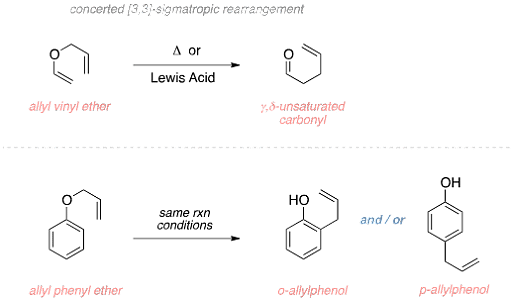
Claisen rearrangement belongs to the category of ‘sigmatropic rearrangement’. It is a reaction where all the bonds break and form at the same time.
Read More:
Mechanism of Claisen Rearrangement
Claisen rearrangement has an exothermic nature and pericyclic reaction. The arrangement reaction is converted and its intermediate transition state is cyclic as it releases energy. The reaction is accelerated by polar solvent effects up to greater extent.
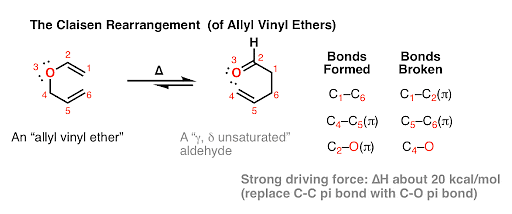
Mechanism of Claisen Rearrangement
For example, ethanol or water solvent mixtures give a 10-fold higher rate constant than sulfolane. Meta-substitution also affects the regioselectivity of this rearrangement.
Read More:
Allyl Vinyl Ethers
The heating of allyl vinyl ethers forms a transition state. The following reaction takes place leading to the formation of the required γ,δ - unsaturated carbonyl compound product. Breakage of the central C-C bond takes place and rearrangement of the two 3-carbon allyl fragments through an intermediate state occurs. The mechanism is given below:

Allyl Vinyl Ether Claisen Rearrangement
Allyl Phenyl Ethers
An electrocyclic process pushes those electrons around the six-membered ring. The resulting dienone now undergoes tautomerization to give more stable aromatic phenol. Thus, the required compound is formed.
This mechanism is given below:

Allyl Phenyl Mechanism
Variations of Claisen Rearrangement
Some of the most popular variations which improve the synthetic value of claisen rearrangement are given below:
| Sl.No. | Category | Process | Reaction mechanism |
|---|---|---|---|
| 1. | Aromatic Claisen rearrangement | The rearomatization of aryl allyl ethers is called the aromatic Claisen rearrangement. The carbon chain of a molecule is formed through etherification of alcohols or phenols and their Claisen Rearrangement under heat circumstances. |  |
| 2. | Bellus–Claisen rearrangement | Allylic ethers, amines, and thioethers react with ketenes to form,-unsaturated esters, amides, and thioesters. |
|
| 3. | Eschenmoser–Claisen rearrangement | This method takes place by heating allylic alcohols in the presence of N,N-dimethylacetamide dimethyl acetal to form γ,δ-unsaturated amide. |
|
| 4. | Ireland–Claisen rearrangement | This reaction produces a γ,δ-unsaturated carboxylic acid by reacting an allylic carboxylate with a strong base such as lithium diisopropylamide. |
|
| 5. | Johnson–Claisen rearrangement | This is an organic reaction of an allylic alcohol with an orthoester in the presence of carboxylic acid such as propionic acid to yield a γ,δ-unsaturated ester. |
|
| 6. | Photo-Claisen rearrangement | The production of ortho- and para-substituted phenols from phenyl ethers after irradiation is the main aim of this method. It is related to the Photo-Fries reaction which is a photochemical rearrangement of aromatic molecules. |
|


Hetero-Claisens
Hetero-Claisen rearrangement is a type of traditional Claisen rearrangement that requires a substrate with double bonds in α and β positions. Both double bonds can be classified as aromatic.

Hetero Claisen Rearrangement
One or more carbon atoms of the initial allyl vinyl ether were exchanged by hetero-atoms such as sulphur, nitrogen, or phosphorus in around a half-dozen known rearrangements. It is possible 3-oxa-1,5-hexadiene rearrangements in which one or more carbon atoms are substituted by non-carbon atoms. These reactions are known as heterodoxa-Claisen-rearrangements (HOCR).

Hetero Claisen Rearragement
Chromium Oxidation
On the opposite side of the unsaturated bond from the alcohol, chromium can oxidise allylic alcohols to alpha-beta unsaturated ketones. This is accomplished through a concerted hetero-Claisen reaction, although there are mechanistic differences because the chromium atom has access to d- shell orbitals, allowing the reaction to take place in a wider range of geometries.

Chromium Oxidation
Aza–Claisen
One of the pi-bonded moieties in the rearrangement can be a minimum.

Azo Claisen
Chen–Mapp Reaction
The Chen–Mapp reaction, also known as the [3,3]-Phosphoramidate Rearrangement or Staudinger–Claisen Reaction, replaces an alcohol with a phosphite and converts it to an imine via the Staudinger reduction. The fact that a P=O double bond is more energetically advantageous than a P=N double bond drives the subsequent Claisen.

Chen-Mapp Reaction
Overman rearrangement
The Overman rearrangement is a Claisen rearrangement of allylic trichloroacetimidates to allylic trichloroacetimidates through an immediate intermediate named after Larry Overman.

Overman Rearrangement
Zwitterionic Claisen rearrangement
Unlike traditional Claisen rearrangements, zwitterionic Claisen rearrangements happen at or below room temperature. Under mild circumstances, the acyl ammonium ions are extremely selective for Z-enolates.

Zwitterion Claisen Rearrangement
Claisen rearrangement in nature
Chorismate mutase catalyses the Claisen rearrangement of chorismate ion to prephenate ion, which is an important step in the shikimic acid pathway (the biosynthetic pathway towards the synthesis of phenylalanine and tyrosine).

Claisen rearrangement of chorismate ion
Things To Remember
- Claisen rearrangement is a method of forming carbon carbon bonds.
- Claisen rearrangement belongs to the category of ‘sigmatropic rearrangement’.
- Do not get confused with Claisen condensation and Claisen rearrangement because both are different reactions.
- Claisen rearrangement has an exothermic nature and pericyclic reaction.
- Meta-substitution also affects the regioselectivity of this rearrangement.
- Hetero-Claisen rearrangement is a type of traditional Claisen rearrangement that requires a substrate with double bonds in locations α and β positions.
Read More:
Sample Questions
Ques. What is the purpose of the Claisen rearrangement? Which acid is required for claisen reaction? (2 marks)
Ans. Claisen rearrangement is an organic chemical reaction that allows for the creation of carbon-carbon bonds in a very efficient manner. When exposed to heat or a Lewis acid, the reactant allyl vinyl ether is transformed into a gamma, delta-unsaturated carbonyl molecule.
Ques. Is there a difference between Claisen condensation and Claisen rearrangement? Claisen reaction is a what kind of reaction? (2 marks)
Ans. Claisen condensation is the reaction of an enolizable ester with a strong base to produce a -ketoester (not to be confused with Claisen rearrangement).
In the presence of a strong base, the Claisen condensation forms a carbon–carbon bond between two esters or one ester and another carbonyl molecule, resulting in a -keto ester or -diketone.
Ques. What is the difference between Claisen rearrangement and Cope rearrangement? Who invented the reactions? (3 marks)
Ans. The main difference between the Cope and Claisen rearrangements is that the Cope rearrangement uses a 1,5-diene as the reactant, whereas the Claisen rearrangement uses an allyl vinyl ether. Rainer Ludwig Claisen invented the Claisen rearrangement and Arthur C. Cope invented the Cope rearrangement. Both of these types of rearrangement have several variations.
Ques. Is it possible to reverse the Claisen rearrangement? Is the Claisen rearrangement a Sigmatropic reaction? (2 marks)
Ans. The Claisen rearrangement, in contrast to the Cope rearrangement, is basically irreversible since the products are significantly more stable than the reactants. The stereochemistry that happens at the rearranging carbon is carried through to the products (i.e. the reaction occurs stereospecifically)
Rainer Ludwig Claisen discovered the Claisen rearrangement in 1912, which is the first example of a [3,3]-sigmatropic rearrangement. Unlike other sigmatropic rearrangements, this one is essentially irreversible due to the production of a carbonyl group.
Read More:
Ques. What is Claisen rearrangement's mechanism? Describe the mechanism of Claisen rearrangement. (5 marks)
Ans. Claisen rearrangement is an organic chemical reaction that allows for the creation of carbon-carbon bonds in a very efficient manner. When exposed to heat or a Lewis acid, the reactant allyl vinyl ether is transformed into a gamma, delta-unsaturated carbonyl molecule.
Claisen rearrangement belongs to the category of ‘sigmatropic rearrangement’. It is a reaction where all the bonds break and form at the same time.
Mechanism of Claisen rearrangement
Claisen rearrangement has an exothermic nature and pericyclic reaction. The arrangement reaction is converted and its intermediate transition state is cyclic as it releases energy. The reaction is accelerated by polar solvent effects up to greater extent. For example, ethanol or water solvent mixtures give a 10-fold higher rate constant than sulfolane.
Allyl Vinyl Ethers
The heating of allyl vinyl ethers forms a transition state. The following reaction takes place leading to the formation of the required γ,δ-unsaturated carbonyl compound product. Breakage if the central C-C bond takes place and rearrangement of the two 3-carbon allyl fragments through an intermediate state occurs. The mechanism is given below:

Allyl Phenyl Ethers
An electrocyclic process pushes those electrons around the six-membered ring. The resulting dienone now undergoes tautomerization to give more stable aromatic phenol. Thus, the required compound is formed.
This mechanism is given below:

Ques. In a Claisen rearrangement, what solvent should be used? Give an example. (2 marks)
Ans. In the Claisen rearrangement, there are significant solvent effects, with polar solvents tending to speed the reaction more. The rate constants for hydrogen-bonding solvents were the greatest. For example, ethanol/water solvent combinations have 10-fold greater rate constants than sulfolane.
Ques. What is the Claisen rearrangement order? Is there a link between Claisen rearrangement and phenols? (3 marks)
Ans. This rearrangement reaction has first-order reaction kinetics. Polar solvents help to speed up the reaction. Hydrogen-bonding solvents allow for even faster reaction speeds and higher rate constants.
The [3,3]-sigmatropic rearrangement of an allyl phenyl ether to intermediate 1, which swiftly tautomerizes to a 2-allylphenol, was the first Claisen rearrangement recorded. The regioselectivity of this rearrangement is affected by meta-substitution.
Ques. For Claisen rearrangement, which method is best and why? (2 marks)
Ans. The interaction of an allylic alcohol with an orthoester to produce a,-unsaturated ester is known as the Johnson–Claisen rearrangement. This reaction has been catalysed using weak acids like propionic acid.
Ques. Describe Bellus–Claisen rearrangement and Photo-Claisen rearrangement. (2 marks)
Ans. In Bellus–Claisen rearrangement, allylic ethers, amines, and thioethers react with ketenes to form-unsaturated esters, amides, and thioesters.

In Photo-Claisen rearrangement, the production of ortho- and para-substituted phenols from phenyl ethers after irradiation is the main aim of this method. It is related to the Photo-Fries reaction which is a photochemical rearrangement of aromatic molecules.

Ques. Describe Hetero-Claisens (3 marks)
Ans. Hetero-Claisen rearrangement is a type of traditional Claisen rearrangement that requires a substrate with double bonds in locations α and β positions. Both double bonds can be classified as aromatic. One or more carbon atoms of the initial allyl vinyl ether were exchanged by hetero-atoms such as sulphur, nitrogen, or phosphorus in around a half-dozen known rearrangements. It is possible 3-oxa-1,5-hexadiene rearrangements in which one or more carbon atoms are substituted by non-carbon atoms. These reactions are known as heterodoxa-Claisen-rearrangements (HOCR).
Read More:



Comments