



Content Writer-SME
Wurtz reaction is an organic chemical reaction used to produce alkanes in laboratories along with a halogen and a compound containing sodium. It is a coupling reaction of two haloalkanes with sodium metal in the presence of dry ether. Wurtz reaction is one of the first-named reactions in Organic Chemistry. The chemical reaction is referred to as Wurtz-Fittig reaction when aryl halide is used in the place of alkyl halide, thereby changing the nature of reaction.
- The Wurtz reaction is named after Charles Adolph Wurtz, who provided experimental proof of the Wurtz reaction in the year 1855.
- Sir Charles Adolph Wurtz is also credited with the discovery of the aldol condensation reaction in organic chemistry.
- Wurtz reaction has many applications in the field of Organic Chemistry and organometallic chemistry.
- This type of chemical reaction generally fails when tertiary alkyl halides are used.
| Table of Content |
Key Terms: Wurtz Reaction, Haloalkanes, Organometallic Chemistry, Alkyl Halides, Wurtz Fittig Reaction, Alkanes, Organic Chemistry, Aldol reaction, Ether
What is Wurtz Reaction?
[Click Here for Sample Questions]
Wurtz reaction is named after the French Chemist Charles Adolphe Wurtz, who also discovered the aldol reaction. In the Wurtz reaction, two alkyl halides (Haloalkanes) react with sodium metal in the presence of dry ether to produce higher alkanes.
- In place of sodium metal, other elements such as activated copper, zinc, iron, silicon, or indium can also be used.
- Wurtz reactions can take place in a dry environment only.
- Sodium reacts with oxygen and moisture vigorously, thus an anhydrous condition is required.
- Sodium cannot be placed in a standard atmosphere because of its high reactivity, so it is placed inside kerosene.
- In place of anhydrous ether, tetrahydrofuran can also be used.
- This reaction uses alkyl free radical containing unpaired electrons in the outer shell to form alkanes.
- In the Wurtz reaction, free radicals are used as catalysts resulting in the formation of alkene as a by-product.
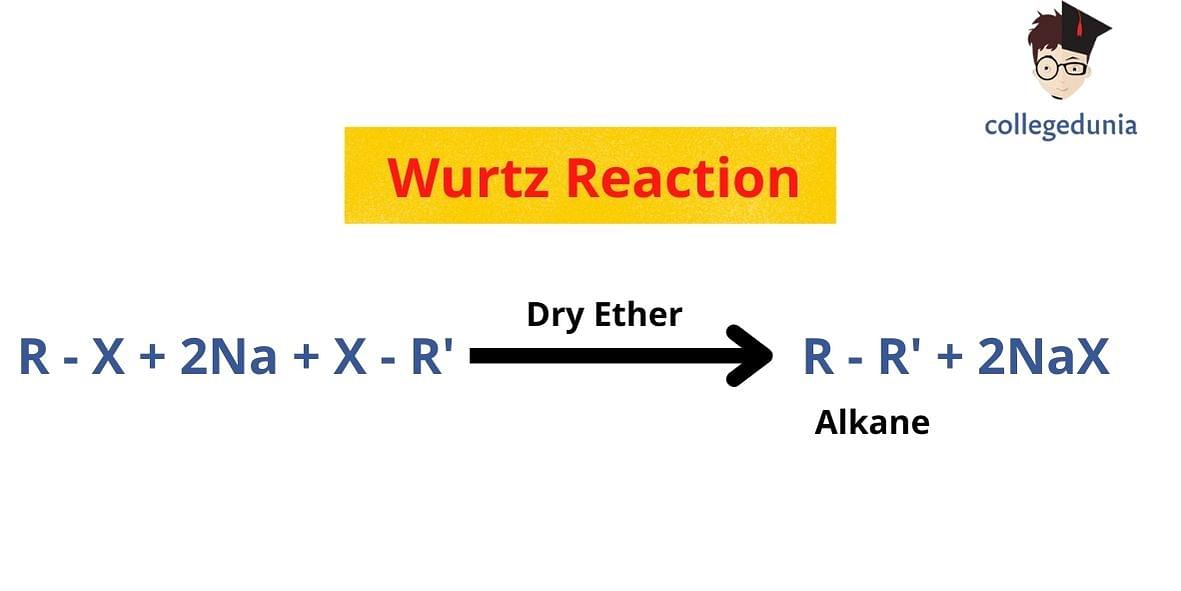
Wurtz Reaction
From the above reaction, it can be underlined that, the reaction of two alkyl halides with a compound containing halogen and sodium forms a longer alkane. This has been explained by Charles Adolph Wurtz as the Wurtz reaction.
Read More:
| Related Topics | ||
|---|---|---|
| Aldol Condensation Reaction | Cannizzaro Reaction | Clemmensen Reduction |
| Finkelstein Reaction | Esterification | Friedel Crafts Reaction |
Wurtz Reaction Equation
[Click Here for Previous Year Questions]
The general form of the Wurtz reaction equation can be written as follows:
2R-X + 2Na → R-R + 2Na+ X–
We can observe from the given equation that the two R groups are joined to produce an alkane with a longer chain along with NaX, where X is a Halogen.
Conditions for Wurtz Reaction
In the Wurtz reaction, alkyl halides and sodium metal react in a dry ether solvent to produce alkanes, usually symmetrical alkanes. Due to the formation of multiple byproducts, this reaction is not appropriate for the preparation of unsymmetrical alkanes. The two most important conditions for the Wurtz reaction to occur are:
- To initiate the reaction and maintain the necessary conditions, the reaction is usually carried out under mild heating.
- Excessive heating or uncontrolled reaction conditions may result in side reactions or degradation of reactants.
- The sodium metal and alkyl halides are dissolved using a dry, aprotic solvent, such as diethyl ether, to avoid undesirable side reactions with moisture.
- Since secondary and tertiary halides can undergo elimination reactions, primary alkyl halides are recommended.
Wurtz Reaction Mechanism
[Click Here for Sample Questions]
Two types of Wurtz reaction mechanisms have been suggested for performing the Wurtz reaction depending upon the conditions.
First Mechanism: By the Formation of Free Radicals as an Intermediate.
| The Wurtz reaction mechanism involves a free radical species denoted by R• which is a part of a halogen-metal exchange. The mechanism is somewhat similar to the mechanism of Grignard reagents. The carbon-carbon bond is formed in a nucleophilic substitution reaction, which can be broken down into the following 3 steps:
R-X + Na → R• + Na+X-
R• + Na → R-Na+
R-Na+ + R-X → R-R + Na+X- Thus, the required alkane product is formed in the Wurtz reaction mechanism. The reaction has relatively low yields due to the formation of multiple products. |
Second Mechanism: Use of an Organometallic Compound as an Intermediate
| An organometallic compound is used in this mechanism as an intermediate and the reaction is performed in a solution. CH3-CH2-I + 2Na• →CH3-CH2-Na(+) + NaI CH3-CH2-Na(+) + CH3-CH2-I →C2H5- C2H5 +NaI The mechanism is also used for the production of ethane and ethylene. |
Examples of Wurtz Reaction
[Click Here for Previous Year Questions]
The examples of the Wurtz reaction are given below:
(I) Alkyl halide, when treated with sodium metal yields di-alkane, in presence of dry ether medium.
R-X + 2 Na + X-R →R-R + 2 Na-X (Basic Reaction)
- R = alkyl group
- X = halogen (F, Cl, Br, I)
(II) Dry ether is used to provide anhydrous conditions as moisture and sodium metal react strongly in the presence of water.
Na + H2O →NaOH + H2
This reaction produces NaOH that reacts with an alkyl halide in order to produce alcohol.
R-X + OH- →R-OH
Wurtz Fittig Reaction
[Click Here for Sample Questions]
Wurtz Fittig reaction is a modification in the Wurtz reaction. The Wurtz reaction in which aryl halides are used in place of alkyl halides is known as the Wurtz Fittig Reaction. This reaction is a very important named reaction in organic chemistry.
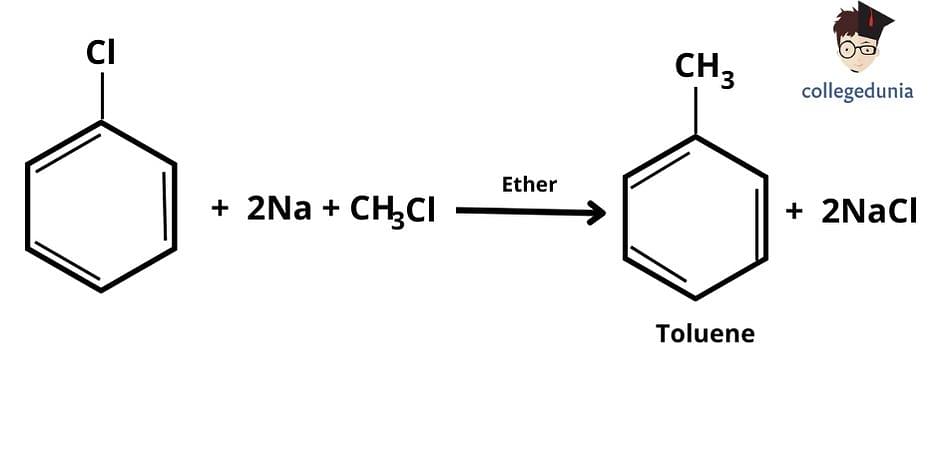
Wurtz Fittig Reaction
Significance of Wurtz Reaction
[Click Here for Sample Questions]
In organic chemistry, the Wurtz reaction is helpful in the production of alkanes. Along with this there are some other applications related to this reaction such as:
- Wurtz reaction can be easily utilized for the preparation of alkene in laboratory settings.
- The reaction can also be significant in formation of cyclic structures such as bicyclobutanes.
Limitations of Wurtz Reaction
[Click Here for Previous Year Questions]
Some of the limitations of Wurtz Reaction are given below:
- Wurtz reactions have a low yield because of the formation of multiple products.
- Using asymmetric halo-alkanes results in the production of alkane mixtures that are hard to separate. And so, only symmetric alkyl halides are preferred.
- Alkyl free radicals undergo side reactions and form alkene by-products.
- Methane cannot be synthesized by using the Wurtz reaction. Organic coupling reactions must contain atleast two carbon atoms, and this makes Wurtz reaction unsuitable for methane production.
- Tertiary alkyl halides cannot be used in the Wurtz reaction.
Things to Remember
- Wurtz reaction is a chemical coupling reaction used to synthesize alkanes.
- The reaction takes place in an anhydrous environment.
- Wurtz reaction uses free radicals as an intermediate to induce nucleophilic substitution.
- Asymmetric haloalkanes are not used in the reaction because they produce mixtures of alkanes that are hard to separate.
- Wurtz reactions have a low yield because of the formation of multiple products.
- Tertiary alkyl halides are not used in the Wurtz reaction.
Read More:
Previous Year Questions
- Wurtz reaction is used to unite…
- Wurtz reaction is not preferred for the preparation of alkanes…
- Isopropyl bromide on Wurtz reaction gives…
- Wurtz's reaction involves the reduction of an alkyl halide with… (JCECE 2005)
- By Wurtz reaction, a mixture of methyl iodide and ethyl iodide gives… (BCECE 2006)
- The Wurtz-Fittig reaction involves condensation of… (JEE Main 2013)
- The reaction in which 2 molecules of chlorobenzene reacts with metallic sodium…
- Which of the following alkane cannot be made in good yield by Wurtz reaction… (NEET 2020)
- CH3CH2Br undergoes Wurtz reaction … (VITEEE 2011)
- The reagent which can do the conversion CH3COOH … (KCET 2021)
- The alkane that gives only one mono-chloro product on chlorination … (NEET 2019)
- The correct order of boiling points of … (KEAM)
Sample Questions
Ques: How will you bring about the following conversions?
(i) Ethanol to ethyl fluoride
(ii) Bromomethane to propanone
(iii) But-1-ene to but-2-ene
(iv) 1-Chlorobutane to n-octane
(v) Benzene to biphenyl. (5 Marks)
Ans: (i) Ethanol to ethyl fluoride

(ii) Bromomethane to propanone

(iii) But-1-ene to but-2-ene

(iv) 1-Chlorobutane to n-octane

(v) Benzene to biphenyl

Ques: How do you account for the formation of ethane during chlorination of methane? (3 Marks) [NCERT]
Ans: Chlorination of methane is a free radical reaction which occurs by the following mechanism:

Ques: For the following compounds, write structural formulas and IUPAC names for all possible isomers having the number of double or triple bond as indicated:
(a) C4H8 (one double bond) (b) C5H8 (one triple bond) (3 Marks) [NCERT]
Ans: (a) Isomers of C4H8 having one double bond are:


Ques: An alkene ‘A’ on ozonolysis gives a mixture of ethanal and pentan-3-one. Write the structure and IUPAC name of ‘A’. (3 Marks) [NCERT]
Ans: Step 1. Write the structure of the products side by side with their oxygen atoms pointing towards each other.

Step 2. Remove the oxygen atoms and join the two ends by a double bond, the structure of the alkene ‘A’ is

Ques: Asymmetric haloalkanes are preferred in Wurtz reactions. (1 Mark)
(a)True
(b)False
Ans: (b) False
Asymmetric haloalkanes are not preferred in Wurtz reaction because they form alkane mixtures that are hard to separate.
Ques: In the Wurtz reaction mechanism electrophilic substitution takes place. (1 Mark)
(a)True
(b)False
Ans: (b) False
In the Wurtz reaction mechanism nucleophilic substitution takes place. Nucleophiles are electron rich and they donate their electrons.
Ques: How do you convert: (All India 2016, 3 Marks)
(i) Chlorobenzene to biphenyl
(ii) Propene to 1-iodopropane
(iii) 2-bromobutane to but-2-ene
Ans: (i) Chlorobenzene to biphenyl (Fittig reaction)

(ii) Propene to 1-iodopropane

Ques: Convert: (5 Marks)
(i) Ethyl chloride to propanoic acid
(ii) 2-Chloropropane to 1-propanol
(iii) Benzene to diphenyl
(iv) tert-Butyl bromide to isobutyl bromide
(v) Aniline to phenyl isocyanide
Ans: (i) Ethyl chloride to propanoic acid

(ii) 2-Chloropropane to 1-propanol

(iii) Benzene to diphenyl

(iv) tert-Butyl bromide to isobutyl bromide

(v) Aniline to phenyl isocyanide

Ques: How can the following conversions be carried out: (All India 2015, 3 Marks)
(i) Aniline to bromobenzene
(ii) Chlorobenzene to 2-chloroacetophenone
(iii) Chloroethane to butane
Ans: (i) Aniline to bromobenzene

Ques: Identify A, B, C, D, E, R and R1 in the following: (5 Marks)

Ans: 
Since D of D2O gets attached to the carbon atom to which MgBr is attached.
So, the product C is-

Therefore, the compound R-Br is

When an alkyl halide is treated with Na in the presence of ether, a hydrocarbon containing double the number of carbon atoms as in the original halide is obtained as a product. This is known as the Wurtz reaction. Therefore, the halide, R1-X, is
Therefore, compound D is

And, compound E is

2 - Methylpropane
For Latest Updates on Upcoming Board Exams, Click Here: https://t.me/class_10_12_board_updates
Check-Out:



Comments