



Education Journalist | Study Abroad Lead
Cyclohexane is a cycloalkane which is an alicyclic hydrocarbon. The molecular formula is C6H6, and consists of a ring of six carbon atoms that is flammable and is considered to be a volatile liquid with a detergent-like odor, reminiscent of cleaning products. Cyclohexane has two non-planar puckered conformation and both are completely free from strain. These are called Chair Form and Boat Form because of their shape.
| Table of Content |
Read More: Collision Theory
CYCLOHEXANE
Cyclohexane is essentially free of ring strain due to its non-polar nature. Chain conformation and boat conformation are two of the most essential conformations it can have. The chain has a more stable structure than the boat has. The skew boat conformation is when the boat conformation is more stable than it usually is due to a small rotation in the C-C bonds. The chair conformation, however, is the most stable cyclohexane form.
Read More:
A cyclohexane conformation can refer to a variety of 3-Dimensional configurations that a cyclohexane molecule might take while maintaining the integrity of its chemical connections.
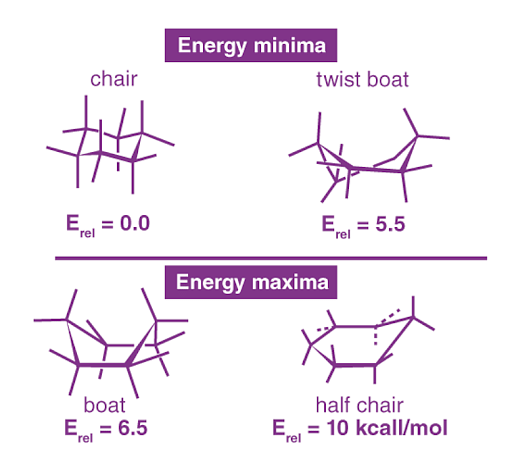
CONFORMATION OF CYCLOHEXANE
In natural-born compounds, the cyclohexane ring is the most common. It is the most important of the cycloalkanes due to its widespread use, which is certainly due to its stability. Because the bond angle deviation in cyclohexane molecules is greater than in cyclopentane, it should be more strained and less reactive. However, compared to cyclopentane, it is less strained and more stable.
Read More:
To prevent the strain, cyclohexane is not a planar molecule as one might assume. It exists as a puckered, non-planar ring with bond angles that are similar to tetrahedral bond angles. Boat and chair conformations are two types of puckered rings for cyclohexane.
Scientists discover that the twelve hydrogens in a chair configuration of cyclohexane are not structurally identical. Six of them are called equatorial because they are found towards the carbon ring's edge. The remaining six are axial because they are lined parallel to the ring's symmetry axis and are positioned above and below the approximate plane of the ring (three in each place).

The equatorial hydrogens are colored blue in the diagram above, while the axial hydrogens are bold. Because cyclohexane has two comparable chair conformations in quick equilibrium, each of the twelve hydrogens has 50% equatorial and 50% axial character. The diagram below shows how to transform a cyclohexane chemical model between two different chair conformations; this is something you should practice with models. It's worth noting that a 'ring flip' turns equatorial hydrogens into axial hydrogens, and vice versa.
Also Read:
BAEYER STRAIN THEORY IN CYCLOALKANES
- Carbon is sp3 hybridized when it is bound to two other carbon atoms in an open-chain chemical (propane), and these hybrid orbitals are utilized to create bonds (strong sigma bonds). The bond (bent bond) is weaker than a usual carbon-carbon bond because the carbon atoms in cyclopropane do not employ these hybrid orbitals to form bonds. Angle strain is the term for this.
- When bond angles differ from the ideal, the ring causes strain. Volatility, reactivity, and heat of combustion all rise as strain increases. Simply said, the smaller the divergence, the less unstable the system is.
- The cyclopropane ring is in the shape of a triangle. The typical tetrahedral angle between two bonds is compressed to 600, and each of the two bonds is pulled in by 24.750, resulting in all three angles being 600 rather than 109.50. (normal bond angle for carbon atoms). The value 24.750 represents the angle strain, or departure, of each bond from the typical tetrahedral direction.
- Similarly, to make the ring system square (angle strain 9.750), cyclobutane has bond angles of 900 instead of 109.50 (typical bond angle for carbon atoms).
- Ring pressure is caused by a divergence from the usual tetrahedral angle in cyclopropane and cyclobutane ring systems. The ring strain will make them unstable when compared to molecules with a tetrahedral bond angle.
Read More:
SACHSE–MOHR THEORY
The ring with six or more carbon atoms, according to this Sachse – Mohr theory, becomes strain-free because all of the carbon atoms are not squeezed into one plane. As a result, the carbon atoms occupy distinct planes while maintaining the regular tetrahedral angle. Strainless rings are the rings that are created. Cyclohexane is available in Chair and Boat forms.
Read More: Carbonyl Compounds
The hydrogen atoms in the chair form of cyclohexane are classified into two types, according to the analysis. Six hydrogen atom linkages are found either straight up or down, or practically perpendicular to the molecule's plane. The hydrogens that are slightly above or slightly below the plane of the Cyclohexane ring are known as Axial Hydrogen, while the hydrogens that lie slightly above or slightly below the plane of the Cyclohexane ring are known as Equatorial Hydrogen. Some of these different shapes are given below
- Chair Form ( more stable)
- Half Chair Form
- Twist Boat
- Boat Form ( less stable)

Angle strain and torsional strain are present in the half chair shape, but not in the boat form, which has no substantial angle strain but does have torsional strain. The Van Der Waals forces bind hydrogen atoms together in this way. Flagpole interactions are the name for this type of contact. Twist boat has a consolation flagpole interaction and is twisted in nature. It also has reduced torsional strain and less angle strain.
Read More:
POINTS TO REMEMBER
- Internal angles of 120 degrees are found in a regular hexagon form.
- Planar cyclohexane has a ring strain of over 84 kJ/mol.
- With an overall ring strain of 0 kJ/mol, the chair conformation is the lowest energy conformation for cyclohexane.
- In what is known as the "ring flip," cyclohexane rapidly rotates between the two most stable conformations, known as the chair conformations.
- At normal temperature, the energy barrier formed by the half chair conformation is easily overcome, allowing for equilibration on the order of 80,000 times per second between the two chair conformations.
Read More:
SAMPLE QUESTIONS
Ques. What's the Difference Between a Boat and a Chair Form? (3 marks)
Ans. Only 1% of cyclohexane exists in the shape of a boat, while 99 percent exists in the form of a chair.
The boat conformer shape has a lot of energy, while the chair conformer form has a lot of energy.
Boat Conformation has a D3d symmetry, while Chair Conformation has C2v symmetry.
In this scenario, the Boat conformer form contains flawlessly staggered C-H bonds, whereas the Chair conformer form has all C-H bonds that are perfectly overshadowed.
Ques. Which of the Cycloalkanes has the Greatest Angle Strain? (2 marks)
Ans. The smaller cycloalkanes, cyclopropane, and cyclobutane have particularly severe ring stresses because their bond angles deviate greatly from 109.5° and their hydrogens eclipse each other.
Read More:
Ques. Can Chair Conformers of Cyclohexane be Less Stable? (3 marks)
Ans. In most instances, the cyclohexane Chair conformer is always more stable than the boat conformer. Between the Chair conformer and the Boat conformer, the Chair conformer is more stable since the Boat conformer has larger steric and torsional loads. There are six axial and six equatorial C-H bonds in the chair configuration (out of twelve bonds of cyclohexane). Furthermore, the Chair conformers produce C-C-C bonds that are excessively close to 109.5, which is why it is free of angle and torsional strain.
Ques. What is the Principle Behind Strainless Rings? (2 marks)
Ans. The Theory of Strainless Rings is what it's called. Or the Sachse-Mohr hypothesis. "In cycloalkanes, carbon atoms (C6) positioned in various planes restore natural tetrahedral angle and the ring puckers," it states. Rings that are free of angle pressure are known as strainless rings.
Read More:
Ques. What is Meant by Angle Strain? ( 2 marks )
Ans. Angle strain is the increase in a molecule's potential energy caused by bond angles that are not optimal. Take, for example, cyclopropane. The cyclopropane ring could only take one conformation, that of a plane, due to its stiffness. The carbon atoms in the cyclopropane ring are tetracoordinate.
Ques. Which conformation of cyclohexane is chiral? (2 marks)
Ans. Angle strain-free cyclohexane conformation: chair conformation is achiral because it has a center of symmetry, whereas boat conformation is achiral because it has a plane of symmetry. Because there is no symmetry in the twist boat shape, it is chiral.
Read More:
Ques. Which is the most stable conformation of cyclohexane? (2 marks)
Ans. The most stable shape of cyclohexane is the chair form illustrated to the right. Because the C-C-C bonds are nearly free of angle pressure, they are quite similar to 109.5o. It also has a staggered structure that eliminates torsional stress.
Ques. Which conformation of cyclohexane is the least stable? (2 marks)
Ans. The boat conformation is the least stable, although it has the maximum strength. It has steric hindrance on carbon 1 and carbon 4 between the two equatorial hydrogens, as well as torsional tension because each bond in the Newman projection almost entirely ellipses neighboring links.
Also read: Precipitation Titration
Ques. Are diastereomers optically active? (3 marks )
Ans. The capacity of a linear polarised light to rotate the polarisation axis is known as optical operation. This effect can only be observed in chiral materials (those that lack mirror symmetry). Naturally, because neither diastereomer has mirror symmetry, they are both optically active.
Ques. Which conformation is more stable axial or equatorial? (2 marks)
Ans. Due to the fact that axial bonds are parallel to each other, substituents bigger than hydrogen experience more steric crowding when axial rather than equatorial driven. As a result, replaced cyclohexanes would prefer conformations in which the bigger substituents take on an equatorial orientation.
Also check:



Comments