



Education Journalist | Study Abroad Lead
Degenerate Orbitals are the orbitals having the same levels of energy. These orbitals are associated with various principles like Aufbau Principle, Hund’s rule, and Pauli’s Principle which helps us understand the basic manner in which the electrons are distributed in the orbitals.
| Table of Content |
Key Takeaways: Degenerate orbitals, electronic structure, covalent bonding, Hund’s rule of multiplicity, Aufbau Principle, electrons.
What are Degenerate Orbitals?
[Click Here for Sample Questions]
The electrons orbitals of equal energy levels are known as Degenerate Orbitals. The electrons of the orbitals are not affected by any external factors, like an electric or magnetic field. The application of the magnetic field is disrupted by the degeneracy of these orbitals.

Degenerate Energy Levels
Read More: Shapes of Atomic Orbitals
Example of Degenerate orbitals
[Click Here for Sample Questions]
An atom has four orbitals which are s, p, d, f. All the p orbitals, px, py, pz, are having the same energy as the p-orbital. Hence, they can be called degenerate orbitals. Every orbital, at first, consists of one electron, the second electron has to be of the opposite spin. In the end, there are 6 electrons possessed by three orbitals. Therefore, the p-orbital is filled.
Read More: Cannizzaro Reaction Mechanism
Hund’s Rule of Multiplicity
[Click Here for Sample Questions]
According to Hund’s rule of Multiplicity, stated by Friedrich Hund:
- Electrons are responsible for filling the Degenerate Orbitals.
- In a sub-shell, one electron is added to each of the degenerate orbitals before two electrons are added to any orbital.
- Electrons are added always to a subshell having the same value of the quantum spin number till each orbital in that subshell possesses at least one electron.
- Hund’s rule of multiplicity states that, in a given electronic configuration, electron pairing in p, d, and f orbitals cannot take place until each electron in a sub-shell possesses one electron each. Suppose, the electronic configuration of an atom of Carbon is 1s22s22p2. So, the orbital will be occupied by two 2s electrons and the different orbitals will be filled with two electrons (2p) as per Hund’s rule.
The diagram below explains the correct order by which the orbitals are filled with electrons:

Aufbau Principle
[Click Here for Sample Questions]
Electrons in an orbital are filled in the order from lower to higher energy levels. The lower energy level of the orbital gets filled first as stated in Afbau’s Principle. This principle is highly responsible for stating the type of chemical bond which an atom can form. Aufbau’s Principle is utilized to determine the electronic configuration of an ion or an atom.

Aufbau Principle - Filling of orbitals
Read More: Franck Hertz Experiment
Detailed Explanation for Degenerate Orbitals
[Click Here for Sample Questions]
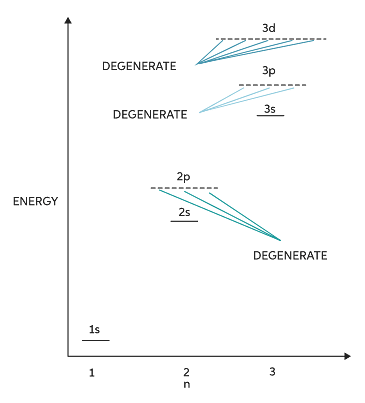
There are three orbitals present in the 2p sub-shell as 2Px, 2Py, 2Pz orbitals. In a similar way, electrons fill in the degenerate 3p orbital that is 3px, 3py, 3pz. All the orbitals are having similar energy levels. Electrons in the 4P orbitals are also having similar energy and are filled as 4px, 4py, 4pz. Hence 2P, 3P & 4P are all degenerate molecular orbitals. In the case of the d orbital, it consists of 5 degenerate orbitals which are 3dxy, 3dyz, 3dxz, 3dx2-y2, 3dz2. Hence, the degrees of the degeneracy of the orbitals are similar to the energy.
Degeneracy: The total number of the different states having the same energy is known as degeneracy. The value or degree of degeneracy is:
- For p-orbital: 3
- For d-orbital: 5
- For f-orbital: 7
It is noticed that fully filled and half-filled orbitals degenerate orbitals have extra stability because of their symmetry.
Read More: Charge to Mass Ratio of Electron
Things to Remember
- Degenerate Orbitals are the ones with the same levels of energy.
- The elements whose all the orbitals are filled are the most stable atoms and they do not react with other elements.
- In the ground-state electron configuration, the greatest number of the parallel electron spins happen to spin in any subshell as stated by Friedrich Hund.
- According to Aufbau Principle, the electrons will be filled from lower energy levels to higher energy levels.
- The degeneracy values of orbital p, d, and f are 3, 5, and 7 respectively.
- There are three degenerate orbitals present in P orbital - Px, Py, Pz and five degenerate orbitals present in d orbital - dxy, dyz, dxz, dx2-y2, dz2.
- Degenerate Orbitals is a sub-topic of the chapter Structure of Atom. This particular section carries 2-3 marks and the overall chapter carries 10-11 marks in CBSE Class 11 Examination.
Sample Questions
Ques. What do you mean by degenerate orbitals? (1 marks)
Ans. The electrons which have the same energy levels are known as degenerate orbitals. According to Hund’s rule, degenerate orbitals in lower levels get filled evenly before the electrons get filled in higher energy levels.
Ques. If the 3d Orbital is complete, to which orbital will the new electron enter?(1 marks)
Ans. As stated in Aufbau Principle, the electron enters from lower energy levels to higher energy levels. If the 3d orbital is complete, the electron will enter the 4p orbital which is the next higher level orbital.
Ques. What are the uses of Hund’s rule? (2 marks)
Ans. Hund’s rule is used in the following:
- Atomic Chemistry
- Spectroscopy
- Quantum Chemistry
Ques. Which two of the following are degenerate orbitals? Why? (2 marks)
4dxy, 3dyz, 4dyz, 4dz2
3dyz, 4dyz
3dyz, 3dxy
4dxy, 4dyz, 4dz2
Ans. As the degenerate orbitals are of main shell and same subshell. So the correct options are c) 3dyz, 3dxy, and d) 4dxy, 4dyz, 4dz2.
Ques. State Hund’s rule of multiplicity. (2 marks)
Ans. Hund’s rule of multiplicity states that, in a given electronic configuration, electron pairing in p, d, and f orbitals cannot take place until each electron in a sub-shell possesses one electron each.
Ques. State the degenerate orbitals of p and d orbitals. (2 marks)
Ans. There are three degenerate orbitals present in p orbital - px, py, pz and five degenerate orbitals present in d orbital - dxy, dyz, dxz, dx2-y2, dz2.
Ques. What configuration violates Hund’s rule in degenerate orbitals? (2 marks)
Ans. The violation of Hund’s rule is that every orbital with the same energy must possess one electron which has an identical spin before the deposition of two electrons in the same orbit. This configuration of electrons violates Hund’s law.
Ques. What is degeneracy? Mention its values for various orbitals. (3 marks)
Ans. Degeneracy is the total number of the different states having the same energy. The value or degree of degeneracy is:
- p-orbital: 3
- d-orbital: 5
- f-orbital: 7
Also check:



Comments