



Content Curator
Kinetic energy is the energy possessed by any object due to motion. When work is done on an object by exerting a net force, the object accelerates and gains kinetic energy as a result. Kinetic energy is the property of a moving object that is determined by its mass as well as its motion. The simplest example of kinetic energy would be that of a bullet fired by a gun. It is because of kinetic energy (owing to its high speed) that the small bullet can pierce through another object. Translation (movement along a path from one location to another), rotation around an axis, vibration, or any combination of motions are possible to form kinetic energy. The derivation of the kinetic energy formula using algebra and calculus will be discussed in this article.
Read Also: Types of Energy
| Table of Content |
Key Terms: Kinetic Energy, Algebra, Calculus, Mechanical energy, Mass, Velocity
Applications of Kinetic Energy
[Click Here for Sample Questions]
Take a look at a few examples of kinetic energy in our everyday lives:
- Hydropower Plants: When moving water with kinetic energy collides with the dam's turbine, the kinetic energy of the water is turned into mechanical energy. This mechanical energy drives the turbines, which results in the generation of electrical energy.
- Windmills: When wind (moving air) strikes the blades of a windmill, it causes them to rotate, resulting in the generation of energy. Moving air has kinetic energy, which causes the blades to rotate, so the kinetic energy is transformed to mechanical energy in this case as well.
- Moving Car: Due to the heavy mass and velocity, moving vehicles have Kinetic energy. To keep in mind Kinetic energy’s formula, we now know that when comparing a truck and a vehicle traveling at the same speed on the same road, the truck will have more kinetic energy due to its larger size. A truck will have more kinetic energy than a car because kinetic energy is directly proportional to the mass of the moving object.
Also Read:
Kinetic Energy Formula
[Click Here for Sample Questions]
The kinetic energy of an item is exactly related to its mass and the square of its velocity:
K.E. = 1/2 m v2
The kinetic energy has units of kilograms-meters squared per second squared if the mass is in kilograms and the velocity is in meters per second. Joules (J) are commonly used to quantify kinetic energy; one Joule equals 1 kg m2 / s2.
Also Check:
Derivation of Kinetic Energy using Algebra
[Click Here for Sample Questions]
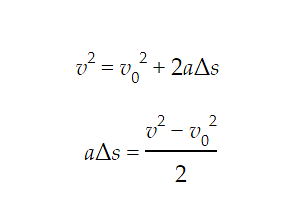
One of the greatest methods to fully comprehend the formula is to derive kinetic energy using simple mathematics. Starting with the work-energy theorem and adding Newton's second law of motion, we get

By rearranging the kinematics equation, we can arrive at
Check Important Notes for Types of Spring
Combining the two expressions we get,


We already know that kinetic energy refers to the energy that an object possesses as a result of its movement. As a result, at rest, the kinetic energy should be zero. As a result, we can define kinetic energy as:

Derivation of Kinetic Energy using Calculus
[Click Here for Sample Questions]
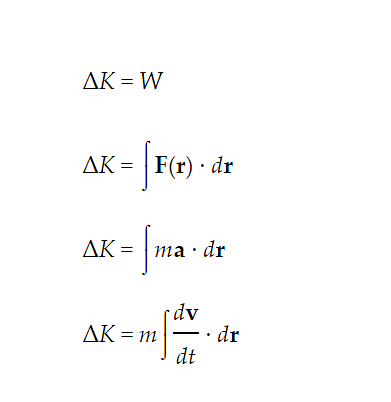
The following is a calculus-based derivation of kinetic energy. We won't need to make any assumptions regarding acceleration when using calculus to derive a kinetic energy equation. Starting with the work-energy theorem and Newton's second law of motion, we get
Rearranging the differential terms to bring the function and the integral into the agreement is the next step.
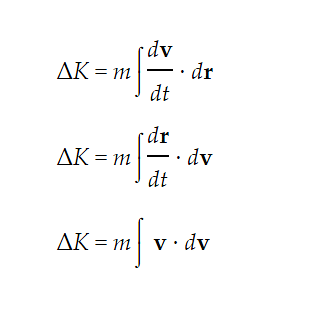
We now know that a body's kinetic energy is 0 when it is at rest. As a result, the kinetic energy is:
Points to Remember
[Click Here for Sample Questions]
- When a force exerts some force on a body, the kinetic energy increases in proportion. As a result, according to this theory, work and energy are interchangeable.
- To modify the particle's kinetic energy, a force is required. The speed of a particle does not change if the resulting force acting on it is perpendicular to its velocity, and hence the kinetic energy does not change.
- The adjective kinetic comes from the Greek word κίvησις kinesis, which means "motion." Aristotle's conceptions of actuality and potentiality gave rise to the distinction between kinetic and potential energy.
- The kinetic energy of an item, like any physical quantity that is a function of velocity, is determined by the relationship between the object and the observer's frame of reference. As a result, an object's kinetic energy is not constant.
- Due to the relative motion of the bodies in the system, a system of bodies may have internal kinetic energy. Planets and planetoids, for example, circle the Sun in the Solar System. The molecules in a gas tank are travelling in all directions. The sum of the kinetic energies of the bodies in the system is the system's kinetic energy.
Also Read:
Sample Questions
Ques. Name the different types of kinetic energy and state an example for each.
Click here for the answer
Ans. The different types of kinetic energy are as follows:
- Radiant Energy – electromagnetic waves such as X-rays, sunshine.
- Thermal Energy – Geothermal energy, geysers, boiling water
- Electrical Energy – Lightning, AC/DC devices, batteries
- Mechanical Energy – A bullet fired from a gun, wind energy
- Sound Energy – Human voice, stereo speakers, buzzing bee.
Ques. What is kinetic energy dependent on?
Click here for the answer
Ans. The kinetic energy of a body is equal to half the product of its mass and the square of its velocity.
We have observed that
K.E ∝ m and also
K.E ∝ v2.
A bigger body with a faster movement has more kinetic energy and vice versa.
Ques. Calculate the average frictional force required to bring a 600 kg automobile to a stop over a distance of 35 meters at a speed of 36 km/h.
Click here for the answer
Ans. Given m = 600 kg, s =35 m
final velocity = 0 (Since the body will stop finally)
u= 36 km/h
u = 36 kmph = 10 m/s
According to work-energy principle,
W = Change in K.E. = 1/ 2 m (v2 - u2)
- x s = 1/ 2 m (v2 - u2)
And, W = F x s F x 35 = 1 /2 x 600 x (0 - 102)
On solving, we get that:
Average frictional force (F) = 857 N
Ques. State and prove the work-energy theorem.
Click here for the answer
Ans. The work done on a body is equal to the change in its kinetic energy, according to this formula. i.e. W = kinetic energy change
Proof: Assume that m is the mass of a body traveling in a straight line at a constant beginning velocity of u.
Let F denote the force exerted to it from point A to point B, resulting in a velocity of V at B.
If dx is a minor displacement from P to Q and an is the body's acceleration, then F = ma.
If dw be the work done from P to Q, then
If W = total work done from A to B, then
Ques. Calculate the work done and the power of an engine that can maintain a speed of SO ms-1 for a train with a mass of 3 106 kg for a distance of 5 km on a rough level track. The friction coefficient is 0.05. Given the value of g = 10 ms-2.
Click here for the answer
Ans.
Ques. What percentage of K.E. of a moving particle is transferred to the stationary particle of
(a) 9 times it’s mass
Click here for the answer
Let m1 = mass of moving particle = m
and m2 = mass of stationary particle = 9 m
and their velocities are u1 and u2 = 0 (given)
v2 = velocity of the stationary particle after the collision.
So, % of K.E. transferred to the stationary particle
(b) Equal mass
Ans.
Ques. A string traveling across a pulley connects a 1-kilogram mass on the floor to a 2 kg mass, as indicated in the diagram. Calculate the mass's speed (after they've been released) when the 2 kg mass just strikes the ground. Demonstrate that the system's gain in kinetic energy equals its loss in potential energy. The initial height of the 2 kilograms mass is 3 meters above the ground.
Click here for the answer
Ans. Here, m2 = 1kg
m1 = 2kg
u = 0
h = 3m
The system is shown in the figure. According to Newton’s Second law of motion, the equation of motion for 2 kg mass is
mg – T = ma
or
2 × 9.8 – T = 2a …(i)
(Free body diagrams of m1 and m2)
Since both the masses are initially at rest, therefore initial K.E. of the system = 0
Final K.E. of the system
∴ Gain in K.E. = 29.4 – 0 = 29.4 J
Initially P.E. of the system = m1gh1 + m2gh2
= 2 × 9.8 × 3 + 1 × 9.8 × 0
= 58.8 J ( âµ here h2 = 0)
Finally, the 2 kg reaches the floor and mass 1 kg is at a height of 3m.
∴ Final P.E. of the system = m1gh1 + m2gh2
= m1g × 0 + 1 × 9.8 × 3
= 29.4 J
∴ Loss of P.E. = 58.8 – 29.4
= 29.4 J
Thus Gain in K.E. = Loss of P.E. = 29.4 J.
Physics Related Links:



Comments