



Education Content Expert
Work is a force causing the displacement of an object. Work is said to be done when an object experiences displacement, i.e. there is a shift in the position of the object.
- Work is represented by the symbol ‘W’.
- It is a scalar quantity as it has only magnitude and no direction.
- The SI unit of work is Joule (J).
Work is the product of the force in the direction of the displacement and the magnitude of the displacement. Thus, Work Formula is given as
| W = F.d |
Here, W denotes work, F refers to the force and d is the displacement of the object.
Read More: NCERT Solutions for Class 11 Physics Work, Energy, and Power
Key Terms: Work, Work Formula, Displacement, Force, Work Done, Vector, Magnitude, Joule, Motion, Direction
What is Work?
[Click Here for Sample Questions]
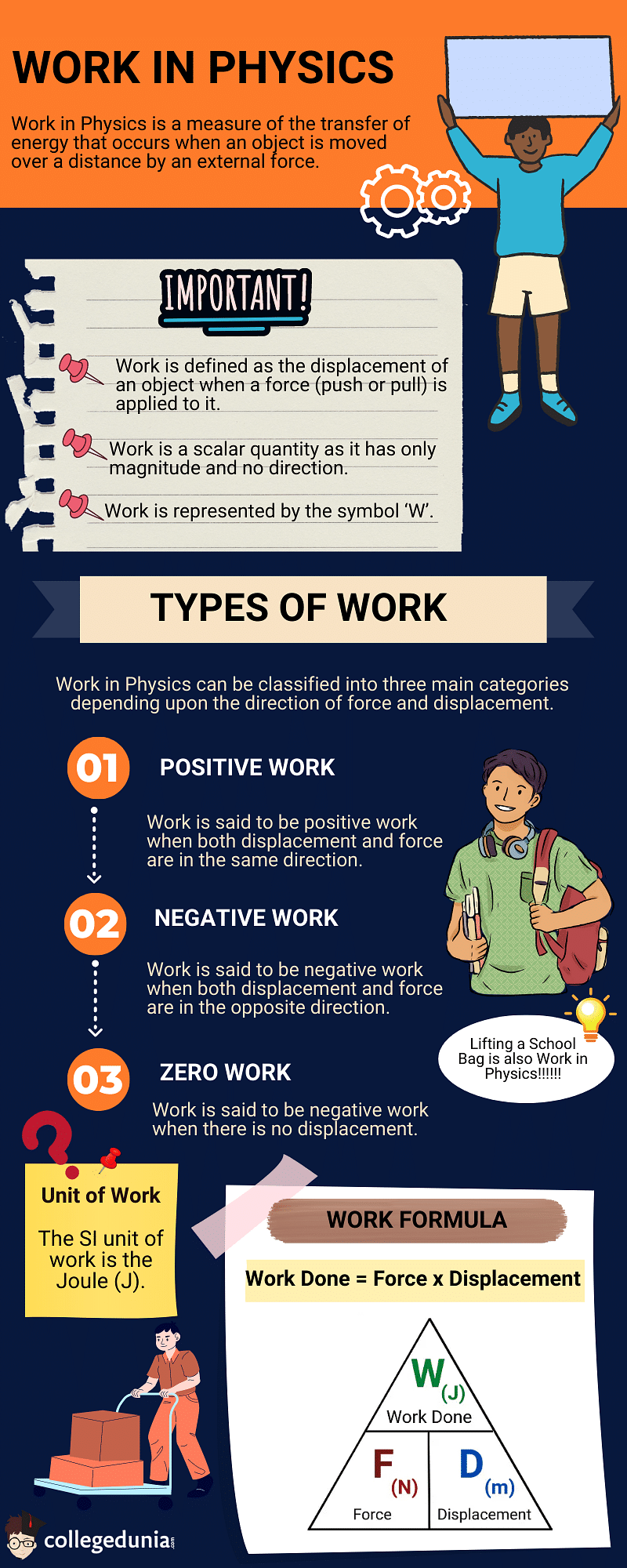
Work in Physics is a measure of the transfer of energy that occurs when an object is moved over a distance by an external force. Work can be either positive, negative, or zero.
- It is said to be positive work when both displacement and force are in the same direction.
- It is said to be negative work when both displacement and force are in the opposite direction.
- If there is no displacement, there is no work done.
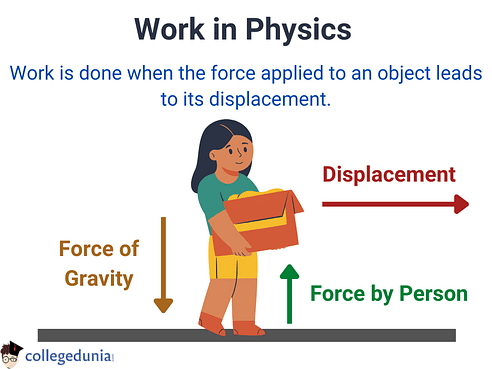
Consider a boy lifting a box and moving it from one position to another. In this case, work is said to be done as the object is displaced through the applied force.
Read More:
Work Formula
[Click Here for Previous Years' Questions]
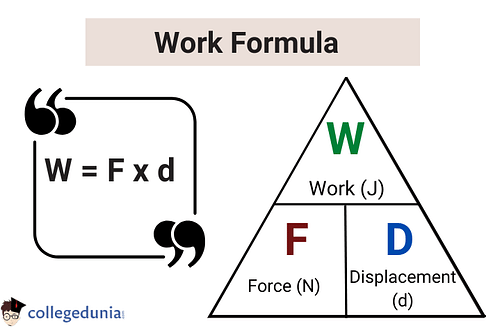
Work is the product of the applied force and displacement in the direction of the force applied. It is the dot product of the two vectors- force and displacement.
Work Formula is given as
| W = F.d |
If the force is been exerted at an angle θ to the displacement, then the work done formula is:
| W = F.d.cos θ |
Where
- W: Work Done
- F: Force Applied
- d: Displacement in the direction of the force.
- θ: Angle between force and displacement.
Read More: Work Energy & Power MCQs
Solved ExampleExample: A boy applies a force of 10 Newton to displace an object by 2 meters. Find the work done using the work formula.
Using the Work Formula, W = F.d W = 10 x 2 = 20 J Thus, the work done is 20 J. |
Derivation of Work Formula
[Click Here for Sample Questions]
Work done by an object by force F is equal to the change in kinetic energy. Thus,
W = (1/2)mv2 - (1/2) mu2 = 1/2m(v2-u2)
Using the equation of motion,
v2-u2 = 2as
W = (1/2)m(2as)
W = mas
According to Newton’s Second Law of Motion,
F = ma
Thus, W = Fs (s = d = Displacement)
If the force along the direction of displacement is Fcosθ, then work done by the force F in displacing the body through displacement d is
W = (Fcos θ)d
Read More: Work Energy & Power Important Questions
Unit of Work
[Click Here for Previous Years' Questions]
The SI unit of work is the Joule (J). It is defined as the work done by a force of 1 N in moving an object for a distance of 1 m in the direction of the force.
| 1 Joule = 1 Newton x 1 Meter |
Work done is also measured using units like
- Erg
- Foot-pound
- Foot-poundal
- Kilowatt-hour
- Liter-atmosphere
- Horsepower-hour
Read More: Unit of Work
Work Formula Solved Examples
[Click Here for Sample Questions]
Here are a few solved examples on Work Formula to get a better idea about the concept:
Example 1: Calculate the work done if 20 N of force is applied on an object to cause a displacement of 3 m.
Solution: Given that
- Force (F) = 20 N
- Displacement (D) = 3 m
Using the Work Formula,
W = F.d
W = 20 × 3
W = 60 Joules
Therefore, the work done is 60 joules.
Example 2: Calculate the work done if the force applied is 2 N, displacement is 3 m and the angle between force and displacement is 45 degrees.
Solution: We are given that
- Force (F) = 2 N,
- Displacement (d) = 3 m
- θ = 45o
Using the Work Formula,
W = Fd cos θ
W = 2N × 3m x cos 45o
W = 3.51 Joules
Thus, the work done is 3.51 Joules.
Check More:
Things to Remember
- Work is defined as the transfer of energy by a force causing the displacement of an object.
- It is a scalar quantity with the SI unit as Joule (J).
- Work Formula is given as W = F.d, where F is the force applied and d is the displacement.
- Work is also calculated using the formula W = F.d.cos θ, where θ is the angle between force and displacement.
- 1 Joule of work is said to be done when 1 Newton of force is applied to move an object through a distance of 1 m.
Previous Years’ Questions
- What is the work done by the force of gravity when the particle goes up…
- What is the work done to drag the 60 kg weight...
- Calculate the work done by the applied force... [DUET 2011]
- Calculate the work done when the spring is stretched from 0.1 to 0.2 m...
- What is the work done to pull the hanging part on the table... [JIPMER 2000]
- What is the work done in taking charge of Q once along the loop... [NEET 2005]
- Calculate the work done by the force in displacing the particle... [KEAM]
- Find the unknown angle between the force and displacement vector... [AMUEEE 2011]
- The area under the displacement curve gives... [JKCET 2008]
- The work done by a given force only depends on... [JKCET 2018]
Sample Questions
Ques. What will be the work done by the force in moving an object through a distance of 7 m? The object is horizontally dragged across the surface by a force of 150 N acting parallel to the surface. (2 Marks)
Ans. Given that
- Force F = 150 N
- Displacement d = 7 m
Since F and d are both in the same direction, θ = 0. (θ is the angle of the force and displacement.)
W = F × Cos θ × d
W = 150× 7 × Cos 0
W = 1050 J [Cos 0 = 1]
Therefore, the work done is 1050 J.
Ques. Calculate the work done by a coolie if he carries a bag weighing 100 N through some distance. (2 Marks)
Ans. It is given that, Weight of the bag = 100N
The weight of the bag will be acting in the vertical direction and its motion will be in the horizontal direction. Thus, the displacement of the bag in the direction of the force (weight) is zero.
So, d = 0
Using Work Formula,
W = F.d
W = (100)(0)
W = 0 J
Thus, the work done by the coolie on the bag is 0 J.
Ques. What is Work Done? (3 Marks)
Ans. Work is said to be done when displacement is caused due to the applied force. It is equal to the product of the magnitude of applied force and the distance through which the body moves. Mathematically, work done is expressed as
W = F x d
Here,
- F denotes force applied.
- D is the displacement of the object.
Ques. What is Displacement? (2 Marks)
Ans. Displacement is the change in the position of an object or body from its initial position. If an object moves from point X to point Y, then its position changes. This change in position is considered displacement. Displacement is a vector quantity that has both magnitude and direction. It only deals with the motion of an object in a straight line. Displacement can have a positive, negative, or zero value.
Ques. What is Work Formula? (2 Marks)
Ans. Work done by an object can be calculated using the Work Formula which is given as follows:
W = F.d
W = (Fcos θ)d
Here
- W = Work Done
- F = Force Applied
- D = Magnitude of Displacement
- θ = Angle between the vector of force and vector of displacement.
Ques. What is the SI Unit of Work? (1 Mark)
Ans. The SI unit of work is Joules (J). The term ‘Joule’ is named after the English Physicist James Prescott Joule. It is defined as the work required to exert a force of one newton through a displacement of one meter.
1 Joule = 1 Newton x 1 Meter
Ques. What is the difference between Distance and Displacement? (3 Marks)
Ans. Distance is defined as the length of the actual path between two points whereas displacement is the length of the shortest distance between two points. The difference between distance and displacement is as follows:
| Distance | Displacement |
|---|---|
| Distance is defined as the complete length of the path traveled by an object. | Displacement is defined as the shortest distance between the initial and the final position of an object. |
| It is a scalar quantity with only magnitude. | It is a vector quantity with both magnitude and direction. |
| Distance Formula is given as Distance = Speed × Time | Displacement Formula is given as Displacement = Velocity × Time |
Ques. Calculate the work done if a force of 30 N acts on an object to displace it 8 m in the direction of the force. (3 Marks)
Ans. We are given that
- Force (F) = 30 N
- Displacement (d) = 8 m
Using the Work Formula,
W = Fd
W = 30 x 8
W = 240 J
Therefore, the work done is 240 J.
Ques. Give some examples of Work Done. (2 Marks)
Ans. Here are a few examples of work done:
- Pushing a car from rest.
- Walking up the stairs.
- A horse pulling a plow through the field
- Pushing a grocery cart.
- A student lifting a bag on his back.
Ques. What are the applications of Work Formula? (1 Mark)
Ans. Work formula is used to calculate:
- Work Done
- Force Applied
- Displacement
Check-Out:



Comments