



Education Journalist | Study Abroad Lead
Potential energy is the energy stored in an object due to its position. It can be classified as Gravitational Potential Energy, Electric Potential Energy, etc. Potential Energy Formula depends on the force acting on the two objects.
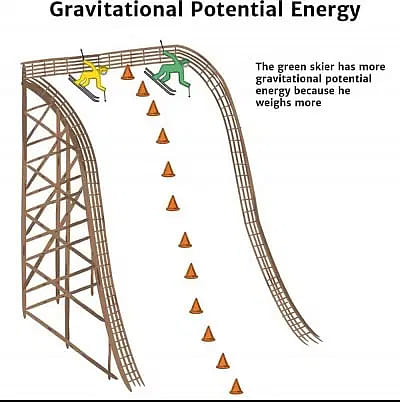
- Gravitational potential energy is the energy of an object due to its height above the ground.
- Elastic potential energy is stored in a deformed object, such as a stretched rubber band.
- The electric potential energy of an electric charge is the energy that an object has due to its position in an electric field.
- Potential energy is responsible for the motion of planets, springs and pendulums, and the behaviour of electric circuits.
Key Terms: Potential Energy, Gravitational Potential Energy, Elastic Potential Energy, Energy, Force, Electric Charge
Potential Energy Formula
[Click Here for Sample Questions]
The potential energy formula depends on the type of potential energy. The most common types of potential energy include:
Gravitational Potential Energy
The formula for gravitational potential energy is –
Ug = mgh
Where
- Ug = Potential Energy of a given object
- m = mass of the object
- g = acceleration due to gravity
- h = height of the object
Example – A ball held above the ground has gravitational potential energy due to its position in the gravitational field of the Earth.
Elastic Potential Energy
As elasticity is dependent on the force exerted by the object force, in this case, is defined as
Ue = ½ kx2
Where,
- Ue is the elastic potential energy
- k is the spring constant
- x is the displacement of the spring from its equilibrium position
Example – Elastic potential energy is stored in a spring when it is stretched. When it is released, the elastic potential energy is converted into kinetic energy.
Check Out:
| Important Concepts Related to Potential Energy | ||
|---|---|---|
| Pulley | Scalar and Vector Quantities | Thermal Expansion |
| Elastic and Inelastic Collisions | Inelastic Collision Formula | States of Matter |
| Thermal Properties of Matter | Specific Heat Capacity | Thermal Conductivity |
Electric potential energy
It is the energy required to bring a charged particle from infinity to a given point in an electric field.
UE = ke\(q_1q_2 \over r\)
Where
- UE is the electric potential energy
- ke is Coulomb's constant (9×10⁹ Nm2/C2)
- q1 and q2 are the charges of the two objects in coulombs
- r is the distance between the two objects in meters
Example – When a battery is not connected to a circuit, the electric potential energy is stored in the battery.
Derivation of Potential Energy Formula
[Click Here for Sample Questions]
The potential Energy formula can be derived from the following equation –
W = Fd
- where W is the work done,
- F is the force applied
- d is the displacement.
We can derive the equation by considering a conservative force. Considering a situation where an object of mass m is lifted from a height h1 to h2, the force required to lift the object can be expressed as a product of mass into gravitational distance = mg
So, F = mg
The displacement of the object is equal to the difference in height between the two positions, which is given by d = h2 – h1. Hence, work done to lift the object is \(W = mg(h_2 - h_1)\).
Since potential energy is the ability of an object to do work, the potential energy of the object at height h2 is given by
\(U = mg(h_2 - h_1)\)
This is the potential energy formula for gravitational potential energy.
Solved Examples
[Click Here for Sample Questions]
Example 1: Calculate the gravitational potential energy of an object with a mass of 5 kg when lifted to a height of 10 meters above the ground. (Use g = 9.8 m/s²)
Solution: The formula for gravitational potential energy (PE) is given by:
U = mgh
where:
- m is the mass of the object,
- g is the acceleration due to gravity (9.8 m/s²),
- h is the height above the reference point.
Substitute the given values into the formula:
Potential Energy = 5 x 9.8 x 10
= 490 Joules
Therefore, the gravitational potential energy of the object is 490 Joules.
Example 2: A spring has a potential energy of 100 Joules when compressed. If the spring constant is (k = 50 N/m), find the compression distance.
Solution: The formula for the potential energy stored in a spring is given by: \([ PE = \frac{1}{2} k x^2 ]\)
where:
- k is the spring constant,
- x is the compression or stretching distance.
Rearrange the formula to solve for x:
\([ x = \sqrt{\frac{2 \cdot PE}{k}} ]\)
Substitute the given values into the formula:
\([ x = \sqrt{\frac{2 \cdot 100 \, \text{J}}{50 \, \text{N/m}}}]\)
\([ x = \sqrt{4} ]\)
x = 2m
Therefore, the compression distance of the spring is 2 meters.
Check Out:
Things to Remember
- Potential energy is the energy an object possesses due to its position or condition.
- Gravitational Potential Energy is associated with an object's position in a gravitational field.
- Elastic Potential Energy is stored in objects undergoing deformation, like springs.
- Gravitational Potential Energy Formula = m⋅g⋅h, where m is mass, g is acceleration due to gravity, and h is height.
- Elastic Potential Energy Formula = ½ kx2, where k is the spring constant, and x is the compression or stretching distance.
- According to the law of conservation of energy, the total mechanical energy (kinetic + potential) of an isolated system remains constant.
- Potential energy is measured in joules (J) in the International System of Units (SI).
Sample Questions
Ques. What is the relationship between potential energy and kinetic energy? (1 Mark)
Ans. Potential energy is converted to kinetic energy and kinetic energy enables the object to store potential energy in it.
Ques. What are the advantages of nuclear potential energy? (1 Mark)
Ans. Nuclear potential energy supports the fusion and fission of nuclear atoms, further leading to the generation of heat.
Ques. Give some examples of elements that constitute chemical energy in them. (1 Mark)
Ans. Coal, bauxite, lime, Baking soda, vinegar, and some other materials constitute potential energy in them.
Ques. How is potential energy related to height? (1 Mark)
Ans. Potential Energy is directly proportional to the height of the object.
Ques. Explain Electrical Potential Energy. (1 Mark)
Ans. It is the energy needed by a charged ion to move against an electric field.
Ques. Explain Zero Point potential energy. (1 Mark)
Ans. When the potential energy of 2 objects is equal then it is called Zero point potential Energy.
Ques. A Block of mass 15kg is dragged upon an inclined plane in an upward direction. Calculate the potential energy of the block if the topmost point is at the height of 5m.consider the gravitational force acting as 10m\s2. (3 Marks)
Ans. Given
m = 15kg
g = 10m/s2
h = 5m
Potential Energy = m*g*h
= 15*10*5
= 750J
So the potential energy of the block is 750J.
Ques. After climbing a building which is 3.6m long John gains potential energy of 800J. Determine the weight of John. (3 Marks)
Ans. Given
m = ?
g = 10m/s2
Potential Energy = 800J
h = 3.6m
From the formula PE = m*g*h
800 = m*10*3.6
m = 800/10*3.6
m = 22.2 kg
Therefore, the mass of the man is 22.2kg.
Ques. A spring with a spring constant of 500N/M shows an elongation of 0.04m due to the addition of a 600 kg block to it. Determine the potential energy of the spring. (3 Marks)
Ans. K =500n/m
X = 0.04 m
m = 600kg
The formula for the Potential Energy of spring can be written as
PE = 0.5*m*g*x
= 0.5*600*10*0.04
= 120J
The potential energy of the spring is 120J
Ques. Calculate the spring constant which is elongated to 0.05m with the addition of weight 5N. (3 Marks)
Ans. Given
W = 5N
x = 0.05m
We know that from Hooke's law,
F = -kx
k = -F/x
k = -100 N/m
Therefore the spring constant is 100 N/m.
Also Read:



Comments