



Content Curator
To achieve everyday needs, all living organisms require energy. The breakdown of food molecules like glucose provides this energy. Catabolic reactions are those in which glucose is broken down into carbon dioxide and water and energy is emitted in the form of ATP in the presence of oxygen. Breathing is the mechanism through which we obtain the oxygen we require while also releasing carbon dioxide. The diaphragm is an important part of the respiratory system. It aids in the contraction and relaxation of the lungs, which increases the surface area of the lungs. It is located at the bottom of the chest, isolated from the abdomen. Let’s discuss this topic further in detail.
| Table of Content |
Key Takeaways: Diaphragm, breathing, respiration, respiratory system, chest, vacuum, pressure
Meaning of Diaphragm
[Click Here for Sample Questions]
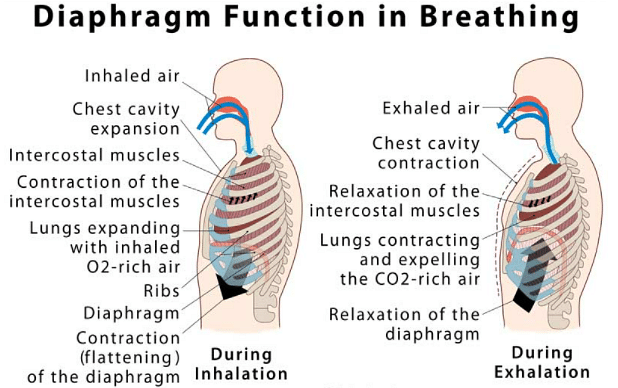
The diaphragm is a set of thin skeletal muscles located near the base of the chest in the human body. The diaphragm is also responsible for separating the abdomen from the chest. The diaphragm contracts and flattens when we breathe. As a result, a vacuum is created. The vacuum effect then aids in the inhalation of air. So when the diaphragm relaxes, air from the lungs is pushed out, which aids in carbon dioxide exhalation. This gives us some insight into the diaphragm’s significance.

The video below explains this:
Diaphragm Anatomy Detailed Video Explanation:
Also Read:
Anatomy of Diaphragm
The diaphragm is involved in the body’s expulsive motions, such as coughing, sneezing, and sobbing. Apart from assisting in respiration, the diaphragm performs the following roles. The diaphragm’s movement is controlled by the phrenic nerve. Diaphragms include the rubber arcing spring, coil spring, and flat spring, as well as the silicone broad seal rim15.
The diaphragm features three apertures that help to provide a place for certain constructions to pass through. These are the openings:
- Esophageal Opening: The oesophagus and the vagus nerve both travel via this opening. The digestive system is controlled by these structures.
- Aortic Opening: The aorta is the body’s major artery, carrying blood from the heart. The aorta and the thoracic duct both travel via this aperture.
- Caval Opening: The inferior vena cava travels through this aperture. It is the vein that carries blood from the body to the heart.
Also Read:
Functions of Diaphragm
Along with the lungs, the diaphragm is the most important feature of the human respiratory system. Respiratory passage is a passage where the air travels to the lungs by this channel. This passage is composed of Nostrils, nasal passageways, pharynx, larynx, trachea, bronchi, and lungs.
Inspiration
Fresh air enters the lungs as a result of this procedure. Inhalation is the process of taking in or inhaling air. Between the lungs, a pressure gradient is generated, which aids in the passage of air in and out of the body. The pressure gradient is the pressure exerted to allow gases to move from a higher concentration to a lower concentration. As air goes from a higher to a lower pressure, the pressure within the pulmonary cavity lowers, allowing air from the atmosphere to reach the lungs.
Expiration
Carbon dioxide is evacuated from the body through the lungs in this way. It's also referred to as air exhalation or outflow. The air moves out of the lungs when the pressure inside them exceeds the ambient pressure. The diaphragm is also crucial in this situation. The diaphragm returns to its normal place when it relaxes, reducing the capacity of the thoracic cavity. The reduction in thoracic cavity volume causes a decrease in pulmonary cavity volume, which allows the pressure in the pulmonary cavity to rise, generating a high-pressure zone in comparison to air pressure.
Also Read:
Symptoms of Diaphragm Conditions
Symptoms of a problem affecting the diaphragm are similar to those of a heart attack. If you have chest pain or pressure that extends to your jaw, neck, arms, or back, get emergency medical attention.
The following are some of the symptoms of a diaphragm problem:
- Breathing problems when lying down
- Breathing problems
- Pain in the chest, shoulder, back, or abdomen
- Lower rib pain is a common ailment.
- An abdominal fluttering or pulsating sensation
- Skin that is bluish in colour
- Heartburn
- Having difficulty swallowing
- Food regurgitation
- Pain in the upper abdomen after eating
- Hiccups
- Pain on one side
Also Read:
Diseases of Diaphragm
[Click Here for Sample Questions]
The diaphragm, as we all know, is a very crucial component of the human body. It is essential for breathing. However, several situations can cause the diaphragm to malfunction. The following are a few of these conditions.
Hiatal Hernia
It is a type of hernia that occurs in the stomach. The upper section of the stomach bulges out from the diaphragm’s esophageal aperture, causing this disease. These can be caused by diaphragm changes as people get older. A hiatal hernia can also be caused by trauma or birth abnormalities. Acid reflux, chest burn, and chest discomfort are some of the symptoms of hiatal hernia.
Diaphragmatic Hernia
This occurs when a person’s abdominal organ bulges out from the chest through the diaphragm aperture. Congenital diaphragmatic hernia refers to a condition that is present from birth. Accidental injuries might potentially result in a hernia. Rapid breathing or trouble breathing are possible signs.
Phrenic Nerve Damage
Surgery, spinal cord problems, and autoimmune diseases can all cause injury to the phrenic nerve. This syndrome can also be caused by certain illnesses and neuromuscular problems. The diaphragm can become paralysed or defective as a result of this.
Also Read:
How to maintain Diaphragm Health?
[Click Here for Sample Questions]
As a result, several factors should be kept in mind to protect our diaphragm from these diseases and to live a life with a healthy diaphragm:
- To consume smaller pieces of food and chew them thoroughly.
- Before exercise, stretch and warm up.
- To stay away from foods that cause heartburn or acid reflux.
- Exercising within our capabilities.
- To perform particular diaphragm-strengthening workouts.
Also Read:
Points to Remember
Following are some important points:
- The diaphragm is a very crucial structure and part of the respiratory system.
- When the diaphragm contracts, there is increase in the volume of the thoracic cavity which leads to creation of negative pressure in the cavity, which draws air into the lungs.
- Symptoms of a problem affecting the diaphragm are similar to those of a heart attack.
- Stressed people tend to breathe quickly and shallowly, with constant diaphragm muscle tension.
- Catabolic reactions are those in which glucose is broken down into carbon dioxide and water and energy is emitted in the form of ATP in the presence of oxygen.
Sample Questions
Ques: Is it possible to live without a diaphragm? (2 Marks)
Ans: We can't exist without one, and it's a vital element of our bodies. Since the diaphragm is such a hardworking muscle, one takes 23,000 breaths per day, which means that if you live to be 80, you will have taken almost 673,000,000 breaths! It's no surprise that this extraordinary muscle deserves special attention.
Ques: Which organ is in charge of the diaphragm? (2 Marks)
Ans: The diaphragm is the most important respiratory muscle, separating the thoracic cavity (which contains the heart and lungs) from the abdominal cavity: when the diaphragm contracts, the volume of the thoracic cavity increases, creating a negative pressure in the cavity, which draws air into the lungs.
Ques: What is the number of openings on a diaphragm? (2 Marks)
Ans: The diaphragm has three major and five minor apertures. In the central tendon, the vena caval trunk is located at the level of the T8 vertebra. The Inferior Vena Cava as well as some branches of the right phrenic nerve can travel through it.
Ques: Do we have two diaphragms? (2 Marks)
Ans: The diaphragm of mammals has long been researched as a respiratory muscle. However, there is growing evidence that it should be classified as two different muscles, the crural and costal diaphragms.
Ques: What is the main function of the diaphragm wall? (2 Marks)
Ans: Since, Diaphragm walls have a static or sealing function, these can be utilised as cut-off walls for dams or excavation pits, foundations, or structure enclosures. They have been created from the ground up as concrete or steel-reinforced concrete walls.
Ques: Is the diaphragm a voluntary contracted muscle? (2 Marks)
Ans: The diaphragm is a muscle that is both voluntary and non-voluntary.
Skeletal muscles do not contract unless we actively choose to do so. Internal smooth muscles, such as those in the digestive system and the heart muscle, work involuntarily.
Ques: What structures can be found behind the diaphragm? (2 Marks)
Ans: The quadratus lumborum and psoas major muscles are involved. The oesophagus, as well as the two main blood vessels of the lower half of the body, the inferior vena cava and the descending aorta, cross through the diaphragm. The vena Caval foramen is the entrance for the inferior vena cava.
Ques: Can stress have an effect on the diaphragm? (2 Marks)
Ans: Stressed people tend to breathe quickly and shallowly, with constant diaphragm muscle tension. Generally, the diaphragm generates mechanical forces that massage the inner organs and help them function properly.
Also Read:



Comments