



Education Journalist | Study Abroad Lead
Angiosperms and Gymnosperms are the two main categories of plants that may have a shared ancestor. These are seed-bearing plants with a few similarities and belong to the Kingdom Plantae. Gymnosperms have existed for at least 200 million years before angiosperms evolved. The key difference between the two is their diversity. Angiosperms are more diverse than gymnosperms as they adapt to various terrestrial ecosystems.
| Table of Contents |
Key Terms: Angiosperms, Gymnosperms, Vascular Plants, Tissue, Trees, Seeds, Pollination, Reproduction
Read More: Anatomy of Flowering Plants
Angiosperms
[Click Here for Sample Questions]
The word ‘Angio’ comes from a Greek word that means a vessel or a container. As the name suggests, these plants are vascular and bear fruits in the form of seeds or mature ovaries. They are flowering plants which bear fruits and reproductive organs. Angiosperms are more diverse and adaptive to various terrestrial ecosystems. Around 3,00,000 species of angiosperms have been identified to date.
Fruit trees like oranges, bananas, pear, apple, mango, cherry, and peach initially have flowers from which the fruit originates. The pollination process generally takes place via agents such as honey bees.
Other examples of angiosperms include grains such as wheat, rice, and corn. Pollination in these plants occurs due to winds. Some other angiosperms include eggplant, broccoli, tomato, sugarcane, pepper, rose and lily.
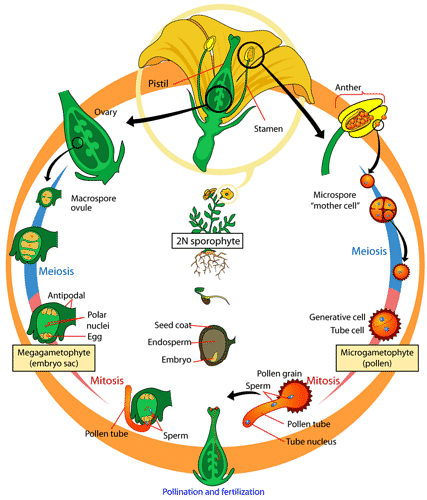
Life Cycle of Angiosperms
Gymnosperms
[Click Here for Sample Questions]
The word ‘Gymno’ is also a Greek word that means naked. So, gymnosperm basically refers to plants that produce naked seeds. They are vascular plants that bear naked seeds directly on sporophylls without any cover.
As compared to angiosperms, there are very few species of gymnosperms. The reason there are fewer species of gymnosperms is that the seeds lack protection. When the seeds are released, they are naked and unprotected, which makes them prone to damage by weather, animals, and other factors. Some examples of gymnosperms are spruce, juniper, fir, pine, cypress, and redwood.

Life Cycle of Gymnosperms
Difference between Angiosperms and Gymnosperms
[Click Here for Sample Questions]
Tabulated below are the major differences between Angiosperms and Gymnosperms:
| Angiosperms | Gymnosperms |
|---|---|
| Seeds are enclosed within an ovary and produced by flowering plants. | Seeds are naked or unenclosed and produced by non-flowering plants. |
| These plants are seasonal. | These plants are evergreen. |
| They have triploid tissue. | They have haploid tissue. |
| Their leaves are flat. | The shape of their leaves is needle-like and scale-like. |
| They are hardwood trees. | They are softwood trees. |
| Their reproduction relies on animals. | Their reproduction relies on plants. |
| Flowers are the reproductive organs of these plants. | Cones are the reproductive organs of these plants. |
| Reproduction is either unisexual or bisexual. | Reproduction is unisexual. |
| Vessels can be seen to be located in the xylem. | Except in Gnetales, vessels are not seen in the xylem. |
| Phloem has the presence of many companion cells. | Phloem has no companion cells in gymnosperms. |
| Pollination is both unisexual and bisexual in angiosperms, and flowers have a corolla and a calyx. | Pollen sits directly on the ovule after fertilisation. |
| In angiosperms, cones have an irregular occurrence. | In gymnosperms, cones have the usual brown colour appearance. |
| In angiosperms, archegonia is absent. | In gymnosperms, archegonia is seen. |
| Angiosperms are fruit-bearing plants. | The process of fruit formation is absent in gymnosperms. Hence, these plants do not possess fruits. |
| Angiosperms are mainly used for food, clothing, medication, etc. | Gymnosperms are mainly used for paper, lumber, etc. |
Read More: Difference Between Xylem and Phloem
Things To Remember
- Angiosperms can adapt to various terrestrial ecosystems and are more diverse compared to gymnosperms.
- Angiosperms are flowering plants that have seeds enclosed in ovaries.
- Gymnosperms are non-flowering plants that have naked or unenclosed seeds.
- The reproductive system of angiosperms is present in flowers, and the reproduction is unisexual or bisexual.
- The reproductive system of gymnosperms is present in cones, and their reproduction is unisexual.
Read More: Difference between Cross Pollination and Self Pollination
Sample Questions
Ques. Why are angiosperms better than gymnosperms? (2 marks)
Ans. Angiosperms are flowering plants, while gymnosperms are non-flowering plants. Flowering plants have an advantage over non-flowering plants as they mature quickly and produce more seeds. The seeds of angiosperms are enclosed in a fruit which allows for easy dispersal by animals, wind, or water, and the flower protects the ovule. Gymnosperm seeds are naked and unprotected, making them vulnerable to damage from animals, weather, or other factors.
Ques. What is the reproductive organ in gymnosperms and angiosperms? Give a few examples of both. (2 marks)
Ans. In gymnosperms, the female reproductive organ is the cone, and the male reproductive organ is pollen. While in angiosperms, the reproductive organ is the flower. The female reproductive organ is the carpel or gynoecium or pistil, and the male reproductive organ is the stamen or androecium.
Angiosperms can be monocots or dicots. Examples of monocot angiosperms are grass, lily, orchid, agave, etc. While some examples of dicot angiosperms are sunflowers, oak, maple, roses, peas, etc. Examples of gymnosperms include non-flowering trees like spruce, fir, and pine.
Ques. Write about the economic importance of gymnosperms. (3 marks)
Ans. The economic importance of gymnosperms:
- Some gymnosperms have medicinal value. The fresh juice of cycas circinalis leaves is a useful cure for stomach infections, some skin infections, and blood vomiting.
- Gymnosperms like Cedrus, Pinus, Abies are the main sources of different types of wood. Juniperus wood is used for making scales, pencils, holders, etc. And some species of Pinus serve as a good source of wood alcohol, turpentine, and wood gas.
- Cycas are of great economic importance, as their different species are used for different purposes. C. rumphii and C. revoluta are used for decoration as they remain fresh for a long time. Some species of cycas are taken as food, such as the succulent leaves of certain species, which are cooked as vegetables.
Ques. Why are angiosperms and gymnosperms classified separately, even when both bear seeds? (2 marks)
Ans. Angiosperms and gymnosperms are classified separately because they both bear seeds but in a different manner. In gymnosperms, the seeds are naked and unprotected. While in angiosperms, the seeds are enclosed in the ovary of a flower, which then turns into fruits. Gymnosperms do not bear flowers or fruit, while angiosperms do. Moreover, angiosperms are diversely adapted to terrestrial ecosystems as compared to gymnosperms.
Ques. What are some important characteristics of gymnosperms? (3 marks)
Ans. Some important characteristics of gymnosperms and angiosperms are:
- Gymnosperms are perennial and can be medium-sized trees, large trees, or shrubs.
- Their stems are branched, woody, erect and aerial except for Cycas, which is unbranched.
- Gymnosperm is heterosporous, which means it produces microspores and megaspores.
- Seeds of gymnosperms are uncovered and unprotected.
- The reproductive organs are cones, except for the female organs of Cycas.
Ques. Differentiate monocots and dicots. (3 marks)
Ans. Tabulated below are the major differences between monocots and dicots:
| Monocots | Dicots |
|---|---|
| Monocots are plants whose seeds contain only one cotyledon. | Dicots are plants whose seeds contain two cotyledons. |
| Usually, their leaves possess parallel venation. | Their leaves possess reticulate venation. |
| Their vessels are rounded in outline. | Their vessels are polygonal in outline. |
| Some examples of monocots are: grass, palm, orchid | Some examples of dicots are green peas, apples and grapes. |
Ques. What type of pollination occurs in angiosperms? (2 marks)
Ans. Angiosperms are flowering plants with flowers as their reproductive organ. Inside the flower, the process of reproduction is carried out and the fruits are borne. Prior to the process of reproduction, pollination occurs in such plants, i.e, the pollen grains are transferred to the stigma of the plant, either by insects, animals, wind or water. Pollination is necessary in angiosperms as it ensures the fusion of male gamete from the pollen with female gamete in the ovary. Both cross-pollination and self-pollination are seen in Angiosperms.
Biology Related Links:



Comments