



Content Writer
Anatomy of flowering plants takes us deep into the arrangement of cells and tissues within the plant bodies of flowering plants. Anatomy is a branch of biology that deals with the study of the internal structures of living organisms.
- The internal structure includes the structure of tissues.
- Anatomy of flowering plants includes arrangement within roots, stems, leaves, flowers, fruits, and seeds.
- Tissue is a group of cells with a common origin, structure, and function.
- There are three types of tissues, namely secretory, permanent, and meristematic tissue.
- The cell is the basic structural and functional unit of living organisms.
- In multicellular organisms, several cells group together impart a certain shape, structure, and function to an organism.
- Different structures represent the required differences in the organs of plants.
- They help the plants to survive, grow and reproduce.
Read More: Anatomy of Flowering Plants MCQ
Key Terms: Anatomy of flowering plants, Flowering plant, Cell, Tissue, Roots, Stems, Leaves, Flowers, Meristematic Tissues, Permanent Tissues, Xylem, Phloem, Epidermal, Ground Tissue System, Vascular Tissue Systems.
Meristematic Tissues
[Click Here for Sample Questions]
Meristematic Tissues are simple tissues that are capable of a continuous division of cells. The tissue at the root tip and stem tip is called apical meristems and is meant for growth in length.
- Meristematic tissues are also known as meristems.
- The tissues that lie all along the lateral sides of roots and stems are called lateral meristems.
- They are meant for growth in the girth or thickness of plants.
- Meristems that lie between permanent tissues are called intercalary meristems.
- They are basically green plants and are meant for internodal elongation.

Meristematic Tissue
Read More:
Characteristic of Meristematic Tissues
Some important characteristics of meristematic tissues are as follows:
- Meristematic tissues consist of immature cells.
- They consist of thin-walled that do not contain intercellular space.
- Meristems do not contain any form of reserve food material.
- The protoplasm of the tissues contains one or more nuclei.
- They are in the state of active division.
Meristematic Tissue
Read More: Anatomy of Flowering Plants: Important Questions
Permanent Tissues
[Click Here for Sample Questions]
Permanent tissues are types of tissues that do not contain any form of cell division. They are simple and complex tissues. Permanent tissues primarily focus on the structure and functions of plants.
- Permanent tissues are fully grown plants and do not have the ability to divide.
- They are bigger in size and form a certain kind of shape.
- The rate of metabolism is slow in these tissues.
- Simple tissue and complex tissue are two types of permanent tissues.
Characteristic of Permanent Tissues
Some important characteristics of Permanent tissues are as follows:
- Permanent Tissues attain shape and size by the process of cellular differentiation.
- The cells in the tissues are either dead or living.
- Cytoplasm in these tissues is vacuolated and diluted.
- They have either thick or thin walls depending upon the type of tissues.

Permanent Tissues
Read More: NCERT Solutions For Class 11 Biology Chapter 6: Anatomy of Flowering Plants
Simple Tissues
[Click Here for Sample Questions]
Simple tissues are a type of permanent tissue that consists of a single type of cell. These tissues have the same origin, structure, and function. They are also known as homogeneous tissue.
- They are mainly found in the construction of organs, epidermal layer, and mechanical support.
- They form the basis of the plant body.
- Simple tissues are of different types, like Parenchyma, Collenchyma, and Sclerenchyma.
Parenchyma
Parenchyma is a simple permanent living tissue that contains isodiametric cells with thin cell walls. It consists of a large central vacuole, peripheral cytoplasm, and a nucleus.
- Parenchyma forms the ground tissue in almost all parts of the plant body.
- It is meant for photosynthesis and storage of water and food materials.
- These tissues are made of unspecialized living cells.
- The parenchyma contains a small number of vacuoles.
- These help in the process of transpiration.
Characteristics of Parenchyma
The characteristics of parenchyma are as follows:
- Parenchyma tissues have soft areas of leaves, stems, roots, flowers and fruits.
- These tissues contain uncountable amounts of water and sometimes act as a water reservoir.
- They are found in oval, polygonal or elongated shapes.

Parenchyma
Read More: Difference between bryophytes and pteridophytes
Collenchyma
Collenchyma is a permanent living tissue containing oval, spherical, or polygonal cells. The cell walls are thickened in corners due to pectin, a large central vacuole, peripheral cytoplasm, and a nucleus.
- Thickening in corners is due to the deposition of cellulose, hemicellulose, and pectin.
- It is a living mechanical tissue.
- These tissues provide elasticity to the tender parts of a plant, like growing stems, petioles, pedicels, and fruit stacks.
- The refractive index of collenchyma tissues is high due to the presence of pectin.
- They are either elongated and spherical or oval in shape.
Characteristics of Collenchyma
Some of the characteristics of collenchyma are as follows:
- They provide flexible support to the plant and help in its growth.
- Collenchyma helps in the process of photosynthesis as they contain chloroplast.
- These tissues protect leaf margins from tearing.
- Cells of the tissues are closely packed; as a result, they do not have intercellular spaces.

Collenchyma
Read More: Aestivation in Plants
Sclerenchyma
Sclerenchyma is dead mechanical tissue. Cells lack cytoplasm and nucleus. The cell walls are thickened by cellulose and lignin. Sclerenchyma cells can be fibres and sclereids. It provides mechanical strength to mature plant parts.
- Sclerenchyma does not contain any form of intermolecular spaces between tissues.
- They are found in shells of nuts, fibres, wood, etc.
- These tissues are divided into two categories, namely Sclerenchyma fibres and Sclereids.
- They consist of elongated fibres with pointed ends and narrow lumen.
Characteristics of Sclerenchyma
Some important characteristics of sclerenchyma are as follows:
- Sclerenchyma provides mechanical support to the plant.
- These tissues contain xylem vessels and tracheids.
- They help in the reduction of water loss due to the presence of waxy coating.
- After maturation, they lose the ability to multiply and stretch.
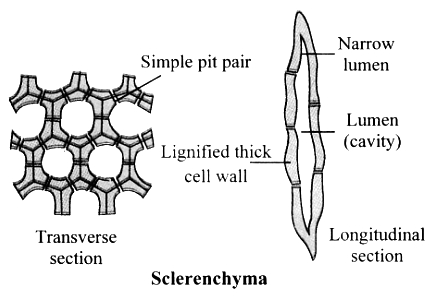
Sclerenchyma
Read More:
Complex Tissues
[Click Here for Sample Questions]
Complex tissues are permanent tissues that contain more than one type of cell. These tissues have a common origin point. In these tissues, cells work together as a unit.
- Complex tissues originate from the meristematic tissues.
- They are also known as vascular tissues, as they are formed of vascular bundles.
- These tissues provide mechanical support to the plants.
- They are heterogeneous in nature as they are made of different types of cells.
- Xylem and phloem are two chief types of complex issues.
Xylem
Xylem are water-conducting tissue that is situated in deeper layers of the plants. These tissues provide flexibility and support to the plants. They are made up of tracheids, trachea, xylem fibres, and xylem parenchyma.
- The xylem consists of a nucleus and a protoplast.
- They are colourless compounds with large vacuoles.
- The nucleus and cytoplasm found in the xylem will migrate toward tyloses.
- It is used for the transportation of water and other inorganic solutes.
- They are divided into the category of primary and secondary xylem.
Phloem
Phloem are food-conducting tissues that are situated towards the outer side of the plant. These tissues do not provide any support to the plants. They are made up of sieve cells, sieve tubes, companion cells, phloem parenchyma, and phloem fibres.
- Phloem helps in the translocation process and transports different sap.
- Carbohydrates produced are stored in tubes or bulbs that are made of phloem.
- The cells of these tissues are alive.
- They have elongated and tubular structures.
Read More: Difference between algae and fungi
Tissue System
[Click Here for Sample Questions]
Tissues system consists of a group of tissues derived from a portion of meristem. These tissues do not have any structural or morphological similarity. These tissues will determine how various tissues and their functions are based on the location.
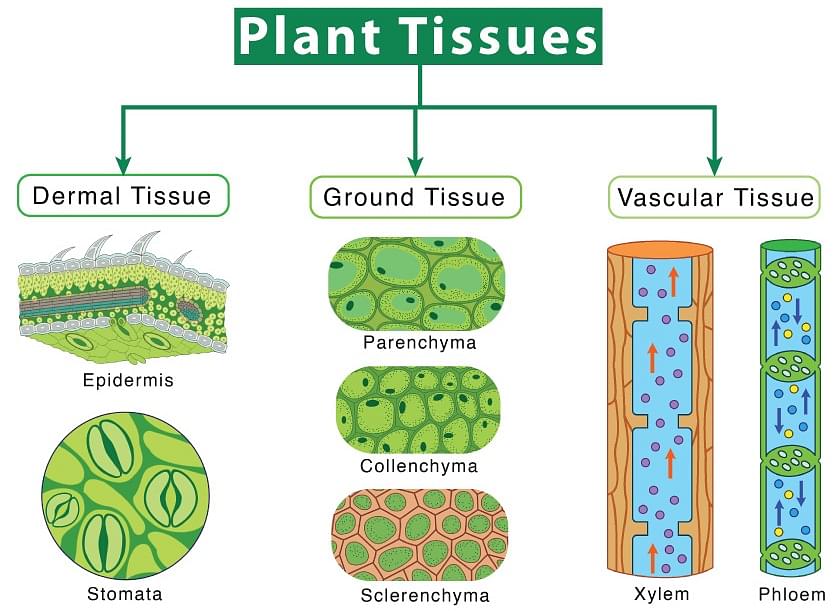
- Tissue System consists of epidermal, ground, and vascular tissue systems.
- The outermost layer of plants consists of an epidermal tissue system.
- The tissue system between epidermal and vascular tissue systems is the ground tissue system.
- It is made of parenchyma.
- The innermost vascular tissue system consists of the pericycle, pith, xylem, and phloem.
Epidermal Tissue System
Epidermal tissue system is basically found on the entire surface of the plant. The root hairs of these tissues are unicellular, and the trichomes found in these tissues are multicellular.
- Epidermal tissue contains stomata that help in the regulation of gaseous substances.
- They will lose water by the process of transpiration.
- These tissues form the outer cover of the plants that contain the epidermis, cuticle, stomata, and epidermal extensions.
Ground Tissue System
Ground Tissue System originates from from the ground meristem, plerome, and periblem. They contain simple types of tissues. These tissues contain mesophyll leaves that contain chloroplast.
- Ground tissues form the internal organs of the plants.
- They contain parenchyma, collenchyma, sclerenchyma, glandular and laticiferous tissues.
Vascular Tissue System
Vascular tissue system is made of complex tissues of the xylem and phloem. They are made of vascular bundles which have dicot seeds. The roots of these tissues are arranged alternatively.
- The strands found in the vascular tissue system are in the form of either gymnosperms or angiosperms.
- They help in the conduction of water and minerals.
- These tissues help in the translocation of organic solutes.
- They provide mechanical support to the plant.

Tissue Systems in Flowering Plants
Read More: Androecium
Things to Remember
- Anatomy of flowering plants is associated with the structure and study of an organisation of tissues in flowers.
- A simple tissue that is capable of a continuous division of cells is called meristematic tissue.
- Meristems in stem tips and root tips are called apical meristems.
- The tissues without cell divisions are categorised as permanent tissues.
- Parenchyma is a simple permanent living ground tissue.
- Collenchyma is a living mechanical tissue with pectin thickenings.
- Xylem is water-conducting tissue, whereas phloem is a food conducting tissue.
Read More: Fruit
Sample Questions
Ques: What are the tissues that provide mechanical strength to plants? (2 marks)
Ans: Collenchyma provides mechanical strength to tender parts like pedicels, peduncles, and petioles. Sclerenchyma and xylem provide mechanical strength to mature parts of the plant body.
Ques: What are the three different tissue systems in plants? (2 marks)
Ans: Flowering plants consist of epidermal, ground, and vascular tissue systems. The outermost layer of plants consists of an epidermal tissue system. The tissue system between epidermal and vascular tissue systems is nothing but a ground tissue system. It is made of parenchyma. The innermost vascular tissue system consists of the pericycle, pith, xylem, and phloem.
Ques: What is phytotomy? How is it useful to a botany student? (2 marks)
Ans: The study of the internal structure of plants is called phytotomy. It is useful to study the internal arrangement of tissues in roots, stems, and leaves under a microscope.
Ques: What are the plant tissues that affect growth and development? (5 marks)
Ans: A simple tissue that is capable of a continuous division of cells is called meristematic tissue. These issues affect the growth and development of plants.
- Meristematic tissue at the root tip and stem tip are called apical meristems.
- They are meant for growth in length.
- These tissues lie between permanent tissues are called intercalary meristems (grass plants).
- They are meant for internodal elongation.
- Meristematic tissues that lie all along the lateral sides of roots and stems are called lateral meristems.
- They are meant for growth in the girth or thickness of plants.
Ques: What is a living mechanical tissue? How does it impart flexibility to different parts of a flowering plant? (3 marks)
Ans: The living mechanical tissue is collenchyma. Collenchyma is a simple permanent living tissue that contains oval, spherical, or polygonal cells with cell walls thickened in corners due to pectin, a large central vacuole, peripheral cytoplasm, and a nucleus.
- Thickening in corners is due to the deposition of cellulose, hemicellulose, and pectin.
- It is a living mechanical tissue that provides elasticity to the tender parts of a plant like growing stem, petiole, pedicels, and fruit stacks.
Ques: Which plant tissue remains in an active phase always? (3 marks)
Ans: Meristematic tissue remains in an active phase always. The cells of this tissue have thin cellulosic walls, no intercellular spaces, peripheral cytoplasm, and a large nucleus.
- Meristematic tissues that lie all along the lateral sides of roots and stems are called lateral meristems.
- They are meant for growth in the girth or thickness of plants.
Ques: Which are flowering plants called? (2 marks)
Ans: In botany, Flowering plants are also called Angiosperms whereas non flowering plants are called Gymnosperms. Angiosperms produce the seeds inside the fruit.
- It is divided into two major categories, namely racemose, where the floral axis is of indefinite growth.
- Cymose is the second category, where the growth of the floral axis becomes limited after a certain period.
Ques: What is ground tissue? Where does it present? (2 marks)
Ans: The ground tissue is parenchyma. Parenchyma is a simple permanent living tissue. It forms the ground tissue in almost all parts of the plant body. It is meant for photosynthesis and storage of water and food materials.
Ques: What is the anatomy of flowering plants? (2 marks)
Ans: Flowering plants consist of epidermal, ground, and vascular tissue systems. The outermost layer of plants consists of an epidermal tissue system. The tissue system between epidermal and vascular tissue systems is nothing but a ground tissue system. It is made of parenchyma. The innermost vascular tissue system consists of the pericycle, pith, xylem, and phloem.
Ques: What is Plant Anatomy? (2 marks)
Ans: Plant Anatomy is a branch of biology that deals with the study of the internal structures of living organisms. The study of plant anatomy is called phototomy. It is useful in analysing the functions of each of the structures that make up the plant.
Ques: What is the difference between xylem and phloem? (4 marks)
Ans: The difference between xylem and phloem are as follows:
| Xylem | Phloem |
|---|---|
| Xylem is water-conducting tissue. | Phloem is a food conducting tissue. |
| It is situated in deeper layers of the plant. | It is situated towards the outer side of the plant. |
| They provides mechanical support to plants. | They does not provide mechanical support to plants. |
| It is made up of tracheids, trachea, xylem fibres, and xylem parenchyma. | It is made up of sieve cells, sieve tubes, companion cells, phloem parenchyma, and phloem fibres. |
For Latest Updates on Upcoming Board Exams, Click Here: https://t.me/class_10_12_board_updates
Check out:



Comments