



Education Journalist | Study Abroad Lead
Area and Surface Area are two totally different concepts of Geometry. The area is the measurement of a two-dimensional plane flat surface and it is used to explain the space reserved by two-dimensional shapes like squares, circles, rectangles, triangles, and many more. On the other hand, the surface area is the measurement of three-dimensional solid shapes and it is used to explain space reserved by the external surface of three-dimensional shapes like cubes, cuboids, cylinders, cones, spheres, and many more.
| Table of Content |
Key Terms: Area, Surface Area, Perimeter, 2D Shapes, 3D Shapes, Cuboid, Parallelogram, Curved Surface Area, Lateral Surface Area
What is Area?
[Click Here for Sample Questions]
The area is the measurement of the amount of space within the perimeter of any two-dimensional geometric shape. The area can be measured in square units, such as cm², m², etc. The area of any shape will totally depend upon the dimensions of that shape.
Read More: Difference Between Area and Perimeter
Area of Different Shapes
[Click Here for Sample Questions]
To find the area of different shapes, the length and breadth of the shape are the main measurements. For students, it will be very easy to find the area of any shape if they have two measurements i.e length and breadth.
Given below are some of the facts to find the area of different shapes:
-
Area of Rectangle
Area of a rectangle = Length × breadth.
One can find the area of a rectangle by applying the values of length and breadth.
Suppose length = 10 cm and breadth = 7 cm
Area of Rectangle = Length × width
Area = 10 × 7
Area = 70 square cm
-
Area of Square
Area of square = side × side
Suppose side = 10 cm
Area of square = side × side
= 10 × 10
= 100 square cm
-
Area of Parallelogram
Parallelogram is also like a square and rectangle. It is also a quadrilateral-like rectangle and it has also 4 sides.
Area of parallelogram = Height × Width
If, height = 10 and breadth = 12
Area = 10 × 12 = 120 square cm

Area of Different Shapes
What is Surface Area?
[Click Here for Sample Questions]
The area which is measured for 3-dimensional shapes is called a surface area. The surface area is the sum of all the faces of solid objects. All the faces of 3-d objects are 2-dimensional. Students can find the surface area of the solid object by adding the area of all the faces.
Take an example to understand the surface area. Suppose, a cube has six faces. Thus, the surface area of the cube will be the sum of the areas of all six faces. Because all the sides of a cube are squares, so the surface area of a cube will be 6 × (Area of a square).
The surface area has three parts:
- Curved Surface Area (CSA): The area of all the curved surfaces in a solid object is known as the Curved Surface Area (CSA). For example, the circular cylinder.
- Lateral Surface Area (LSA): The area of all the faces of the object except the area of the base and top is known as the Lateral Surface Area (LSA). For example: in the cube area of all the faces is LSA.
- Total Surface Area (TSA): The area of all the faces including the area of the base is known as the Total Surface Area (TSA).
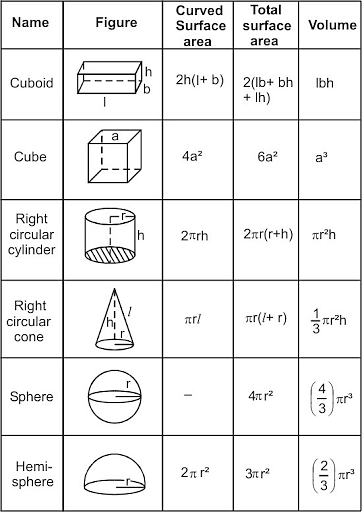
Surface Area Formulas
Read More: Surface Area of a Cylinder Formula
Difference Between Area and Surface Area
[Click Here for Sample Questions]
Tabulated below are the main differences between area and surface area.
| Area | Surface Area |
|---|---|
| The area is the measurement of the amount of space within the perimeter of any two-dimensional geometric shape. | The area which is measured for 3-dimensional shapes is called a surface area. |
| The area can be represented in 2- dimensional shapes. Example- Rectangle, Square, Circle | The surface area can be represented in 3-dimensional shapes and solid shapes. Example- Cylinder. Prism, Cube, Cuboid |
| The area can be defined as the size measurement of a plane surface. | The surface area can be defined as the measurement of the open surface of a solid object. |
Read More: Equation of a Plane in Three-Dimensional Space
Area Formulae Related to 2D Shapes
[Click Here for Sample Questions]
Listed below are some area formulae of 2D shapes:
- Area of rectangle = l × b, where l and b are variables
- Area of square = s × s = s2, where s is the side of the square
- Area of triangle = ½ × b × h, where b and h are variables
- Area of parallelogram = b × h, where b and h are base and height
Surface Area Formulae Related to 3D Shapes
[Click Here for Sample Questions]
Listed below are some surface area formulae of 3D shapes:
- Surface area of cube = 6 × a × a = 6a2, where a is the length of the side.
- Surface area of the cuboid = 2h (l+b), where h is height, l is length, and b is breadth.
- Surface area of the sphere = 4πr2, where r is the radius.
- Surface area of the cone = ½ × l × 2πr = πrl, where l is the slanting height.
Things to Remember
- The area is related to a two-dimensional measurement while the surface area is related to a three-dimensional measurement.
- The area is that space that is reserved by 2-dimensional figures and the surface area is that space reserved by the external part of the 3-dimensional shape.
- The area of any shape depends on the dimensions of the shape and it may vary.
- Triangles, rectangles, circles, and squares are the best examples of Area, and cubes, cuboids, prisms, and cylinders are the main examples of surface area.
- To find the area of a plane, one needs to find the area in one shape.
- To find the surface area, one needs to sum up the area of all the faces.
- The surface area has three parts: CSA, LSA and TSA.
Sample Questions
Ques. What is the total surface area of a cylindrical tin which a radius of 17 cm and a height of 4 cm? (2 Marks)
Ans. Given r = 17 cm and h = 4 cm
Total surface area of a cylinder as (TSA) = 2πr (h + r) sq.units
TSA = 2 × 22/7 × 17(17 + 4)
= 2 × 22/7 × 17 × 21
= 2444 cm2
Therefore, the total surface area of a cylindrical tin is 2444 cm2.
Ques. The sum total of the radius of the base and height of a solid right circular cylinder is given as 37 cm. If the TSA of the solid cylinder is given as 1628 sq. cm, what will be the volume of the cylinder? (3 Marks)
Ans. Given in question
Sum of radius and height of circular cylinder = 37
i.e. r + h = 37
Total surface area = 1628 sq. cm.
So, 2πr(r + h) = 1628
By putting all the values
2 × 22/7 × r × 37 = 1628
r = (1628×7)/(44×37)
r = 7
So, r + h = 37
7 + h = 37
h = 37 – 7
h = 30 cm
So, the volume of the cylinder would be
πr2h = 22/7 × 72 × 30
= 22 × 7 × 30
= 4620 cm3
So, the volume of a cylinder is 4620 cm3.
Ques. If the total surface area of a solid cylinder is 462cm2. Its curved surface area is one-third of the total surface area. What is the volume of the cylinder? (3 Marks)
Ans. TSA = 462 cm2 = 2πr(r+h)
CSA = 2πrh = 1/3 (TSA)= 1/3 × 462 = 154 cm2
∴TSA − CSA = 2πr2 ⇒ 308 = 2πr2
(308 × 7)/(2 × 22) = r2
r2 = 49
r = 7cm
CSA = 154 = 2πrh
⇒154 = 2 × 22/7 × 7 × h
So, h = 3.5 cm
Ques. What is the difference between the area of a rectangle and a cuboid same? (2 Marks)
Ans. The area of a rectangle is equal to the multiplication of its length and breadth. The area of a cuboid is the total surface area of the cuboid which is equal to twice of (Length × Breadth + Breadth × Height + Length × Height).
Ques. A solid cylinder has a total surface area of 462 cm2. Its CSA is one-third of its total surface area. What is the radius of the cylinder? (3 Marks)
Ans.
Given, Curved surface area = 1/3 × Total surface area
2πrh = 1/3 × (2πrh + 2πr2)
4πrh = 2πr2
2h = r…(1)
Now, Total surface area = 462
Curved surface area = 1/3 × 462
2πrh = 154
2 × 22/7 × 2h2 = 154
h2 = (154 × 7) / (2 × 22 × 2) = 1078 / 88 = 12.25
h = 3.5 cm.
From (1), r = 7
Ques. What is the difference between surface area and total surface area? (2 Marks)
Ans The surface area is the area of one face of an open solid shape in a three-dimensional plane. The total surface area is referred to the sum of the area of all the surfaces of the solid. For example, a cube has 6 faces, so its total surface area will be 6 times the surface area of one face. Since the face of the cube is in a square shape, therefore, the total surface area will be 6 × side2.
Ques. Define the area of a shape on a flat surface? (1 Mark)
Ans. The area of the 2-dimensional shape in a flat surface is the region covered by that shape and determines the size of the shape.
Ques. A toy is in the form of a cone mounted on a hemisphere of a common base of diameter 7 cm. If the height of the toy is 15.5 cm, what will be the total surface area of the toy? (3 Marks)
Ans. Total Surface Area of the Toy = Surface area of hemisphere + surface area of cone
Radius of hemisphere and cone = 3.5 cm
Height of the cone, h = 15.5 – 3.5 = 12 cm
For the given toy,
Surface Area of Hemisphere = 2πr2
Surface Area of Cone = πrl
Total surface area of the toy = 2πr2 + πrl
= πr (l + 2r)
= 22/7 × 3.5 (\(\sqrt{(12)^2 + (3.5)^2}\) + 2 × 3.5)
= 11 × (12.5 + 7)
= 214.5 cm2
Therefore, the total surface area of the toy = 214.5 cm2.
Ques. Two cubes, each of whose side is 2 cm, are joined end to end. Find the surface area of the resulting cuboid thus formed? (2 Marks)
Ans. Length of resulting cuboid = 2(2) = 4 cm
Breadth of resulting cuboid = 2 cm
Height of resulting cuboid = 2 cm
Thus, TSA of resulting cuboid = 2(4×2 + 2×2 + 2×4) = 40 square cm.
Also Check:



Comments