


3D shapes normally surface with three different dimensions known as length, breadth, and height. Surface area means as a standalone term. The surface area of an object is determined by the measure of the total area the surface of the object is known to occupy.
Read More: Difference Between Sequence and Series
In simple words, the surface area that a typical three-dimensional object is seen to occupy is the total area of all of its surfaces. Now, when segmenting it to a singular object, like a hemisphere, then the surface area of it can be described as the portion covered by the total surface of the object.
| Table of Content |
Read More: Difference Between Relation and Function
The Surface Area of a Hemisphere
Hemisphere is normally known as half a sphere. This three-dimensional figure can be obtained when a sphere is seen to be cut along the plane that runs through the center of it.
The surface area of the hemisphere can also be defined as the sum of the surfaces of all the portions that tend to cover the surface of the hemisphere. For example, when wrapping an object with a gift wrapper, you need to cover each little of the body of the object.
In addition, a hemisphere can be segmented into two parts: a hollow or a solid. Surface area of a hemisphere is generally measured in terms of square units. Usually, the surface area of a hemisphere can be further classified into the total surface area and the curved surface area it gives rise to.

The Surface Area of a Hemisphere
The video below explains this:
Surface Area and Volume Detailed Video Explanation:
Formula of Surface Area of a Hemisphere
Typically, the formula for the surface area of a hemisphere can be estimated for two different forms of the object namely, a hollow hemisphere, and a solid hemisphere.
- The curved surface area of a hemisphere(CSA)
- The total surface area of a hemisphere(TSA)
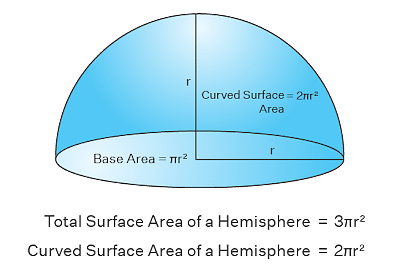
Formula of Surface Area of a Hemisphere
The curved surface area of a hemisphere (CSA) is generally described as the area involving only the curved surface of the object, with the exclusion of both the circular top and base. The total surface area of a hemisphere (TSA), on the other hand, generally describes the estimated measure of the total area the surface of the object occupies.
Also Read:
Total Surface Area of a Hemisphere
As mentioned previously, the total surface area of a hemisphere (TSA) can be described as the total portion occupied by the curved surface area and the base of it, altogether.
In general, the total surface area of a hemisphere can be evaluated by determining the sum of the area involved in the curved surface and the surface of the base. If the radius is elementally provided, then the surface area of a hemisphere can be determined by the following equation,
Thus, Surface area of a hemisphere = Curved Surface Area + Base Area of the Hemisphere
= 2 π r2 + π r2 = 3 π r2
Wherein, the ‘r’ is known to be the radius of the hemisphere.
Therefore, the formula followed for determining the total surface area of a hemisphere is given by the equation,
Surface Area (SA) = 3πr2, wherein SA is known to be the surface area, while r is the radius.
Read More:
Curved Surface Area of a Hemisphere
As mentioned earlier, the curved surface area of a hemisphere (CSA) can be determined by finding the area involving the curved surface of the object, with the exclusion of both the circular top and base of it. In simple words, it is the area covered by the curved surface of the object.
With the inclusion of radius ‘r’, the curved surface area of the hemisphere can be estimated by the following equation,
Curved surface area of a hemisphere = ½ of the Curved Surface Area of a sphere (CSA), which is,
= ½ (4 π r2)
= 2 π r2,
wherein, ‘r’ is known to be the radius of the hemisphere.
The curved surface area of a hemisphere is 2πr2 square units.
Read More:
Things to Remember
- A hemisphere, is generally given rise to by cutting a sphere along the plane, running through its center point. For example, if an apple is cut along its center point, then it can get in the shape of a hemisphere.
- The surface area of a hemisphere can be described as the sum of the surfaces of all the parts that tend to cover the surface of the hemisphere.
- The total surface area of a hemisphere (TSA) mainly defines the measure of the total area the surface of the object is known to occupy. The formula of total surface area of the hemisphere is: TSA = 3πr2.
- The curved surface area of a hemisphere (CSA) can be defined as the area involving the curved surface of an object, with the exclusion of both the circular top and the base of it. The formula of the curved surface area of a hemisphere is 2πr2 square units.
Read More:
Sample Questions
Ques. Determine the surface area of a hemisphere with a radius of 4 cm.
Solution: The radius of the given hemisphere is, r = 4 cm
As per the formula, the curved surface area = 2πr2 square units.
As per the formula, the total surface area = 3πr2 square units
When replacing the value of r in the formula, then,
(i) CSA of the hemisphere = 2πr2 = 2 × 3.14 × 4 × 4
CSA = 3.14 × 32
Thus, CSA = 100.48 cm2
(ii) TSA of the hemisphere = 3πr2 = 3 × 3.14 × 4 × 4
TSA = 3.14 × 48
Thus, TSA = 150.72 cm2
Ques. Determine the value of a hollow hemisphere.
Solution: As per the formula, the Curved surface area of the outer hemisphere can be denoted as = 2π 2r2
As per the formula, the Curved surface area of the inner hemisphere can be denoted as = 2π r12
Now, when determining the area of the ring, it can be said = π (r22 – r12)
Therefore, the Total surface area of hollow hemisphere, TSA = 2π r22 + 2πr12 + π(r22 – r12)
TSA = 2π (r22 + r12) + π(r22 – r12)
Hence, it can be said that, TSA = 3πr22 + πr12 (the equation involves r1 as the radius of the external hemisphere, while r2 as the radius of the internal hemisphere respectively.)
Read More:
Ques. Determine the value of the surface area of a hemisphere, the radius of which measures 7 units? (Use the value π as = 22/7)
Solution: As per what is given in the question, the radius of the hemisphere = 7 units
As per the formula, the surface area of a hemisphere can be stated as = 3 π r2
= 3 (22/7) 72
= 3 × 22 × 7
= 462 units2
Hence, the surface area of the hemisphere can be denoted as 462 units2
Ques. Given that the curved surface area of a solid sphere is 98.56 cm2, determine the radius of the sphere.
Solution: As per the given question, let us first assume that the Curved surface area of a sphere = 98.56 cm2
Therefore, 4 Π r2 = 98.56
4 * (22/7) * r2 = 98.56
r2 = 98.56 * (1/4) * (7/22)
r2 = 98.56 * (1/4) * (7/22)
r2 = 7.84
r = √(2.8 ⋅ 2.8)
Hence, r = 2.8 cm
Thus, the radius of the sphere can be stated as 2.8 cm.
Ques. Given that the radius of a particular hemisphere is 7 cm, determine the curved surface area of the hemisphere, in respect of the radius.
Solution: As per the formula generally known for the curved surface area of a hemisphere,
It can be said that the curved surface area of the hemisphere
= 1/2 x 4πr2
= 2πr2
= 2π(7)2
= 308 cm2
Hence, the curved surface area of the hemisphere is 308 cm2.
Read More:
Ques. What is the curved surface area of a hemisphere whose radius is 21 units. (Use the value of π = 22/7)
Solution: As per the equation, the curved surface area of the hemisphere = 21 units
Typically, as per the formula, the Curved surface area of a hemisphere = 2 π r2 = 2 (22/7) 212 = 2 × 22 × 21 × 3
= 2772 units2
Hence, the curved surface area of the hemisphere can be denoted as 2772 units2.
Ques. Determine the radius of the hemisphere with a total surface area of 462 units2 by using the surface area of a hemisphere. (Use the value π = 22/7)
Solution: As per the formula, the total surface area of a hemisphere can be assumed as = 462 units2
Thus, 3 π r2 = 462
r2 = 462/(3π) = 49
Hence, the value of r = 7 units
Given that, the radius of the hemisphere is = 7 units
Ques. Determine the curved surface area and the total surface area of a hemisphere that has a radius of 21 cm.
Solution: As per the given equation, the curved surface area of the hemisphere is 21 cm
Thus, as per the formula of curved surface area = 2πr2
= 2 x 21 x 21
= 2772 cm2
Now, given the equation, the total curved surface area can be stated by = 3πr2
= 3x 21x21
= 4158 cm2
Also Read:



Comments