



Education Journalist | Study Abroad Lead
The surface area of a sphere is the area covered by the outer surface of the sphere. The surface area of an object is equal to the total of the areas covered by its surface. An object with depth and height forms a three-dimensional shape. A sphere is a three-dimensional form with evenly distributed points on its area. A sphere's surface area can be calculated using the integration method.
| Table of Content |
Key Terms: Radius, Diameter, Sphere, Circle, Area, Volume, Lateral Surface Area, Curved Surface Area, Cylinder
What is the Surface Area of a Sphere?
[Click Here for Sample Questions]
A sphere is an object where each of the points on its round surface is equal to the sphere's fixed centre. The radius is the distance between the centre and the surface. The area occupied by the curved surface of a sphere is known as its surface area. Both circle and sphere are round in shape. The key difference between the two is that the sphere is a three dimensional figure as it has volume whereas the circle is a two dimensional figure. The unit of surface area of the sphere is square units.
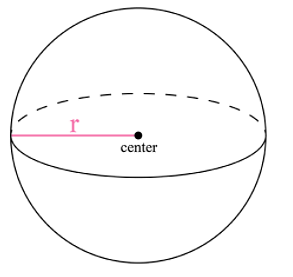
Sphere
Formula of Surface Area of a Sphere
[Click Here for Sample Questions]
A sphere is a three-dimensional object that resembles a circle and has a round shape. The surface area of every three-dimensional object can be divided into three categories. It's as follows:
- Curved Surface Area
- Lateral Surface Area
- Total Surface Area
The formula for calculating the surface area of a sphere can be used to compute the sphere's surface area. Let us assume a sphere of radius ‘r’. The area ‘A’ of sphere can then be determined by the formula:
| A = 4πr2 |
Derivation of Surface Area of a Sphere
[Click Here for Sample Questions]
Because a sphere has a circular shape, we connect it to a parabola, such as a cylinder, to calculate its surface area. A cylinder is a shape with a curving surface having flat surfaces on both sides. When the radius of a cylinder and the radius of a sphere are the same, the sphere can precisely fit into the cylinder. This signifies that the cylinder's height is the same as the sphere's diameter. As a result, Archimedes showed that when the radius of a cylinder and sphere is 'r,' the surface area of a sphere is equal to the lateral area of a cylinder.
Thus,
| Surface Area of a Sphere = Lateral Surface Area of a Cylinder |
Here,
Lateral Surface Area of a Cylinder = 2πrh
where, r = radius of a cylinder and h = height of a cylinder
Now, we assume that sphere get perfectly fit in cylinder so the height of cylinder is also the diameter of cylinder
Height of Cylinder = Diameter of Sphere = 2r
So,
Surface Area of a Sphere = 2πrh
Now, In the surface area of a sphere we can replace h with 2r (because Height of cylinder = diameter of Sphere = 2r )
So, the surface area of a sphere = 2πrh = 2πr(2r) = 4πr2
Hence,
A = 4πr2
Here, r is the radius of the sphere.
How to Find the Surface Area of a Sphere
[Click Here for Sample Questions]
Let’s take a look at this example to see how to use the formula to determine the surface area of a sphere.
Example: Find the surface area of a sphere with a radius of 6 cm.
Step 1: Note the given radius of the sphere. Here, the radius of the sphere is 6 cm.
Step 2: Now, we know that the surface area of sphere = 4πr2, so by substituting the values in given formula we get, 4 × 3.14 × 6 × 6 = 452.16
Step 3: Thus, the surface area of a sphere is 452.16 cm2
Curved Surface Area of a Sphere
[Click Here for Sample Questions]
The area of all the bent portions of a solid is called the curved surface area. Because a sphere has only one curved surface, its curved surface area equals its overall surface area. So,
Curved Surface Area of Sphere = Total Surface Area of Sphere = 4πr2
Lateral Surface Area of a Sphere
[Click Here for Sample Questions]
The lateral surface area includes all regions excluding the bases (i.e., top and bottom).
We don't require any precise top or bottom portions in the shape of a sphere. So, the lateral Surface area of a sphere is the same as the total surface area of a sphere. Thus,
Lateral Surface Area of Sphere = Total Surface Area of Sphere = 4πr2
Total Surface Area of Sphere
The total surface area of a solid is the sum of its sides, top, and bottom. A sphere does not have any sides. So, it is calculated as 4πr2.
Total Surface Area of Sphere = 4πr2
Things to Remember
- A sphere is an object where each of the points on its round surface is equal to the sphere’s fixed centre.
- The total surface area, lateral surface area and curved surface area of a sphere are equal, i.e, 4πr2.
- The volume of a sphere of radius ‘r’ can be determined by the formula, V = 4/3 πr3
- The radius of a sphere is the distance between the sphere's centre and any point on the sphere's surface. It is denoted by ‘r’. So, r = d/2.
- The diameter of a sphere is the longest line in the centre of the sphere that touches both the ends of the sphere. Diameter is double of the radius of the sphere. It is denoted by ‘d’. So, d = 2r.
Sample Questions
Ques. If the surface area of a sphere is 314 cm2 then find the diameter of the sphere. (2 marks)
Ans. Given,
The surface area of a sphere = 314 cm2
Hence, 4πr2 = 314
r2 = 314/4π
r2 = 314/(4 × 3.14)
r2 = 314/12.56
r2 = 25
r = 5
r = d/2
So, d = 10
Thus, the diameter of a sphere is 10 cm.
Ques. Calculate the cost of painting a football that is shaped like a spherical with a radius of 7 cm. If the cost of football painting is INR 2.5 per square cm. (Assume π = 22/7) (2 marks)
Ans. We know that,
Surface area of a sphere = 4πr2
So, 4 × 22/7 × 7 × 7 = 616 cm 2
So, the area of football is 616 cm2
Now, the cost of painting football is 2.5 × 616 = INR 1540
Ques. How many square kilometres is the land area if three-fourths of the world’s surface is covered by water, assuming the earth is spherical with a radius of 6370 km? (2 marks)
Ans. Given that,
Radius of earth = 6370 km
Water on the earth = ¾ % of total area
Area of land = ¼ × 4πr2 = πr2
= 4 × 22/7 × (6370)2
= 127527400 km2
Ques. Find the surface area of a sphere with a diameter of 8 cm. (2 marks)
Ans. Given,
The diameter of sphere = 8 cm
So, radius = 8 /2 = 4 cm
We know that,
The surface area of a sphere = 4πr2
= 4 × 22/7 × 4 × 4
= 201.14 cm2
Ques. Calculate the volume of a sphere with 154 cm2 of surface area. (3 marks)
Ans. Given,
The surface area of sphere = 154 cm2
We know that,
The surface area of a sphere = 4πr2
So, 4πr2 = 154 cm2
4 × 22/7 × r2 = 154
r2 = 49/4
r = 3.5
Now, volume of a sphere = 4/3πr3
= 4 × 22/7 × 3.5 × 3.5 × 3.5
= 179.66 cm3
So, the volume of a sphere is 179.66 cm3.
Ques. One ladoo with a radius of 5 cm belongs to a shopkeeper. How many ladoos of radius 2.5 cm can be made from the same material? (3 marks)
Ans. Volume of laddoo having radius 5 cm (V1) = 4/3 × 22/7 × (5)3
= 11000/21 cm3
Also, Volume of laddoo having radius 2.5 cm (V2) = 4/3πr3
= 4/3 × 22/7 × (2.5)3 cm3
= 1375/21 cm3
Therefore,
Number of laddoos of radius 2.5 cm that can be made = V1/V2 = 11000/1375 = 8
Ques. The diameter of the moon is about a quarter of the diameter of the earth. Calculate their surface area ratio. (3 marks)
Ans. Diameter of moon = 1/4 of diameter of earth
Let radius of earth per km
Then the radius of moon = (r/4) km
Now, surface area of earth = 4πr2
Surface area of moon = 4π(r/4)2
= 4π × (1/16) r2 = (1/4) × πr2
Ratio between surface area of moon and earth = (1/4) × πr2 : 4πr2 = (1/4) : 4 = 1/16
Ques. As air is pumped into a spherical balloon, its radius rises from 7 cm to 14 cm. Calculate the ratio of the balloon's surface areas in both scenarios. (4 marks)
Ans. Radius of the spherical balloon initially, r1 = 7 cm
Surface area of the balloon initially = 4πr2
= 4 × π × (7)2
= 4 × π × 49
Radius of the spherical balloon after air is pumped, r2 = 14 cm
Surface area of the balloon after air is pumped = 4πr2
= 4 × π × (14)2
= 4 × π × 196
Ratio of the two scenarios = Surface area of the balloon before air is pumped / Surface area of the balloon after air is pumped
= 4 × π × 49 : 4 x π × 196
= 1:4
Ratio of surface areas of the balloon in the two scenarios = 1 : 4
Ques. A sphere can be perfectly fit in the cylinder with a height of 10 cm. Find the surface area of a sphere? (3 marks)
Ans. Given,
The height of a cylinder = 10 cm
We know that,
Height of a cylinder = diameter of a Sphere = 2r
So, the radius of a sphere = 10/2 = 5 cm
Now,
Surface area of a sphere = 4πr2
= 4 × 22/7 × 5 × 5
= 314.28 cm is the surface area of the sphere.
Ques. The price per square metre of velvet is Rs 10. Calculate the price of 1000 rubber balls with a radius of 0.12 m. (2 marks)
Ans. The surface area of a ball = 4πr2
= 4 × 3.14 × 0.12 × 0.12
= 0.181 m
Now, the price of manufacturing ball = 0.181 × 10
= Rs 1.81
Now, the price of manufacturing 1000 balls = 1.81 × 1000 = Rs 1810
Read More:



Comments