



Education Journalist | Study Abroad Lead
The surface area of a rectangular prism is the total area or region covered by its six faces. Prism can also be stated as a polyhedron with two polygonal bases parallel to each other. Prisms are solids with flat parallelogram sides and non-distinct polygon bases. There are various types of prisms such as a rectangular prism, pentagonal prism, square prism, triangular prism, hexagonal prism and many more. Further, you shall learn more about the surface area of a rectangular prism. Also, the surface area of a rectangular prism is the total area of lateral faces and rectangular bases.
| Table of Content |
Key Terms: Prism, polyhedron, Total surface area of a rectangular prism, Lateral surface area of a rectangular prism, cube, cuboid.
Surface Area Of A Rectangular Prism
[Click Here for Sample Questions]
The total area or region covered by all the faces of a rectangular prism is defined as the surface area of a rectangular prism. It is a three-dimensional object. It consists of six faces and all are rectangular in shape. Hence, both the bases of the rectangular prism must be rectangles as well.
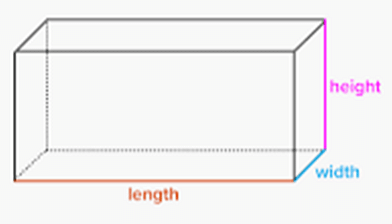
Rectangular Prism
Surface Area Of A Rectangular Prism: Formula
[Click Here for Sample Questions]
To find the surface area of a rectangular prism, we need to find the sum of the areas of all the faces of the prism.
Further, a rectangular prism is divided into two types:
- Total surface area of a rectangular prism
- Lateral surface area of a rectangular prism
Total Surface Area of a Rectangular Prism
[Click Here for Sample Questions]
The total surface area of a rectangular prism can be found by calculating the total area of all its six faces. The formula for the surface area of a rectangular prism is,
Total surface area of a rectangular prism = 2(lb+bh+hl)
Where,
l= length of a rectangular prism
b= breadth of a rectangular prism
h= height of a rectangular prism
Lateral Surface Area of a Rectangular Prism
[Click Here for Sample Questions]
The lateral surface area of a rectangular prism can be calculated by finding the sum of all the lateral faces of the prism. This does not include the area of the bases. The formula for the lateral surface area of a rectangular prism is,
Lateral surface area of a rectangular prism= 2(l+b) h
Where,
l= length of a rectangular prism
b= breadth of a rectangular prism
h= height of a rectangular prism
How To Calculate the Surface Area of a Rectangular Prism
[Click Here for Sample Questions]
The surface area of a rectangular prism can be found by using the following steps:
Step 1: The given dimensions of the rectangular prism must be in same units if not then make same.
Step 2: Once the dimensions are made the same, one can calculate the lateral surface area or the total surface area as per the condition given.
Step 3: Utilize the formula for the lateral surface area or the total surface area.
Step 4: The units calculated are in square units.
Things to Remember
[Click Here for Sample Questions]
- The total surface area of a solid is the sum of the areas covered by all the faces or surfaces enclosing the object.
- The unit of measurement of the area of the rectangular prism is square units.
- A rectangular prism with all sides the same is called a cube.
- An oblique rectangular prism is stated as a prism in which faces are not perpendicular to one another.
- If all the vertices of a rectangular prism are the same as ‘l’, then the volume of the prism is given as ‘l3’.
- If all the edges of a rectangular prism are equal, then the surface area of the prism will be 6 times the area of the face.
Solved Questions
Ques. Find the surface area of a rectangular prism with base as 8 cm, height as 14 cm, and side as 6 cm. (2 marks)
Ans:
Given- b= 8 cm
l= 6 cm
h=14 cm
The surface area of a rectangular prism= 2(lb+bh+hl)
= 2(6x8+ 8x14+ 14x 6)
= 2(48+112+84)
The surface area of a rectangular prism = 488 cm2.
Ques. Determine the minimum area of the wrapping paper required to wrap a rectangular box with dimensions length as 26 cm, breadth as 16 cm, and height as 22 cm. (3 marks)
Ans: The area of the top and bottom surfaces is equal hence, simply twice the area of top and bottom
2lb= 2 (26x16) = 832 cm2
Similarly, we calculate the area of the sides of the faces of the box
2bh= 2(16x22) = 704 cm2
2lh= 2(26x22) = 1144 cm2
Therefore, the total surface area of the box= 2(lb+ 2bh+hl)
= 832+704+1144
= 2680 cm2.
Ques. Sheila needs to buy some cardboard to build a box without a lid 6cm long, 7 cm wide, and 9 cm high. How much cardboard she should buy? (4 marks)
Ans: The dimensions of the box given is,
Length, l= 6 cm
Breadth, b= 7 cm
Height, h= 9 cm
The area of an open box without lid can be calculated by calculating the total area of 5 surfaces:
Base area= l x b
Area of 4 lateral faces or lateral surface area= 2(l+b) h
Total surface area of the rectangular prism (open box) = lb+2lh+ 2bh
= 6x7+ 2(6x9) + 2(7x9)
= 42+108+126
= 276 cm2.
Sheila requires a carboard of 276 cm2.
Ques. Total surface area of the rectangular prism is 94 cm2 with a base area as 12 cm2 and the perimeter of the base being 14 cm. using the formula of surface area of the rectangular prism calculate its height. (4 marks)
Ans: Let l, b, h be the length, breadth, and height of a rectangular prism respectively.
Base area = l x b = 12 cm2
Base perimeter = 2 (l+b) = 14 cm
Surface area = 94 cm2
Now, using the formula
Total surface area of the rectangular prism= 2(lb+ 2bh+hl) = 94 cm2
Or 2lb+2(l+b) h= 94 cm2
2x12 + 14h= 94 => 14h= 94-24
h= 70 cm.
Thus, the height of the prism is 70 cm.
Ques. Rama has a playing top which is covered in single color. He wished to color the object with crayons. The top is shaped like a cone surmounted by a hemisphere. The entire top is 16 cm in height and the diameter of the top is 8 cm. find the area he has to color. (4 marks)

Ans: Given,
r= d/2=8/2=4 cm.
The total surface area of the top = curved surface area of hemisphere + curved surface area of cone
curved surface area of hemisphere= (1/2) (4 pr2) =2 pr2.
= 2 p x4 x 4= 32p= 100.53.
Height of the cone, h= 12 cm.
Slant height of the cone, l= sq. root of r2+h2.
= sq. root (42+ 162) = sq. root 272= 16.49 cm.
curved surface area of cone= prl
= p x 4x 16.49= 207.22 cm.
The surface area of the top = 2 pr2+prl
= 100.53+207.22 = 307.75 cm2.
The total area Rama has to cover is 307.75 cm2.
Ques. Rob made a bird bath for his garden in the shape of a cylinder with a hemispherical; depression at one end. The height of the cylinder is 1.45m and its diameter as 60 cm. find the total surface area of the bird bath. (3 marks)

Ans: Let h be the height of the cylinder and r be the common radius of the cylindrical hemisphere. Then,
Radius, r = d/2=60/2=30cm.
Height, h= 1.45 x100=145 cm.
The total surface area of the bird bath= curved surface area of the cylinder + curved surface area of the hemisphere
= 2 prh +2 pr2= 2 pr(h+r)
= 2 x p x 30(145+30)
= 33000 cm2 or 3.3 m2.
The total surface area of the birdbath is 3.3m2.
Ques. Two cubes each of volume 27 cm3 are joined end to end. Find the surface area of the resulting cuboid. (3 marks)

Ans: We can find the length of the edge of each cube, where the length of the edge is ‘a’.
Volume of cube= a3
a3 = 27.
Therefore, the length of each cube, a= a3=3 cm.
Now, length of resultant cuboid, l= a=3 cm
Breadth of resultant cuboid, b=a= 3 cm
height of resultant cuboid, h= 2a=6 cm
Total surface area of the cuboid= 2(lb+ bh+hl)
= 2(3x3+ 3x6+ 6x3) = 90 cm2.
The total surface area of the cuboid is 90 cm2.
Ques. A cubical block of side 7 cm is surmounted by a hemisphere. What is the greatest diameter the hemisphere can have? Find the surface area of the solid. (3 marks)

Ans. From the given figure it can be observed that the greatest diameter possible could be the edge of the cuboid itself and it is 7 cm.
Therefore, the radius of the hemisphere, r= 7/2=3.5 cm.
Total surface area of the solid= surface area of cuboid+ curved surface area of hemisphere- area of base of hemisphere
Total surface area of the solid= 6a2+ 2 pr2 - pr2= 6a2+ pr2
Total surface area of the solid= 6(7)2+p(3.5)2.
= 294+38.5= 332.5 cm2.
The surface area of the solid is 332.5 cm2.
Ques. From a solid cylinder whose height is 2.4 cm and diameter 1.5 cm, a conical cavity of the same height and same diameter is hollowed out. Find the total surface area of the remaining solid to the nearest cm2. (4 marks)

Ans. Given that,
Height of the conical part = height of the cylindrical part (h)= 2.4 cm
Diameter of the cylindrical part = 1.5 cm or radius, r = 1.5/2= 0.75 cm.
Slant height, l = sq. root of r2+h2.
= sq. root (0.75)2+(2.4)2= sq. root of 6.3225= 2.51 cm.
Total surface area of the remaining solid= CSA of cylinder + CSA of conical part +Area of base of cylinder.
= 2 prh +prl+pr2
= 2 p x 0.75 x 2.4+ p x 0.75x 2.51+ p x (0.75)2.
= 18.99 = 19 cm2. (approx.)
The total surface area of the remaining solid is 19 cm2.
Ques. A wooden article was made by scooping out a hemisphere from each end of a solid cylinder. If the height of the cylinder is 12 cm, and its base is of radius 3 cm, find the total surface area of the article. (3 marks)

Ans. We know that,
Height of the cylinder =12 cm
Radius of the base, r = 3 cm
Total surface area of the article = curved surface area of the cylinder + 2(surface area of a hemisphere)
= 2 prh+ 2(2 pr2) =2 pr(h+2r)
= 2 x p x 3 (12+2x3)
= 2376/7= 339.42 cm2
Total surface area of the article is 339.42 cm2.
Read More:



Comments