



Education Journalist | Study Abroad Lead
Trachea and oesophagus both are tube-like structures, however, they serve entirely different functions. These organs are found in the region of the neck in the human body. In general, the trachea is known as the windpipe, whereas, the oesophagus is known as the food pipe. Both perform interdependent functions which means that none of them is independent of each other and is essential for human survival. But they do not share any common property in terms of characteristics and features. The food pipe and the windpipe are essential components of human physiology, therefore, it becomes significant to understand the difference between the two. So, in this article, we will discuss the functions and the differences between the oesophagus and trachea, that is, the food pipe and the windpipe.
| Table of Content |
Key Takeaways: Oesophagus, food pipe, windpipe, trachea, digestive system, respiratory system, neck, passage, oxygen.
What is Oesophagus?
[Click Here for Sample Questions]
Oesophagus is also known as the food pipe. It performs the functions of transferring nutrients and other vitamins from the mouth to the stomach. A food pipe is a tube-like structure that is found in the digestive canal. After swallowing the food with the help of several enzymes present in our mouth, the food bolus moves through the oesophagus and reaches the stomach. This passage is governed by the peristaltic movement. The nature of the food pipe is determined by its outer body which is made up of muscular lumen.
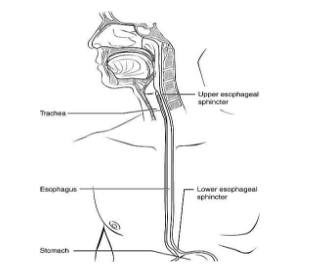
Anatomy of Oesophagus
What is Trachea?
[Click Here for Sample Questions]
Trachea is also known as the windpipe because it performs the most essential function of transferring the inhaled air to the lungs and exhaled air back to the nostrils, this means that the trachea accompanies breathing. It is also a tube-like structure but comparatively smaller than the oesophagus. It is known to be situated very close to the food pipe and is surrounded by a C – shaped cartilage. Its position begins from the larynx region to that of the lungs. This trachea further bifurcates into two bronchi which later extends into the thoracic and cervical region.
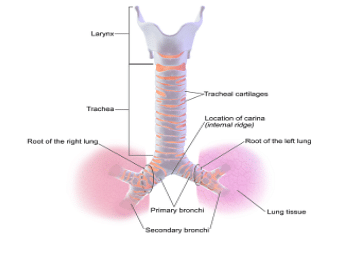
Anatomy of Trachea
Difference Between Trachea and Oesophagus
[Click Here for Sample Questions]
The difference between the food pipe and the windpipe are as follows.
| Parameters | Trachea | Oesophagus |
|---|---|---|
| Definition | It extends from the larynx to the bronchial tube. The trachea has a membranous and tube-like structure. | It extends from the throat to the stomach. Oesophagus is known to be a part of the alimentary canal. |
| Also known as | Windpipe | Food pipe |
| Length | 10 – 11 cm | 25 cm |
| Function | Transfers air to and from lungs and nostrils. Accompany the process of respiration. | Generates a motion known as Peristaltic movement for the movement of food from the mouth to the stomach. |
| Composition | Contains two parts. | Consists of three parts. |
| Parts Name | Thoracic and the Cervical parts. | Abdominal, thoracic part, and cervical parts. |
| Organ System | Part of the respiratory system. | Part of the digestive system. |
| The opening is protected by | By an epiglottis | By two sphincters |
Similarities Between Trachea and Oesophagus
[Click Here for Sample Questions]
Both food pipe and windpipe share a few of the common properties, mainly in terms of appearance and location. Some of these similarities are as follows.
- Both the trachea and oesophagus have a tube-like appearance or a tubular structure and are found in the neck region of humans.
- Both the pipes, that is, the trachea and oesophagus are known to perform the function of transportation.
- Both the trachea and oesophagus are a type of muscular tubes. These tubes are mainly located in line with a mucous membrane.
Things to Remember
[Click Here for Sample Questions]
- The food pipe and the windpipe perform the functions that are associated with each other. Both are similar in terms of significance but have their own unique ways of contributing to the physiological processes in the human body.
- The tube-like appearance is a major similarity between the trachea and the oesophagus and both are located around the neck in a human body.
- Peristaltic movement makes sure that one can eat and swallow the food in the upside-down position as well. Moreover, it takes care of the absence of gravity and ensures the continuity of the process of chewing and eating.
- Since the trachea serves an essential function of accompanying in the breathing exercise, it is necessary to secure the windpipe from any kind of damage. So, the C – shaped cartilage protects the windpipe or trachea from getting damaged due to sleeping or injury.
- The anatomy of both the trachea and oesophagus varies from each other. The trachea is around 11 – 12 cm long cartilaginous whereas the oesophagus is muscular with a length of around 20 – 25 cm.
Sample Questions
Ques. Explain the location of the oesophagus and trachea. (2 marks)
Ans. Oesophagus and trachea are tube-like structures found in the region of the neck of an individual. These are a food pipe and windpipe which are placed just adjacent to each other. However, both are separated from each other through epiglottis. Epiglottis can be defined as a flap in the throat that separates the two pipes.
Ques. What is the importance of the trachea? (3 marks)
Ans. The trachea is a windpipe that is situated in the neck of humans. It acts as a passage between the larynx and the lungs and serves to be an important part of the respiratory system. Its main function is to transfer the oxygen from the nostril to the lungs and from the lungs back to the nostril. Therefore, the trachea accompanies the process of inhalation and exhalation. Without a trachea, the human body shall collapse. The process of respiration in the human body works on the basis of adequate flow of oxygen in and out of the body which is supported by the trachea.
Ques. How is food carried through food pipe? (3 marks)
Ans. Food is carried from mouth to stomach through a food pipe which is also known as the esophagus. Esophagus is a tube-like structure present inside the neck region of humans. It connects the throat to the stomach. The peristaltic movement takes place inside the esophagus which generates wave–like motions. This movement is responsible for the movement of food particles inside the tube through continuous relaxation and contraction of the pipe. Once the food is eaten and chewed, it moves into the pipe following which the peristaltic movement gets initiated.
Ques. What makes the trachea and oesophagus similar? (4 marks)
Ans. The trachea and oesophagus are known as windpipe and food pipes respectively. Both of them share a group of common properties. Most importantly, both are highly similar in terms of appearance and location. Such as, both the trachea and oesophagus have a tube-like appearance or a tubular structure and are located in the neck region of humans. Another similarity could be seen in terms of their functions as both perform the function of transportation. Both the trachea and oesophagus are a type of muscular tubes. These tubes are mainly located in line with a mucous membrane.
Ques. How is food pipe different from windpipe? (2 marks)
Ans. The food pipe is different from the windpipe in terms of its function. Food pipe extends from throat to stomach and transfers food from mouth to stomach whereas, the windpipe accompanies respiration and carries oxygen to and from the nostril and lungs. Both are separated from each other by a flap called epiglottis.
Ques. What is a food pipe made up of? (2 marks)
Ans. The oesophagus is a food pipe that contains four layers—the mucosa, submucosa, muscular, and tunica adventitia. The mucosa is usually made up of stratified squamous epithelium which itself contains numerous mucous glands. The submucosa is a relatively thick structure with a loose fibrous layer. This connects the mucosa to the muscularis.
Ques. State the difference between the oesophagus and trachea. (4 marks)
Ans. The trachea extends from the larynx to the bronchial tube and has a membranous and tube-like structure. Whereas, Oesophagus extends from the throat to the stomach and is known to be a part of the alimentary canal. The trachea has a length of around 11 – 12 cm long and is cartilaginous whereas the oesophagus is muscular with a length of around 20 – 25 cm. The trachea serves the function of transferring air to and from the lungs and nostrils. And also accompany the process of respiration. Whereas, the oesophagus generates a motion known as Peristaltic movement for the movement of food from the mouth to the stomach.
Ques. Mention the four layers of oesophagus. (2 marks)
Ans. The oesophageal wall is known to contain four layers, such as
- mucosa—surface epithelium, lamina propria, and glands.
- submucosa—connective tissue, blood vessels, and glands.
- muscularis (middle layer) upper third, striated muscle.
- adventitia—connective tissue that merges with the connective tissue of surrounding structures.
Also Check:



Comments