



Education Journalist | Study Abroad Lead
Human eye is one of the most powerful and sophisticated sense organs we have. It assists us in viewing objects as well as enables us to perceive light, color, and depth. In terms of its functioning, it is comparable to cameras. Cameras help humans see things when light from outside enters them. The structure and operation of the human eye also aid in our comprehension of how a camera works. Our eyes can gaze around and adjust dynamically based on the environment. Hence, we might think there is no difference between the human eye and a camera. The camera sees whatever the eyes can see, so how exactly are they different from each other? Things, however, are not as simple as they seem; they are way more complicated. In this article, we will discuss the differences and similarities between the eye and the camera.
Read More: The Human Eye and The Colourful World
| Table of Content |
Keywords: Human eye, Retina, Photoreceptors, Photograph, Camera, Accommodation
Human Eye
[Click Here for Sample Questions]
A human eye has a 2.3 cm diameter and is a spherical-shaped ball filled with fluid. It is made up of the following components:
- Sclera: The sclera is the outer covering, a solid white layer that protects the skin (white part of the eye).
- Cornea: The cornea is the front transparent section of the sclera. Light can enter the eye through the cornea.
- Iris: The iris is a black muscular tissue with a ring-like structure behind the cornea.
- Pupil: A pupil is a tiny aperture in the iris.
- Lens: A lens is a translucent structure located behind the pupil. It changes form due to the action of ciliary muscles to focus light on the retina.
- Retina: A light-sensitive layer made up of many nerve cells. It converts the lens's pictures into electrical impulses.
- Optic nerves are classified into two categories: cones and rods.
- Cones: Cones are nerve cells that are exceptionally responsive to intense light. They aid with fine-grained central and color vision.
- Rods: Rods are the optic nerve cells that are particularly sensitive to low-light conditions.
- Blind Spot: The area where there are no sensory nerve cells at the interjunction of the optic nerve and the retina is known as a blind spot.

Human Eye Anatomy
The video below explains this:
Human Eye One Shot Detailed Video Explanation:
Camera
[Click Here for Sample Questions]
A camera is an optical equipment that collects visual images. At its most basic, cameras are sealed boxes (the camera body) with a small hole known as the aperture that allows light to pass through and capture a picture on a light-sensitive surface. Cameras use various methods to manipulate how light falls on a light-sensitive surface. Lenses focus the light that enters the camera, and the aperture size can be enlarged or constricted. A shutter mechanism controls how long the photosensitive surface is exposed to light.

Camera
In the art of photography, the still image camera is the primary tool. Captured images can be reproduced later as part of the photography, digital imaging, or photographic printing processes. Film, cinematography, videography are similar artistic professions in the moving-picture camera realm.
Read More: Scattering of Light
Mechanism:
Cameras catch light photons, often from the visible spectrum. Still, they can also capture photons from other parts of the electromagnetic spectrum. Light enters an enclosed box by a converging or convex lens. An image is captured on a light-sensitive medium in all cameras. The amount of time light enters the camera is controlled by a shutter mechanism. Most cameras also have a viewfinder. A viewfinder is used to display the scene that is to be captured and it lets you manage the focus and exposure.

Mechanism of Camera
Eye vs Camera
[Click Here for Sample Questions]
The eye and camera differ from each other as follows:
- An eye is a visual organ, whereas a camera is a piece of technology used to capture or record images.
The first and most obvious distinction between an eye and a camera is that an eye cannot record images. The eyes detect and interpret light using living cells, which are converted into electrical signals that are conveyed to the brain and processed into an image. On the other hand, the camera employs a diaphragm through which the image is captured on film or, in newer cameras, on tape or digitally.
- Eyes are more flexible than cameras.
Tiny muscles in the human eye contract and relax, allowing the eyes to change shape and remain focused on a moving object. These muscles can also change the thickness of the lens to accommodate the image being viewed. A camera cannot do this, and it must rely on a range of lenses. This is why photographers frequently alter the lens of their camera based on the distance from the target. Furthermore, cameras rely on mechanical components to maintain focus on a moving object.
- A camera sees in two dimensions, whereas the eye perceives in three dimensions.
This implies that we notice the height, width, and depth when looking at something. We can only observe height and width with a camera. Because a photograph is a flat medium, there is no way to have depth in the image. This is accomplished chiefly through the eye's stereoscopic vision. Attempting to bring the forefingers of both hands together from the sides is a simple demonstration of this. This is considerably easier to achieve with both eyes open than with just one, and it's nearly impossible with a camera.
- Eyes see through photoreceptors while cameras use photosites.
Photoreceptors are specialized cells found in human eyes. Rods and cones are the two types. Cones are used for color vision, whereas rods are used for low-light vision. Cones are classified into three categories, each responding to a different wavelength of light. Blue cones, for example, respond to short wavelengths, red cones to long wavelengths, and green cones to middle wavelengths. The color we see is caused by the brain activating the cones in different combinations.
Cameras use photosites to gather light. A typical camera contains millions of these light collectors, which collect light and transform it into a signal that electronic systems can read. Furthermore, cameras employ filters that divide light into its fundamental colors – red, blue, and green. By blending these colors, it creates a full-spectrum image.
- Eyes are more adaptable than cameras.
The retina and sections of the pupil adjust in size when the focus changes. The movement of the lens, on the other hand, changes the direction of a camera. The the eye may also adjust to the dark, and in a matter of seconds, one can begin seeing better in the night. However, if a camera is not designed to capture low-light photographs, it will never adapt.
- Eyes have a blind spot while the cameras don’t.
The human eye features a blind spot, which is positioned where the optic nerve meets the retina. Under normal conditions, we are unaware of this blind spot because the brain uses information from the other eye to fill in the missing area of the image. A camera does not have this kind of blind spot.
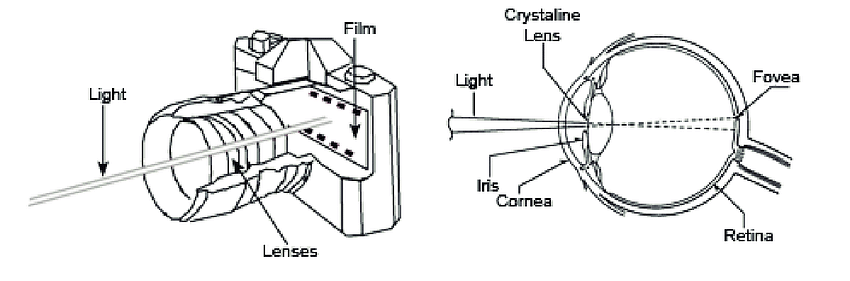
Human Eye and Camera
Differences between Human Eye and Camera
[Click Here for Sample Questions]
The differences between the human eye and the camera are as follows:
| Human Eye | Camera |
|---|---|
| Human Eyes are visual organs | The camera is a piece of technology |
| Eyes are flexible and are filled with fluid. | Cameras are rigid. |
| Since the lens is flexible, they are moved with the muscle. | Cameras are rigid, so the lens is solid. |
| Rod and cons are specialized cells that send images to the brain. | There is a simple compound present in the film that retains the images. |
| Eyes cannot record images | Cameras can record images, videos |
| Eyes can see in three dimensions | Cameras can see in only two dimensions |
| The eye can adjust to the dark in a matter of seconds, one can begin seeing better in the night after some time. | However, if a camera is not designed to capture low-light photographs, it will never adapt. |
| The human eye features a blind spot, which is positioned where the optic nerve meets the retina. | A camera does not have this kind of blind spot. |
Similarities between Human Eye and Camera
[Click Here for Sample Questions]
Although with all these differences, our eyes and the camera do have some things in common such as:
- Our Cornea functions similarly to the front lens element of a lens. They are the focusing elements of the eye, together with the lens, which is located behind the iris. The cornea widely bends which in turn diverges the rays of light via the pupil, the circular aperture in the center of the colored iris.
- Our iris and pupil function similarly to the aperture of a camera. The iris is a muscle that, when contracted, covers all but a small central section of the lens, allowing for changeable control of the amount of light entering the eye, allowing the eye to function correctly in a wide variety of viewing circumstances, from dim to extreme light.
- The sensory layer that lines the very back of our eyes is known as the retina. It functions similarly to the imaging sensor chip in a digital camera. The retina contains a large number of photoreceptor nerve cells, which convert light rays into electrical impulses and convey them through the optic nerve to the brain, where an image (of what we see) is finally received and perceived. The retina is likely the most significant component of our eyes because of its reception and perception function. If the "film" in the eye (i.e. the retina) is faulty, we will not get a decent quality image or picture no matter how good the rest of the eye is.
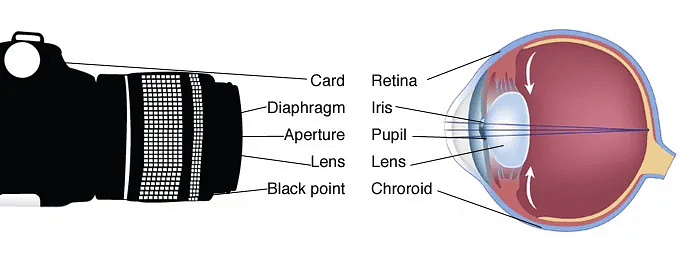
Human Eye and Camera Similarities
Also Read: Tyndall Effect
Things to Remember
- An eye is a visual organ, whereas a camera is a piece of technology used to capture images.
- An eye cannot record images; a camera can.
- Tiny muscles in the human eye contract and relax, allowing the eyes to change shape and remain focused on a moving object.
- A camera sees in two dimensions, whereas the eye perceives in three.
- Photoreceptors are specialized cells found in human eyes. Rods and cones are the two types. Cones are used for color vision, whereas rods are used for low-light vision.
- Cameras use photosites to gather light.
- The eye possesses a blind spot, often known as scotoma, but cameras have no such limits.
- Our Cornea functions similarly to the front lens element of a lens.
- Our iris and pupil function similarly to the aperture of a camera
- The retina functions similarly to the imaging sensor chip in a digital camera.
Sample Questions
Ques. Write five differences between our eyes and the camera. (5 marks)
Ans. The difference between human eyes and cameras are as written below:
- The human eye comprises living cells, whereas the camera is made up of artificial cells.
- The retina is used by the eye to focus the image, while the camera alters the location of the lenses.
- The pupil is the tiny aperture of the eye that controls the amount of light that enters the eye. In contrast, the diaphragm controls it in the camera.
- An eye detects the image with light-sensitive cells on the retina, whereas the camera uses photographic film.
- A human eye can see in three dimensions, and the camera can see only in two dimensions.
Ques. Write three similarities between our eyes and the camera. (3 marks)
Ans. The similarities between human eyes and the camera are discussed below:
- Lenses in both cameras and eyeballs can focus and display an image (upside down) of what they are looking at.
- The image is both real and reversed in both cases.
- Our iris and pupil function similarly to the aperture of a camera which allows the entry of light.
Ques. Explain the structure of the eye. (5 marks)
Ans. A human eye has a 2.3 cm diameter and is a spherical-shaped ball filled with fluid. It is made up of the following components:
- Sclera: The sclera is the outer covering, a solid white layer that protects the skin.
- Cornea: The cornea is the front transparent section of the sclera. Light can enter the eye through the cornea.
- Iris: The iris is a black muscular tissue with a ring-like structure behind the cornea.
- Pupil: A pupil is a tiny aperture in the iris. Its size is determined by the iris that controls the amount of light that enters the eye.
- Lens: A lens is a translucent structure located behind the pupil. It changes form due to the action of ciliary muscles to focus light on the retina. It grows narrower when focusing on distant objects and thicker when focusing on nearby objects.
- Retina: A light-sensitive layer made up of many nerve cells. It converts the lens's pictures into electrical impulses. These electrical impulses are subsequently carried to the brain via the visual nerves.
- Optic nerves are classified into two categories. Cones and rods are examples of these.
- Cones: Cones are nerve cells that are exceptionally responsive to intense light. They aid with fine-grained central and color vision.
- Rods: Rods are the optic nerve cells that are particularly sensitive to low-light conditions.
- The area where there are no sensory nerve cells at the interjunction of the optic nerve and the retina is known as a blind spot.
Ques. Explain the mechanism of a camera. (3 marks)
Ans. Cameras catch light photons, often from the visible spectrum, but they can also capture photons from other parts of the electromagnetic spectrum. Light enters an enclosed box by a converging or convex lens. An image is charged on a light-sensitive medium in all cameras. A shutter mechanism controls the amount of time light enters the camera. Most cameras also include a viewfinder, which displays the scene to be captured and lets you manage the focus and exposure.
Ques. Explain the term ‘blind spot’? (2 marks)
Ans. There are no light-sensitive cells, i.e. no rods and cones, at the intersection of the optic nerve and the retina in the eye. Hence, no vision is possible there. This is known as a blind area. So, a blind spot is a small patch of the retina that is insensitive to light where the optic nerve exits the eye.
Ques. Explain the term ‘accommodation’? (3 marks)
Ans. Accommodation refers to an eye's ability to concentrate on the retina, both distant and local objects, by adjusting its lens's focal length or converging power. A regular eye has the ability to focus on the retina, things as far away as infinity and as close as 25 cm. The accommodation power of the eye is around four dioptres. For a person with normal vision, the accommodation power of the eye is around four dioptres.
Also Check:



Comments