



Content Curator
Blind spot is the entry point of the optic nerve on the retina that is insensitive to light. It is a tiny area of each eye's visual field that corresponds to the position of the optic disc (also known as the optic nerve head) within the retina. There are no photoreceptors (i.e., rods or cones) in the optic disc, therefore image detection is not possible. There are no light-sensitive cells at the area where your optic nerve joins your retina, therefore you can't see anything there.
Read More: Human Eye
Read More: Neuron
Importance of Blind Spot
- The optic nerve and blood vessels exit the eyeball through the scotoma. The optic nerve links the retina to the brain. It transports pictures to the brain for processing. This is how you know what you're looking at. The item or picture is seen by your eyes, and then it is interpreted by your brain. Because our brains generally fill in any information we need based on the visuals surrounding our blind zone, we seldom see it.
- Side-view mirrors on automobiles are an excellent illustration of how individuals adjust for blind spots. Cars going beside you frequently enter your blind spot. The side-view mirrors provide you a different perspective on the same region.
Causes of Blind Spot
- A functional blind spot the size of a pinhead exists in each of our eyes. There are no photoreceptors in this tiny area where the optic nerve passes through the retina's surface. There is a blind spot because there are no photoreceptor cells detecting light. The eye cannot send any messages about the image to the brain without photoreceptor cells, which usually interprets the image for us.
- There is no need to be concerned about the blind area. It is a natural occurrence that serves a function. However, if you find that your blind spot is expanding, or if you have other blind spots in your range of vision, or if you have floating blind spots, this is not normal and should be checked by an eye specialist.
Read Also:
Diagram of Blind Spot

Testing for a Blind Spot
- Each eye has a fairly wide blind area, around 4° of viewing angle, or the breadth of your four fingers held at arm's length. Fortunately, they are at distinct places in each eye; the one in the left eye is about 10° (two hand widths at arm's length) to the left of centre vision, while the one in the right eye is about the same distance out on the other side.
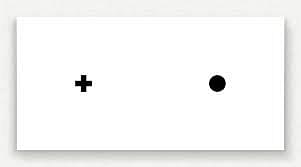
- . They are either filled in perceptually (a fascinating phenomenon) or disregarded and therefore not seen. These are two very different explanations for why the blind spots in the eyes are rarely seen or detected, even when one eye is covered. On paper, a fixation point and a letter, such as an X, split horizontally can be used to show the blind spot.
O…………………………………………X
- Fixate the O with only the right eye open, then gently move your head closer and farther until the X disappears at a specific distance (approximately 25 cm), when it falls over the blind spot of the open right eye.
Blind Spot Treatment
- Treatment is determined on the underlying cause. A scotoma that appears before a migraine headache is generally transient and disappears within an hour. If the blind spot is on the outskirts of your vision, it is unlikely to cause serious vision problems.
- If you have a scotoma in your centre vision, it may not be treatable with glasses, contacts, or surgery. Your healthcare practitioner will advise you to utilise vision aids to compensate for your reduced eyesight.
Some things that can be useful which are as follows-
- Phone keypads with large numbers and watch faces
- Filters that reduce glare on computer displays
- 'Speaking' clocks and scales
- Audiobooks, magazines, newspapers, or devices that read' written information aloud are all examples of this.
- Books with large typefaces
- Increasing the font size on an eReader on electronic devices such as iPads, Nooks, or Kindles
- Computer gear such as illuminated keyboards and software that magnifies screens and converts text to voice for computers and mobile phones are examples of personal computer hardware.
Read More: What is Thyroid Gland
Possibility for Shrinking of Blind Spot
- Studies have identified that by performing specific eye training activities, you may be able to reduce your blind spot. Researchers discovered that certain eye workouts might reduce the blind spot by up to 10% in a short trial with ten individuals.
- The study's activities included projecting an image of a tiny ring directly into an individual's blind spot and displaying waves of light and dark bands flowing through the ring. The participants were asked to determine which way the bands moved through the ring and the colour of the ring. At the start of the research, the ring's size was adjusted such that it was noticeable around 70% of the time.
Read More: Zoology
Things to Remember based on Blind Spot
- Natural blind spots exist solely in vertebrate eyes; cephalopods, such as octopus, have retinal axons that cross over the back of the retina, allowing the optic nerve to escape the eye without passing through the photoreceptor layer.
- The optic nerve links the retina to the brain. It transports pictures to the brain for processing. This is how you know what you're looking at. The item or picture is seen by your eyes, and then it is interpreted by your brain.
- Without photoreceptor cells, the eye is unable to deliver picture-related information to the brain, which typically interprets the image for us.
- Side-view mirrors on automobiles are an excellent illustration of how individuals adjust for blind spots. Cars going beside you frequently enter your blind spot. The side-view mirrors provide you a different perspective on the same region.
- Previously, it was thought that the most sensitive area to light would be where the optic nerve enters, however the most sensitive area to light is located laterally to the blind spot. It is referred to as fovea or fovea centralis. It is a small dip in the yellowish spot known as macula lutea.
- The fovea is a narrow region of the retina that permits light to fall directly on the densely packed cones. It is the area with the best vision. So the blind spot is the region with no visual awareness, while the fovea is the region with the highest resolution.
- The natural blind spot arises when axons travelling through the front of the retina converge to form the optic nerve's head and where retinal blood vessels enter and exit the eyeball, resulting in a hole in the photoreceptor mosaic.
Read More: What is Endocrine Glands
Important Questions based on Blind Spot
Ques: Why does someone get a blind spot all of a sudden? [ 1 MARK]
Ans: Some blind spots are caused by migraine, while others by more serious diseases such as glaucoma, macular degeneration, or retinal detachment.
Ques: Is it possible to repair blind spots? [ 2 MARKS]
Ans: While you won't be able to eliminate your blind spots, you may be able to "reduce" them. According to a 2015 study, participants who trained their eyes using a computer monitor and an eye patch were able to reduce the size of a blind spot by 10%. However, training one eye did not improve the untrained eye's blind spot.
Ques: Is it true that all animals have inherent blind spots? [2 MARKS]
Ans: The majority of vertebrates do. However, while having comparable eye structures to humans, squids and octopuses do not have blind spots. They have photoreceptor cells that face the light rather than away from it. As a result, their photoreceptor nerves run beneath the retina, resulting in no blind spots. The photoreceptor cells in human eyes are orientated away from the light, not toward it, and the photoreceptor nerves are located in front of the retina.
Ques: When should you consult a physician regarding a blind spot? [ 2 MARKS]
Ans: If you discover a blind spot that hasn't been there before, have a blind spot that interferes with your regular vision, or have other changes in your vision, you should consult your eye doctor right away. Your doctor will do a thorough eye exam to identify whether there is cause for worry and to assess your general visual health.
Ques: Is it possible that anxiety can produce blind spots? [ 2 Marks]
Ans: Anxiety can induce tunnel vision, visual snow, and perhaps other visual spots. Furthermore, floaters, tunnel vision, and visual snow might make you frightened, apprehensive, and hypervigilant since you believe they are a sign of a significant eye condition.
Ques: What makes it harder to fix blind spots? [ 2 Marks]
Ans: The blind spots are not visible while both eyes are open because the visual fields of the two eyes overlap. Indeed, even with one eye closed, the blind spot can be subjectively difficult to notice due to the brain's capacity to "fill in" or disregard the missing piece of the image.
Ques: How large of a blind spot one should you have? [ 2 MARKS]
Ans: In humans, the blind spot is around 12–15° temporally and 1.5° below the horizontal, and it is approximately 7.5° high and 5.5° broad.
Ques: What factors influence the size of blind spots? [ 2 MARKS]
Ans: The size of scotomas is determined by the topography of the examined area's surface. The prominent nasal portion of the optic disc looks less 'blind' than the shallow temporal portion, most likely due to more intense light scattering by the prominent nasal portion of the disc.
Ques: How can you eliminate blind spots in your vision? [ 2 MARKS]
Ans: Begin by closing your left eye and focusing your right eye on the star form. Slowly advance closer and closer to your computer screen, keeping your gaze fixed on the star. You will see that the circular dot on the right will vanish at some time. This is due to the fact that it is in your blind area.
Ques: Are there any potentially hazardous blind spots? [ 3 MARKS]
Ans: We all have natural blind spots in our eyes that we aren't aware of. However, some people have blind spots, which might signal a significant eye problem. Sudden blindness, blankness, or black patches in our eyesight might be a sign of:
- Diabetic retinopathy - A condition caused by diabetes. Diabetic retinopathy causes retinal damage and can result in blindness.
- Macular degeneration - Causes gradual blurring of vision over time.
- AIDS-related vision issues – Cotton wool spots, which are white patches on the retina that do not cause vision loss, are the most frequent eye issue among AIDS patients.
Read Also:



Comments