



Content Curator
Extensive property and intensive property are the classifications of physical matters. It was Richard C Tolman who introduced these terms in 1917. If the extensive properties are matched together, it will give results to intensive properties. It is the ratio of more than two extensive properties that will give rise to intensive properties. For example, density equals mass into volume. Herein, mass and volume are two different extensive properties and the combination of both gives the result to density.
Also Read: Difference between Area and Volume
| Table of Content |
Intensive Properties & Extensive Properties
[Click Here for Sample Questions]
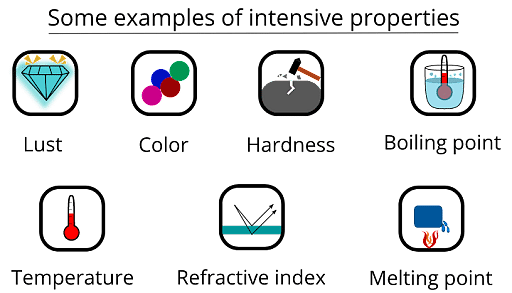
Intensive properties are not dependent on any other substance. They are independent in nature. They have very bulky properties and do not depend on any other properties. The best part of intensive properties is they remain intact. Their characteristics remain the same. Even the size of such properties remains the same. Temperature, pressure can define intensive properties well.
On the other hand, extensive properties define themselves. It has an inverse relationship with the intensive properties and thus is dependent on the other substances. One can easily identify an extensive property and the mix of two and more extensive properties give rise to intensive properties. They have variable characteristics, size, volume, and nature. Therefore the mixture of extensive properties gives rise to a separate characteristic. Volume, length, breadth, and size are some good examples of extensive properties.

Read More:
Differences Between Intensive And Extensive
[Click Here for Sample Questions]
The key differences between Intensive and Extensive properties are tabulated below.
| Intensive properties | Extensive Properties |
|---|---|
| Intensive properties are independent of each other. | Extensive properties are dependent on the other substances. |
| The size of the intensive properties does not change. | The size of the extensive properties varies from one another. |
| One cannot compute and define the intensive properties. | One can easily measure, and compute the extensive properties. |
| One can easily identify the intensive properties because of their unchanged characteristics. | The extensive properties cannot be identified easily because their characteristics are changeable. |
| Examples of intensive properties are color, pressure, order, density. | Examples of extensive properties are mass, volume, length, Breadth. |
How To Understand The Difference Between Intensive And Extensive Properties?
[Click Here for Sample Questions]
Because of its extensive characteristics, identification of intensive and extensive properties is not difficult. If the mass of the system is doubled, the difference can be identified. If the mass of the intensive properties is increased, it will result in extensive properties. But if the characteristics of any property do not change after mixing with to or if the mass is increased but the properties of the physical substance do not change, it means it is the intensive property and it cannot result in two extensive properties.
Read More:
Relation Between Intensive & Extensive Properties And Thermodynamics
[Click Here for Sample Questions]
Thermodynamics has a useful relationship with both intensive and extensive properties. When the heat flows and transforms from one matter to the other then the thermal dynamics take place. It is the matter and its related factors that thermodynamics is dependent on. The following parameters can define the thermodynamics that results in the different intensive and extensive properties.
Path Function- If the path takes a different parameter or a different state to reach the current state of the system then it results in thermodynamics. It is the frictional force that can define the path function Well.
State function- It is a different kind of variable that defines the current state and not the previous step that was undertaken to define the state of thermodynamics. An example of such a function is temperature. It is the initial end though ending line of the system that defines the state function. The path function works well when the system moves from the initial to the final pathway.
Things to Remember
[Click Here for Sample Questions]
- Intensive and extensive properties are physical properties of any matter.
- Extensive properties are dependent on other substances while intensive properties are independent.
- The size of any substance does not matter. The boiling point or the melting point is defined as the intensive properties irrespective of their size and characteristics.
- A temperature is a great form of intensive property and thus it is used to measure and experiment with different items as samples.
Read More:
Sample questions
Ques. Define intensive properties along with some examples. (3 marks)
Ans. Intensive properties are not dependent on any other substance. They are independent in nature. They have very bulky properties and do not depend on any other properties. The best part of intensive properties is they remain intact. Their characteristics remain the same. Even the size of such properties remains the same. Temperature, pressure can define intensive properties well.
Ques. Define extensive properties along with some examples. (3 marks)
Ans. Extensive properties define themselves. It has an inverse relationship with the intensive properties and thus is dependent on the other substances. One can easily identify an extensive property and the mix of two and more extensive properties give rise to intensive properties. They have variable characteristics, size, volume, and nature. Therefore the mixture of extensive properties gives rise to a separate characteristic. Volume, length, breadth, and size are some good examples of extensive properties.
Ques. State the differences between intensive properties and extensive properties. (3 marks)
Ans.
| Intensive properties | Extensive Properties |
|---|---|
| Intensive properties are independent of each other. | Extensive properties are dependent on the other substances. |
| The size of the intensive properties does not change. | The size of the extensive properties varies from one another. |
| One cannot compute and define the intensive properties. | One can easily measure, and compute the extensive properties. |
Ques. Why are intensive properties important? (3 marks)
Ans. Intensive properties do not change their characteristics and their size. Intensive properties can be identified well and the mixture of two extensive properties gives rise to intensive properties. The ratio of two extensive properties gives rise to intensive properties and they are very helpful in identifying any physical structure of the matter depending on their size and conditions.
Ques. Explain the role of intensive and extensive properties in thermodynamics. (3 marks)
Ans. It is the mass of the independent property that defines the concentrated property. The volume of any substance differs from the volume of the property. Therefore temperature, pressure are some of the intensive properties that can define thermodynamics well. It is the path function at the initial and the final position that integrates the extensive properties to give rise to the intensive properties that will finally result in the state function of the thermodynamics.
Ques. Explain volume as an extensive property. (3 marks)
Ans. Volume is the combination of mass, energy, and any particle number. Volume is referred to as age and the mass is referred to as r.
H= 2r
When the mass and the energy which are the intensive properties are mixed or integrated it results in the extensive properties called volume.
Ques. Explain temperature as the intensive property. (3 marks)
Ans. A temperature is a high form of intensive property because it does not change its substance matter under any circumstances. At different points of the substance, the temperature is always different. The properties change as per their nature. It does not depend on the properties of any substance. It is the reason why the melting and the boiling point are regarded as the highest form of intensive properties and do not change with the substance. Hence, the temperature is considered to be the best intensive property used for various experiments.
Ques. Explain the Importance of intensive property over extensive properties. (3 marks)
Ans. Intensive properties help in identifying the element and the different substances. Extensive properties change their characteristics in a regular interval and thus do not help in identifying any substance. The quantity can change but the intensive properties will not change. Hence, depending on their independence and the identification characteristics, the intensive properties are regarded as more important than the extensive properties.
Read More:



Comments