



Exams Prep Master
Linkage and crossing over are genetic events that occur in eukaryotic organisms during the meiosis phase of sexual reproduction. Each of the genetic events results in a different set of chromosome pairs passed to the offspring. Notably, the genetic linkage or linkage is an exception to George Mendel's Law of independent assortment. The law stated that each of the traits is inherited independently of other traits, but shortly after his works were rediscovered expectations were found. While chromosomal crossover or crossing over, was discovered by Frans Alfons Janssens in 1909, whereas the theory was established by Thomas Morgan in his book Mechanism of Mendelian Heredity (1915). Here we will know more about linkage and crossing over, their differences, consequences and go through some important questions.
Read More: Heterotrophic Bacteria
| Table of Content |
Key Takeaways: Linkage, crossing over, chromosome, gene, traits, meiosis, chromatids, sexual reproduction
Also Read: Reproductive Health
Genetic Linkage
The tendency of genes or DNA sequences in a chromosome to be inherited together during the meiosis phase of sexual reproduction is termed as Genetic linkage or simply linkage. This tendency was first observed by British geneticists. They tried to reproduce the results of Mendel’s work for flower color (purple and red) and the shape of pollen grains(long and round). When they crossed purebreds of purple flowers with long pollen and red flowers with round pollen. The occurrence of purple-colored flowers with long pollen was higher in offspring than expected. And similar results were found for red flowers with round pollen. But astonishingly recombinant alleles of the mentioned traits were significantly less than expected from Mendel’s Law of independent assortment. It was concluded that the genes of such traits were related because of their closeness on a chromosome. Read more on Chromosomes and Genes
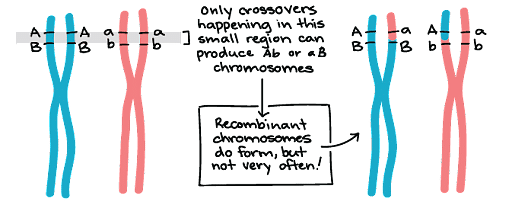
Later works by Thomas Morgan and his students clarified the phenomena; it was observed that the distance between genes on a chromosome determined the frequency of recombination. As when the frequency of recombination between two genetic markers is high if the respective genes are further apart from each other, it is called unlinked genes. Whereas if two genetic markers have a low frequency of recombination then they are assumed to be proximity, which is called linked genes. And more likely to be inherited together. Thus the relative positions of two genes or associated genetic markers are described in terms of their frequency of recombination in linkage map or genetic map.
Also read:
Crossing Over or Chromosomal Crossover
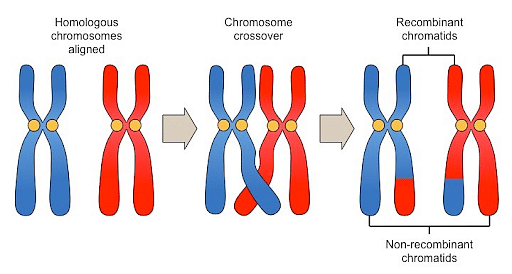
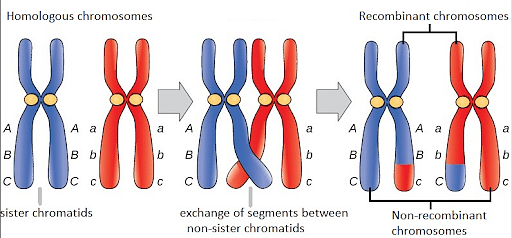
When genetic material gets exchanged between non-sister chromatids of homologous chromosomes during sexual reproduction is called crossing over or chromosomal crossover.
Often the occurrence of crossing over of genetic materials happens in matching regions of similar chromosomes. And the unlinked genetic markers are more likely to undergo such exchanges. Moreover, as genes are positioned further apart the frequency of recombination increases and hence they undergo crossover.
However, two popular theories are stating the principle of such genetic events: genetic repair theory and bacterial transformation theory. In genetic repair theory, the damaged parts or broken strands of the DNA get replaced during meiosis. Whereas, the bacterial transformation theory suggests that the meiosis evolved from bacterial transformation to propagate genetic variance. However, evidence concludes that crossing over might have evolved from bacterial transformation, which successively developed from DNA repair, thus interlinking each of the processes.
Also read:
Difference between Linkage and Crossing Over
As mentioned above the frequency of recombination between two genetic markers or genes is used to describe the likelihood of linkage and crossing over. It is worth mentioning that the chromosomal crossover can only occur during the pachytene stage of prophase I of meiosis. On the other hand, it is not so with linkage. It keeps genes together during meiosis by the virtue of their proximity. This leads us to note the differences between the two genetic events, which are as follows.
| Sl. no. | Genetic Linkage | Crossing over |
|---|---|---|
| 1 | Linkage ensures that related genes in a chromosome are inherited together. | Crossing over results in the detachment of genes in the same chromosomes and segregating them into different gametes. |
| 2 | The chances of a pair of genes getting inherited together are inversely proportional to the distance between them in the chromosome. | The chances of genes getting segregated into different gametes are directly proportional to the distance between them in the chromosome. |
| 3 | The linkage strength between a pair of genes increases as their distance decreases. | The occurrence of chromosomal crossover increases as the distance between a pair of genes increases. |
| 4 | Conversely, the linkage strength decreases as the genes are further apart. | Whereas, the occurrence decreases as the genes are nearby. |
| 5 | Due to linkage, the parental traits are carried forward in the progenies. | Due to chromosomal crossover, the parental traits get alternated in the progenies. |
| 6 | It reduces the chances of variance in traits of a progeny in sexual reproduction. | The segregation of genes might introduce trait alternation or the formation of new traits down the line. |
Read More:
Points to Remember
- The tendency of genes or DNA sequences in a chromosome to be inherited together during the meiosis phase of sexual reproduction is termed linkage. Whereas, when genetic material gets exchanged between non-sister chromatids of homologous chromosomes during sexual reproduction is called crossing over.
- The frequency of recombination between two genetic markers is high if the respective genes are further apart from each, it is called unlinked genes. Whereas if two genetic markers have a low frequency of recombination then they are assumed to be proximity, which is called linked genes.
- The linked genes are more likely to be inherited together during meiosis. On the other hand, unlinked genes in a chromosome are more likely to go through a chromosomal crossover.
- The phenomenons can be associated with the distance between two genes; genes getting inherited together are inversely proportional to the distance between them in the chromosome. And genes getting segregated into different gametes is directly proportional to the distance between them in the chromosome.
- The crossing over occurs for DNA repair, which developed in bacterial transformation, to produce genetic variation. Whereas through genetic linkage the progenies carry forward the parental lineage of taits.
Read More:
Sample Questions
Ques. What is genetic linkage? (3 marks)
Ans. The tendency of genes or DNA sequences in a chromosome to be inherited together during the meiosis phase of sexual reproduction is termed as Genetic linkage or simply linkage. This tendency was first observed by British geneticists. They tried to reproduce the results of Mendel’s work for flower color (purple and red) and the shape of pollen grains(long and round). When they crossed purebreds of purple flowers with long pollen and red flowers with round pollen.
Read More:
Ques. What is chromosomal crossing over? (3 marks)
Ans. The process in which genetic material gets exchanged between non-sister chromatids of homologous chromosomes during sexual reproduction is called crossing over. Often the occurrence of crossing over of genetic materials happens in matching regions of similar chromosomes. And the unlinked genetic markers are more likely to undergo such exchanges. Moreover, as genes are positioned further apart the frequency of recombination increases and hence they undergo crossover.
Read More:
Ques. How is linkage different from crossing over in terms of recombination frequency? (2 marks)
Ans. The frequency of recombination between two genetic markers is high if the genes are further apart from each other, and they are more likely to undergo crossover. Whereas if two genetic markers have a low frequency of recombination then they are close to each other and are likely to have linkage tendency.
Also Read:
Ques. How did George Mendel’s Law of independent assortment fail to describe the linkage? (3 marks)
Ans. In George Mendel’s experiments on pea plants, he formulated three laws. Out of which the law of independent assortment states that alleles are distributed into gametes independently of each other. But in a similar experiment on pea plants, it was observed that recombinant alleles of some traits were significantly less than expected from his law of independent assortment. The genes of such traits were related because of their closeness on a chromosome, thus an exception to Mendel's law.
Read More:
Ques. What are linked genes? (1 mark)
Ans. The genes that are inherited together are called linked genes. Also if two genes have a low frequency of recombination they are said to be linked.
Read More:
Ques. Differentiate between linkage and crossing over. (5 marks)
Ans.
| Sl. no. | Genetic Linkage | Crossing over |
|---|---|---|
| 1 | Linkage ensures that related genes in a chromosome are inherited together. | Crossing over results in the detachment of genes in the same chromosomes and segregating them into different gametes. |
| 2 | The chances of a pair of genes getting inherited together are inversely proportional to the distance between them in the chromosome. | The chances of genes getting segregated into different gametes are directly proportional to the distance between them in the chromosome. |
| 3 | It reduces the chances of variance in traits of a progeny in sexual reproduction. | The segregation of genes might introduce trait alternation or the formation of new traits in the offspring. |
| 4 | Conversely, the linkage strength decreases as the genes are further apart. | Whereas, the occurrence decreases as the genes are nearby. |
| 5 | Due to linkage, the parental traits are carried forward in the progenies. | Due to chromosomal crossover, the parental traits get alternated in the progenies. |
Ques. State Mendel’s Law of independent assortment. (2 marks)
Ans. Mendel’s law of independent assortment states that alleles are distributed into gametes independently of each other and the allele received from one gene does not influence the allele received from another gene. That is alleles are independent units.
Read More:
Ques. How is linkage and crossing over related to the distance between genes in a chromosome? (3 marks)
Ans. The genes getting inherited together are inversely proportional to the distance between them in the chromosome. Thus, the linkage strength between a pair of genes increases as their distance decreases, and the strength decreases as the distance increases.
Read More:
Whereas, genes getting segregated into different gametes is directly proportional to the distance between them in the chromosome.The occurrence of chromosomal crossover increases as the distance between a pair of genes increases. And the occurrence decreases as the genes are close.
Read More:



Comments