



Content Curator
Taxonomy is the branch of science that deals with the classification of species into different groups.
- Taxis is a Greek term that means arrangement, while nomos is another Greek word that means law.
- Taxa (singular taxon) are the classifications used to categorize organisms.
- In 1813, French taxonomist A. P. de Candolle proposed standards and methods for establishing classification.
- For the first time, he used it to identify plants, and it was then used for animal categorization.
- Taxonomie was the first word he used to describe taxonomy.
- Carolus Linnaeus is known as the Father of Taxonomy.
| Table of Content |
Key Terms: Taxonomy, Plant taxonomy, Animal taxonomy, Living organism, Father of Taxonomy, Species, Hierarchy of nature, Genus, Taxons, Seeds
What is Taxonomy?
[Click Here for Sample Questions]
Taxonomy is the study of identifying, characterizing, and classifying all living organisms, including plants.
- The classification is based on behavioral, genetic, and biochemical differences.
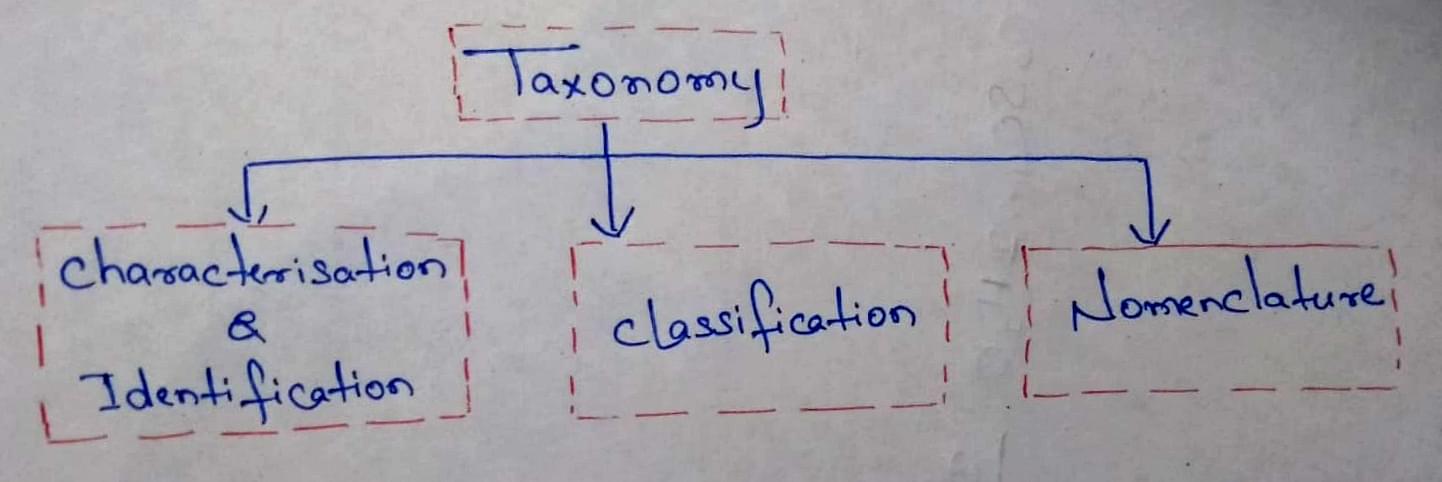
- Taxonomy processes include characterization, identification, and categorization.
- Organisms are classified into kingdom, phylum, class, order, family, genus, and species.
- Carolus Linnaeus is known as the "Father of Taxonomy."
- He developed a method for naming and organizing species.
- This method is being followed today.
- His contributions to taxonomy were the Hierarchical classification system and Binomial nomenclature system.
- Species are groups of organisms that possess similar characteristics.
- Species are recognized by their morphological characteristics.
- For example, different types of mangoes belong to one species.
- Because there are millions of species in nature, it is impossible to recognize and categorize them without a correct method.
- The Linnaeus classification system, with some modifications, is used to classify living beings all across the world.
Also check:
Linnaeus Classification System
[Click Here for Sample Questions]
Linnaeus divided the universe into three main kingdoms: animals, plants, and minerals.
- He created a hierarchy of nature.
- He classified kingdoms into classes.
- Classes were subdivided into orders, which were then subdivided into genus.
- Genus is then subdivided into species.
- All organisms are recognized and classified into one of the above-mentioned groups, and named accordingly.
Alpha Taxonomy
The system of finding, identifying, characterizing, and naming Taxons is referred to as alpha taxonomy.
- A taxon is a collection of organisms that can be combined to form a single unit.
- William Bertram coined the phrase "Alpha taxonomy" in a series of papers published in 1935 and 1937.
Beta Taxonomy
The categorization of species according to the natural system of classification in a hierarchical way is referred to as beta taxonomy.

Linnaeus Classification System
Plant Taxonomy
[Click Here for Sample Questions]
Plant taxonomy is an important branch of taxonomy.
- It is a science that deals with plant identification, classification, and naming.
- As was earlier established, nature is divided into three kingdoms.
- One of these is the plant kingdom, which is separated into two major categories: plants that can produce seeds and plants that cannot.
- Flowering plants, conifers, ginkgos, and cycads are the only plants that can produce seeds.
- These are reproduced through pollination and other means.
- Horsetails, ferns, and mosses are examples of seedless plants.
- Spores are used to reproduce these.
Animal Taxonomy
[Click Here for Sample Questions]
Animal taxonomy is the study of identifying, classifying, and naming animals.
- The Linnaeus classification system is used to classify animals.
- Taxonomists organize them hierarchically, beginning with the kingdom and on through phyla, classes, orders, families, genera, and species.
Taxonomists divided the animal kingdom into two major groups:
- Vertebrates: Mammals, birds, reptiles, fish, and amphibians are examples of vertebrates.
- Invertebrates: Arthropods, mollusks, and annelids are all members of the phylum Invertebrates.
Also Read:
Things to Remember
- Taxonomy is the study of identifying, characterizing, and classifying all living organisms, including plants.
- The name 'taxon' was coined by German scientist Adolf Meyer for the first time.
- Carolus Linnaeus is known as the "Father of Taxonomy."
- Linnaeus divided the universe into three main kingdoms: animals, plants, and minerals.
- Alpha taxonomy refers to the process of finding, identifying, characterizing, and naming Taxons.
- Beta taxonomy refers to the categorizing of species in a hierarchical manner according to the natural system of classification.
Sample Questions
Ques. What do you mean by Taxonomy? (2 Marks)
Ans. Taxonomy is a biological science discipline. It is the process of classifying and naming species based on their resemblance and dissimilarity. The organism classifies it into taxa. Domain, kingdom, phylum, class, order, family, genus, and species are the major levels in taxonomy.
Ques. What is an example of taxonomy? (2 Marks)
Ans. The best example of taxonomy is
“All humans are a taxon at the species level since they are all the same species, but humans and all other primates are also a taxon at the order level because they all belong to the order Primates”.
Ques. Who is the father of taxonomy? (1 Mark)
Ans. Carolus Linnaeus is known as the Father of Taxonomy.
Ques. Who first coined the term taxonomy? (1 Mark)
Ans. The term taxonomy was coined by A. P. de Candolle.
Ques. What is chemotaxonomy? (2 Marks)
Ans. Cytotaxonomy is a classification system based on cytological data such as chromosomal number, structure, and behavior. Chemotaxonomy resolves the ambiguity by using the chemical ingredient of the plant.
Ques. What is a kingdom? (2 Marks)
Ans. It is the highest categorization level. This is a large taxonomic group. The Plantae kingdom, for example, has all varieties of plants, whereas the Animalia kingdom contains all forms of animals, from insects to tigers. It is made up of several distinct phyla.
Ques. What Is Taxonomy's Importance? (3 Marks)
Ans. Humans are part of nature, and plants, animals, and other species play an important role in human life. The tremendous biodiversity existing on Earth meets all of the human requirements, whether they be for food, medicine, or raw resources for industry. For efficient utilization, both helpful and detrimental characteristics of creatures must be obvious to humans, hence an ordered organization (taxonomy) of organisms is required.
The taxonomic organization also aids in finding similarities and differences among species during hybridization and cross-breeding.
Ques. Describe the Taxonomic Principles. (3 Marks)
Ans. Although systematics is a subset of taxonomy, the terms are often used interchangeably.
The following are some of the fundamental principles of systematics or taxonomy:
- Identification- Identifying the creature, examining its physical and anatomical traits, and investigating it utilizing numerous key points are all part of this process.
- Classification- The organism is allocated a distinct level of taxonomic depending on its features based on the findings of the identification investigation.
To avoid any confusion, an organism is given a scientific name that is the same all over the world. The scientific name is made up of the genus and species names together.
Ques. What is the kingdom system of classification? (2 Marks)
Ans. Organisms are classified into two kingdoms based on the existence or lack of a cell wall, as postulated by Linnaeus ( father of taxonomy).
On the basis of lack of tissue differentiation, Haeckel divided unicellular animals, algae, and fungus into three kingdom systems, with the addition of the new kingdom Protista.
In order to construct phylogenetic categorization, R.H. Whittaker grouped all living organisms into five kingdoms.
Ques. What is alpha and beta taxonomy? (2 Marks)
Ans. The system of locating, identifying, defining, and naming Taxons is known as alpha taxonomy. A taxon is a collection of creatures that may be grouped together to create a single entity.
William Bertram coined the term Alpha taxonomy in a series of studies published between 1935 and 1937.
The categorization of species according to the natural system of classification in a hierarchical way is referred to as beta taxonomy.
For Latest Updates on Upcoming Board Exams, Click Here: https://t.me/class_10_12_board_updates
Also Read:



Comments