



Content Curator
RBC, WBC, platelets, and plasma are the four basic components of blood. Blood is a type of connective tissue that is fluid and plays an important role in the human body. Plasma makes up around 55% of the blood in the human body. Although white blood cells make up only around 1% of your blood, they have a significant influence. Leukocytes are another name for white blood cells. They guard you against sickness and illness. Consider white blood cells to be your immune system's first line of defence.
Red Blood Cells (RBC)
Erythrocytes are another name for red blood cells. Haemoglobin, a respiratory pigment that binds to oxygen or carbon dioxide molecules, is stored in RBCs. This aids in the delivery of oxygen to the human body's various tissues and organs. It also removes carbon dioxide from various organs and tissues, which is then restored in the lungs.

Red Blood Cell
Haemoglobin is mostly made up of iron, which interacts with oxygen to give blood a crimson hue. It takes up 40-45 percent of the total blood volume. The movement of nutrients and hormones throughout the human body is the fundamental function of RBCs.
RBC's Lifespan: RBC has a lifetime of 100-120 days. They are removed from the circulatory system at the end of their existence. The lifetime of RBCs is shortened when a person has chronic conditions.
Also Read:
White Blood Cells (WBC)
Leukocytes are another name for white blood cells. These cells protect the human body against infection by acting as a defence system. They make antibodies, which are unique proteins that recognise and fight diseases entering the human body. Granulocytes and agranulocytes are two types of WBC cells.
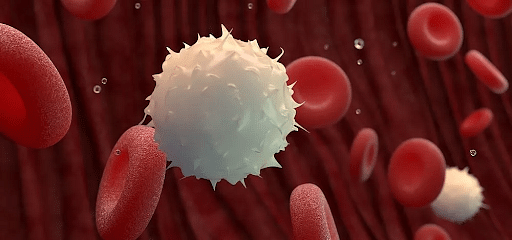
White Blood Cells
Granulocytes are white blood cells with apparent granule-like features in their cell bodies, thus their name. Agranulocytes, on the other hand, lack these granule-like features. Neutrophils, basophils, and eosinophils are the three types of granulocytes. Lymphocytes and monocytes are the two forms of agranulocytes.
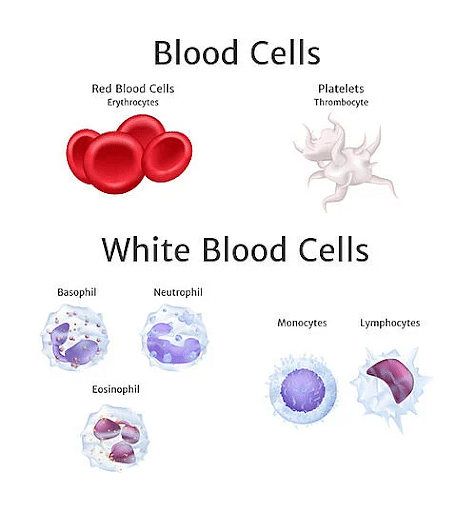
Types of White Blood Cells
Also Read:
Differences Between RBC and WBC
The major differences between RBC and WBC are tabulated below.
| RBC | WBC |
|---|---|
| Erythrocytes are the scientific name for red blood cells. | WBC is also known as Leukocytes. |
| RBCs are shaped like a bi-concave disc | The shape of WBCs is uneven. |
| The diameter ranges between 6 and 8 micrometres. | The diameter ranges between 12 and 17 micrometres. |
| RBC has a lifetime of roughly 120 days | WBC has a lifetime of 12-20 days before being eliminated in the lymphatic system. |
| On maturity, red blood cells do not contain a nucleus. | The presence of a massive central nucleus distinguishes WBCs. |
| These cells are red in colour due to the presence of haemoglobin. | These cells are colourless because they lack pigment. |
| There is just one kind of RBC | Neutrophils, B lymphocytes, T lymphocytes, monocytes, basophils, and eosinophils are all forms of WBCs present in the blood. |
| They aid in the delivery of breathing gases to various regions of the body. | They aid in the production of antibodies that combat disease-causing bacteria. |
| Haemoglobin is a component of red blood cells. | Antibodies are found in white blood cells, as well as MHC (major histocompatibility complex) antigen cell markers. |
| Around 36-50 percent of human blood is made up of these cells. | They account for around 1% of all human blood. |
| The production of RBC is called Erythropoiesis. | The process of WBC formation is called Leukopoiesis. |
| These cells travel between the circulatory and nervous systems. | These cells migrate back and forth between the circulatory and lymphatic systems. |
| Anaemia is caused by a low RBC count. | Leukopenia is caused by a low WBC count. |
Things to Remember
- RBC, WBC, platelets, and plasma are the four basic components of blood.
- Blood is a type of connective tissue that is fluid and plays an important role in the human body.
- Haemoglobin, a respiratory pigment that binds to oxygen or carbon dioxide molecules, is stored in RBCs.
- Erythrocytes are another name for red blood cells.
- RBC has a lifetime of 100-120 days.
- WBC protects the human body against infection by acting as a defence system.
- Leukocytes are another name for white blood cells.
- Granulocytes and agranulocytes are two types of WBC cells.
Also Read:
Sample questions
Ques. What is the primary role of red blood cells (RBCs)? (2 marks)
Ans. Red Blood Cells' major role is to transport oxygen from the lungs to tissue in various sections of the body via the circulatory system. They also return carbon dioxide and other waste products to the lungs, where they are expelled from the body. Because RBCs have a bi-concave shape, they aid in the continual exchange of oxygen over a broad surface area.
Ques. What are the blood's primary functions? (2 marks)
Ans. The primary function of blood is to deliver oxygen and nutrients throughout the body. It is also in charge of controlling body temperature.
Ques. What is a Red Blood Cell's average lifespan? (2 marks)
Ans. A normal adult human's red blood cells have a lifetime of 100 to 120 days. Diseases or illnesses, on the other hand, might severely reduce one's lifetime.
Ques. What are leukocytes and what do they do? (2 marks)
Ans. White blood cells are also known as leukocytes. They are responsible for protecting the body from germs and diseases.
Ques. What are the White Blood Cells (WBC) Main Functions? (2 marks)
Ans. White blood cells' major role is to create antibodies in the body and to boost the body's immunity. The body is protected from germs and illnesses by a strong defence mechanism. WBC defends the body by digesting foreign substances and cancer cells and creating antibodies against them.
Also Read:
Ques. What is the WBC lifespan? (2 marks)
Ans. WBC have a lifetime of 12 to 20 days on average. However, just like RBCs, WBCs' lifetime might be shortened if the person is unwell. The number of WBCs in an individual varies with age; for example, a newborn infant has a higher number of WBCs than an adult.
Ques. Describe the RBC and WBC shapes. (2 marks)
Ans. White blood cells, on the other hand, have no fixed structure and are disc-shaped and biconcave.
Ques. Identify the different types of white blood cells. (2 marks)
Ans. Neutrophils, B lymphocytes, T lymphocytes, monocytes, basophils, and eosinophils are examples of white blood cells.
Ques. Where do red blood cells come from? (2 marks)
Ans. The bone marrow is where red blood cells are made. Before being released into circulation, it must develop for seven days.
Ques. What are the diseases and symptoms that occur when the body's white blood cell count is low or high? (2 marks)
Ans. When the number of white blood cells in the bloodstream falls, the body becomes vulnerable to a variety of illnesses. A weakened immune system, myelodysplastic syndrome, cancer, and myeloproliferative condition can all be caused by a high or low white blood cell count in the body. Physical or mental stress, as well as inflammation, are some of the usual indications of a low WBC count.
Ques. Name the components of the formed elements in the blood and mention one major function of each of them. (2 marks)
Ans. Blood corpuscles are the formed elements in the blood, they constitute 45% of the blood. Formed elements are – (erythrocytes, RBCs or red blood corpuscles), (leucocytes, WBCs or white blood corpuscles) and throm¬bocytes or blood platelets. The major function of RBCs is to transport oxygen from the lungs to body tissues and CO2 from body tissues to the lungs. White blood cells provide immunity to the body. Blood platelets play an important role in blood clotting.
Ques. Why do we consider blood as a connective tissue? (2 marks)
Ans. Connective tissue connects different tissues or organs of the body. It consists of living cells and the extracellular matrix. Blood is vascular connective tissue, it is a mobile tissue consisting of fluid matrix and free cells. Blood transports materials from one place to the other and thereby establishes connectivity between different body parts.
Also Read:
Ques. What is the importance of plasma proteins? (2 marks)
Ans. Plasma proteins constitute about 7 to 8% of plasma. These mainly include albumin, globulin, prothrombin and fibrinogen. Prothrombin and fibrinogen are needed for blood clotting. Albumins and globulins retain water in blood plasma and help in maintaining osmotic balance.
Ques. What are the components of blood? (2 marks)
Ans. There are four components of blood:
(i) Plasma is a liquid part of the blood that is yellowish in colour and contains 90% water. It contains food, enzymes, wastes and proteins etc
(ii) Red blood cells are disc-shaped cells containing red coloured pigment called haemoglobin in them. Haemoglobin helps in the transportation of oxygen.
(iii) White blood cells are the fighting cells that protect us against bacteria and foreign materials causing infections.
(iv) Platelets help in clotting the blood.
Ques. Why is blood needed by all the parts of a body? (2 marks)
Ans. Blood is needed by all the parts because it contains the digested food and oxygen in it. It supplies oxygen and digested food to various parts of the body to provide essential energy to them which helps the body to perform various functions.
Ques. Describe the function of the heart. (2 marks)
Ans. The right auricle and ventricle receive blood with carbon dioxide from all parts of the body. The collected blood is then pumped to the lungs for purification. In the lungs, the exchange of gases takes place and purified blood is sent back to the left auricle. It pumps it to the left ventricle, which in turn pumps off the purified blood to all parts of the body through arteries.
Also Read:



Comments