



Education Journalist | Study Abroad Lead
Upper and lower motor neurons are an important part of the Central Nervous System (CNS). Neuron is a brain cell that transmits and processes information through electrical and chemical signaling. Neurons are an important component of our nervous system that are made up of a cell body, an axon, and dendrites. The two types of spinal cord tracts present in the human nervous system ate the somatic sensory pathways and somatic motor pathways. A motor neuron is a neuron that stems off the spinal cord of an organism. It is responsible for projecting its axons outside the spinal cord and also helps in controlling the muscles either directly or indirectly. Upper motor neurons are located in the motor region of our brain stem. These neurons are not responsible for muscle stimulation as they do not carry information down the common pathway. The lower motor neuron, on the other hand, receives the impulses from the upper motor neurons and mainly acts as a connection between the spinal cord and the brain stem with the muscle fibers. In this article, we will learn more about lower and upper motor neurons and understand the differences between the two.
| Table of Contents |
Key Takeaways: Central Nervous System, Neurons, Motor neurons, Brain, Spinal Cord, Receptors, Brain stem, Cerebral Cortex
Motor Neurons
[Click Here for Sample Questions]
The sensory and motor pathways or tracts present in the spinal cord carry the conduction of motor and sensory nerve impulses to and from the brain. The somatic sensory pathways transfer the sensory impulses from the somatic sensory receptors to the cerebral cortex. While the somatic motor pathways transfer the motor impulses from the cerebral cortex to the skeletal muscles. In the somatic motor pathways, two basic sets of neurons are present which are known as the upper motor neuron and lower motor neuron.
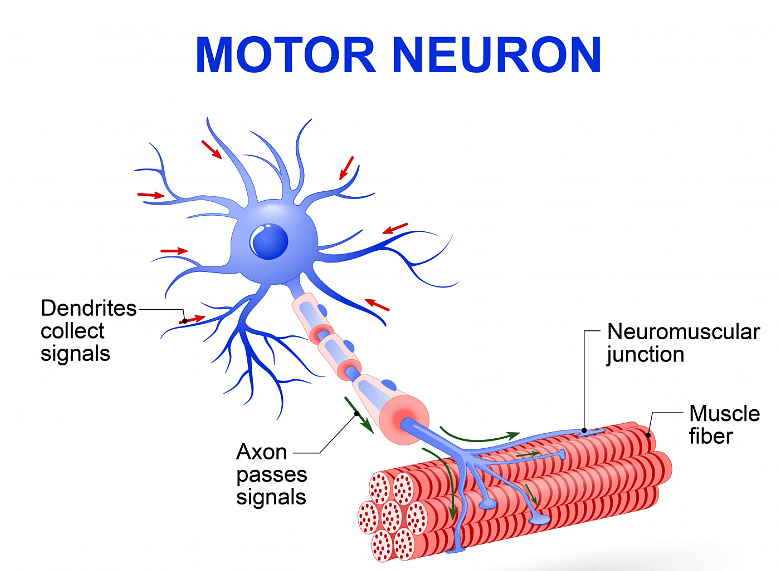
Motor Neurons
What is Upper Motor Neuron (UMN)?
[Click Here for Sample Questions]
Upper Motor Neuron is a kind of motor neuron that starts from the brain stem or from the motor region of the cerebral cortex. William Gowers introduced the term 'upper motor neurons'. It is responsible for transmitting nerve impulses from the brain to lower motor neurons. Hence, it does not deal with transmitting these impulses to the muscles. This transmission of nerve impulses from the upper motor neurons to lower motor neurons takes place by a neurotransmitter that is known as glutamate via glutamatergic receptors. They are first-order neurons. There are six pathways of the upper motor tract which are as follows:
- Corticospinal Tract
- Corticobulbar Tract
- Colliculospinal Tract
- Rubrospinal Tract
- Vestibulospinal Tract
- Reticulospinal Tract
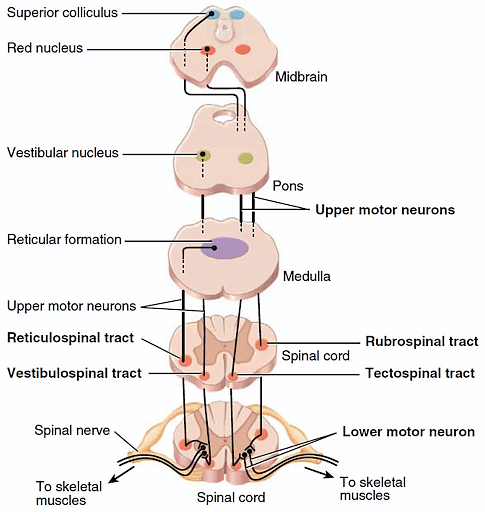
Upper Motor Neurons
Read More:
What is Lower Motor Neuron (LMN)?
[Click Here for Sample Questions]
Lower Motor Neuron is a kind of motor neuron that transmits the nerve impulses it receives from the upper motor neurons to the effector, muscles. It can originate from anterior nerve roots, anterior gray column, brain stem, or cranial nerve nuclei of the cranial nerves. It originates from the spinal cord and ends in the skeletal muscle. Lower motor neurons are mainly responsible for connecting the brain stem or the spinal cord to the muscles. Hence, the lower motor neurons are the spinal and cranial nerves. They are second-order neurons.
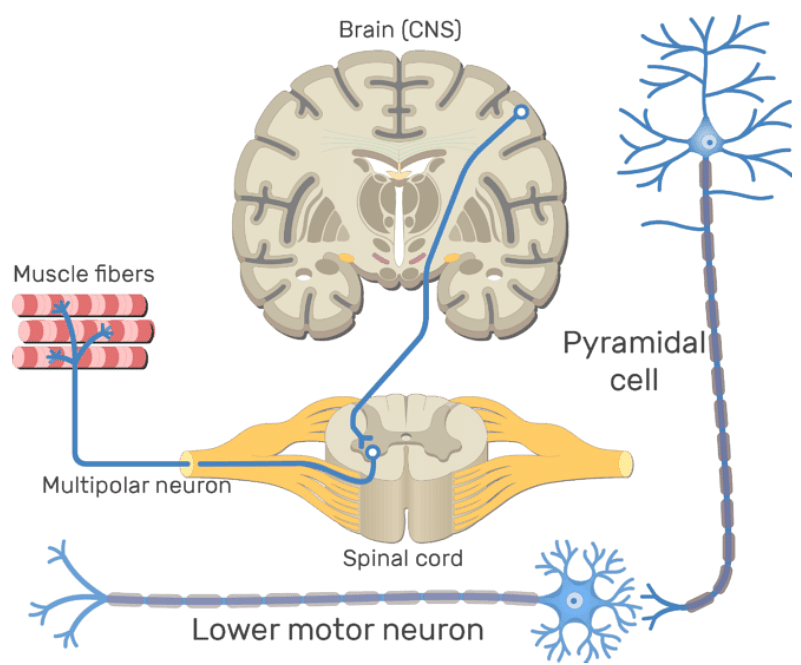
Lower Motor Neurons
If the lower motor neurons are lost, it can lead to muscle atrophy, muscle twitching, and weakness.
Similarities between Upper Motor Neuron and Lower Motor Neuron
[Click Here for Sample Questions]
Upper and lower motor neurons are similar in many ways which are:
- They both are parts of the somatic nervous system.
- Upper and lower motor neurons are both responsible for voluntary muscle movements.
- Both of them transmit nerve impulses from our brain to the muscles.
Read More: Nervous System Diseases: Symptoms, Damages, Guillain-Barre Syndrome
Difference Between Upper and Lower Motor Neuron
[Click Here for Sample Questions]
The main difference between upper and lower motor neurons lies in terms of their origin and function. Some of the differences between the two are as tabulated below:
| Upper Motor Neuron | Lower Motor Neuron |
|---|---|
| Upper motor Neurons are completely located in the central nervous system. | Lower motor neurons are either located within the cranial nerve nuclei present in the brain stem or in the spinal cord gray matter. |
| These neurons form synapses with lower motor neurons. | These lower neurons form synapses with the muscles present in the body. |
| They are mainly classified on the basis of the pathways they travel in. The upper motor neurons have six pathways. | They are mainly classified on the basis of the type of fibre of muscles that they innervate. There are two types of lower motor neurons that are alpha & gamma motor neurons. |
| Their function is to transmit motor impulses from the brain to the lower motor neuron. | Their main function is to collect the transmitted impulses from the upper motor neurons and pass them on to the muscles of the body. |
| The cell bodies of upper motor neurons are bigger as compared to the cell bodies of lower motor neurons. | The cell bodies of lower motor neurons are comparatively smaller. |
| The lesions of upper motor neurons result in the production of spastic hyperreflexia and results in weakness of muscles. | The lower motor neuron lesions result in flaccid muscle weakness, muscular atrophy, hyporeflexia, and fasciculation. |
| They are found in the brain stem or in the cerebral cortex. | They are found in the spinal cord or in the brain stem. |
| The symptoms of damage to upper motor neurons are hyperactive deep reflexes and increased muscle tone. | The symptoms of damage to lower motor neurons are muscle atrophy, hyperactive deep reflexes, and decreased muscle tone. |
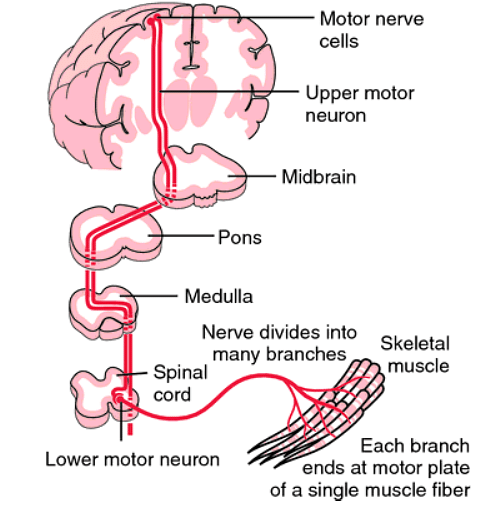
Upper and lower motor neuron
Upper motor neuron lesions mainly occur in the neural pathways that are present above the cranial nerves motor nuclei or the anterior horn of the spinal cord. A lower motor neuron lesion on the other hand affects the nerve fibers that travel from the spinal cord's anterior horn to any associated muscle. Upper motor neurons are present in the central nervous system. They transmit the nerve impulses from the brain to the lower motor neurons. The lower motor neurons then transmit these impulses to our muscles. Both of them together make up our somatic nervous system that is responsible for controlling all our voluntary muscle movements.
Read More:
Things to Remember
- Neurons are an important component of our nervous system that are made up of a cell body, an axon, and dendrites.
- There are two types of motor neurons that can be classified on the basis of their functions such as upper motor neurons and lower motor neurons.
- The upper motor neurons are present in either the brain stem or the motor cortex of the brain.
- These are the neurons that initiate voluntary muscle movement throughout the body.
- The lower motor neurons are present in the spinal cord.
- They are mainly responsible for communicating and transmitting signals to the organs, skeletal muscles, and glands.
- Any damage to the upper motor neurons can stop the electrical signals from reaching the muscles.
- The damage to lower motor neurons includes symptoms such as muscle weakness and muscle paralysis.
Sample Questions
Ques. What are motor neurons? What are the two types of motor neurons? (5 marks)
Ans. Motor neurons, also known as efferent neurons, are the nerve cells that are responsible for transmitting signals away from the CNS towards the muscles in order to cause involuntary movement. Motor neurons release neurotransmitters in order to trigger the responses to lead to the movement of muscles. These neurons allow us to talk, move, eat, breathe, and swallow. In the absence of these cells, we won't be able to perform basic life functions.
The motor neurons are responsible for integrating signals from the brain to the glands, organs, and muscles. The afferent neurons, that is sensory neurons, on the other hand, carry the information from the tissues and sensory organs to the Central Nervous System (CNS).
These neurons form many complex and controlled circuits all throughout the body. Motor neurons are classified into two types based on their function which are:
- Lower motor neurons = These neurons travel from the spinal cord to the rest of the muscles of the body.
- Upper motor neurons = These neurons travel from the brain to the lower motor neurons in the spinal cord.
Ques. Explain the structure of motor neurons. (5 marks)
Ans. Motor nerves are responsible for transmitting the signals from the Central Nervous System to the sensory organs. Therefore, they help to initiate actions.
- Motor neurons lack receptors.
- These neurons are present at the spinal cord's ventral root ganglion.
- They consist of multiple dendrites and a long axon.
- Motor neurons are also referred to as multipolar neurons.
The structure of a motor neuron mainly comprises three components: the axon, the soma, and the dendrites.
- Axon refers to the long extension structure that stems from the soma. It works to communicate information that it receives down its body.
- Soma refers to the cell body where the nucleus is present. It controls the cells. Proteins are produced in the soma in order to maintain the function of a neuron.
- Dendrites refer to the branch-like structures that are found at the end tips of the neuron. These are used to send and receive information to and from other neurons.
Ques. What are upper motor neurons? (5 marks)
Ans. Upper motor neurons (UMNs) originate in the brain's gray matter. They carry the impulses in order to initiate movement. These are the first-order neurons. It is a term introduced in 1886 by William Gowers. They are found in the brainstem and cerebral cortex. These neurons carry information down in order to activate lower motor neurons and interneurons. This in turn directly signals the muscles in the body to relax or to contract. They are mainly responsible for controlling voluntary movement throughout the body.
The transmission of nerve impulses from the upper motor neurons to the lower motor neurons takes place through a neurotransmitter that is known as glutamate via glutamatergic receptors. Some of the pathways or tracts through which upper motor neurons can travel serve many functions. These tracts are pyramid, extrapyramidal, tectospinal, rubrospinal, and reticulospinal tracts. The upper neurons travel through these tracts where they then synapse or form the connections with the neurons that are located within the spinal cord, known as the lower motor neurons.
Ques. Write a short note on lower motor neurons. (3 marks)
Ans. Lower motor neurons are present in the spinal cord. These neurons are mainly responsible for transmitting signals directly to the glands and organs present in the body along with skeletal muscles. The lower motor neurons receive information from the upper motor neurons either via interneurons or directly. Then they stimulate the activity of these neurons by extending their fibers all throughout the body. The few sub-classifications of lower motor neurons are somatic, general visceral motor neurons, and special visceral effects.
Ques. What are the various subtypes of lower motor neurons? (5 marks)
Ans. Somatic, general visceral motor neurons, and special visceral efferent are some subtypes of lower motor neurons.
Somatic motor neurons are originally in the central nervous system. Specifically, they are located in the brain stem from where they project their axons to the skeletal muscles. These somatic motor neurons can be further divided into alpha, beta, and gamma motor neurons.
- Alpha motor neurons are larger relatively. They generate movement by causing muscle contractions.
- Beta motor neurons also innervate intrafusal fibers as well as extrafusal muscle fibers.
- Gamma motor neurons are also referred to as muscle spindles. They do not directly cause any motor function.
Special visceral efferent neurons, also referred to as branchial motor neurons mainly innervate the muscles of the neck and head. They are present in the brain stem.
General visceral motor neurons contribute to both the parasympathetic and sympathetic functions of the Autonomic Nervous System (ANS).
Ques. What are the various pathways that the upper motor neurons can travel? (5 marks)
Ans. The few pathways or tracts through which the upper motor neurons can travel and that serve various functions are:
- In the pyramidal pathway, the upper motor neurons are responsible for controlling the conscious movements of the body. It starts in the motor strip present in the frontal lobe. The nerve impulses travel through it to reach the spinal cord.
- The extrapyramidal tract is any tract or pathway that is located outside the pyramid tract. Here, the neurons are involved in the subconscious motor functions such as balance and posture.
- Rubrospinal pathway is an extrapyramidal tract that is involved in the involuntary movements of the body. These movements are used to improve or maintain the balance of the body.
- Tectospinal pathway or tract is also an extrapyramidal tract. It is responsible for the muscle movements within the neck.
- At last, the reticulospinal tract is vital for controlling the autonomous actions of the body.
Ques. What are neurons? Write the main functions of neurons. (5 marks)
Ans. Neurons are the fundamental units of our nervous system that are specialized to transmit or communicate information to various parts of the body. All the neurons are composed of three different parts which are the cell body, dendrites, and axon. There are mainly three types of neurons which are:
- Sensory Neurons = The sensory neurons are responsible for converting the signals from the external environment into internal stimuli. They are activated by the sensory inputs and carry the information to the spinal cord and the brain.
- Motor Neurons = These neurons are present in the central nervous system. They are multipolar and they extend their axons outside the CNS or the Central Nervous System. They are the most common types of neurons present in the body that communicate information from the brain to the body muscles.
- Interneurons = The axons of interneurons only connect to the nearby motor and sensory neurons. Their main role is to pass the signal between the sensory and motor neurons.
The main functions of a neuron are:
- Electrical Synapse = When any two neurons are connected to each other through a gap junction, an electric synapse is a result. The gaps have ion channels that directly help in the transmission of an electric signal. They are relatively faster than chemical synapses.
- Chemical Synapse = The action potential in chemical synapses affects the other neurons through a gap that is present between both the neurons, which is known as a synapse. This action potential is then carried along the axon to a postsynaptic ending. This initiates the release of neurotransmitters, a kind of chemical messengers. These neurotransmitters then excite the postsynaptic neurons. This generates an action potential.
Read More:



Comments