



Education Journalist | Study Abroad Lead
Grass-eating animals are known as ruminants. Ruminants depend on grass and plants for their nutrition. Just like any other animal, ruminants also have a well-defined digestive system. Most ruminants swallow their food without chewing it properly and after eating the fodder, they keep on chewing their food by letting the food come into the mouth again from the stomach (Rumen) this process is called rumination. Digestion is also different in ruminants; digestion refers to the process of breaking down the food into a simpler form which can be absorbed by the body to give it the energy to perform metabolic activities. The digestive tract of ruminants consists of the mouth, oesophagus, stomach, small intestine, caecum, and large intestine. The digestive tract of ruminants includes four chambers of the stomach named Rumen, Reticulum, Omasum, and Abomasum. The ruminants also have a large alimentary canal because the digestion in ruminants is a time taking process and undergoes many steps before the food is digested completely. In this article, we will have a look at the digestion process of ruminants.
Read About: Endoplasmic Reticulum
| Table of Content |
What is digestion?
Digestion is the process of breaking the big food molecules into small and absorbable nutrients, these nutrients are needed by the body for energy, growth, and cell repair needed to survive. Digestion is a complex process and is done by the digestive system. The digestion of every food starts with ingestion and ends with its absorption and its defecation.
Ruminants
Ruminants are animals that depend on grass and plants for their food, the ruminants have a strange ability to chew the food present in their stomach by bringing it back to their mouth by the process called rumination. Ruminants have a big alimentary canal which includes an extra 4 chambered, stomach which helps the ruminants to digest their food (grass). Some examples of ruminants are Deer, Goat, Zebra, Elephant, Sheep, Cow, Buffalo, Giraffe and etc.
Ruminants
Digestion in ruminants
Ruminants are grass-eating animals. The grass is swallowed by them very quickly and then stored in the muscular sac-like structure called the rumen.
- The rumen is the first part of the four-chambered stomach present only in ruminants.
- In the rumen, the food is partially digested and is converted into cud.
- Plants contain a huge amount of cellulose which is a very complex structure, it is broken into simpler particles in the rumen.
- Rumination is the process of regurgitation of the cud into the mouth.
- Rumen also contains some bacteria that are important for the breakdown of cellulose.
- After the digestive processes in the rumen, the food enters the reticulum.
- The main difference between the digestion in ruminants and other animals is the digestion of cellulose as cellulose is a very complex structure and requires a specific bacterium for its breakdown which is absent in other animals including humans.
Digestion in ruminants
Read More: Digestion in Ruminants
Digestive System of Ruminants
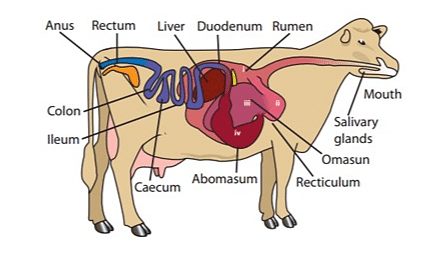
Ruminants have a well-developed digestive system and it is larger than other animals. The digestive system of ruminants comprises:
- Mouth: The mouth of the ruminants is strong and rigid enough for the grazing process. The ruminants have 32 teeth when they become adults, comprised of 8 incisors, 12 premolars, and 12 molars. Their tongue is also very muscular and strong to facilitate the ripping of grass from the ground.
- Oesophagus: The oesophagus is the tubular structure formed of muscles the oesophagus also has 3 parts
1) Cervical,
2) Thoracic,
3) Abdominal section.
The oesophagus of ruminants is made by striated muscles with the function of swallowing food and also for the rumination process. The striated muscles of the oesophagus facilitate movement in both directions.
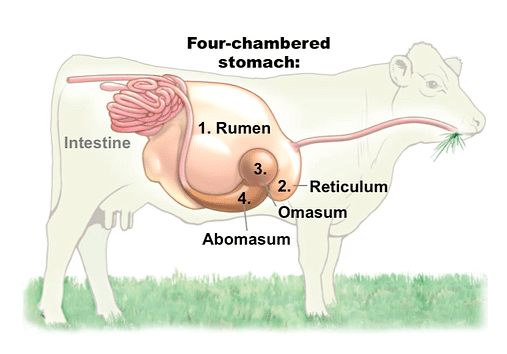
- Stomach: The stomach of ruminants is divided into four chambers: Rumen, Reticulum, Omasum, and Abomasum.
- Rumen: Rumen is the biggest chamber of the stomach. It helps in cellulose digestion and also acts as a food reservoir for the food in ruminants.
- Reticulum: The reticulum is the second chamber of the stomach in ruminants and is located near the heart of ruminants, the reticulum has a bag-like shape.
- Omasum: Omasum is the third chamber of the ruminant stomach that absorbs food and is shaped like a globe.
- Abomasum: Abomasum is the last part(chamber) of the ruminant stomach. This part of the ruminant stomach resembles the human stomach and is lined by digestive glands. The stomach opens into the small intestine through the abomasum.
- Small intestine: Small intestine is a long tubular structure, the small intestine is highly coiled to increase the surface area for the processes of digestion and absorption of different needed nutrients, the inner wall lumen has inward folding called villi which facilitates the absorption and also increases the surface area for absorption. The small intestine of ruminants is very much like the small intestine of humans. It is divided into three parts namely- duodenum, jejunum, and ileum. The small intestine collects the secretions of the gall bladder and pancreas which perform the important digestion processes.
- Caecum: Caecum is the junction present between the small intestine and large intestine.
- Large intestine: It is the last part of the alimentary canal that facilitates the passing of undigested food through it. It also absorbs water from the undigested food.

Digestive System of Ruminants
Read More: Human Digestive System
Process of Digestion in Ruminants
Digestion in ruminants is done in a sequential manner by the organs in the digestive system.
- In ruminants, the digestion starts with the engulfing of food or food ingestion and its chewing. The food is not completely chewed in the mouth instead the ruminants engulf their food quickly as it is mixed with the saliva. The food then goes into the first chamber of the stomach called rumen through a narrow passage called the oesophagus. The pattern of movement of food in oesophagus is called peristaltic movement. Saliva mixed in the food maintains a pH between 6.2-6.8.
- After the food enters the rumen, the food is converted into lumps of food and is called cud. The saliva mixed in the food provides the optimal temperature for the digestion process and also enhances the growth of microbes that are important for digestion purposes. After the food enters the rumen the process of digestion starts for cellulose present in the grass with the help of microbes. A large amount of food remains in the rumen and that is why the rumen is also known as the storage compartment for ruminants.
- When the food is stored in the rumen for a longer period of time, then fermentation of food may take place by the bacteria present and the process is called microbial fermentation. The same bacteria are also responsible for the formation of proteolytic enzymes which result in the breakdown of proteins to amino acids.
- Ammonia is also formed in the rumen from the proteins. The ammonia is then absorbed by the rumen wall and is converted into urea and diffused in the blood.
- The major part (40%-70%) of the protein in food is digested right away in the rumen and the remaining is passed further through the alimentary canal to the small intestine where further digestion takes place.
- The partial digestion of cellulose present in fodder is done in the rumen by the enzyme called cellulase.
- Digestion of cellulose breaks it into fatty acids that are usually absorbed by the ruminal mucosa.
- After the digestion is done in the rumen, the food is transferred to the reticulum where chiming is done with some digestion of fats.
- The food then goes to the omasum and then into the abomasum.
- In the abomasum, the digestive glands are lined on the walls of the gut and secrete which facilitates the digestion process for proteins, cellulose, lipids, glycolipids.
- After the digestion in the stomach, the food enters into the small intestine that collects the secretions of the pancreas and gall bladder and undergoes the final digestion processes, the small intestine has villi for the absorption procedure.
- After the digestion and absorption in the small intestine, the undigested food enters the large intestine where water is absorbed and the wastes are ejected through the anus.

Ruminant Stomach
Things to remember
- Digestion is the process of breaking down the macromolecules into small, simple, and absorbable nutrients.
- Ruminants are animals that depend on plants and grasses for their nutrients.
- Ruminants have four chambers of the stomach that includes rumen, reticulum, omasum, and abomasum.
- The movement of cud from the rumen to mouth is called rumination.
- Rumen has microbes in it that help in the digestion of cellulose.
- The last chamber of the ruminant stomach is called the abomasum and is very similar human gut. The walls contain many digestive glands.
- The length of the digestive tract of ruminants is more than the length and area of the digestive tract in other animals.
Also Read
Sample Questions
Ques. What are ruminants? (3 marks)
Ans. Ruminants are grass-eating animals. Their digestive system is different and longer than other animals because plants leaves and grass contains cellulose which needs more area and more microbes for its digestion. Some examples of ruminants are Cow, Sheep, Buffalo, Giraffe, Deer and etc.
Ques. What is rumen? (5 marks)
Ans. The rumen is the largest chamber of the stomach in the ruminants and is present just after the oesophagus. Regurgitation also takes place from this chamber through rumination. After the rumination, food comes in the rumen again for further digestion, and then the digestion of cellulose takes in the rumen by some microbes and enzyme called cellulase. Proteins are also digested in the rumen and are converted into amino acids and ammonia. After the digestion in the rumen, the food is passed into the reticulum.
Ques. Discuss the different chambers of the stomach present in the ruminants? (5 marks)
Ans. The stomach of ruminants is big and has four different chambers for different processes:
- Rumen: Rumen is the biggest chamber of the stomach among the four chambers that helps in cellulose digestion and also acts as a food reservoir for the food in ruminants.
- Reticulum: The reticulum is the second chamber of the stomach in ruminants and is located near the heart of ruminants, the reticulum has a bag-like shape.
- Omasum: Omasum mainly absorbs food.
- Abomasum: Abomasum is the last part of the ruminant stomach. The stomach opens into the small intestine through the abomasum.
Ques. What is abomasum? (3 marks)
Ans. The abomasum is the last part of the ruminant stomach, it resembles the stomach in humans. The abomasum has digestive glands lined by the mucosal wall of the gut. Which pour their secretions into the lumen of the abomasum and then help in digestion.
Ques. Explain digestion in ruminants in detail? (5 marks)
Ans. Ruminants are grass-eating animals. The grass is swallowed by the ruminants very quickly and then stored in the muscular sac-like structure called the rumen. The rumen is the first part of the four-chambered stomach present only in ruminants. In the rumen the food is partially digested and is converted into cud, cud is the partially digested food of ruminants present in the rumen. Plants contain a huge amount of cellulose which is a very complex structure, it is broken into simpler particles in the rumen. Rumination is the process of regurgitation of the cud into the mouth. Rumen also contains some bacteria that are important for the breakdown of cellulose.
Ques. What is rumination? (5 marks)
Ans. Ruminants keep on chewing while resting even if they are not eating anything, it happens because rumination is the process by which the semi-digested food goes back into the mouth to be chewed, this movement is called regurgitation, and the process responsible for regurgitation of food is called rumination, rumination is the characteristic process that is performed only by the ruminants.



Comments