



Content Curator
Digestion in ruminants is distinct from digestion in non-ruminants since it involves regurgitation of previously swallowed food and re-chewing it again. The Ruminant digestive system is distinguishable because of the presence of a four-chambered stomach. This four-chambered stomach helps in digestion of food rich in fibres such as grass, leaves, etc. All herbivores are not ruminants. Cow, buffalo, deer are some of the examples of ruminants.
| Table of Content |
Keywords: Ruminants; Rumination; Digestion in ruminants; Rumen; Reticulum; Omasum; Abomasum.
Also Read: Life processes
Rumination
Rumination is the process of re-chewing the previously ingested food for a second time. Cud from rumen returns to the mouth for chewing to further break down the food and stimulate the digestion and absorption process. Rumination allows these animals to eat grass, leaves, branches and other fibre-rich foods that can’t be eaten by humans and other animals.
Ruminants
Animals that regurgitate and rechew their food are referred to as ruminants. Typically, ruminants are hooved animals with a four-chambered stomach.
Examples- Cattle, sheep, buffalo, deer, etc.
Also Read:
Digestive System in Ruminant
The main difference between digestion in ruminants and digestion in other mammals is that the ruminant’s stomach has four separate chambers, each with a unique function. Most other mammals have single-chambered stomachs..
Read: Digestive Disorder
Organs of the Ruminant Digestive System
To understand digestion in ruminants, the ruminant digestive system and its organs need to be understood.
Ruminant digestive system is composed of:
- Mouth
The mouth consists of lips, tongue, palate and teeth. Mouth is where ingestion of food (grass) takes place. Food from the mouth is emptied into the oesophagus.
- Oesophagus
Oesophagus is also known as a food pipe. It connects the mouth and stomach. In ruminants, the oesophagus has bidirectional function, which means food can move in both directions (from mouth to stomach and vice versa). This movement of food through the oesophagus is brought about by muscle contraction and relaxation in wave-like fashion.
- Stomach
There are four chambers of the stomach in ruminants — rumen, reticulum, omasum and abomasum — each with a particular function. Stomach stores grass and grain, absorb nutrients, break down and dissolve food.
- The rumen is also known as paunch. It is the first chamber of the stomach.
- The reticulum is also known as honeycomb. The inner side of the reticulum appears structurally similar to a honeycomb. It is attached to the rumen with a thin tissue.
- The third chamber is a sphere-shaped omasum. It is lined with large folds of tissue.
- The abomasum is the last chamber of the stomach and is the true stomach. It is smaller in size. It represents about 4% of the total stomach volume.
- Small Intestine
Small intestine is divided into duodenum, jejunum and ileum. It receives partially digested food from stomach and empties it into cecum
- Cecum
Connects small and large intestines and acts as a transition.
- Large Intestine
It is larger in width and smaller in length compared to small intestine.

Organs of the Ruminant Digestive System
Also Read: Human digestive system
Process of Digestion in Ruminant
The specialisation of the ruminant digestive system allows ruminant animals to eat grass, leaves, etc without completely chewing it first.
Movement of food in the alimentary canal of ruminants:

Movement of food in the alimentary canal of ruminants
- In the mouth grass, leaves, etc are chewed and mixed with saliva.
- Food moves from mouth to rumen through the oesophagus.
- In Ruminant the rumen acts as storage for chewed grass and forms balls of ‘cud’. Cud is a large, non-digestible mass of food that is regurgitated and chewed a second time. The rumen absorbs nutrients through the rumen wall. Bacteria in rumen aids in breaking down and digestion of ingested food.
- Then the reticulum holds food particles that are larger in size, that are not small enough to be digested. The reticulum facilitates regurgitation.
- From reticulum the food moves to omasum. Folds in omasum absorb water and nutrients from the food that passes through it after a second round of chewing.
- The next chamber abomasum in ruminants is lined with glands. The secretions help in further breakdown of food.
- Small intestine receives secretion of the gall bladder and pancreas, which completes the breaking down of food particles. Small intestine also helps in absorption of nutrients.
- Water and nutrients are absorbed in the large intestine. Large intestine facilitates in discarding unabsorbed, undigested food.
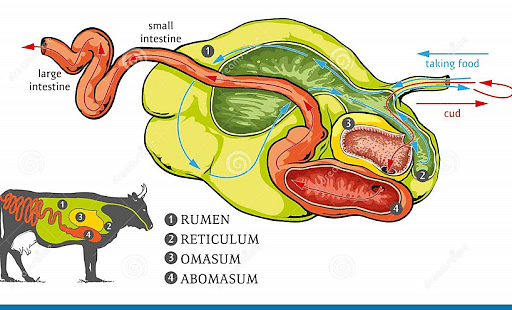
Process of Digestion
Read Difference between Small Intestine & Large Intestine
Points to Remember
- Not all herbivores are ruminants, but all ruminants are herbivores.
- Four chambered stomach is the characteristic feature of ruminants.
- Rumination allows these animals to eat grass, leaves, branches and fibre rich foods that can’t be eaten by humans and other animals.
- Digestion in ruminants is predominantly microbial, whereas in humans it is predominantly enzymatic.
- In ruminants, the oesophagus has bidirectional function, which means food can move in both directions (from mouth to stomach and vice versa).
- Rumination is an adaptive strategy adopted by ruminants to avoid predators.
Also Read:
Sample Questions
Ques. What are ruminants? Give Examples. (2 Marks)
Ans. Animals that regurgitate and rechew their food are referred to as ruminants. Typically, ruminants are hooved animals with a four-chambered stomach.
Examples: Cattle, sheep, buffalo, deer, etc.
Ques. What is ‘cud’ in biology? (1 Marks)
Ans. Cud is a large, non-digestible mass of food that is regurgitated, chewed a second time, by ruminants.
Ques. Briefly describe the stomach of ruminants. (4 Marks)
Ans. Stomach in ruminants has four chambers: rumen, reticulum, omasum and abomasum. Each chamber has its own function. Stomach stores grass and grain, absorb nutrients, break down and dissolve food.
- The rumen is also known as paunch. It is the first chamber of the stomach.
- The reticulum is also called honeycomb. The inner side of the reticulum appears structurally similar to a honeycomb. It is attached to the rumen with a thin tissue.
- The third chamber is a sphere-shaped omasum. It is lined with large folds of tissue.
- The abomasum is the last chamber of the stomach and is the ‘true stomach’. It is smaller in size. It represents about 4% of the total stomach volume.
Ques. Can we survive only on raw, leafy vegetables/grass? Discuss. (1 Marks)
Ans. We humans are heterotrophs. We can’t make our own food like autotrophs. We are dependent on plants and animals for our survival. Humans can survive on cooked vegetables since cellular and chemical integrity of the vegetables are broken down while cooking. This helps in the digestion process in humans. Since cellulase, which breaks down cellulose, is not present in the human stomach, we can’t survive only on raw, leafy vegetables.
Ques. Name the four chambers of the stomach in ruminants? And name the enzyme in ruminants responsible for digesting grass, leaves, plants, etc? (3 Marks)
Ans. The four chambers of ruminant stomach- Rumen, reticulum, omasum and abomasum.
Grass, leaves, etc are largely made up of cellulose, and cellulase in ruminants is responsible for digesting these.
Ques. What are pseudo ruminants? Give examples (2 Marks)
Ans. Pseudo ruminants are herbivorous animals whose stomach is three-chambered. Though diets of ruminant and pseudo ruminant are considerably similar, they differ in the stomach structure.
Example: Rabbits, Horse, Hippopotamus.
Ques. Write the differences in digestion of ruminants and humans. (4 Marks)
Ans.
| Digestion in human | Digestion in ruminant | |
|---|---|---|
| Diet | Omnivorous | Herbivorous |
| Length of alimentary canal | Short | Lengthy |
| Digestion | Predominantly enzymatic | Predominantly microbial |
| Cellulase | Absent | Present |
| Saliva | More in volume | less |
| Regurgitation | Yes | No |
| Stomach | Four chambers | Single chamber |
| Stomach capacity | Very high | Less |
Ques. Why do some animals ruminate? (1 Marks)
Ans. Rumination is an adaptation strategy adopted by some herbivore animals so they can feed on as much and as fast as possible. This minimises their chance of being attacked by predatory animals in open areas. When in safety they ruminate and complete the digestion process.



Comments