



Content Curator
Factors of 72 are the numbers that completely divide 72 leaving zero remainders. There is a total of 12 factors of 72 - 1, 2, 3, 4, 6, 8, 9, 12, 18, 24, 36 and 72 - of which two are prime numbers. All these factors when divide 72, result in an integer quotient.
72 has both positive and negative factors but it doesn’t have any decimal or fraction factors. The total sum of the factors of 72 is 195.
Also Read: Arithmetic operations
| Table of Content |
Key Terms: Factor, Factorization, Prime Factorization, Multiples, Integers, Fractions, Quotient, Decimal, Prime Numbers
What are the Factors of 72
[Click Here for Sample Questions]
Factors of a number can be defined as the numbers that on dividing the former number leave zero as the remainder and an integer as the quotient.
- Factors of 72 are simply the numbers that divide it completely leaving no remainder.
- Factors of 72 are numbers that on multiplying give 72 as result.
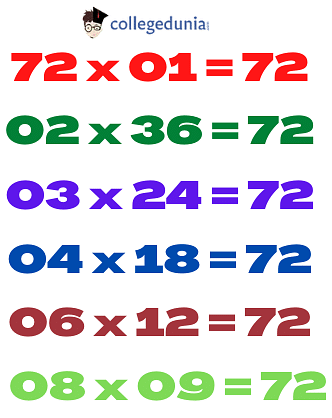
Factors of 72
The factors of 72 are 12 positive and 12 negative integers.
- Positive Factors: 1, 2, 3, 4, 6, 8, 9, 12, 18, 24, 36, and 72
- Negative Factors: -1, -2, -3, 4, -6, -8, -9, -12, -18, -24, -36, and -72
How to find Factors of 72?
[Click Here for Sample Questions]
To find the factors of 72 we can use the multiplication method which involves finding pairs of numbers that on multiplying give the required number.
Factors of 72 using Multiplication Method
Using the multiplication method to find the factors of 72, the first step is to divide 72 by the numbers 1 to 72. Numbers that divide 72 completely will be its factors. Thus;
- 72 ÷ 1 = 72
- 72 ÷ 2 = 36
- 72 ÷ 3 = 24
- 72 ÷ 4 = 18
- 72 ÷ 6 = 12
- 72 ÷ 8 = 9
- 72 ÷ 9 = 8
- 72 ÷ 12 = 6
- 72 ÷ 18 = 4
- 72 ÷ 24 = 3
- 72 ÷ 36 = 2
- 72 ÷ 72 = 1
Thus the factors of 72 are 1, 2, 3, 4, 6, 8, 9, 12, 18, 24, 36, and 72.
Also Read:
| Related Topics | ||
|---|---|---|
| Divisibility Rules | Natural Numbers and Whole Numbers | Decimal Expansion |
| Divisor | Factors and Multiples | Multiplication and Division |
Prime Factorization of 72
[Click Here for Sample Questions]
Prime factorizations of a number can be defined as the method of representing the number through the product of its prime factors. To find the prime factorization of 72, follow the given steps.
- The foremost step is to divide 72 with its smallest prime factor. Here, the smallest prime factor is 2. So, 72 ÷ 2 = 36
- Now, again diving 36 by 2, 36 ÷ 2 = 18
- Repeating the same process, 18 ÷ 2 = 9
- Now, we cannot divide 9 further by 2, so we will move to the next smallest prime factor of 72 which is 3. Thus, 9 ÷ 3 = 3
- Again diving the quotient by 3, 3 ÷ 3 = 1
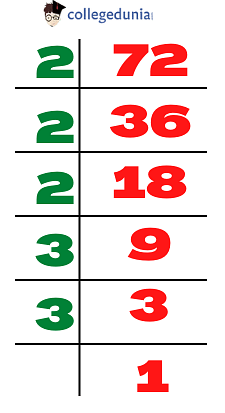
Prime Factorization of 72
Once the quotient is 1, no further division is needed. Thus, the prime factorization of 72 is
2 × 2 × 2 × 3 × 3 or 23 × 32
Also Read: Real Numbers
Factor Tree of 72
[Click Here for Sample Questions]
The factor tree can also be drawn to find the factors of 72. The factor tree of any number is drawn through the process of factorization until we reach its prime factors. The steps to draw a factor tree of 72 are as follows.
- Split 72 into two factors, let’s that be 2 and 36.
- Circle out 2 as it is one of the prime factors of 72.
- Moving on to 36 we will further split it into more factors resulting in 2 and 18.
- Again circling 2 and splitting 18 into 2 and 9.
- Here, we will circle out 2 and split 9 into 3 and 3.
- Here we have two prime numbers 3 and 3.
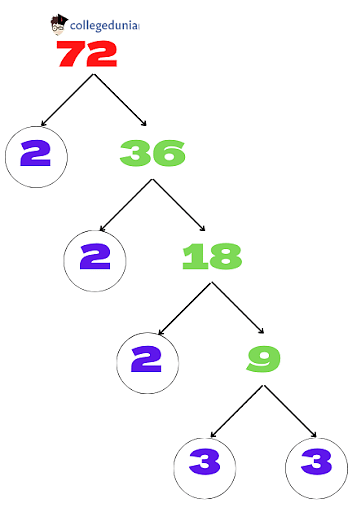
Factor Tree of 72
When we reach prime factors, the tree is complete. Therefore, the prime factors of 72 are:
2 x 2 x 2 × 3 × 3
Also Read: Rational Numbers
Pair Factors of 72
[Click Here for Sample Questions]
There are both positive and negative factors of 72 and thus it also has both the positive pair factors and the negative pair factors. Both are individually discussed below.
Positive Pair Factor
The table below shows the positive pair factors of 72.
| Positive Factors of 72 | Positive Pair Factors of 72 |
|---|---|
| 1 × 72 | (1, 72) |
| 2 × 36 | (2, 36) |
| 3 × 24 | (3, 24) |
| 4 x 18 | (4, 18) |
| 6 x 12 | (6, 12) |
| 8 x 9 | (8, 9) |
Also Read: Algebra
Negative Pair Factors
The table below shows the negative pair factors of 72.
| Negative Factors of 72 | Negative Pair Factors of 72 |
|---|---|
| -1 × -72 | (-1, -72) |
| -2 × -36 | (-2, 36) |
| -3 × -24 | (-3, -24) |
| -4 × -18 | (-4, -18) |
| -6 x -12 | (-6, -12) |
| -8 x -9 | (-8, -9) |
Also Read: Geometry
Solved Examples
[Click Here for Sample Questions]
A few solved examples to understand how to use factors of 72 in numerical.
Example 1: Can we divide 72 by 3, 6, 9 and 10 completely?
Solution: The factors of 72 are 1, 2, 3, 4, 6, 8, 9, 12, 18, 24, 36, and 72.
Thus only the above-mentioned factors can completely divide 18.
Hence, 3, 6 and 9 can divide 72 completely but 10 cannot.
Example 2: Find the prime factors of 72.
Solution: Using the prime factorization method, we can find the prime factors of 72.
Following the steps that are mentioned above, the prime factors of 72 are 2 x 2 x 2 x 3 x 3.
Things to Remember
- The numbers that when dividing another number leave zero remainders are called the latter one’s factors.
- Factors of 72 are the numbers that on multiplying by another number, result in 72.
- There are 12 positive and 12 negative factors of 72.
- The factors of 72 are 1, 2, 3, 4, 6, 8, 9, 12, 18, 24, 36, and 72.
Sample Questions
Ques: Find the common factors of 72 and 18. [2 marks]
Ans: The factors of 72 are 1, 2, 3, 4, 6, 8, 9, 12, 18, 24, 36, and 72.
The factors of 18 are 1, 2, 3, 4, 6, 9 and 18
Thus the common factors of 72 and 18 are 1, 2, 3, 4, 6, 9 and 18.
Ques: Find the common factors of 72 and 20. [2 marks]
Ans: The factors of 72 are 1, 2, 3, 4, 6, 8, 9, 12, 18, 24, 36, and 72.
The factors of 20 are 1, 2, 4, 5, 10 and 20
Thus the common factors of 72 and 20 are 1, 2 and 4.
Ques: Find the common factors of 72 and 9. [2 marks]
Ans: The factors of 72 are 1, 2, 3, 4, 6, 8, 9, 12, 18, 24, 36, and 72.
The factors of 9 are 1, 2, 3, and 9
Thus the common factors of 72 and 9 are 1, 2, 3 and 9.
Ques: Find the common factors of 72 and 36. [2 marks]
Ans: The factors of 72 are 1, 2, 3, 4, 6, 8, 9, 12, 18, 24, 36, and 72.
The factors of 36 are 1, 2, 3, 4, 6, 9, 12, 18 and 36
Thus the common factors of 72 and 36 are 1, 2, 3, 4, 6, 9, 12, 18 and 36.
Ques: What are the prime factors of 72? [2 marks]
Ans: The prime factors of 72 are the prime numbers that when multiplied by another number give 72 as the product. The prime factors of 72 are 2 and 3.
Ques: What are the positive pair factors of 72? [1 mark]
Ans: The positive pair factors of 72 are (1, 72), (2, 36), (3, 24), (4, 18), (6, 12), and (8, 9).
Ques: What are the negative pair factors of 72? [1 mark]
Ans: The negative pair factors of 72 are (-1, -72), (-2, -36), (-3, -24), (-4, -18), (-6, -12), and (-8, -9).
Ques: Find the greatest common factors of 72 and 26. [2 marks]
Ans: The factors of 72 are 1, 2, 3, 4, 6, 8, 9, 12, 18, 24, 36, and 72.
The factors of 26 are 1, 2, 13 and 26
Thus the common factor of 72 and 26 is 2.
Ques: Find the common factors of 72 and 48. [2 marks]
Ans: The factors of 72 are 1, 2, 3, 4, 6, 8, 9, 12, 18, 24, 36, and 72.
The factors of 48 are 1, 2, 3, 4, 6, 8, 12, 16, 24 and 48
Thus the common factors of 72 and 48 are 1, 2, 3, 4, 6, 8, 12 and 24.
Also Read:



Comments