



Content Curator
Rational Number is a very common type of a number, which is in the form of p/q where q is not equal to zero. Rational numbers are important as there are many quantities like measurements, mass, time, etc., that integers cannot express. Rational Numbers make our computations easier and see over the limitations of whole numbers and integers.
| Table of Contents |
Key Terms: Rational Number, Integers, Denominator, Numerator, Real Number, Simplification, Fraction
What is Rational Number?
[Click Here for Sample Questions]
‘Rational’ comes from the word ‘ratio’, and the denotation Q comes from the word ‘quotient’. A rational number is specified as:
- Rational number is a real number that can be represented as the quotient of a/b of two integers.
- Any fraction where the denominator is non-zero is a rational number. It includes integers, fractions, terminating decimals, and repeating decimals.
- Any number which can be expressed as a fraction where both the numerator and the denominator are integers is a rational number.
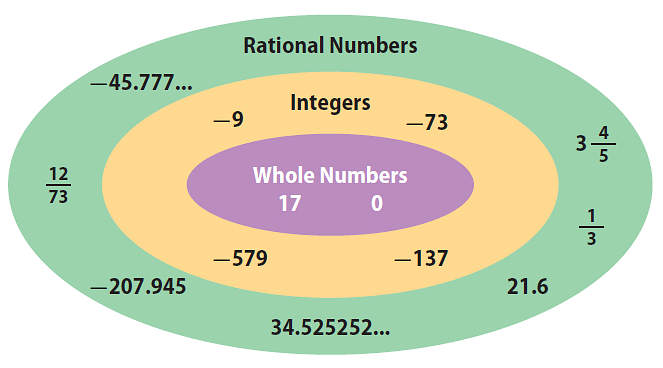
Rational Number
Some examples of rational numbers are:
- 10/2
- -5/7
- 10/999
- -10/-21
Also Check: Decimal Expansion of Rational Numbers
Types Of Rational Numbers
[Click Here for Sample Questions]
The different types of rational numbers are:
- Integers such as 0, -7, 12, etc.
- Fractions with numerators and denominators as integers like 1/2, -9/4, 11/999, etc.
- Terminating decimals like 0.9991, 0.2, etc.
- Non-terminating repeating decimals such as 0.666…, 0,2121…, 0.619619..., etc.
- Positive rational numbers are the rational numbers having the same sign in both their numerator and denominator, like -1/-5, 5/7, -11/-22, etc. All are more than zero.
- Negative rational numbers are the rational numbers having different signs in their numerator and denominator, like 2/-15, -2/99, etc. All are less than zero.
Also Check: Difference Between Fraction and Rational Numbers
Standard Form Of Rational Numbers
[Click Here for Sample Questions]
A rational number is said to be in standard form if the only common divisor between the numerator and the denominator is 1.
For example: 25/125 is a rational number but its standard form is 1/5, as there are no common factors between the numerator and the denominator other than one.
Arithmetic Operations On Rational Numbers
[Click Here for Sample Questions]
Rational numbers can also be added, subtracted, multiplied, or divided. We can perform these four operations on rational numbers as:
- Addition: Adding two rational numbers is the same as adding two fractions. To add two rational numbers, we simply make their denominators the same, and then comes the addition.
- Example: 1/3 + 2/7 = (7+6)/21 = 13/21
- Subtraction: Similar to addition, we first make the denominators the same and then do the substraction.
- Example: 1/3 - 4/6 = (2-4/6 = -2/6 = -1/3
- Multiplication: For multiplying two rational numbers, we multiply their numerators and their denominators separately and then simplify the resultant fraction.
- Example: 1/6 × -5/7 = (1 × -5)/(6 × 7)= -5/42
- Division: For division, we multiply the first fraction (dividend) with the reciprocal of second fraction (divisor)
| p/q ÷ r/s = p/q × s/r |
-
- Example: 1/4 ÷ 3/4 = 1/4 × 4/3= …
Also Check: Irrational Numbers
Difference Between Rational And Irrational Numbers
[Click Here for Sample Questions]
The numbers which are not rational numbers are called irrational numbers. They are represented by Q´ (Q dash). The difference between rational and irrational numbers are:
| Rational Numbers | Irrational Numbers |
|---|---|
| Numbers that can be expressed as fractions of integers, such as p/q where q does not equal 0. Example: 1/-2, 13/21, 5/2, etc | Numbers that cannot be expressed as fractions of integers. Example: √5, π (pi) |
| They can be terminating as well as non-terminating in nature. Example: 2.141141… | They are always non-terminating and non-repeating. Example: √5 = 2.236067977499789696... has no repeating patterns of decimals |
Also Check: Representing Rational Numbers on a Number line
Finding Rational Numbers Between Two Rational Numbers
[Click Here for Sample Questions]
Between any two rational numbers, countless rational numbers can be found. This property of rational numbers is called Dense Property.
The given rational numbers may have the same or different denominator values. Below are the methods with steps to find rational numbers between two rational numbers depending on their denominator values:
1) Find Rational Numbers Between Two Rational Numbers With The Same Denominator Value
Steps to be followed are:
- Check the denominator values if they are the same, check the numerator values.
- If the numerator differs by value more than the required rational numbers between them, simply increment the smaller numerator value by one and find the required number of rational numbers.
- For example, 5 rational numbers between 1/11 and 8/11 are 2/11, 3/11, 4/11, 5/11, and 6/11.
- Else if the values of the numerators differ by a lesser value than the number of rational numbers we need to find, then multiply the numerators and denominators of both the rational numbers by multiples of 10.
- For example, If 10 rational numbers are to be found between 2/8 and 4/8, both the rational numbers are to be multiplied by 10/10.
2/8 × 10/10 = 20/80 and 4/8 × 10/10 = 40/80
Now, 10 rational numbers can be easily found in between. They are 21/80, 22/80, 23/80, 26/80, 27/80, 30/80, 31/80, 33/80, 34/80, 35/80.
Also Check: Rational Number Between Two Rational Numbers
2) Find Rational Numbers Between two Rational Numbers with Different Denominator values
Steps to be followed are:
- To find the rational numbers between two rational numbers with different denominators, we should equate the denominators.
- Equating the denominators can be done either by finding their LCM or by multiplying the denominators of one to both the numerator and denominator of the other.
- On making the denominators equal, the same method for finding the rational numbers between two rational numbers having the same denominator is used.
- For example: Find 5 rational numbers between 2/3 and ¾
LCM of 3 and 4 = 12.
The resulting rational numbers for equating the denominators are 8/12 and 9/12.
- Now the procedure to find rational numbers between two rational numbers with the same denominator value must be followed.
- Hence, the 5 rational numbers are 81/120, 82/120, 85/120, 86/120, and 87/120.
Things To Remember
- A number is called a rational number, if it can be written in the form p/q, where p and q are integers and q is not equal to 0.
- Rational numbers can be integers, fractions, terminating decimals, non-terminating repeating decimals, positive, or negative.
- Rational numbers follow addition, subtraction, multiplication, and division rules same as fractions.
- Numbers that cannot be expressed as fractions of integers are called irrational numbers. For example √5, π (pi), etc
- Interesting fact: The ancient Greek mathematician Pythagoras believed that all numbers were rational, but one of his students Hippasus proved (using geometry) that you could not write the square root of 2 as a fraction, and so it was irrational.
Sample Questions
Ques: Is zero a rational number? Can it be written in the form p/q where p and q are integers and q≠0? (3 Marks)
Ans: Yes, zero is a rational number.
0 = 0/1 = 0/2 = 0/3 etc.
Here q is not equal to zero.
Denominator q can also be taken as a negative integer.
Ques: Find five rational numbers between1 and 2. (3 Marks)
Ans: Let us multiply both the numbers by 7/7
1× 7/7 = 7/7
2× 7/7 = 7/14
Thus, five rational numbers between 7/7 and 7/14 are
7/8, 7/9, 7/10, 7/11, 7/13
Ques: Find five rational numbers between 3/5 and 4/5. (5 Marks)
Ans: We need to find 5 rational numbers between 3/5 and 4/5.
Let us use 6 as a multiplier. We will multiply and divide the numerator and denominator of 3/5 and 4/5 by 6.
3/5 = (3 × 6) ÷ (5 × 6) = 18/30
4/5 = (4 × 6) ÷ (5 × 6) = 24/30
Here, 18/30 and 24/30 have the same denominators.
Thus, 5 rational numbers between 3/5 and 4/5 are
19/30, 20/30, 21/30, 22/30, and 23/30.
Ques: Find five rational numbers between 2/3 and 4/5. (5 Marks)
Ans: Below is the steps to find 5 rational numbers between 2/3 and 4/5:
Multiply 2/3 by 5/5
2/3 × 5/5 = 10/15
Multiply 4/5 by 3/3
4/5 × 3/3 = 12/15
Now both have the same denominators.
We can easily find 5 rational numbers between 2/3 and 4/5 by multiplying both of them by 6.
10/15 × 6/6 = 60/90
11/15 × 6/6 = 72/90
Thus, five rational numbers between 2/3 and 4/5 are
61/90, 62/90, 63/90, 64/90, 65/90.
Ques: State whether the following statements are true or false. Give reasons for your answers. (5 Marks)
(i) Every natural number is a whole number.
(ii) Every integer is a whole number.
(iii) Every rational number is a whole number.
Ans:
(i) True
Natural numbers start from 1 to infinity. i.e 1,2,3,4….
Whole numbers start from 0 to infinity. i.e 0, 1,2,3,4….
Hence, the collection of all-natural numbers and 0 is called whole numbers.
(ii) False
Integers are a set of numbers having numbers from negative infinity to positive infinity, including zero, and excluding decimals and fractions. i.e ….-4, -3, -2, -1, 0, 1,2,3,4….
Whole numbers start from 0 to infinity. i.e 0, 1,2,3,4….
Hence, it is clear that negative integers are not whole numbers.
(iii) False
Since rational numbers are of the form p/q, q ≠ 0 and q do not divide p completely they are not whole numbers.
Ques. Rationalize the denominator. (5 Marks)
a) 2/ √3 - 1
b) 7/ √12 - √5
Ans. Solutions are as followed:
- 23√−1
Multiply and divide by the conjugate of the denominator
The conjugate of (√3 – 1) is (√3 + 1)
23√−1 × 3√+13√+1 = 23√+13√2−12 = 23√+13−1
23√+12 = 3–√ + 1
- Multiply and divide by the conjugate of the denominator
The conjugate of (√12 – √5) is
7/√12-√5 × √12 +√5 / √12+√5
= 7/√12+√5 / √12 (2) - √5 (2)
= 7√12+√5 / 12−5
= 7√12+√5/7 = √12 + √5
| Chapter Related Topics | ||
|---|---|---|
| Real Numbers | MCQs for Real Numbers | Important MCQs on Rational Numbers With Explanation |
| Polynomial | Linear Equation in Two Variables | Introduction to Euclid's Geometry |
| Mathematics Study Guides | ||
|---|---|---|
| NCERT Solutions For Class 6 to 12 | Maths Study Material | Chapter-wise NCERT Solutions |



Comments