



Content Curator
Foci of the ellipse are the reference points in an ellipse that assist in determining the equation of the ellipse. For the ellipse, there are two foci. In addition, the ellipse's locus is defined as the total of the distances between the two foci, expressed as a constant value. An ellipse is a conic with an eccentricity of less than one. An ellipse is a collection of points whose distances from a fixed point and a straight line are in a constant ratio 'e' that is less than one. The fixed point and straight line are referred to as the focus and directrix, respectively. An ellipse has two points that serve as the ellipse's focus.
| Table of Content |
Key Terms: Ellipse, Conic Section, Eccentricity, Directrix, Focus, Parabola, Hyperbola, Foci of an ellipse
Also read: Isosceles Triangle Theorems
What is an Ellipse?
[Click Here for Sample Questions]
In terms of locus, an ellipse is the set of all points on an XY-plane whose distance from two fixed points (called foci) adds up to a constant number. The ellipse is a kind of conic section formed when a plane cuts a cone at an angle with its base. If the plane intersects the cone parallel to the base, it makes a circle.

Ellipse
Ellipse Shape
An ellipse is a two-dimensional form specified along its axes. When a cone is crossed by a plane at an angle with respect to its base, an ellipse is formed.
It has two main sites of interest. For all points in a curve, the total of the two distances to the focal point is always constant.
A circle is also an ellipse in which the foci are all at the same location, which is the circle's center.
Also read: Quadrilateral Formula
Properties of an Ellipse
- Ellipse have two focal points, which are also known as foci.
- A set distance is referred to as a directrix.
- The eccentricity of an ellipse ranges from 0 to 1. 0 ≤ e < 1
- The whole sum of each distance from an ellipse's locus to its two focal points is constant.
- Ellipse has one major and one minor axis, as well as a center.
Ellipse Equation
The equation of the ellipse is given by:
| \(\frac{x^2}{a^2} + \frac{y^2}{b^2}\) = 1 |
Discover about the Chapter video:
Conic Sections Detailed Video Explanation:
What is Foci of an Ellipse?
[Click Here for Sample Questions]
The ellipse's foci are two reference points that assist in creating the ellipse. The foci of the ellipse are equidistant from the origin and are positioned on the ellipse's major axis. An ellipse indicates a point's locus, with the sum of its distances from two fixed points being a constant value.
An ellipse is defined as two locations whose sum of distances from each other point on the ellipse is always the same. They are lying on the elliptical. The focal length of the ellipse is the distance between each focus and the center.
Also read: Differential Equation
How to find Foci of an Ellipse?
[Click Here for Sample Questions]
Assume "S" is the focus and "l" is the ellipse's directrix. Let Z be the perpendicular y' from S on directrix l's foot. Assume that A and A' are the points that split SZ in the ratio e:1. Assume C is the midpoint, and AA' is the origin.
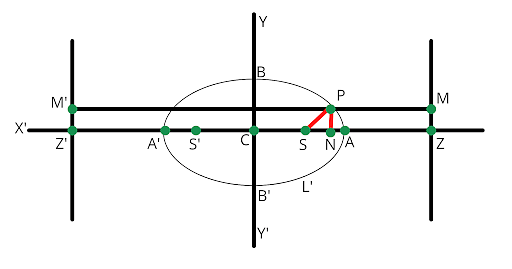
Let CA =a
⇒ A= (a,0) and A’=(-a,0).
Now (AS)/(AZ)=(e)/(1)=(A’S)/(A’Z)
⇒ SA=eAZ & SA’=eA’Z
⇒ CA-CS=e(CZ-CA) …………(1)
⇒ SC+CA’=e(A’C+CZ) ……….(2)
Adding 1 and 2, we get
CA+CA’=e(2CZ)
⇒ 2a=2e x CZ
⇒ CZ=(a)/(e)
⇒ Equation of directrix is x=(a)/(e)
Subtracting 1 and 2, we get
2CS=e(2CA)=e x 2a
⇒ CS =a
⇒ Focus, S= (ae,0)
Therefore, Foci=(ae, 0) & (-ae, 0) due to the symmetry.
Let us consider that P(x,y) be the point on ellipse and PM be the perpendicular distance from P to l
By the definition of Ellipse,
(SP)/(PM) =e
⇒SP=e PM
SP = e2PM2
(x-ae)2 + y2 = e2 [(x2 + a2) / (e2) – (2ax) / (e) ]
\(\frac{x^2}{a^2} + \frac{y^2}{(a^2(1-e^2))}\) = 1
e < 1, 1 – e2 > 0
a2 (1 – e2) > 0
Let it be b2
Then,
| \(\frac{x^2}{a^2} + \frac{y^2}{b^2}\) = 1 |
Focus-Directrix Property of an Ellipse
[Click Here for Sample Questions]
Consider an ellipse with the equation \(\frac{x^2}{a^2} + \frac{y^2}{b^2}\) = 1.
Draw the lines ZD and ZD', which have the equations x = a/e and x = – a/e, respectively.
P (x,y) can represent any two points on the ellipse. Let D' PD be parallel to the x-axis.
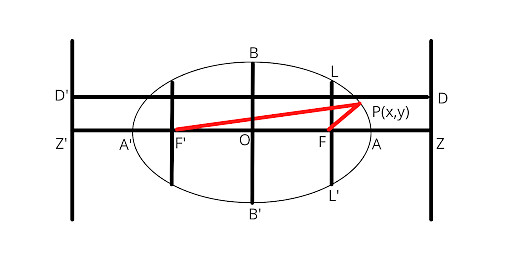
The foci are F (c,o) and F’ (- c,o).
Now PF + PF’ = 2a (by definition of an ellipse)
\(\sqrt{[(x-c)^2]+y^2}+ \sqrt{[(x+c)^2+y^2]} = 2a\)
\(\sqrt{[(x+c)^2+y^2]} = 2a - \sqrt{[(x-c)^2+y^2]}\)
(x + c)2 + y2 = 4a2 + (x - c)2 + y2 – 4a \(\sqrt{[(x-c)^2+y^2]}\)
\(\sqrt{[(x-c)^2+y^2]}\) = [a - (c/a) x]
PF = a - (c/a) x
PF = e [(a/e) – (c/de) x] where c = ae
PF = e [(a/e) – x]
PF = e . PD ——– (1)
Further PF + PF’ = 2a
PF’ = 2a – PF
2a – a + ex = a + ex = e [(a/e) + x]
a + ex = e [(a/e) + x] = e PD’ ——– (2)
From (1) and (2) we have PF/PD=e and PF’ /PD’=e
This demonstrates that an ellipse is the locus of a point that travels in such a way that the ratio of its distance from a fixed point to its distance from a fixed line equals a constant e < 1.
Also read: Difference between Sequence and Series
Eccentricity of Ellipse
The eccentricity of an ellipse is defined as the ratio of distances from the centre of the ellipse to the semi-major axis of the ellipse.
e=c/a is the eccentricity of an ellipse.
c=focal length and a=length of the semi-major axis.
Since c ≤ a the eccentricity is always greater than 1.
Also,
c2 = a2 – b2
Therefore, eccentricity becomes
e = \(\sqrt{(a^2 – b^2) / a}\)
e = \(\sqrt{[(a^2 – b^2) / a^2] e} = \sqrt{[1 - (b^2/a^2)]}\)
Calculation of Location of Foci
[Click Here for Sample Questions]
The formula is as follows:\(\sqrt{F = j^2 - n^2}\)
Where F is the distance between the foci and the ellipse's centre.
j = semi-major axis (major radius)
n is the semi-minor axis (minor radius)
Also read: Determinant Formula
Things to Remember
- The length of the major and minor axis creates the width and height of an ellipse.
- An ellipse is a form of shape that resembles an oval or a flattened circle. In geometry, an ellipse is a plane curve formed by the intersection of a cone and a plane in such a way that the resulting closed curve is an ellipse.
- The foci of an ellipse are two fixed points on its major axis such that the total of the distances from these two points to any point on the ellipse is constant.
- Circles are subsets of ellipses formed when the cutting plane is perpendicular to the cone's axis.
- The foci always lie on the major axis, and the total of the distances from the foci to any point on the ellipse (the constant sum) is larger than the distance between the foci.
Also read: Differentiation and Integration Formula
Sample Questions
Ques: What is an ellipse? [2 marks]
Ans: An ellipse is a curve created by a plane intersecting a cone at an angle to the base. It is a curved line with two focus points. Ellipse is a set of points whose distances from two foci are constant.
The ellipse's major axis runs along the x-axis and has the greatest width across it. It has a length of 2a.
The minor axis runs parallel to the y-axis and has the least width across it. It has a length of 2b.
Ques: Find the coordinate points of foci for the following ellipse: x2 + 2y2 = 3 [2 marks]
Ans: Given:
Ellipse equation: x2 + 2y2 = 3
The given equation can be written as: x2/3 + y2/(3/2) = 1
Therefore, a=√3 and b=√(3/2) where a >b
Therefore, b2 = a2 (1 – e2)
e=1/ √2
Foci = (+ae,0) and (-ae,0)
Therefore, the coordinates of the foci are: (√(3/2), 0) and (√(-3/2), 0)
Ques: If the length of the semi-major axis is 10cm and the semi-minor axis is 7cm of an ellipse. Find its area. [2 marks]
Ans: Given, the length of the semi-major axis of an ellipse, a = 10cm
length of the semi-minor axis of an ellipse, b = 7cm
By the formula of area of an ellipse, we know;
Area = π x a x b
Area = π x 10 x 7
Area = 70 π
or
Area = 70 x 22/7
Area = 220 cm2
Ques: Find the coordinates of foci using the formula when the major axis is 5 and the minor axis is 3. [2 marks]
Ans: Using the formula of F = \(\sqrt{F = j^2 - n^2}\)
F = \(\sqrt{5^2-3^2}\)
F = 25-9
F = 16
F = 4
Foci = (0,4) & (0,-4)
Ques: Find the coordinates of foci using the formula when the major axis is 10 and the minor axis is 6. [2 marks]
Ans. Using the formula of F=\(\sqrt{F = j^2 - n^2}\)
F = \(\sqrt{10^2-6^2}\)
F = 100 – 36
F = 64
F = 8
Foci = (0,8) & (0,-8)
Ques: Find the eccentricity of the conic section (x2/36) + (y2/16) = 1. [4 marks]
Ans: Given: (x2/36) + (y2/16) = 1.
It can also be written as (x2/62) + (y2/42) = 1.
The given conic section is an ellipse, as it holds the form (x2/a2) + (y2/b2) = 1.
Here, a=6 and b=4.
We know that c2 = a2 – b2
c2 = 62 – 42
c2 = 36 – 16 = 20
Hence, c = √20 = 2√5.
We know that the formula for eccentricity is:
e = c/a
Now, substitute the values in the formula, we get
e = (2√5)/6
e = √5/3
Hence, the eccentricity of the given conic section is √5/3.
Ques: Find the eccentricity of the hyperbola (x2/16) + (y2/9) = 1. [4 marks]
Ans: Given: (x2/16) + (y2/9) = 1.
The given hyperbola equation can also be written as
(x2/42) + (y2/32) = 1.…(1)
Hence, the above equation is of the form: (x2/a2) + (y2/b2) = 1. …(2)
So, the axis of the hyperbola is the x-axis.
Now, by comparing the equation (1) and (2), we get a = 4 and b = 3.
We know that the eccentricity formula for a hyperbola is e = \(\sqrt{[1 + (b^2/a^2)]}\)
Now, substitute the values in the formula, we get
e = √[1 + (32/42)]
e = √[1 + (9/16)]
e = √(25/16)
e = 5/4.
Therefore, the eccentricity of the hyperbolic equation is 5/4.
Ques: Determine the eccentricity of the hyperbolic equation (x2 / 4) + (y2 / 25) = 1. [4 marks]
Ans: Given: (x2 / 4) + (y2 / 25) = 1
The given hyperbola equation can also be written as
(x2 / 22) + (y2 / 52) = 1.…(1)
Hence, the above equation is of the form: (x2 / a2) + (y2 / b2) = 1. …(2)
So, the axis of the hyperbola is the x-axis.
Now, by comparing the equation (1) and (2), we get a=2 and b=5.
We know that the eccentricity formula for a hyperbola is e = \(\sqrt{[1 + (b^2/a^2)]}\)
Now, substitute the values in the formula, we get
e = √[1 + (52/22)]
e = √[1 + (25/4)]
e = √(29/4)
e = 1.34.
Therefore, the eccentricity of the hyperbolic equation is 1.34.
Ques: Find a relation between x and y such that the point (x, y) is equidistant from the points (7, 1) and (3, 5). [4 marks]
Ans: Let P(x, y) be the point that is equidistant from the points A (7, 1) and B (3, 5).
Given, AP = BP
AP2 = BP2
(x – 7)2 + (y – 1)2 = (x - 3)2 + (y – 5)2 (by distance formula)
x2 – 14x + 49 + y2 – 2y + 1 = x2 – 6x + 9 + y2 – 10y + 25
- 14x + 50 – 2y + 6x + 10y – 34 = 0
- 8x + 8y = – 16
x – y = 2
This is the required relation between x and y.
Ques: Find the foci of the ellipse having the major axis of 12 units, minor axis as 8 units, and having the coordinate axes as the axis of the ellipse? [3 marks]
Ans: The given values of the major axis and minor axes are 12 units and 8 units.
Hence we have 2a = 12, and 2b = 8, or a = 6, and b = 4 units respectively. Let us now calculate the eccentricity of the ellipse using the formula
e = \(\sqrt{1 – \frac{b^2}{a^2}}\)
e = \(\sqrt{1 – \frac{4^2}{6^2}}\) = \(\sqrt{1 – \frac{4}{6}}\) = \(\sqrt{59}\) = 0.74
The coordinates of the foci are F (+ ae, 0) = (+ 6 (0.714), 0) = (+ 4.2, 0), and F'(- ae, 0) = (- 4.2, 0). Therefore, the coordinates of the foci of the ellipse are (+ 4.2, 0), and (- 4.2, 0).
Mathematics Related Links:



Comments