



Content Curator
The kidney is one of the most important organs of a human which actively takes part in the excretion process of the human body. Due to some specific reasons, this kidney becomes damaged and fails to do its function. What will happen if the municipality workers are not coming to clean our streets for a week? We can see heaps of wastes here and there around the street. The same happens when our kidney fails to function. Wastes that were cleared out of our body by the kidney, would start to accumulate in our body. This is a serious health issue.
The Kidney would stop completely functioning if it is affected by a chronic kidney disease which leads to chronic renal failure. On this condition, doctors would have two solutions for the patient: either dialysis or renal transplantation. Renal transplantation is suggested in the worst situations alone and dialysis is a common solution to renal failure. In the recent era, it has become much popular and less expensive. But how do Hemodialysis works? When should one undergo a Hemodialysis? We can have a detailed look.
| Table of Content |
Read Also: Kidney Function Test
Hemodialysis and its principles
Hemodialysis simply refers to the process in which an artificial kidney (dialyzer) does the function of a kidney when a person's natural kidney fails to do that. When trying to understand, this definition, keep two things in mind:
- Kidneys not only remove end-products of different metabolic processes but also produce certain hormones for our body. The artificial kidney doesn't do that but those hormones are injected into the person's body as a part of the treatment.
- An artificial kidney or Dialyzer is a machine that is kept outside our body and is connected through our veins for its functioning.
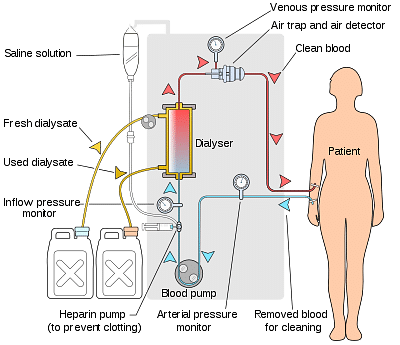
Dialyzer, an electric device, would receive the blood from our body. This blood is filtrated through a filter and after removing the waste products, the blood is pumped back to the human body. By this process, the waste and extra fluid in the blood is removed and the blood pressure level is regulated.
Dialysis works mainly on two principles: the principle of diffusion and the principle of ultrafiltration. The principle of diffusion works by allowing a solution to pass over a semipermeable membrane for dialysis. But in the principle of ultrafiltration, both the solute passing and fluid waste removal are done under a pressure guardian. These principles would be clearer when the procedure of Hemodialysis is explained.
Necessity for Hemodialysis
The very first thing to remember while learning Hemodialysis is that Hemodialysis is not the only solution for kidney diseases. It depends upon the magnitude of damage your kidney has. Scientifically, the efficiency of kidney functioning is measured based on glomerular filtration rate (GFR).
GFR refers to the efficiency rate of your kidney in filtering the blood based on blood pumped to it. On a GFR basis, doctors have a parameter of 5 stages. With your GFR rate decreasing, you have more chance to undergo a Hemodialysis i.e., one would be suggested for Hemodialysis at the fifth stage, where you would have GFR below 15%. Talking positively, one should undergo Hemodialysis only if his GFR falls below 15%.
Check Also:
Procedure of Hemodialysis
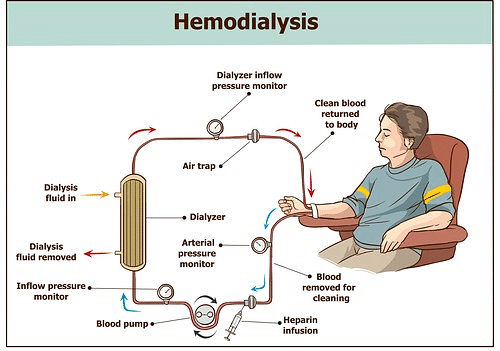
To perform Hemodialysis, we mainly need four things- a Dialyzer (artificial kidney), dialysate (a solution), a blood delivery system, and access to our blood vessels. The dialyzer plays the major role of filtering the blood; but let us begin from where the actual process begins i.e., from the access to the blood vessels.

Access to a human body vessel can be done in three ways- through a fistula, graft, or rarely through a catheter (a soft tube inserted into a large vein into the neck or chest). This selection depends on the nature of the patient's body. This access may be placed as a part of your body, through minor surgery.
Also Read:
The access to our blood vessel will be connected to the dialyzer which has two sides. One side would be for collecting our blood and the other for the dialysate. These two (blood and dialysate) are passed parallelly through two narrow tubes. This narrow tube acts as a filter as it is not big enough for substances like urea. Moreover, dialysate act like a deterging agent that separates the waste from our blood where diffusion and ultrafiltration happen.

The blood flow at a rate of 300-500ml/min, which is regulated by the blood delivery system.
This process is done frequently for 4 hours (or more, depending on the patient's condition) where the blood flows out of the body, gets filtrated, and will return to the body. So, dialyzer acts as a kidney kept outside our body. Hemodialysis is normally done 3 times a week.
Complications of Hemodialysis
Considering what we have discussed so far, it is clear that Hemodialysis is a process in which an organ's work is replaced by a machine's work. The human body would find it difficult to get adjusted to this condition. Just imagine that your eyes are replaced with a 48MP camera, do you feel you would have the same vision. No. The same happens when a kidney's function is replaced by a dialyzer.
According to reports, nearly 55% percent of people will experience hypotension, where they would faint due to low blood pressure. Blood pressure, as you know, is the pressure that blood exerts on the blood vessels. So, when we make an alternative way for the blood to flow, the blood pressure eventually gets reduced.
Beyond hypotension, 15% of people vomit after a Hemodialysis. Very few people have other health issues like itching, body pain, and fever after they undergo a Hemodialysis. Rarely, people are also seen with neurological disorders like disequilibrium syndrome as a side effect of Hemodialysis.
Despite all these side effects, Hemodialysis is regarded as the best solution among the three solutions for chronic renal failure. Moreover, doctors advise patients to ignore these side effects as they are minute issues if we compare with what would have happened to their body in the absence of Hemodialysis.
Things to Remember
- Hemodialysis is the medical procedure through which a machine performs the function of a kidney when it fails to function properly or completely shut down.
- A dialyzer (artificial kidney), a dialysate (solute), a blood delivery system and access to blood vessels (fistula, graft, or catheter) are used for the Hemodialysis process.
- It functions under the principles of diffusion and ultrafiltration, where the solute, dialysate, and blood are passed through two narrow tubes, where substances like urea are blocked and filtered blood is allowed to flow back to the body.
- Hemodialysis is the most recommended solution for kidneys with GFR below 15% despite the side effects it has.
Read Also: Life Process
Sample Questions
Ques: What is Hemodialysis?
Ans: Hemodialysis is the medical procedure through which a machine performs the function of a kidney when it fails to function properly or completely shut down. The Kidney would stop completely functioning if it is affected by a chronic kidney disease which leads to chronic renal failure. On this condition, doctors would have two solutions for the patient: either dialysis or renal transplantation. Renal transplantation is suggested in the worst situations alone and dialysis is a common solution to renal failure
Ques: When will one have to start doing Hemodialysis?
Ans: The Kidney would stop completely functioning if it is affected by a chronic kidney disease which leads to chronic renal failure Renal transplantation is suggested in the worst situations alone and dialysis is a common solution to renal failure. Scientifically, the efficiency of kidney functioning is measured based on glomerular filtration rate (GFR).
GFR refers to the efficiency rate of your kidney in filtering the blood based on blood pumped to it. On a GFR basis, doctors have a parameter of 5 stages. With your GFR rate decreasing, you have more chance to undergo a Hemodialysis i.e., one would be suggested for Hemodialysis at the fifth stage, where you would have GFR below 15%.
Ques: How does Hemodialysis work?
Ans: For performing hemodialysis access would be made to our blood vessel will be connected to the dialyzer which has two sides. One side would be for collecting our blood and the other for the dialysate. These two (blood and dialysate) are passed parallelly through two narrow tubes. This narrow tube acts as a filter as it is not big enough for substances like urea. Moreover, dialysate act like a deterging agent that separates the waste from our blood where diffusion and ultrafiltration happen.
The blood flow at a rate of 300-500ml/min, which is regulated by the blood delivery system.
This process is done frequently for 4 hours (or more, depending on the patient's condition) where the blood flows out of the body, gets filtrated, and will return to the body.
Ques: Can Hemodialysis cure kidney diseases?
Ans: Hemodialysis is performed for both chronic renal failures and acute renal failures. But, acute renal failure needs to be performed for a short period and it will completely cure the kidney's damage. But in the case of chronic renal failure, one's kidney is not cured through Hemodialysis.
Read More: Difference between Open and Closed Circulatory Systems
Ques: What all apparatus are used for Hemodialysis?
Ans: The apparatus required to perform a Hemodialysis include:
- a Dialyzer (artificial kidney)
- dialysate (a solution)
- a blood delivery system, and
- Access to our blood vessels.
The dialyzer plays the major role of filtering the blood; but let us begin from where the actual process begins i.e., from the access to the blood vessels.
Access to a human body vessel can be done in three ways- through a fistula, graft, or rarely through a catheter (a soft tube inserted into a large vein into the neck or chest). This selection depends on the nature of the patient's body. This access may be placed as a part of your body, through minor surgery.
Ques: What are the other different forms of dialysis?
Ans: Dialysis is mainly of two forms. One is Hemodialysis and the other is peritoneal dialysis. Rather than a Hemodialysis, peritoneal dialysis will have a soft plastic tube placed in the patient's belly through which a cleaning agent will enter our body, filter our blood and exit the body through the tube. This is often regarded as a good method of dialysis.
Ques: Can dialysis injure our health?
Ans: According to reports, many people had side effects on performing Hemodialysis. In a study, it was found that nearly 55% percent of people will experience hypotension, where they would faint due to low blood pressure. Blood pressure, as you know, is the pressure that blood exerts on the blood vessels. So, when we make an alternative way for the blood to flow, the blood pressure eventually gets reduced.
Beyond hypotension, 15% of people vomit after a Hemodialysis. Very few people have other health issues like itching, body pain, and fever after they undergo a Hemodialysis. Rarely, people are also seen with neurological disorders like disequilibrium syndrome as a side effect of Hemodialysis.
Ques: Can Hemodialysis be done at home?
Ans: Yes, Hemodialysis is even done at home, nowadays. But the expense of the same would be high and it requires good training to operate the machines. This is not offered everywhere. But still, many people prefer to do dialysis at home as it is more comfortable for them.
Relatable Links:



Comments