



Content Curator
Prehistoric Earth was initially devoid of oxygen and abundant in methane. The oldest known living forms were minute organisms (microbes) that left traces of their existence in rocks dating back 3.7 billion years. Our ecosystems are structured by feeding connections. To absorb energy from their food, they and other animals require oxygen. Microbes left evidence in the hard structures ("stromatolites") they created, which date back 3.5 billion years. Stromatolites form when bacteria from sticky mats catch and bind sediments into layers.
Read More: Genetic Variation
| Table of Content |
Key Terms: Evolution, Atmosphere, Multicellular Life, Cyanobacteria, Darwin’s Theory of Evolution
Evolution of Life
[Click Here for Sample Questions]
Evolution has resulted in today's diversity of life on Earth. Life on Earth began at least 3.5 to 4 billion years ago and has continued to evolve ever since. All living things on Earth used to be primitive Unicellular Organisms. The first multicellular species appeared much later, and Earth's biodiversity increased dramatically as a result. The timeline of life on Earth is depicted in the diagram below. Humans are a very relatively new addition to the evolutionary timeline.
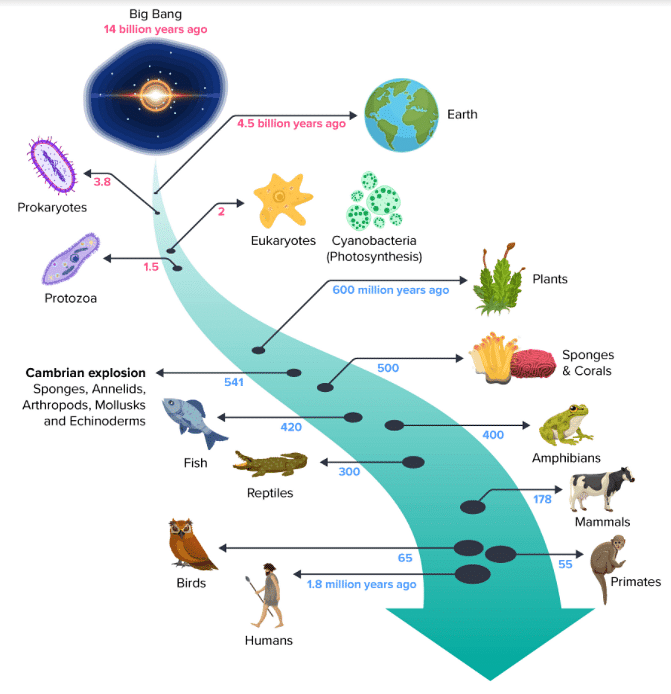
Evolution
Evolution is the most widely accepted theory of life on Earth today, and it is backed up by a lot of evidence. This wasn't always the case, though.
Read More: Origin and Evolution of Man
The dinosaurs were formerly one of the most significant groups of species that dominated the prehistoric landscape. They came in a variety of sizes and shapes, with the smallest being the size of a chicken and the largest weighing in at a whopping 77 tonnes. Dinosaurs roamed the globe for millions of years until they were wiped off by an asteroid collision and global climate change.
However, dinosaurs did not all become extinct; in fact, the birds we see today are essentially descendants of dinosaurs. They descended from a group of dinosaurs known as the theropods, who were known for being bipedal. This is clear today, as all modern birds are bipedal.
An Oxygen Atmosphere
[Click Here for Sample Questions]
Cyanobacteria laid the foundation for a dramatic change when they originated at least 2.4 billion years ago. They were the first photo-synthesisers on the planet, producing food from water and solar energy while also releasing oxygen. This caused a sudden and significant increase in oxygen, making the environment less suitable for other microorganisms that couldn't survive it.
Changes in seafloor rocks provide evidence for the Great Oxidation Event. When oxygen is present, iron oxidises (reacts chemically with it) and is eliminated from the system. Iron bands can be seen on rocks that predate the catastrophe. Iron bands are absent from rocks discovered after the catastrophe, indicating that oxygen had entered the picture.

Atmosphere
It stabilised at lower levels after the initial pulse of oxygen, where it would remain for another several billion years. As cyanobacteria died and floated down through the water, their carcasses decomposed, lowering oxygen levels. As a result, the water was still unsuitable for most life forms that require a lot of oxygen.
Read More- Heredity and Evolution
Multicellular Life
[Click Here for Sample Questions]
Other innovations, on the other hand, were taking place. Microbes can process a wide range of substances, but they lack the specialised cells required for complex bodies. Organelles, which are found in various cells throughout an animal's body (skin, blood, bone), each perform a specific function. Microbes are single-celled organisms with no organelles or nuclei to store their DNA .
When germs started living within other microbes and acting as organelles for them, something extraordinary happened. These mutually beneficial connections gave rise to mitochondria, the organelles that convert food into energy. DNA was also wrapped in nuclei for the first time. The new complex cells (also known as "eukaryotic cells") included specialised sections that sustained the entire cell.
Cells began to live together as well, most likely for the sake of obtaining specific advantages. Simply by becoming larger, groups of cells may be able to feed more efficiently or acquire protection. Cells began to serve the needs of the group by each cell doing a specific task. Some cells were tasked with forming junctions to keep the group together, while others were responsible for producing digestive enzymes to break down food.
Darwin and the Theory of Evolution
[Click Here for Sample Questions]
Evolution is a concept that has been around for ages. It may be traced back to Aristotle, the ancient Greek philosopher. Evolution, on the other hand, is most commonly identified with Charles Darwin. In 1859, Darwin published On the Origin of Species, a treatise about evolution. Darwin stated the hypothesis of evolution through natural selection in the book. He also gave a lot of evidence that evolution takes place.

Darwin and the Theory of Evolution
Natural selection, as outlined by Darwin, is the process by which evolution happens. In natural selection, certain members of a species produce more children than others because they are better adapted or fitted to their environment, hence they pass "advantageous features" to their offspring. This can result in significant changes in the species' traits over many generations. This is because they develop adaptations. A characteristic that aids an organism's survival and reproduction in a specific environment is called adaptation.
There are both long and short necks in this giraffe group. In this habitat, giraffes with long necks appear to have an edge. These giraffes were able to graze from higher branches because of their long necks. The giraffes with longer necks were able to breed and pass on this feature to their progeny over time.
Read More- Genetics and Evolution
Things To Remember
- Humans have only been on the planet for around 190,000 years, even though it is nearly 4 billion years old.
- Bacteria have only been around for a little more than 3 billion years.
- Dinosaurs ruled the Earth throughout the Mesozoic Era, while humans did not exist until 64 million years later.
- Human life is thought to have begun in Africa, where cavemen lived.
Sample Questions
Ques. What was Earth-like in prehistoric times? (3 Marks)
Ans. Because the ancient continent of Gondwana covered the South Pole and blocked off polar ocean currents, the Earth was generally frigid during the early Cambrian. Average temperatures were, however, 7 degrees Celsius higher than they are now. Early people hunted and gathered in caves, rudimentary houses, or tepees throughout the Palaeolithic period (approximately 2.5 million years ago to 10,000 B.C.). For hunting birds and wild animals, they employed simple stone and bone tools, as well as primitive stone axes.
Ques. What is the Next Evolutionary Milestone? (2 Marks)
Ans. The rise of the Great Apes, which eventually split into modern humans, is the next evolutionary milestone. Humans are still evolving and adapting today, thus evolution did not come to a halt here. Scientists believe that during the next few millennia, a new species of human could emerge, even though the alterations are not yet visible.
Ques. What is the most prehistoric creature on Earth? (2 Marks)
Ans. Cyanobacteria are the world's earliest living organisms. These bacteria are thought to be the earliest known life form on the planet. Evidence of cyanobacteria activity can be found in fossilised stromatolites, a type of stratified rock made up of microbial mats of microorganisms that date back over 3.5 billion years.
Ques. How were prehistoric animals so big? (2 Marks)
Ans. For a long time, environmental factors like increased oxygen levels in the air and larger landmasses (i.e., more room) were assumed to have a role in their enormous size. These studies demonstrate that dinosaurs of varied sizes coexisted. In some situations, they shrank rather than got larger over time.
Ques. What is the characteristic of prehistoric? (2 Marks)
Ans. More advanced hunter-gathering, fishing, and basic kinds of farming characterise it. Farming, animal domestication, stable settlements, and the birth of great ancient civilizations mark this period (eg. Sumerian, Egyptian). The emphasis is on portable art and massive building.
Ques. What was the first animal on Earth after dinosaurs? (2 Marks)
Ans. The morganucodontids, tiny shrew-sized creatures who lived in the shadows of the dinosaurs 210 million years ago, were the earliest known mammals. They were one of several mammalian lineages that appeared about the same time. All living mammals, including humans, are descended from a single line that has survived.
Ques. How do we know about the formation of the earth? (2 Marks)
Ans. Formation. Around 4.5 billion years ago, as the solar system was settling into its current configuration, gravity drew spinning gas and dust in to form Earth, the third planet from the Sun. Earth, like its other terrestrial planets, has a solid crust, a rocky mantle, and a central core.
Ques. Why was Darwin's theory of evolution not accepted? (3 Marks)
Ans. When the theory was released, there was insufficient evidence to convince many scientists that God created all animals and plants that live on Earth (creationism). It took 50 years for the mechanism of inheritance and variation to be discovered after the hypothesis was published. The origin of DNA, the irreducible complexity of the cell, and the scarcity of transitional species are all discussed in Darwin's hypothesis. The author forecasts a paradigm shift away from evolution and toward an alternate explanation as a result of these limitations.



Comments