



Exams Prep Master
Adaptation refers to the quality of an organism that makes it adjust to its surroundings. It is the process or the state of adjusting or changing in order to become suited to an environment. Every type of organism needs a specific place to survive and reproduce properly. There are different types of animals in our environment that are able to adapt to different conditions but only for a short period of time. Let’s learn more about adaptation and discuss some important questions.
Key takeaways: Adaptation, theory of adaptation, survival of the fittest, structural adaptation, behavioral adaptation, physiological adaptation.
Read more: Ecology and Environment
What is Adaptation?
[Click Here for Sample Questions]
“Adaptation can be defined as the physical or behavioral characteristic of organisms helping them to survive better in the contemporary world.”
Organisms adapt to their environment depending on various biological factors such as genetics, physiology, reproduction, and several others. This is the biological meaning of Adaptation.

Theory of Adaption (Survival of the Fittest)
[Click Here for Sample Questions]
The theory “Survival of the Fittest” states that:
| You adapt to the changes, You Survive You aren’t able to adapt, You are eliminated |
Given by Charles Darwin, the theory points out that habitat changes accompany some other changes as well:
- Habitat Tracking- Search for a similar environment as the previous one.
- Extinction- If a similar environment is not found, Species die or go extinct.
- Genetic Change- Organisms with slight mutations survive better in an environment than the others there.
Also Read:
| Related Articles | ||
|---|---|---|
| Community definition | Competitive exclusion principle | Marine biology |
| Pelagic zone | R Factor | Parasitic symbiosis |
Types of Adaptation
[Click Here for Sample Questions]
Adaptations can be classified into the following types:
Structural Adaptation
Such adaptation involves the physical features of an organism helping them to survive in the environment including the different types of terrestrial habitats. These physical changes are the changes in the physical environment.

Fig: Structural Adaptation
You must be familiar with weather conditions in deserts with very high temperatures, water scarcity, and a fall in the temperature at night but still, have you seen both flora and fauna existing there? All of them look so refreshing and energetic. Ever Wondered Why?
Plants: They have found different ways to store water, either in their roots, stems, or leaves, and use it when required:
- Thick waxy cuticles- Unlike those with porous leaves, desert plants like Cactus have thick waxy cuticles which help them in reducing transpiration (the process of releasing water from the leaves to the air).
- Crassulacean acid metabolism (CAM)- Plants like Pineapple, Agave, and others keep their stomata closed during the day and open in the night when the temperature is low to take in CO2 and at the time of sunrise, they release it.
- Leaves into Spines- Some plants have leaves modified into spines to reduce the surface area and prevent loss of water due to transpiration. Eg- Opuntia
Animals:
- Animals like Kangaroo Rat are majorly dependent on dry seeds for their diet and don’t even require extra water intake. Their source of water is the metabolized activity of the seeds they consume.
While organisms have adapted to the high temperatures, they have also adapted to the cold climate. However, to survive in a cold climate, one must keep the body warm by not letting the heat escape. Here comes Allen’s rule given by Joel Asaph Allen which states that the mammals living in cold climates have shorter ears and limbs than those in the warm climate. This reduces the surface area and thus, prevents the heat from escaping. Eg- Snowshoe Hare.
|
Behavioral Adaptation
Anything an organism does, that is their action to survive in the environment is known as Behavioural Adaptation. Birds Migrate, Rabbits dig borrow, Desert Lizards bask in the sun. All these are examples of Behavioural Adaptation.
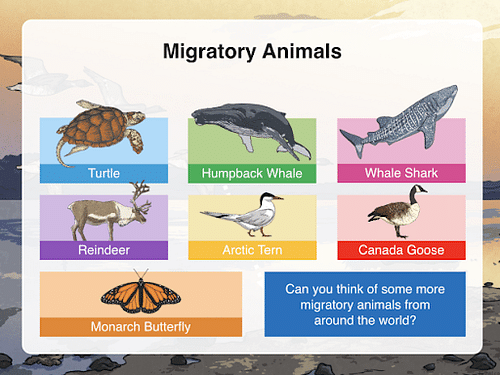
Fig: Behavioral Adaptation
Physiological Adaptation
Physiological adaptations like structural adaptations, also include physical changes in the species. Physiological adaptations, however, are not always observed in the organism’s appearance. Such adaptation can be either due to changes in the environment or because of the behavior of other species.
|

Fig: Physiological Adaptation
Another example can be snakes making venom to kill their prey or a squid spraying ink.
Thus, physiological Adaptation is How our body adapts to certain stimuli. It majorly is the internal changes that take place inside the body.
Importance of Adaptation
[Click Here for Sample Questions]
- Adaptation is important for living organisms to survive. Animals die as they are unable to adapt to environmental changes. These adaptations are due to genetic changes. The animals that manage to survive, pass on the mutated genes to their offspring which is called natural selection.
- Adaptations such as camouflage and coloration protect animals from predators. In dangerous environments, DNA mutations help in the longer survival of animals and such traits of survival are passed on to their future generations. All these adaptations make it easier for a variety of organisms to thrive on planet earth.
- Darwin, who gave the Adaptation Theory, studied two turtles. One with short legs and straight shells ate from the lower ground while the other with long legs and round shells gradually. The latter were the ones who could reach a great height which can help them to get food, especially at the time of a natural calamity and so, were selected. Thus, the new generation of species grew with these adaptations.
- This shows the importance of Adaptation for the survival of organisms and how natural selections play a role here.
Also Read: Productivity in Ecosystem
Things to Remember
- Adaptation refers to the quality of an organism that makes it adjust to its surroundings.
- Given by Charles Darwin, in simple words, states that you adapt to the changes, You Survive, you aren’t able to adapt, you are eliminated
- Structural Adaptation is adaptation where organisms change the structure of their body to adapt to the environment
- Behavioural Adaptation is the adaptation where the actions are taken by organisms to adapt to the environment
- Physiological Adaptation is the way our body adapts to the surrounding.
- According to Joel Asaph Allen, the rule states that mammals living in cold climates have shorter ears and limbs than those in a warm climate.
Also Read:
Sample Questions
Ques: According to Allen’s Rule, the mammals from colder climates have: (1 Mark)
(i) shorter ears and longer limbs
(ii) longer ears and shorter limbs
(iii) longer ears and longer limbs
(iv) shorter ears and shorter limbs
Ans: The Correct option is iv- shorter ears and shorter limbs
Ques: Read the following statements about adaptations in desert plants and select the correct ones. (1 Mark)
(i) They have a thick cuticle on their leaf surface
(ii) They have flattened stems and large-sized leaves.
(iii) They have stomata present in deep sunken pits.
(iv) They use the CAM pathway for photosynthesis.
(v) Their stomata remain open during the day.
Ans: The Correct options are i, iii, and iv.
Ques: Hummingbirds live among the bushes in the tropics while Penguins live on Icebergs. Can we interchange their habitat? Give reason for your choice. (3 Marks)
Ans: No, Hummingbirds can’t survive in Polar regions because to survive there, one must prevent heat from escaping the body which is ensured by a low surface area but they have a large surface area relative to their volume which makes them lose the heat easily and so they aren’t suitable for habitat in the cold. However, Penguins have a low surface area and thus can prevent the escape of heat.
Ques: We know that Plants need water from time to time but in deserts, we have high temperatures and scarcity of water, and still, plants survive there. How? (2 Marks)
Ans: It is because plants there have found different ways to store water, either in their roots, stems, or leaves, and use it when required. Some use Thick waxy cuticles, some follow Crassulacean acid metabolism (CAM) while some have Leaves modified into Spines.
Ques: Write a Short note on: (3 Marks)
(a) Physiological Adaptation
(b) Kangaroo Rats don’t need an external source of water
(c) Birds migrate to different regions.
Ans: (a) Physiological adaptation is the way your body adapts to the changes in the environment. For Eg-. You go to high altitudes which have low atmospheric pressure, and your oxygen supply gets disrupted. Your body takes a moment to adapt to this change and react accordingly. It increases the RBC production, decreases Hemoglobin’s binding capacity, and increases your breathing rate which makes you feel back to Normal this is because Your body has adapted to the change.
(b) Kangaroo Rats rely on the dry seeds they eat for water. Their source of water is the metabolized activity of the seeds they consume.
(c) Birds migrate in search of a suitable environment when the one around them becomes unsuitable. This is known as Behavioural Adaptation.
Ques: Explain giving reasons: ( 5 Marks)
(a) Why the tourists visiting Rohtang Pass or Mansarovar are advised to resume normal active life only after a few days of reaching there.
(b) It is impossible to find small animals in the polar regions.
(c) Desert Lizards can maintain a fairly constant body temperature.
Ans: a) Tourists visiting Rohtang Pass near Manali (> 3500 m) may suffer from altitude sickness. They resume normal active life only after a week because, in low atmospheric pressure at high altitudes, the body does not get enough oxygen. Gradually, the body compensates for low oxygen availability by-:
(i) Increasing red blood cell production.
(ii) Decreasing the binding affinity of hemoglobin.
(iii) Increasing the breathing rate.
b) Small animals have a large surface area relative to their volume. So, they tend to lose body heat very fast during cold conditions. They need to spend more energy to generate body heat. Due to this smaller animals are rarely found in polar regions.
c) Desert Lizard bask in the sun & absorb heat when their body temperature is below the comfort level & move into the shade when it is higher. This helps them maintain a fairly constant body temperature.
For Latest Updates on Upcoming Board Exams, Click Here: https://t.me/class_10_12_board_updates
Check-Out:



Comments