



Education Journalist | Study Abroad Lead
Hookworm and Liver Fluke are parasites that live in the human body and cause contagious and infectious diseases. Hookworms are found in the small intestine whereas Liver Fluke, as the name suggests, is mainly found in the liver of various mammals. Both the creatures are known to cause mild to high threatening diseases, namely, Helminthiasis and Fascioliasis respectively. The two most common hookworms which are found in the human body are Ancylostoma duodenale and Necator americanus. The average size of an adult hookworm is 11 mm in size whereas the size of liver fluke ranges from 8 mm to 15 mm.
Read Also: Human Health and Diseases
| Table of Content |
Key Terms: Life Cycle, Parasites, Blood, Digestive System, Diseases, Lungs, Symptoms
What is a Hookworm?
[Click Here for Sample Questions]
Hookworms are a kind of parasite which feeds on blood and resides in the small intestine of the human body. They are harmful for the human digestive system and can cause diseases like Helminthiasis, which affects the human lungs, skin and digestive system. Hookworms belong to the class Secernentea and order Strongylida. Itching, rash, nausea, abdominal pain, intestinal cramps and blood in stool are a few symptoms of Hookworm infection in the human body.

Hookworm
Life Cycle of Hookworm
[Click Here for Sample Questions]
Life Cycle of a Hookworm is completed in 4 stages, namely, egg stage, larval stage and adult stage. Mentioned below are the details:
- Egg Stage: Female hookworms lay around 30,000 eggs per day in the small intestine. The eggs contain two to eight sectioned embryos that pass to the soil via human stool. It hatches in about 24-48 hours and transforms to larvae, which is the second stage of its development.
- Larvae Stage: In this second stage, larvaes are hatched in the deposited faeces. They are initially non-infective and they feed on soil microorganisms. The larva grows in four stages where the first and second stage is called the rhabditiform stage. After feeding for a week, they transform into the third stage which is a filariform stage. In this form, they survive up to a week. They are extremely motile and keep moving to higher ground in order to find a host easily. These larvae can only infect by penetration through the skin. A common route for these larvae to enter is through the feet of barefoot walkers. Once the larvae enter the host, they travel in the circulatory system to the lungs and then enter the alveoli. They travel to the trachea from where they are swallowed into the small intestine. In the small intestine, the larvae goes to its fourth stage to become an adult hookworm. It takes almost five to nine weeks from entering the host to becoming an adult.
- Adult Stage: The adult hookworms can cause infection which may last from 1 year to 5 years in which some worms might die within a year. Some hookworms are also found to have lived up to 15 years. The larvae remain dormant in tissues and can be recruited after some adult worms die. The worms mate inside the host, in which the females lay eggs. They are passed out with the host’s faeces to start the cycle again. The hookworms can lay up to nine to ten thousand eggs per day.
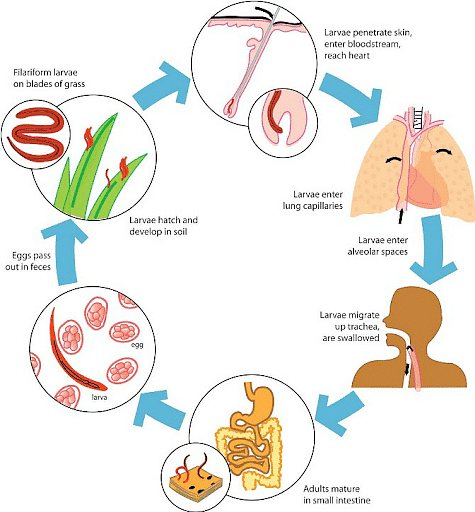
Life Cycle of Hookworm in Human Body
Symptoms of Hookworm Infection
[Click Here for Sample Questions]
Most commonly seen symptoms of Hookworm infections in human body are:
- Rash on the skin (feet mainly) from where the larvae entered the body
- Fever
- Coughing or Wheezing
- Abdominal pain
- Loss of appetite
- Diarrhoea
- Weight loss
- Anaemia
What is Liver Fluke?
[Click Here for Sample Questions]
Liver Flukes are parasites which reside in the liver and cause diseases, called liver fluke disease. The scientific name of liver fluke is Fasciola hepatica. They belong to the phylum Platyhelminthes. Liver flukes are mobile and can travel through bile ducts. They are normally found in moist environments and as they prefer watery habitats to lay eggs. Liver Fluke possesses the capability to move with the blood circulation.

Liver Fluke
Life Cycle of Liver Fluke
[Click Here for Sample Questions]
The life cycle of a liver fluke is completed in 4 stages, as mentioned below:
- Egg Stage: The adult female liver fluke lays immature eggs in the bile duct of the host and passes outside through defecation. The eggs get embryonated when they come in contact with water and take the form of larva which is called miracidia.
- Intermediate Host Stage: The eggs infect different species of snails in which they grow into larvae called cercaria larvae. The cercaria larvae grow and leave the host. Snails are intermediate hosts for the liver fluke and it leaves the host to look for vegetation. Cercaria larvae are capable of swimming in the water. Metacercariae have a rigid outer body which allows them to live for a longer time. If humans consume water that is contaminated with the cysts, the cysts will release immature eggs in the small intestine.
- Young Fluke Stage: After the intermediate stage, now the fluke parasite enters the human body through the peritoneal cavity. Then it enters the liver and starts feeding on liver cells. All of it starts happening within a few days of coming in contact with the parasite. After eating a good amount of liver cells, it then travels to the bile duct and starts transforming into an adult liver fluke.
- Adult Stage: Metacercaria finally gets transformed into adult liver fluke. It takes approximately 3 months for it to become mature. An adult liver fluke can be as long as 3 cm. Adult female liver fluke lays approximately 20,000 to 25,000 eggs per day in its last state of pregnancy.
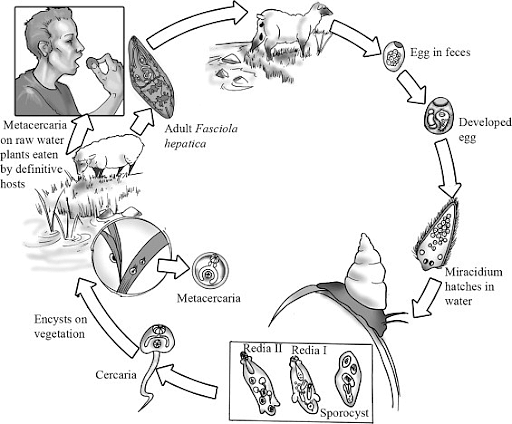
Life Cycle of Liver Fluke in Human Body
Symptoms of Liver Fluke Infection
[Click Here for Sample Questions]
Signs and symptoms of hookworm infection may vary from host to species. The common symptoms of liver fluke infection are:
- Abdominal pain
- Fever
- Vomiting
- Nausea
- Hives
- Diarrhoea
- Malaise
- Decreased appetite
- Weight loss
If the infection is more severe then the person can even get stones or bile duct cancer.
Also Read:
Things to Remember
[Click Here for Sample Questions]
- Hookworms are parasites that feed on blood which are found in the small intestine of the human body.
- The hookworm larvae can only infect by penetration through the skin.
- The hookworm larvae take almost five to nine weeks from entering the host to become an adult.
- Liver flukes are hermaphrodites, which means they have both sets of male and female reproductive organs.
- Liver fluke infections also cause serious medical issues and veterinary diseases.
- The digestive system of liver flukes is simple and they primarily feed on blood.
- The adult female liver fluke lays immature eggs in the bile duct of the host and passes outside through defecation
Also Check:
Sample Questions
Ques. How do snails get affected by liver fluke in summer? (2 marks)
Ans. Snail populations multiply in a rapid manner and snails are invaded by hatching miracidia during the summer. On the other hand, fewer snails appear and fewer fluke eggs hatch if the climate is dry and cold during summer. In the autumn time, the contamination level is much lower and after some time, it may disappear. Clinical fasciolosis is caused from summer infection of snails over a very short period of time in July to October.
Ques. What are the characteristics of a Hookworm? (4 marks)
Ans. The morphology of infecting parasite species have a lot in common. Some of the notable characteristics of hookworms are:
- Hookworms look pale dark or can be slightly pink in colour.
- The head is turned round in the shape of a hook which gives them the name ‘hookworm’.
- They have two sets of teeth.
- Male hookworms are generally 0.5 mm in size whereas female hookworms are generally stouter and little longer than males.
- They are dimorphic, with the males having bursa characteristics.
- Some common hookworms residing in the human body are Ancylostoma duodenale and Necator americanus.
Ques. How do hookworms spread? (2 marks)
Ans. Hookworm’s eggs are passed in the stool of the infected individual. If the contaminated individual defecates in an outside environment like bushes, fields, etc then the eggs are passed to soil. They are then able to develop and bring forth the young worms, they grow and they start looking for human hosts. Individuals walking barefoot are most common hosts as the larvae can enter through the skin.
Ques. Is liver fluke infection contagious? Support your answer. (2 marks)
Ans. Liver fluke infections are not said to be contagious. They don't pass by direct contact of an infected person. They have to be ingested in order to pass to another body. They can enter the human body by coming in direct contact with the larvae or by intake of unhygienic food. Therefore simply coming in contact with the infected person will not spread the disease.
Ques. How is Hookworm Infection diagnosed? What are the prevention methods? (3 marks)
Ans. Hookworm infection is mainly diagnosed by taking the stool sample and observing it under a microscope. A concentration procedure is followed, since the hookworm eggs may be difficult to find in case of light infections.
Prevention Method:
Some of the prevention methods are:
- Ensure to wear shoes whenever going out.
- Drinking safe water.
- Proper cooking of food.
- Maintenance of hygiene.
Ques. How is Liver Fluke Infection diagnosed? What are the prevention methods? (3 marks)
Ans. The stool sample is collected and tested for the presence of eggs in them. If found positive we can say that the parasite has moved to the bile duct. The enzyme-linked immunosorbent assay (ELISA) is used to diagnose liver fluke infection.
Prevention Method:
Some of the prevention methods are:
- Ensuring that freshwater fish is well cooked before consumption.
- Proper Sanitation should be done in the cooking area.
- Though there is no vaccine available for the liver fluke infection, being aware of various preventive measures is good. These parasites are mostly found in parts of Australia and moist regions.
Ques. How Liver Fluke Infection can be treated? (2 marks)
Ans. There are certain medicines that can be consumed to cure liver fluke infection. The most suitable medicine for it is triclabendazole. It can be consumed orally and it cures the infection for a majority of people. Corticosteroids are also suggested to people showing severe symptoms. Surgery might be required for more complications.
Biology Related Links:



Comments