



Content Curator
Wind chimes are a type of musical instrument made by using suspended tubes, rods, bells, or other metal or wood objects.
- It is a percussion instrument that produces sound when it is struck against similar elements.
- They are used as decorative items in our house or any other suitable place.
- The wind chimes usually hang at the door or a window where the natural wind blows it so that you may hear the pleasant sound.
- The sound produced by wind chimes is entirely dependent on the random effect of the wind.
- Therefore, they are considered as an example of chance-based music.
| Table of Content |
Key Terms: Wind chimes, Metals, Wind, Musical instruments, Percussion instruments, Equidistant points, Process of making wind chimes
How to Make a Wind Chime?
[Click Here for Sample Questions]
Wind chimes can be a decorative item or a piece of enjoyment.
- The best are the ones that sound great in the store but most of the time, they do not chime in gentle breezes.
- There could be various ways one can make a wind chime.
- You can put your own ideas into it, and also be as creative as you want.
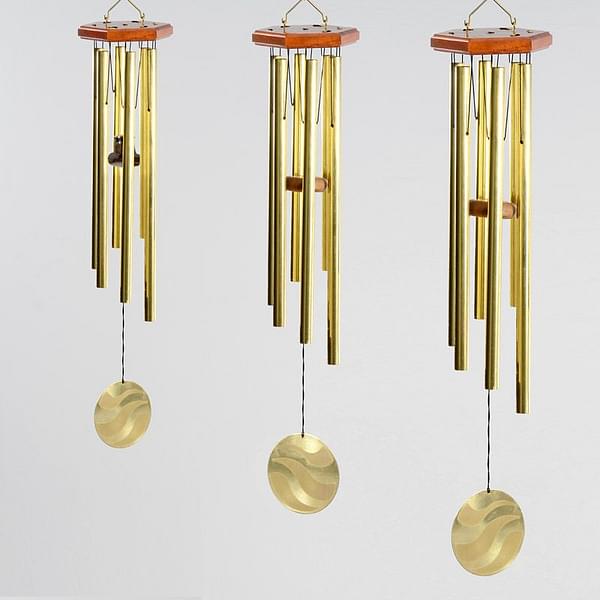
Materials Required
The following are the materials required to construct a wind chime
- 5 to 8 Metal tubes or pipes
- Synthetic cord
- A circular wooden striker (clapper)
- A circular wooden platform holds the chimes (bigger than the striker)
- A block of wood for the sail
- A pipe cutter, hacksaw, or hand saw
- Some Sandpaper
- A Pencil
Read More:
| Related Articles | ||
|---|---|---|
| Wave Power | Ground Wave propagation | Difference between Transverse and Longitudinal Waves |
| Interference of Waves | Gravity Waves | Wave Nature of Electromagnetic Radiation |
Procedure
[Click Here for Sample Questions]
Here are the detailed steps to create a wind chime:
Step 1
Mark 5 to 8 equidistant points on the circumference of the circular wooden platform.
Step 2
Drill all the marked points, including the center, of the wooden platform.
Step 3
Thread the sail (wooden block) and striker together with a piece of synthetic cord. The length of the cord is up to you; however, a longer cord requires stronger winds to move the sail due to its increased weight.
Step 4
Attach the striker to the wooden platform with a synthetic cord.
Step 5
Cut the metal tubes (chimes) using a pipe cutter, hacksaw, or hand saw. The length of your chimes directly affects their pitch. Shorter chimes generally produce higher-pitched tones, while longer ones create lower-pitched sounds.
Step 6
Sand the edges of the chimes using sandpaper to remove sharp points.
Step 7
Drill holes into the top of the metal tubes.
Step 8
Prepare a length of thread for each chime and thread them through the respective top holes. Then, securely tie the chimes onto the base, ensuring they hang at equal distances.
Read More:
| Related Articles | |||
|---|---|---|---|
| Oscillations | Maxwell's Equations | Resistance | |
| Electromagnetic Field | Electrical Insulators | Continuous Charge Distribution | |
Things To Remember
- Wind chimes are percussion instruments made by suspending tubes, rods, bells, or other objects made of metal or wood.
- The gentle melodies of wind chimes are entirely dependent on the nature of the wind.
- The length of your chimes directly affects their pitch.
- Shorter chimes generally produce higher-pitched tones, while longer ones create lower-pitched sounds.
- Wind chimes are considered an example of chance-based music.
Sample Questions
Ques. How do you make a homemade wind chime? (4 Marks)
Ans. Wind chimes can easily be built using various leftover metallic and wooden materials at home. It is an easy procedure and does not have much complexity. When you look at a wind chime, you can actually figure out how to make it. You need to take care of the size, length, and quality of the material that you are going to use.
Cut the required wooden top mount and the windcatcher. Make them well-furnished by scratching and painting them with different layers. Cut the aluminum tubes of different sizes, and suspend them from the top mount using a string. Attach the windcatcher using another string. Make knots at the required places. Use the model given above in the article to get the best results. After you are done with the model, hang it somewhere the wind can blow it easily like through a window, door, or garden.
Ques. What are the materials required to make wind chimes? (2 Marks)
Ans. The materials and tools required to construct a Wind Chime are
- 5 to 8 Metal tubes or pipes
- Synthetic cord
- A circular wooden striker (clapper)
- A circular wooden platform holds the chimes (bigger than the striker)
- A block of wood for the sail
- A pipe cutter, hacksaw, or hand saw
- Some Sandpaper
- A Pencil
Ques. How do wind chimes make the sound? (2 Marks)
Ans. As the wind blows past the chimes, the tubes hit or meet in the center, known as the clapper. This impact causes vibrations that propagate throughout the tubes, creating sound waves with varied pitches. The pitch is determined by the length of the tube and the material used for its production.
Ques. What is the type of sound produced by wind chime? (2 Marks)
Ans. The sound will range from pleasant tinkling to loud banging depending on the size of the tube, which can be set to generate a certain note.
Ques. Why are wind chimes beneficial? (3 Marks)
Ans. Wind chimes have another kind of importance which is a bit different from scientific stuff. Vaastu and Feng Shui mentioned that wind chimes are of great importance. Gaurav Mittal, who is a great Vaastu expert, says and we quote, “ Wind chimes are said to bring positive energy at home. One can also use wind chimes to reduce the impact of Vaastu dosha and bring harmony to the house.”
Ques. Mention the important measures to take care of while making a Wind Chime. (3 Marks)
Ans. There could possibly be three prominent measures that should be taken care of while making a wind chime. They are-
- Material needs to be of top quality and weather-resistant that we are going to use for making a wind chime.
- The number of rods or bells of the wind chime plays a vital role in deciding the sound quality it will be producing.
- The symbols are present in the design of the wind chime.
Ques. Why does Wind Chimes correspond to chance-based music? (2 Marks)
Ans. Wind chimes are something related to music. They are percussion instruments that are struck randomly by the blowing wind and consequently make random musical sounds. Thus, wind chimes are considered an example of chance-based music.
Ques. What is a Percussion Instrument? (2 Marks)
Ans. A percussion instrument corresponds to a type of musical instrument that makes or creates sound while it is being struck or scraped by a beater. The beater could use both the attached or enclosed beaters. The sound effect can also be created by scraping or rubbing using the hands. It may also be done by striking a similar instrument.
Some examples of Percussion Instruments are drum, snare, timpani, bass drum, etc.
Ques. How to measure the length of the wind chimes? (3 Marks)
Ans. The complete length of the wind chime should be from the top ring to the sail. The number of tubes used in the wind chime actually decides the number of notes that would be played while the wind blows it. The more tubes you will add, the more notes will be heard.
The length actually plays a vital role in the sound and the notes, especially the depth and tone. If you keep the length of the tube length, the tones will be more full and chimes will be short. Long tubes will make the pitch of the sound higher. Usually, chimes in the market are designed for 8 to 10 meters per hour wind speed.
Ques. What is the best place to hang Wind Chimes? (3 Marks)
Ans. The wind chimes can best be placed in front of a window. You should probably avoid hanging it at doors because it might hit your head which is pretty annoying. Direction-wise, it is best to the East, South, or South-East direction. It is believed that it invites growth when it is hung in the east direction, it brings wealth when hung in the southeast direction, and it brings fame when hung in the South direction. Obviously, these are just beliefs and scientifically they have no influence on a person’s life except that they produce a unique musical sound.
For Latest Updates on Upcoming Board Exams, Click Here: https://t.me/class_10_12_board_updates
Check-Out:



Comments