



Education Journalist | Study Abroad Lead
Hydroiodic Acid is a colourless strong acid formed by dissolving hydrogen iodide in water. In an aqueous solution of hydrogen iodide, the chemical formula of hydroiodic acid is HI. This acid reacts with oxygen in the air to give iodine. It is colourless and odourless and produces dense white fumes in moist air. The acid is also known to redden the litmus upon contact. Hydroiodic acid is a strong acid generally used as a reducing agent. The acid, in its anhydrous form, is made up of hydrogen and an iodine atom.
| Table of Content |
Key Terms: Hydroiodic Acid, Acids, Iodide, Aqueous Solution, Ammonia, Reducing Agent, Hydrogen, Sodium Hydroxide, Atoms
Hydroiodic Acid: Formula And Structure
[Click Here for Sample Questions]
Iodide’s electronegative nature polarises the hydroiodic acid. Because of the iodide ion’s huge size, the negative charge scatters, resulting in a weaker H-I bond. This allows H+ to easily dissociate, making HI a stronger acid than HCl, HBr, and HF.

Structure of Hydroiodic Acid
The chemical formula of hydroiodic acid is HI. Tabulated below are the properties of HI:
| Density | 1.7 gm/cm3 |
|---|---|
| Molecular Mass | 127.91 g/mol |
| Boiling Point | -35.36°C |
| Melting Point | -50.8°C |
| pH value | 3.01 mMol/L |
| Formula | HI |
Physical & Chemical Properties of Hydroiodic Acid
[Click Here for Sample Questions]
Hydroiodic acid is colourless and has an acrid odour. Aside from that, the acid is highly soluble in water. Hydrogen iodide is the gas, which when dissolved in water produces hydroiodic acid.
Other physical properties of the acid, which include, melting and boiling points, density, pH value, etc are dependent on the concentration of the HI in an aqueous solution. “Concentrated” HI solutions are 48-57% HI.
Hydroiodic acid is also a reactive acid. Because of its strong reactivity, one should use it with caution. It reacts violently with metal powders like ammonia, which can cause explosions and fire. It also reacts vigorously with bases and is highly corrosive. It decomposes upon heating, generates toxic fumes, and oxidises rapidly in the air.
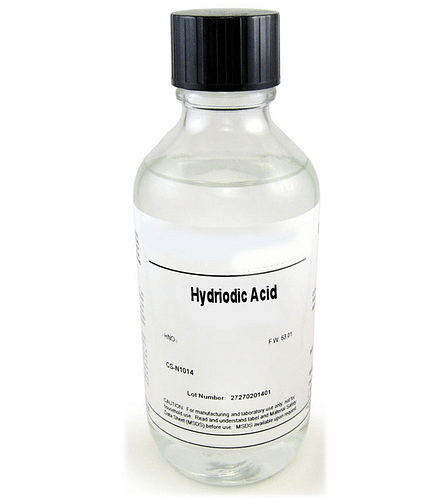
Hydroiodic Acid
Read More: Carboxylic Acids
Reactions of Hydroiodic Acid
[Click Here for Sample Questions]
Hydroiodic acid is used as a reducing agent. It also adds to the alkene to give alkyl iodide. As a reducing agent, one of its uses is to reduce aromatic nitro compounds to Aniline.
Hydroiodic acid reacts to seething nitric corrosive structures nitrogen, oxygen and water. The reaction is as follows:
2HNO3 + 6HI → 2NO + 3I2 + 4H2O
Hydroiodic acid also responds with base compounds like sodium hydroxide structures sodium iodide and water. The reaction is as follows:
HI + NaOH → NaI + H2O
Hydroiodic acid also reacts with oxygen in the air to give iodine, as shown in the equation below:
4 HI + O2 → 2 H2O + 2 I2
Uses of Hydroiodic Acid
[Click Here for Sample Questions]
There are many different uses of hydroiodic acid. One of the most common uses for hydroiodic acid is as a reducing agent for different industrial purposes. Another common use for hydroiodic acid is to produce alkyl iodides, an important group of organic compounds. This is produced by reacting HI with either primary alcohols or with alkenes.
Being used in disinfectants and pharmaceuticals and as a primary source of iodine in the synthesis of different inorganic and organic compounds are also some of its other uses. Hydroiodic acid is also used for illicit purposes like in the production of methamphetamine from pseudoephedrine or ephedrine, found in nasal decongestant pills.
For this reason, hydroiodic acid is also listed as a U.S. Federal DEA List 1 Chemical, which is a list maintained by the US Federal Drug Enforcement Administration, containing chemicals used in manufacturing controlled substances or drugs.
Cativa Process
Cativa process is one of the major uses of hydroiodic acid. This process serves as a co-catalyst to the production of acetic acid by the carbonylation of methanol.
Read More: Potassium Acetate
Health Hazards of Hydroiodic Acid
[Click Here for Sample Questions]
Hydroiodic acid also has various health hazards. The HI acid is corrosive in nature and can produce burns if it comes in contact with skin. It can also cause irritation in the eye and can cause serious eye damage.
The HI gas if inhaled can also affect the mucous membranes as well as the eyes and skin.
Read More: Lewis Acids and Base
Things to Remember
- Hydroiodic acid is a strong acid formed by dissolving hydrogen iodide in water. The acid is an aqueous solution of hydrogen iodide.
- Hydroiodic acid is colourless and has an acrid odour. Dense white fumes are produced by it in moist air.
- The chemical formula of hydroiodic acid is HI. Its structure is diatomic.
- Hydroiodic acid is highly reactive in nature. It is also highly corrosive in nature and needs to be used with caution.
- Hydroiodic acid also can cause skin burns if it comes in contact with the skin and can also cause serious damage to the eyes upon contact. If inhaled, the acid can also affect the mucous membranes.
- One of the most common uses of hydroiodic acid is as a reducing agent for different industrial purposes.
Sample Questions
Ques. How is hydroiodic acid prepared commercially? (3 Marks)
Ans. Hydroiodic acid can be prepared in many ways. It can be prepared commercially by conducting the reaction of the iodine (I2) with hydrazine, giving hydrogen iodide and nitrogen gas as a result.
2I2 + NH2NH2 → 4HI + N2
Ques. What is the resultant product we would get upon reduction of propionic acid with hydroiodic acid, in the presence of a little P? (1 Mark)
Ans. Propane is the result of propionic acid being subjected to reduction with hydroiodic acid, in the presence of a little P.
Ques. What is the pH of hydroiodic acid? (1 Mark)
Ans. The pH of hydroiodic corrosive is 1.85.
Ques. What are the health hazards of hydroiodic acid? (3 Marks)
Ans. Hydroiodic acid has serious health hazards. The acid is highly corrosive in nature and can cause skin burns upon contact. It also can lead to serious eye damage if it comes in contact with the eyes. The HI gas if inhaled can also harm the mucous membranes.
Ques. What is the formula for hydroiodic acid? (1 mark)
Ans. The formula for hydroiodic acid is HI.
Ques. What are the chemical properties of hydroiodic acid? (3 Marks)
Ans. Hydroiodic acid is colourless and has an acrid odour. It is highly reactive in nature and reacts violently with metal powders like ammonia, which can lead to explosions and fire. It oxidises rapidly in the air and decomposes and releases toxic fumes upon heating.
Ques. What are the physical properties of hydroiodic acid? (3 Marks)
Ans. Hydroiodic gas is produced when hydrogen iodide is dissolved in water. It is highly soluble in water and “concentrated” HI solutions are 48-57% HI. Other physical properties like boiling point, melting point, density, etc depend on the concentration of HI in an aqueous solution.
Ques. What are the uses of hydroiodic acid? (3 Marks)
Ans. Hydroiodic acid’s most common use is as a reducing agent for different industrial purposes like disinfectants and pharmaceuticals. Other than that, it is also used to produce alkyl iodides, an important class group of organic compounds, by reacting HI with either primary alcohols or with alkenes.
Ques. What is the Cativa Process? (2 Marks)
Ans. The Cativa process is one of the major end uses of hydroiodic acid. It is the process which acts as a co-catalyst to the production of acetic acid via the carbonylation of methanol.
Ques. How does hydroiodic acid react to other compounds? (5 Marks)
Ans. Some of the reactions of hydroiodic acid are as follows:
Hydroiodic acid reacts to seething nitric corrosive structures nitrogen, oxygen and water. The reaction for the same is:
2HNO3 + 6HI → 2NO + 3I2 + 4H2O
Hydroiodic acid also responds with base compounds like sodium hydroxide structures sodium iodide and water. The reaction is as follows:
HI + NaOH → NaI + H2O
Hydroiodic acid also reacts with oxygen in the air to give iodine:
4 HI + O2 → 2 H2O + 2I2
Check-Out:



Comments