



Content Curator
A proportion is a statement that shows the relation between two quantities or variables. Proportion can be divided into two types:
- Inversely Proportional
- Direct Proportional
Direct proportion is a statement in which if one quantity is increasing then the other quantity will also increase simultaneously. Inversely proportion is the reverse of direct proportion. In this, if one quantity is increasing then the other quantity will be decreasing simultaneously.
An example can be cited when, to do a specific job, there are more workers. As the number of workers increases, the time taken by workers to complete the work decreases. This can be defined as an example of inversely proportional.
Read Also: Exponents and Powers
| Table of Content |
Key Terms: Inversely Proportional, Direct Proportional, Constant Value, Distance, Time
Inversely Proportional Meaning
[Click Here for Sample Questions]
Two variables are termed inversely proportional if they are directly proportional to the reciprocal of one another.
- Simply, when two variables or quantities are in inverse proportion, then the product of the two variables is equivalent to a constant value.
- The general meaning of inversely proportional is “as one becomes larger, the other becomes smaller and vice-versa”.
- Inversely Proportional is also often known by other terms, like inverse proportion or varying inversely or inverse variation or reciprocal proportion.
- Two variables, x and y, that are in inverse proportion can be denoted as: x ∝ 1/y or x ∝ y-1.
- Inversely proportional is basically a relationship between two variables when their product equals a constant value.
- There is a sign to represent inversely proportional. Therefore, an inversely proportional symbol can be represented as ∝.
- The inversely proportional symbol is very much like the symbol of infinity (∞).
Read Also:
| Topic Related Concepts | ||
|---|---|---|
| Direct Proportion | Direct Variation Formula | Direct and Inverse Proportions MCQ |
| Proportion Formula | Inverse Variation Formula | Quadrant |
Graphical Representation of Inversely Proportional
[Click Here for Sample Questions]
Let us assume two quantities x and y are inversely proportional to each other i.e., x ∝ 1/y. Hence, the graphical representation will be:
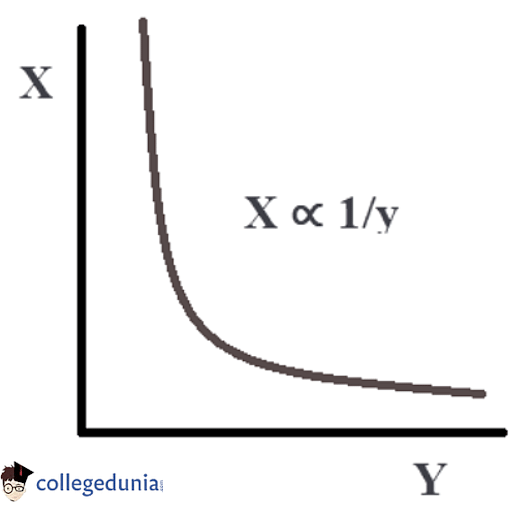
Inversely proportional graph
Formula of Inversely Proportional
[Click Here for Sample Questions]
If two variables x, y are inversely proportional, then x ∝ 1/y, that means xy = k (some constant), and if they are directly proportional, then x ∝ y that means
x/y = k.
Considering two variables, x and y, as two quantities in inverse variations, then
⇒ x ∝ 1/y
⇒ x = k(1/y)
Here, ‘k’ is a universally positive constant. Thus, it can also be denoted as: xy = k
Now, assume that x and y are in inverse variation and x has two values x1 and x2 which correspond to y with two values y1 and y2 respectively. Thus, by the definition of inverse variation, we can say:
x1 y1 = x2 y2 = (k)
Thus, it becomes:
| x1 / x2 = y2 / y1 = k |
Thus, the inverse proportional formula can be expressed as: y = k/x
Applications of Inversely Proportional
[Click Here for Sample Questions]
There are several Inversely proportional applications, including:
- In relation to speed, time and distance (speed = distance/time), speed is inversely proportional to time. The representation will be speed ∝ 1/time.
- Electric current is inversely proportional to resistance.
- In the equation of pressure, pressure will be more if the area is less. So, pressure is also inversely proportional to area.
- The intensity of light decreases with an increase in the distance which also states inversely proportional.
Methods to Solve Inversely Proportional
[Click Here for Sample Questions]
There are two ways to solve a problem having inversely proportional variables:
Method 1
In an inverse proportion, X1*Y1 = X2*Y2
Therefore, to solve this problem we can use the equation to find the unknown terms as one pair would always be given in the question.
Method 2
We also know that in an inverse proportion, the equation x + y = k becomes x = k/y.
So in order to find the value of k, we can use the given values to find the unknown ones with the help of the above method. You can also use an inversely proportional formula to solve the sums.
Equation of Inversely Proportional
[Click Here for Sample Questions]
You can set up an equation using these four simple steps:
Step 1) First of all, write the proportional relationship.
Step 2) Using the constant of proportionality, convert it into an equation.
Step 3) In the third step, use the given data to get the constant of proportionality.
Step 4) The final step is to replace the constant of proportionality with an equation.
Read More: Divisibility rule of 3
Things to Remember
- Two variables are called inversely proportional to one another if they are directly proportional to the reciprocal.
- Proportion can be divided into two types: Inversely Proportional and Direct Proportional
- The formula for inversely proportional is y = k/x.
Sample Questions
Ques. A man can complete a wall in 8 days. How much time will 2 men take to complete the wall? (2 marks)
Ans. Let the number of days be x. The quantities will vary inversely.
| Number of man | 1 | 2 |
| Number of days required | 8 | x |
Therefore, 1 x 8 = 2 x X
Or, 1 x 8/2 = X
Or, X = 4 days
Hence, 2 men will complete the work in 4 days.
Ques. Find the value of ‘a’ if x and y vary inversely: (2 marks)

Ans. If the given quantities vary inversely then
20 x 100 = 50 x a
Or, 20 x 100/50 = a
a = 40.
Ques. If 15 men can do a piece of work in 12 days, how many men will do the same work in 6 days? (3 marks)
Ans. Let the number of required men be z.
The table will look like this-
| Number of men | 15 | Z |
| Number of days required | 12 | 6 |
Thus, it varies inversely.
Therefore, 15 x 12 = z x 6
Or, 15 x 12/6 = z
= z = 30 men.
Hence, 30 men will be required to complete the work in 6 days.
Ques. 6 pipes are required to fill a tank in 1 hour and 20 minutes. How long will it take if only 5 pipes of the same type are used? (3 marks)
Ans. Let the desired time to fill the tank be x minutes. Thus, we have the following table.
| Number of pipes | 6 | 5 |
| Time taken (minutes) | 80 | X |
Lesser the number of pipes, the more will be the time required by it to fill the tank. So, this is a case of inverse proportion.
Hence, 80 x 6 = X x 5 {Thus, X1 x Y1 = X2 x Y2}
80 x 6/5 = X
X = 96.
Thus, the time taken to fill the tank is 96 minutes or 1 hour 36 minutes.
Ques. A train covers a certain distance in 2 hours at 60km/hr speed. How much time it will to cover the same distance at 120 km/hr speed? (3 marks)
Ans. Let the time required to complete the distance at 120 km/hr be y.
Therefore, the table looks like this.
| Speed of the train | 60 | 120 |
| Time taken by train (hour) | 2 | y |
Hence, 2 x 60 = 120 x y
Or, 2 x 60/120= y
Or, y = 1
Therefore, the train will cover the same distance in 1 hour with 120 km/hr speed.
Ques. If 15 workers can build a wall in 48 hours, how many workers will be required to do the same work in 30 hours? (3 marks)
Ans. Let the number of workers required to complete the wall in 30 hours be y.
The tabulated format is shown below:
| Number of workers | 15 | Y |
| Time required (hours) | 48 | 30 |
Obviously more the number of workers, the faster will they build the wall.
So, the number of hours and the number of workers are inversely proportional to each other.
Hence, 48 x 15 = 30 x y
Or, y = 48 x 15/30
= y = 24.
Therefore, 24 workers will be required to complete the work in 30 hours.
Ques. A contractor estimates that 3 persons could rewire Jasminder’s house in 4 days. If, he uses 4 persons instead of three, how long should they take to complete the job? (3 marks)
Ans. Let the time taken by 4 persons to complete the work be t.
| Persons | 3 | 4 |
| Days | 4 | t |
Here, the given data is inverse proportional.
Therefore, 3 x 4 = 4 x t
Or, 3 x 4/4 = t
t = 3 days.
Hence, the time taken by 4 workers to complete the rewiring is 3 days.
Ques. A school has 8 periods a day each of 45 minutes duration. How long would each period be, if the school has 9 periods a day, assuming the number of school hours to be the same? (3 marks)
Ans. If the number of school hours remains the same for both 8 periods and 9 periods. Then, the number of periods and duration of each period will be inversely proportional to each other.
Let the duration of 1 period be d.
| Number of periods | 8 | 9 |
| Duration of one period | 45 minutes | D |
Therefore, 8 x 45 = 9 x D
Or, 8 x 45/9 = D
Or, 8 x 5 = D
Thus, D = 40 minutes.
Hence, the duration of one period will be 40 minutes in the case of 9 periods.
Ques. A factory requires 42 machines to produce a given number of articles in 63 days. How many machines will be required to complete the same number of articles in 54 days? (3 marks)
Ans. Let the number of machines required to be y.
According to the question, the number of machines required is inversely proportional to the days.
| Number of machines | 42 | Y |
| Days required | 63 | 54 |
Therefore, 42 x 63 = Y x 54
Or, 42 x 63/54 = Y
Y = 49
Hence, 49 machines are required to complete the work in 54 days.
Ques. There are 100 students in a hostel. Food provision for them is for 20 days. How long will these provisions last, if 25 more students join the group? (5 marks)
Ans. Suppose the provision last for y days when the number of students is 125. We have the following table.
| Number of students | 100 | 125 |
| Food provision (days) | 20 | y |
Note that the more the number of students, the sooner the provision would exhaust. Therefore, this is a case of inverse proportion.
So, 100 x 20 = 125 x y
100 x 20/125 = y
= y = 16
Thus, the provision will last for 16 days when 25 more students are introduced to the hostel.
Alternatively, we can write x1 : x2 = y1 : y2
Thus, 100 : 125 = y : 20
Or, y = 100 x 20/125y = 16
Therefore, the provision will last 16 days when 25 new students join the hostel.
Check-Out:



Comments