



Content Curator
Variable is the alphabet used to describe an unknown number in algebra and statistics. Most commonly used letters in algebraic equations are x, y and z. In the equation x+3 = 5, “x” is a variable. Variables are used in Statistics as data items and are mostly used to express numbers and measurable characteristics. Variables are of two types: Independent Variables and Dependent ariables. Linear equations can have one variable or two variables.
| Table of Content |
Key Terms: Variable, Algebraic Expressions, Dependent Variable, Independent Variable, Linear Equation
Introduction to Variable
[Click Here for Sample Questions]
When an alphabet is used to describe an unknown number, it is called variable. Variables are mainly used in Algebra. The quantity of a variable can be different for every mathematical problem. In simple words, variable acts as a symbol of a number when value of that number is unknown. The letters that are commonly used in algebraic equations and expressions are x, y and z.
For example, in the equation below, x is a variable:
x+10 = 15
To find the value of x, we need to solve the equation. In the above equation:
x = 15–10
x = 5
Variables are also used in Statistics. However, in statistics, they are sometimes known as data item. In statistics, variables can represent age, capital expenditure, income, sex etc. They represent the characteristics and numbers that can be measured.
Also Read: Difference between Variables and Constants
Types of Variables
[Click Here for Sample Questions]
Variables can be divided into two categories: Dependent Variable and Independent Variable.
Dependent Variable
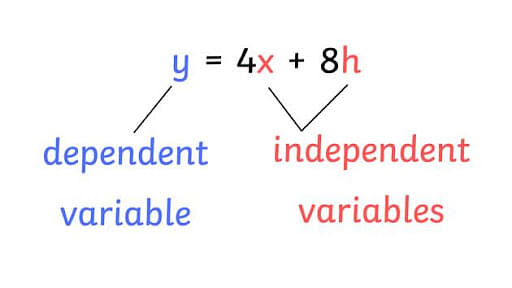
The variable whose value depends on another variable or number is called dependent variable. The output of function is called dependent variable. The value of dependent variable changes according to whatever is put to function. When there is a change in value of an independent variable, the value of the dependent variable also changes.
For example, in the equation below, y is a dependent variable:
y = 8+4x
The value of y is dependent on the function “8+4x” so “y” is a dependent variable.
Independent Variable
The variable whose value does not depend on other variables or numbers is called independent variable. Input in a function is called independent variable. Independent variable does not change according to the changes in any values of a function.
For example, in the equation below, y and z are independent variables.
x = 3y+3z
In the above equation, x is a dependent variable and y and z are independent variables. This is because other variables do not affect the value of y and z.
Types of Variables
Linear Equations and Variables
[Click Here for Sample Questions]
Linear Equation in One Variable: Any equation that has a maximum of one variable in order 1 is called Linear Equation in one variable. These equations can only have one solution.
Linear Equations in Two Variables: When an equation is written in standard form of ax+by+c = 0, where x and y are coefficients and a, b and c are actual numbers, the equation is called linear equation in two variables.
Also Read: Linear Equation
Things to Remember
- Variables are the alphabets used to describe unknown numbers in algebra and statistics. Most commonly used letters in algebraic equations are x, y and z.
- In other words, variable acts as a symbol of a number when value of that number is unknown.
- The two types of variables are dependent variables and independent variables.
- Dependent variables are variables whose value depends on another variable or number.
- Independent Variables are variables whose value does not depend on other variables or numbers.
Sample Questions
Ques. What is an Equation and what are different parts of equation? (3 marks)
Ans. Mathematical statements that indicate the relationship between two values are known as Equations. An equal sign (=) equates the two values in an equation.
An example of equation is 3x+2 = 92.
Another simpler example of equation is x = 20.
The different parts of equation include variables, operators, constant, term and coefficient.
Ques. What are Algebraic Equations and what are different types of algebraic equations? (5 marks)
Ans. A balanced equation that includes constants, variables and coefficients is called an algebraic equation. Both sides of such an equation hold the same value. To change one side of an equation, other side of equation must also be changed.
There are five major types of algebraic equations:
- Cubic Equations
- Quadratic Equations
- Trigonometric Equations
- Rational polynomial Equations
- Polynomial Equations
Also Read: Algebra Formula
Ques. What are Terms and Factors of terms? (3 marks)
Ans. Terms refer to the sections of algebraic expressions that are separated by subtraction or addition. Terms can include variables, constant and coefficients. The total number of terms in an expression determines the types of expression. Expressions can be monomial, binomial, trinomial or polynomial.
Ques. What are monomials and binomials? (3 marks)
Ans. An algebraic expression that includes only one term is referred as Monomial. In other words, a monomial is a single term expression. Some examples of monomials are 3x, 6b, xy, -23y, 4a, 4b, and 7.
An algebraic expression that includes two unlike terms is called a Binomial. A few examples of binomials are x +y, mn–4n, 3p–2a, 5y+x, a–b, etc.
Ques. What are Trinomials and Polynomials? (3 marks)
Ans. An algebraic expression that includes three terms is referred to as Trinomial. A few examples are x+y+z, 3x–2y+7z, a+b+c, a+b+5, etc.
A polynomial is an algebraic expression that has more than one term. The word poly means many. A few examples of polynomial terms are a+by+cz, ax+3+2x, etc.
Ques. What is an Algebraic Expression? (5 marks)
Ans. The plan of using alphabets or letters to express numbers without mentioning their actual values are called Algebraic Expressions. The letters used are called variables. Algebraic Expressions are a combination of both constants and variables. It can also include coefficients. In other words, an expression in mathematics that is made of constants, variables and algebraic operations are called Algebraic Expressions.
A few examples of algebraic expressions are 2x+3y, 5x–8 and 6y+x.
Also Read: Standard Algebraic Identities
Ques. Write a note on Linear Equation in One Variable. (3 marks)
Ans. Any equation that has a maximum of one variable in order 1 is called Linear Equation in one variable. These equations can only have one solution.
A few examples of linear equations in one variable are:
2x = 20
20x+2 = 42
3x–2 = 4
Linear equations in one variable have the standard representation formula ax+b=0.
Ques. Write a note on Linear Equation in Two Variables. (5 marks)
Ans. When an equation is written in standard form of ax+by+c=0, where x and y are coefficients and a, b and c are actual numbers, the equation is called linear equation in two variables. The value of x and y act as a solution for the equation and both sides of the equation are equal.
A few examples of Linear equation in two variables are:
2x+3y=11
5y–4z=20
20xy=50
Ques. What is the value of x for the equation x = 2y when y = 10. (5 marks)
Ans. The equation: x = 2y
Here x is a dependent variable and y is an independent variable.
Now, y = 10 and substituting the value of y in given equation:
x = 2(10)
x = 20
Therefore, when y = 10, the value of x is 20.
Ques. If x = 20, then what is the value of y in y = 2x2 (5 marks)
Ans. The equation: y = 2x2
Here x is an independent variable and y is a dependent variable.
Now, x = 20 and substituting the value of x in given equation:
y = 2(20)2
y=800
Therefore, when x = 20, the value of y is 800.
Also read:



Comments